


Ever wonder, “Why am I gaining weight after working out?” You’re not alone.
After 20 years working as a personal trainer, I’ve seen this play out over and over again. Someone starts out exercising with the best intentions. They join a gym, start running, or begin a new workout routine.
But instead of feeling better, they see unexpected side effects:
- They feel hungrier than ever.
- They feel exhausted after workouts.
- Their neck, shoulders, or back start hurting.
- or worst of all…
The scale starts going up instead of down.
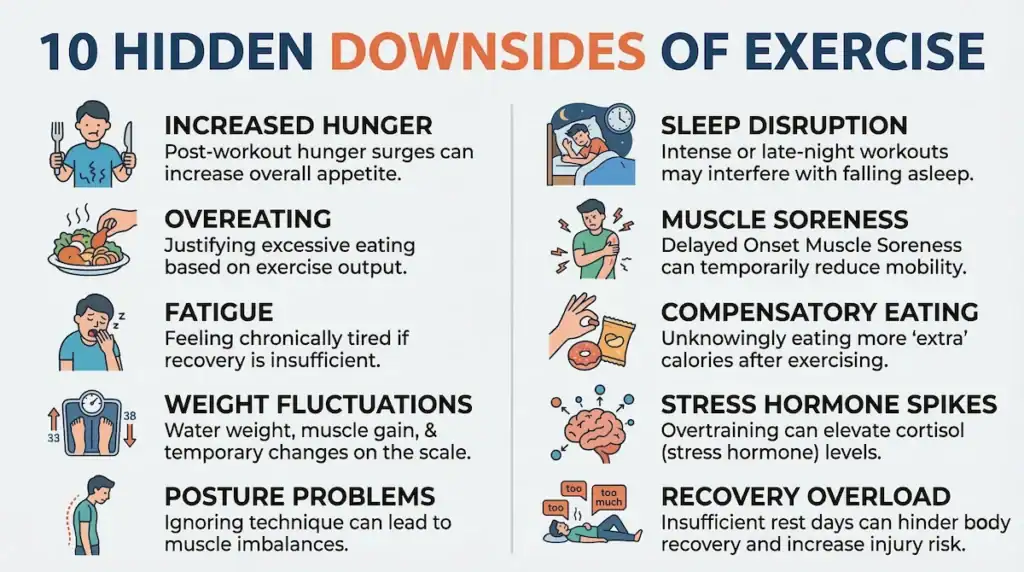
Exercise is one of the best things you can do for your health. But it’s not magic. Exercise can also trigger unintended consequences, like:
- Increased hunger
- Overeating later in the day
- Fatigue and burnout
- Posture problems
- Sleep disruption
- And even weight gain
Most people think: Exercise = weight loss. But in reality, it can be much more complicated.
Let’s break down the 10 hidden downsides of exercise you hardly ever hear about, and then focus on practical strategies to address them.
Before we go further, remember: The goal isn’t just to exercise more; it’s to exercise in a smart way that works.
1. “Why Am I Gaining Weight After Working Out?”
Here’s the first thing I’ll tell every new client who panics after stepping on the scale mid-program:
The scale going up doesn’t mean you’re getting fatter.
Total body weight depends on many factors, and exercise affects most of them. Before quitting your workout over a single number, let’s examine what’s happening in your body.
Your Muscles Are Swollen
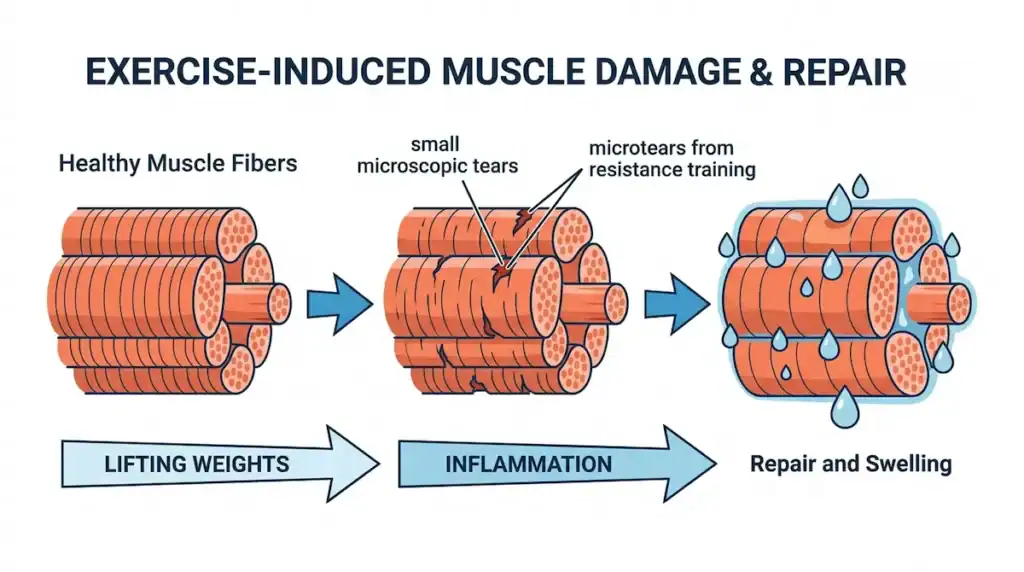
Every time you lift weights, you’re creating microscopic tears in your muscle fibers. And that’s not a bad thing. This is literally how muscle is built.
A 2020 review on exercise-induced muscle damage notes that “extreme or unaccustomed eccentric exercise can cause exercise-induced muscle damage,” with membrane tears and other structural changes in muscle fibers, leading to characteristic ionic disturbances.1
As your body repairs that damage, it floods your tissue with fluid and plasma proteins. This results in muscle swelling.
This temporary edema (water weight) can add to the scale even before any new muscle fibers are built. That’s why you’ll look pumped after a hard session and why your muscles might feel dense and heavy the next morning.
You’re Storing More Glycogen
When you start training consistently, your body gets better at storing carbohydrates as glycogen in your muscles and liver.
This is your body’s primary fuel source during exercise. But there’s a catch: every gram of glycogen pulls roughly 3 grams of water into the muscle cell with it.2
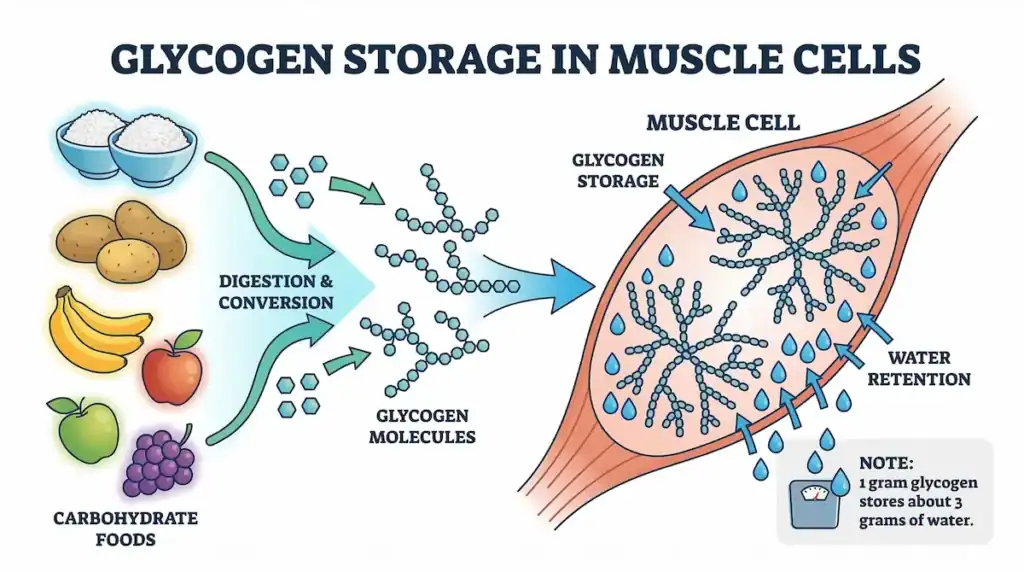
Depending on your training volume and diet, this glycogen and water can build up, adding anywhere from a few hundred grams to a couple of kilos to the scale. It’s not fat, but fuel storage.
You’re Actually Recomping
This one surprises a lot of people. If you’re lifting weights and eating reasonably well, then it’s entirely possible to lose fat and build muscle at the same time. This process is called body recomposition and can mislead the scale.
A 2017 randomized trial of resistance training with or without diet in adults reported significant fat loss in all intervention groups, with the resistance‑training‑only group showing a significant increase in lean mass at the same time.3
Muscle is far less energy dense than fat, so that means you can be in a caloric deficit, actively losing fat, and still watch the scale creep up because the muscle you’re building adds body weight faster than the fat you’re losing disappears.
Your body is actually improving underneath, even if the scale doesn’t show it right away. Focus on all positive changes, not just weight.t.
Food Volume & Supplements
This one gets overlooked a lot. The scale weight at any given time will reflect everything inside your body. So it also includes every meal, every single sip of water, and every supplement currently moving through your digestive system.
If you eat a higher-volume meal or drink an extra liter of water, you could easily wake up 2 kilos heavier the next morning.
And if you recently started adding creatine to your routine, then you can expect another 1-2 kg on top of that. Creatine draws water directly into your muscle cells, which is actually a sign it’s working, not that you’re gaining fat.
What You Should Do Instead
Stop relying on daily weigh-ins to judge your progress. Body weight fluctuates by 5-6 lbs. on any given day, as we just covered. Instead, track your weekly average weight, weigh yourself daily, and divide by 7.
A 2013 pilot study in well‑hydrated older inpatients found short‑term weight fluctuations of 1.1–3.6% over three days. For a 70 kg person, that’s roughly 0.8–2.5 kg of normal variation, depending on body size.4
Even better, grab a tape measure to track your waist. Waist size reveals more about body fat changes than any scale number.
2. “Exercise Makes Me Hungry”
This is one of the most understood things in fitness. Exercise, especially strength training, is actually a significant appetite suppressant. Studies consistently show that moderate exercise reduces hunger hormones, not increases them.
A 2016 meta‑analysis focusing on overweight/obese individuals reported that an acute bout of exercise “suppresses acylated ghrelin” and increases PYY, GLP‑1 and pancreatic polypeptide, indicating a hormonal profile consistent with reduced hunger after exercise.5
If you’re finishing every workout absolutely ravenous, then the workout itself probably isn’t the real culprit. So if it isn’t the workout, what’s really causing that hunger?
Here’s what actually is…
It Might Just Be a Habit
This is the most common cause I see with clients and the most overlooked. If you’re always eating a meal or a shake right after training, your body’s internal clock learns to expect food at that time.
So the hunger you feel post-workout isn’t your body screaming for fuel. Instead, it’s a simple conditioned response baked into your daily rhythm.
You can change the timing of your post-workout meal for a few weeks and see if that ravenous feeling goes away.
It Could Be Mental
A lot of post-workout hunger is psychological, not physiological. People feel they’ve earned food after a hard session, so they eat more, even when they’re not actually physically hungry.
Research has shown that simply thinking about exercise can trigger the urge to snack. So when the workout is done, your mental reward switch flips on, and you’re suddenly standing in front of the fridge.
People who view their workouts as chores are way more likely to compensate with food afterward than people who genuinely enjoy training. The more miserable the session felt, the bigger the perceived debt.
And your brain doesn’t cash in that debt in salad… but it goes for fat, sugar, and salt because those are the foods that light up your brain’s reward circuits the hardest and fastest.
You’re Doing Too Much Cardio
If you’ve moved past moderate exercise into high-volume endurance training, long runs, extended cardio sessions, two-a-days… then yes your body will eventually start driving up your hunger biologically.
At that energy output, your survival mechanism kicks in hard.
Your body sees this massive calorie burn as a threat and ramps up appetite aggressively to compensate. So this is a real physiological hunger response, but it does require a lot of training volume to trigger it.
Your Body Thinks It’s Starving
When you push through exhausting, calorie-depleting workouts, your body doesn’t know you’re trying to lose weight. Instead, it interprets the massive energy exponential as a survival threat.
So it does exactly what it was designed to do over millions of years of evolution. It cranks your appetite up hard to replace what was lost and to protect your fat stores from further depletion.
This drive is a powerful, usually unconscious force, but it makes it very hard to push through the long-term, starving hunger.
You Burned Through Your Glycogen
The harder you train, the more your body shifts away from burning fat and towards burning glycogen. This is stored carbohydrate in your muscles and liver. Your brain runs primarily on glucose, so when glycogen stores are low, this creates a problem.
A review titled “Sugar for the brain: the role of glucose in physiological and pathological brain function” states: “The mammalian brain depends on glucose as its main source of energy,” noting that the human brain is ~2% of body weight but uses ~20% of glucose‑derived energy.6
Your brain doesn’t respond well when glycogen stores are low. Instead, it sends a red alert and almost-urgent panic, craving fast carbohydrates to refill the tank as quickly as possible.
This is why some people can demolish an entire pizza after a brutal training session.
Your Hunger Hormones Are Spiking
Intense exercise temporarily changes the hormones that regulate your appetite. Often lowering the hunger hormone ghrelin and increasing the satiety hormones for a few hours post-workout.
But as these signals wear off and your body works to restore fuel stores, hunger can rebound and push you to eat more later. This happens especially if you’ve created a large energy deficit.
A 2007 study in the American Journal of Clinical Nutrition found that 60 minutes of vigorous running significantly suppressed the hunger hormone acylated ghrelin for several hours compared with rest, helping to temporarily blunt appetite after exercise.7
At the same time, overly stressful training drives up cortisol, which is your body’s main stress hormone. And elevated cortisol doesn’t just make you tired and irritable, but it also ramps up cravings for processed high-carbohydrate foods as your body tries to recover from the stress.
A review on stress, cortisol, and appetite‑related hormones notes that elevated cortisol can increase appetite and is associated with cravings, particularly for calorie‑dense comfort foods high in sugar and fat, via effects on reward pathways.8
The harder and more frequently you’re training without adequate recovery, the more pronounced this hormonal hunger response becomes.
“Why Does Working Out Make Me Crave Junk Food?”
Your brain doesn’t crave chicken and broccoli when genuine hunger hits you. Instead, it craves foods that are high in fat, carbohydrates, and sweetness, because those foods produce the greatest activation of your brain’s reward pathways.
It’s all evolutionary. Your ancestors needed to seek out the most calorie-dense foods available. Your brain still operates on this same programming.
So when exercise creates any level of real hunger or depletion, then the specific foods your brain reaches for will almost always be processed, calorie-dense, and deeply satisfying in the short term.
The hunger may be modest, but the craving it produces is quite loud. This is because your body isn’t getting what it actually needs.
When you’re not eating enough protein and carbohydrates to support your training, then your muscles persistently demand more fuel. That chronic low-level depletion can produce ongoing cravings that no amount of junk food actually resolves.
You may also be dehydrated. Sweat losses during training are very high, and dehydration has a well-documented ability to mimic hunger signals.
So before you raid the pantry after a workout, be sure to drink a full glass of water and wait 10 minutes. A surprising number of these cravings will go away.
You’re Stuck on the Blood Sugar Roller Coaster
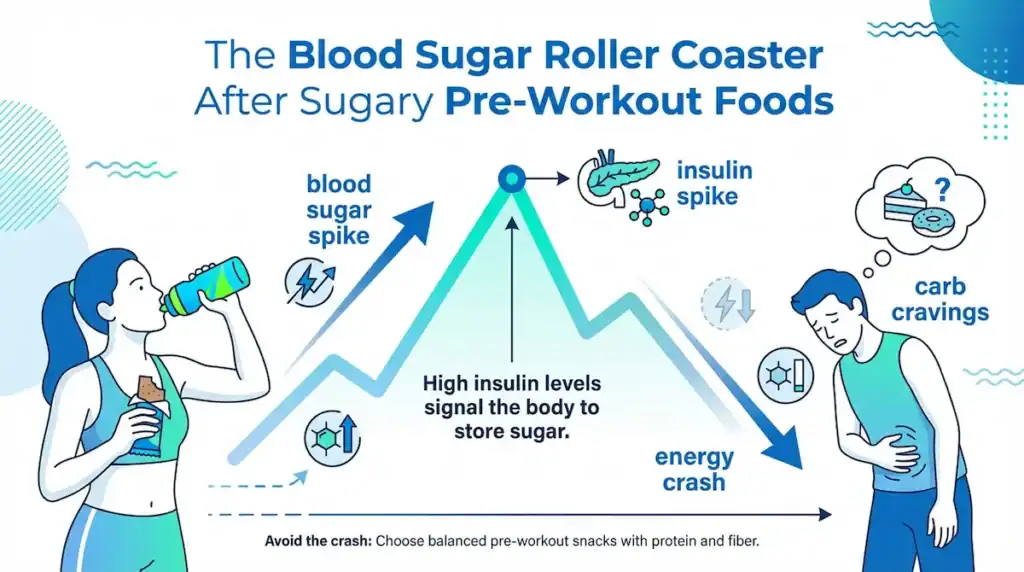
If you’re fueling your workouts with sugary sports drinks, high-carb pre-workout meals, or processed snacks, then you’re setting yourself up for a hunger crash.
The reason is that these foods spike insulin. Insulin is a storage hormone. When insulin levels are elevated, your body stores fat and can’t access it for fuel.
A 1997 study in the Journal of Applied Physiology found that modest pre-exercise insulin elevations from carbohydrate ingestion suppressed lipolysis during exercise, limiting the body’s ability to oxidize fat for fuel.9
So the moment the glucose from that pre-workout meal burns off mid-session, then you’ll hit a wall. Blood sugar drops, fat stores are unavailable, and your brain panics for energy, so you finish the workout feeling totally desperate for food.
It’s not a weakness, but it’s biochemistry. The fix is simple, though… You have to stabilize your pre-workout nutrition and stop riding the sugar spike.
If post-workout hunger keeps erasing the calorie deficit you worked for, BioTRUST’s GLP-1 Companion Stack is one option I like. It supports healthy appetite signaling while also helping support lean muscle during weight loss, so you’re not just focused on making the scale drop.
A 3-part daily stack designed to support people using GLP-1 medications or losing weight naturally. It combines muscle, protein, collagen, and appetite support to help you maintain a healthier body composition as you lose weight.
- Natural GLP-1 Support: Helps support healthy appetite signals, fullness & metabolic function
- Lean Muscle Support: Helps preserve muscle, strength & healthy body composition during weight loss
- High-Protein Collagen: Adds 20 g of protein with 5 collagen types to help support daily protein intake
- Skin, Joint & Hair Support: Provides collagen peptides to support skin elasticity, joints, hair & nails
- 3-Part Weight-Loss Support: Combines muscle, protein/collagen & appetite support in one simple daily stack

3. The “I Earned It” Effect (Compensatory Eating)
I’ve seen this pattern derail more fat loss programs than almost anything else, and a lot of people don’t even realize that it’s happening.
So you just crushed a hard workout. You’re sweaty, tired, and proud of yourself. But somewhere in the back of your mind, you hear a little voice saying, “You earned it.”
So you grab a post-workout smoothie with a little extra peanut butter. You skip the stairs because, hey, you already trained today.
You ordered the larger dinner portion because you ran this morning. You park yourself on the couch all evening because your body “deserves the rest.”
Sound about right?
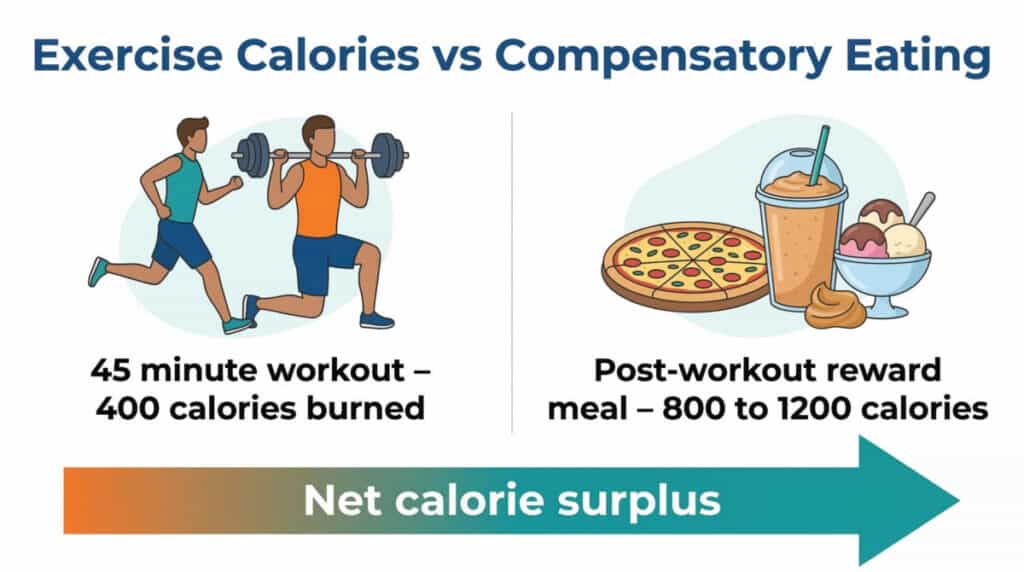
This is called compensatory eating. More formally, the compensation theory of exercise. And it’s one of the main reasons hard-training people struggle to lose weight.
The Conscious Part
The most obvious version happens at the dinner table. So you ran five miles and feel like you deserve pizza tonight. You hit a PR on deadlifts, so the ice cream is justified. You “worked it off” before you even ate it.
The problem is that this math rarely ever works out in your favor. A hard 45-minute run might burn 400 to 500 calories, but a post-workout reward meal can easily double or triple that in one sitting, and you’ll feel totally justified when you’re doing it.
But it’s not just the food. The earned-it mindset also gives you a hall pass from everyday movement. You take the elevator instead of the stairs, you skip the evening walk, you sit through the school pickup instead of walking to the gate.
Small stuff, but it adds up across an entire day.
The Subconscious Part (This One’s Sneaky)
The interesting part is that some of this compensation isn’t a conscious choice at all… It’s your biology.
Your brain treats exhausting workouts as a survival emergency when glycogen stores are depleted. So it ramps up your appetite hard, triggers urgent cravings for fast carbohydrates, and lowers your baseline movement to conserve energy for the rest of the day.
You’ll move a little slower, you’ll feel a little less peppy, you’ll sit a little more, and you’re not actively making this decision… but it just happens.
A 2021 review in Current Biology found that the average person unconsciously compensates for roughly 28% of calories burned through additional activity, meaning only about 72% of the extra energy expenditure from exercise contributes to a net deficit.10
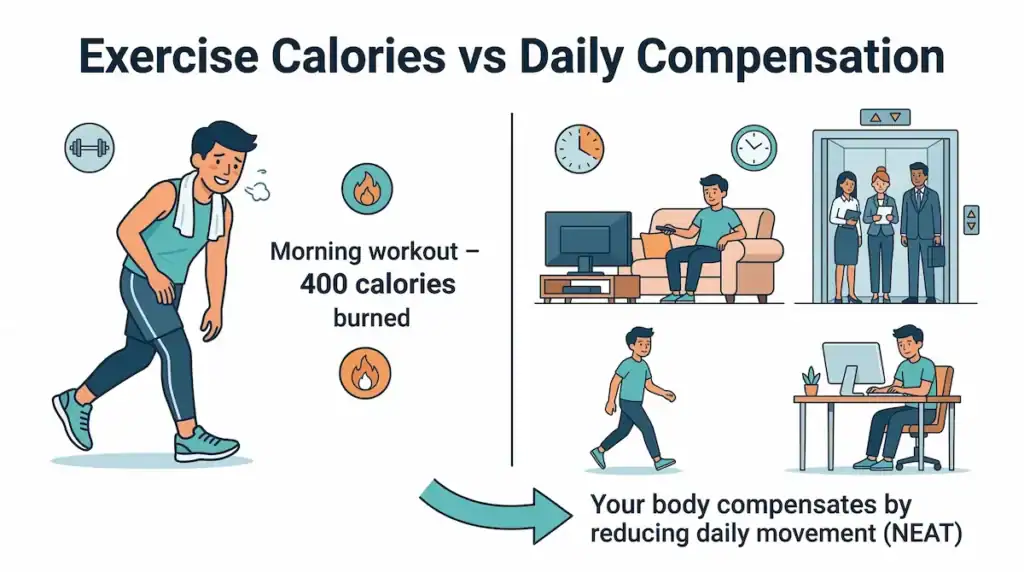
You may have worked hard, but your body made sure you didn’t benefit.
How to Break the Cycle
Is it more willpower? Trying to force your way through biological compensation is a long-term battle you’ll ultimately lose.
Instead, the real shift is mental. Stop treating exercise as a punishment that needs to be offset with a reward.
Training should become a normal, satisfying part of your routine instead of an obligation you resent. Then the psychological justification for the compensation will go away.
There is no debt to repay, and you’re not suffering through something, but you’re doing something that you value.
This mindset change alone will eliminate hundreds of calories from your diet per day without a single moment of dietary restriction or deprivation.
4. “Why Am I So Tired After Working Out?”
There’s a big difference between feeling that pleasant feeling of fatigue after a good workout and dragging yourself through the rest of the day like you were hit by a dump truck.
The first one is normal, but the second is a signal that you’ll need to pay attention to.
Your body is telling you something if exercise consistently wipes you out rather than energizes you. Here’s what’s really going on…
Your Brain Is the One Pulling the Plug
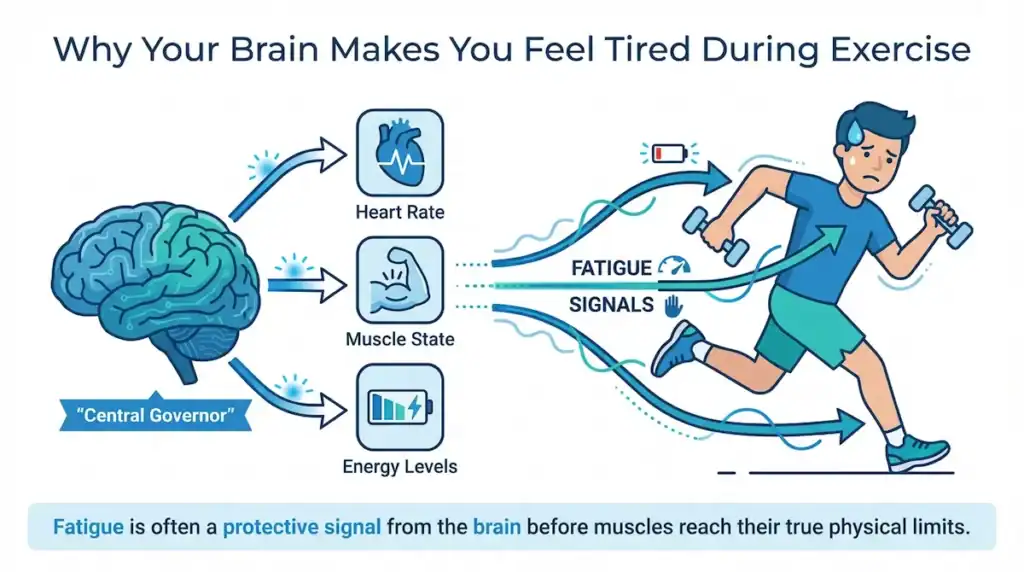
The fatigue you feel after a hard workout isn’t just coming from your muscles. Your brain is generating a significant portion of that fatigue.
Your brain acts like a central governor. It’s a built-in protection system that monitors your energy output and triggers feelings of exhaustion well before your muscles reach their physical limits.
A 2012 paper in Frontiers in Physiology by Tim Noakes proposed that fatigue is a brain‑derived emotion generated by a ‘central governor’ that monitors energetic costs and physiological threats, throttling performance via neural networks to protect muscles from reaching true physical limits.11
You have defined neural networks involving your amygdala and anterior cingulate cortex that constantly track the energetic costs of what you’re doing.
So when that cost gets too high, your brain doesn’t ask you to slow down. It actually makes you feel like you don’t have a choice.
When you feel that hard, tired feeling post-workout, that’s your nervous system shifting gears on purpose. It’s pulling you out of fight-or-flight mode and forcing you into rest-and-recovery mode so your body can repair the damage you just caused.
It’s not a weakness, but it’s your biology doing exactly what it’s supposed to. The problem starts when that recovery response hasn’t fully completed, and then you pile another hard session on top of it.
You’re Training Too Hard, Too Often
This is the most common cause of chronic post-workout exhaustion that I see, and it almost always follows the same pattern.
People gravitate towards a training intensity that’s too hard to be a comfortable aerobic workout, but not hard enough to be a genuine high-intensity effort.
So they train in this middle ground “black hole” day after day. This accumulates lactic acid, spikes stress hormones, and grinds down their recovery capacity without ever fully adapting.
Taking every set to absolute failure makes this worse. Training to failure induces massive neuromuscular and central nervous system fatigue. This is the kind that can add 24-48 hours to your recovery time from a single session.
A 2022 meta‑analysis in Sports Medicine found that resistance training performed to muscle failure induced significantly greater acute neuromuscular fatigue, including larger decreases in movement velocity and biomechanical performance, compared with non‑failure training.12
Now, when you stack that across weeks without adequate rest, and you’re not just tired after workouts, you’re tired all the time. Performance drops, mood tanks, motivation disappears. That’s overtraining, and it can take weeks to climb out of that hole.
You’re Under-Fueling
Your body eventually runs out of road if you’re training hard while eating in a significant caloric deficit. When your energy is chronically restricted, your nervous system responds by dialing down your baseline activity to conserve fuel, leaving you feeling sluggish, unmotivated, and lethargic without even knowing why.
This can get worse if your pre-workout nutrition is built around high-carb meals or sugary drinks. Intense exercise burns through blood glucose and muscle glycogen fast, so when that glucose runs out, your brain panics.
This results in a hard crash with mental fog, physical lethargy, irritability, and a crazy craving for anything sugary.
And if you’re restricting carbs at the same time, then your body may start breaking down muscle tissue through gluconeogenesis to keep your brain fueled. Underfueling while overtraining is one of the most common ways people’s bodies end up totally wrecked.
You’re Doing Too Much HIIT
Short, true high-intensity intervals are very effective. But the way most people do hit long work intervals, short rest periods repeated back in 45-minute classes is their risk for prolonged fatigue.
When done correctly, HIIT should feel very hard for a short period and leave you feeling pleasantly spent after. But done wrong, it can trigger a phenomenon called constrained energy expenditure.
This is where your body compensates for the massive calorie burn by leaving you lethargic for the rest of the day. You sit more, move less, conserve energy. but not as a conscious choice, but as your biological response can’t override it.
A 2020 review in Medicine & Science in Sports & Exercise notes that high‑dose exercise (such as frequent HIIT) leads to greater compensation via reduced non‑exercise activity thermogenesis (NEAT), leaving people “lethargic” or sedentary for the rest of the day to conserve energy.13
Even worse, excessively high-intensity work can cause genuine cellular damage. Work in roles that are too long with rest periods that are too short, breaking down basic components of your cells.
This floods your bloodstream with ammonia and degrades your mitochondria, which are the energy-producing engines inside your cells. That’s why a bad HIIT session can leave you feeling terrible for 24-48 hours.
If that’s happening to you regularly, then you’re not getting fit, but you’re accumulating damage.
A 2021 study in Cell Metabolism reported that excessive high‑volume high‑intensity aerobic exercise caused mitochondrial functional impairment, including reduced respiration and biogenesis, along with impaired glucose tolerance in healthy volunteers.14
You’re Not Sleeping Enough
Sleep is where your body actually rebuilds from your training. Without it, everything else starts falling apart.
Sleep deprivation doesn’t necessarily reduce your muscles’ physical ability to contract, but it does massively increase how hard everything feels. Your perceived exertion will go sky-high, your motivation will fall apart, and the workouts that would normally feel doable will become a hard mental battle.
A 2025 meta‑analysis in Frontiers in Physiology found that sleep deprivation significantly increased ratings of perceived exertion (SMD = 0.51) during exercise while having smaller, less consistent effects on actual muscle strength, making workouts feel much harder without necessarily reducing contractile capacity.15
Chronic sleep restriction also dysregulates cortisol and disrupts your appetite and recovery hormones. This means you’re piling intense exophysical stress on a nervous system that’s already compromised.
Forcing yourself out of a deep sleep cycle with a 5am alarm to squeeze in an early workout is a trap. Worth calling out. Done occasionally, it’s not a big deal. But done chronically, it can trigger a low-grade fight-or-flight response every single morning.
It may contribute to a fatigue cycle that builds up over time. So if you’re waking up exhausted and dragging yourself through workouts in the dark, the workout isn’t the problem; your sleep schedule is.
The Bigger Picture: Allostatic Load
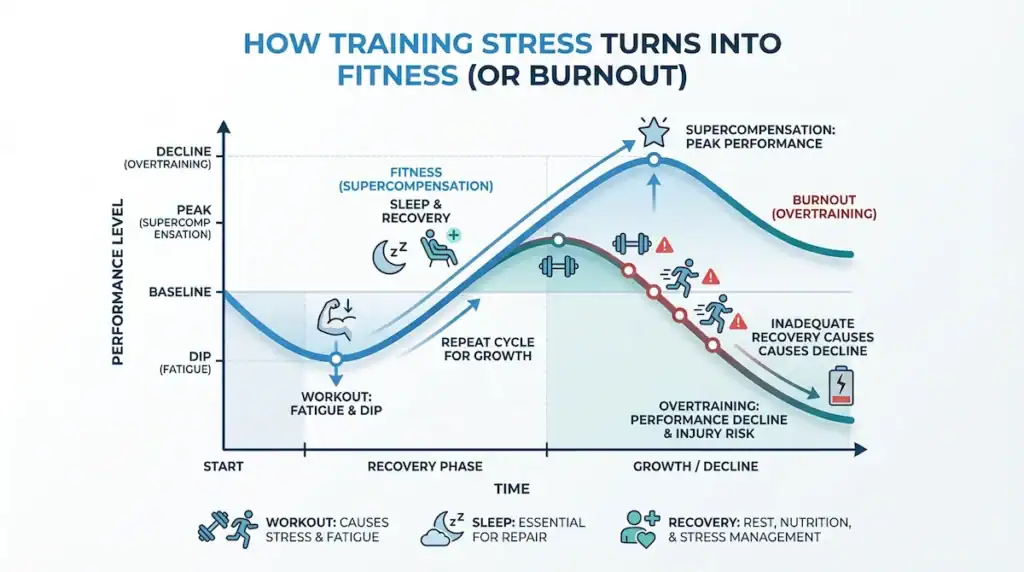
Your body doesn’t separate the stress from your workouts from the stress in the rest of your life. It all accumulates in the same bucket.
If you’re training hard while also dealing with poor sleep, chronic work stress, relationship pressure, and a generally chaotic lifestyle, then your stress load, what physiologists call allostatic load, can exceed your body’s capacity to recover.
And when that happens, then an intense workout doesn’t just make you tired. It pushes your nervous system past its limit and can trigger a full shutdown response.
This is a state in which your body feels intensely heavy, drained, and depleted due to a forced demand for rest.
A 2025 review in Frontiers in Physiology explained that allostatic load—the cumulative cost of adapting to stressors like hard training, poor sleep, work stress, and life pressures—can exceed the body’s recovery capacity, leading to multisystem dysregulation and impaired performance adaptation.16
This is your entire system telling you you’ve had enough.
What to Do About It
If your workouts are consistently exhausting you rather than energizing you, the answer is almost never to push through. Instead, it’s to pull back.
Reduce training volume, prioritize sleep, stabilize your nutrition, and give your nervous system time to reset. More isn’t always better.
The goal is to provide a training stimulus your body can actually recover from, because fitness is built during recovery, not during the workout itself.
5. Exercise Can Increase Posture Problems
Every client of mine who walks into the gym after years behind a desk, I’ll tell them that the workout doesn’t create their posture problems, but it does make the ones they already have impossible to ignore.
When you add load, speed, and fatigue to a movement pattern, then everything that was quietly compensating in the background gets exposed. The slightest thing you barely notice sitting at your computer becomes a genuine liability the moment you put a barbell on your back.
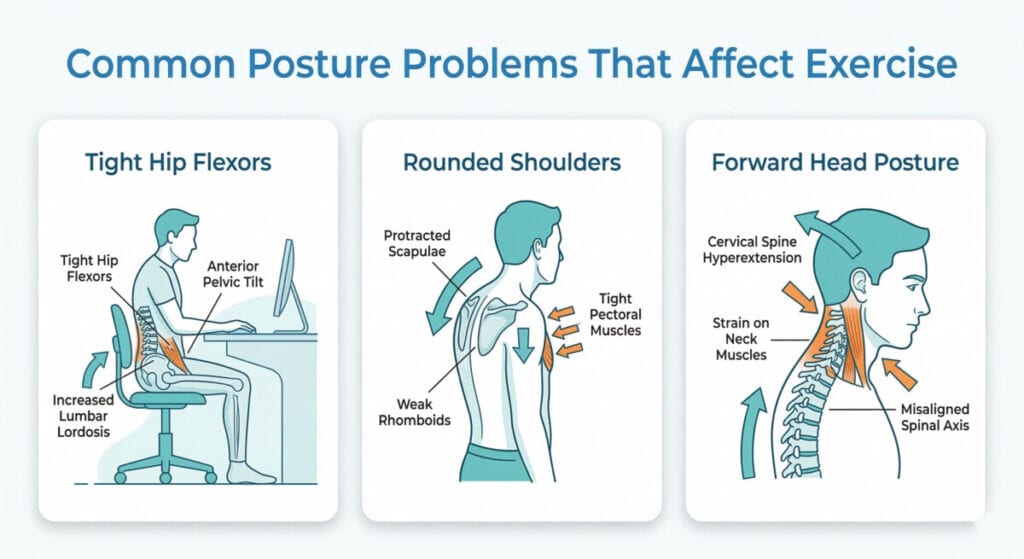
Tight Hip Flexors: The Sitting Tax
Modern life is essentially a prolonged hip flexor shortening exercise. The more you sit, the more your hip flexors and hamstrings adapt to that shortened position, and the more your glutes forget to turn on.
You see this problem the moment you try to run, squat, or lunge. Proper hip extension needs your glutes to fire and your hip flexors to lengthen.
But if neither is happening, then your body compensates by overextending your lower back to complete the movement. Then your spine ends up doing a job your hips were supposed to handle.
Your lower back pays the price under the repetitive stress of exercise.
Watch a fatigued runner, and you’ll see it clearly. The pelvis tips forward, the belly drops out, and the stride gets sloppy. It’s not just tiredness… it’s a hip flexor problem that’s becoming a whole-body issue as you watch.
Rounded Shoulders: A Pressing Disaster
If you spend enough time leaning over a desk, steering wheel, or phone, then your chest muscles will adaptively shorten while your upper back weakens. Your shoulders roll forward into an internal rotation and stay there.
Now, when you try to bench press, do a push-up, or pull yourself over a bar in that position, you’ll be asking a structurally compromised shoulder joint to handle significant load.
Because you lack the rotational capacity to pull your shoulders into a stable position, your body compensates by shifting your weight. It does so by elbows flaring out, shoulders shrugging up towards your ears, and the external rotators of your shoulder are placed under a constant, brittle stretch.
This results in burning pain, joint impingement, and the kind of chronic shoulder irritation that never quite goes away. It isn’t a strength problem… it’s a mobility issue that can lead to injury during exercise.
Neck Tension: The Weight of a Forward Head
Your head weighs roughly 10-12 pounds in a neutral position. For every inch it drifts forward, which is what happens when your upper back is rounded, adds about 10 additional pounds of load onto your cervical spine.
So even just a moderately forward head posture can triple the mechanical demand on your neck.17
Now throw exercise into that equation. Craning your neck to look up during a kettlebell swing, jetting your chin forward while running, yanking your head back to clear a pull-up bar… Each of these movements takes an already stressed cervical spine and magnifies the sheer force across it.
Your neck extensors work overtime at their end range trying to support your head, which is no longer properly balanced over your spine. This results in muscle spasms, chronic neck tension, and tension headaches that seem to appear out of nowhere after training.
Poor Lifting Mechanics: Fatigue Exposes Everything
Your technique is only as good as your fatigue level allows.
When neuromuscular fatigue builds up, whether it’s from taking sets too close to failure, doing too much volume, or jumping into heavy compound lifts after an exhausting cardio session, then proprioception degrades.
Your brain’s ability to sense where your body is in space becomes unreliable. Techniques that looked acceptable when you were fresh start to fall apart in ways you may not even notice in the moment.
A slightly rounded lower back on a deadlift, a knee caving on a squat, a shoulder drifting forward on a press. Under light load, these errors are minor…
But under heavy load with a fatigued nervous system, they can create destructive shear forces across joints and vertebral segments that accumulate into herniated discs, impingements, and connective tissue changes over time.
Stopping just a few reps short of failure isn’t a sign of not working hard enough, but it’s how you keep your mechanics intact long enough to get stronger.
Heavy training puts stress on your tendons, ligaments, and connective tissue. Consider adding a collagen supplement, such as BioTrust Ageless Multi-Collagen to support joint health and recovery.
Powered by 5 Types of Bioactive Naturally Hydrolyzed Collagen Peptides for Full-Body Support (Odorless & Flavorless)
- Natural GLP-1 Support: Helps support healthy appetite signals, fullness & metabolic function
- Lean Muscle Support: Helps preserve muscle, strength & healthy body composition during weight loss
- High-Protein Collagen: Adds 20g of protein with 5 collagen types to help support daily protein intake
- Skin, Joint & Hair Support: Provides collagen peptides to support skin elasticity, joints, hair & nails
- 3-Part Weight-Loss Support: Combines muscle, protein/collagen & appetite support in one simple daily stack

6. “Why Do I Feel Wired After a Workout?”
If you’ve ever finished a late evening training session and then spent the next two hours staring at the ceiling, then you already know this feeling. You’re physically tired, but your brain is still running at full speed, and your sleep feels like it’s completely out of reach.
It’s not insomnia, but it’s your body’s chemistry.
Your Body Just Triggered a Fight or Flight Response
Your body treats every time you train hard as a survival event…
Your sympathetic nervous system, the branch responsible for fight or flight, fires up and floods your system with adrenaline and noradrenaline. These hormones are specifically designed to energize you, sharpen your focus, and prepare you for action.
Your heart rate climbs, your breathing accelerates, blood gets redirected to your working muscles, and your entire system shifts into high gear.
Cortisol joins in the party too. It mobilizes fuel substrates to keep you going through the session. Together, this hormonal cocktail keeps your body in a state of elevated alertness well after the last rep.
On top of that, vigorous exercise triggers the release of endorphins, which are your body’s natural opiates. They produce that euphoric, kind of electric feeling many people get after a hard workout.
Add a surge of dopamine, serotonin, and norepinephrine from cardiovascular training. And then you’ve got a potent neurochemical cocktail that elevates your mood, sharpens alertness, and makes you feel fantastic.
Which is great… unless it’s 10 pm.
Your Body Temperature Is Still Elevated
Exercise creates considerable heat, and your body’s core temperature can stay elevated for hours after the workout ends.
This is partly due to a phenomenon called EPOC, or Excess Post-Exercise Oxygen Consumption. Also known as Afterburn Workouts, where your body continues burning extra energy as it recovers.
This is a big deal because your body temperature directly regulates sleep. So to fall asleep, your core temperature needs to drop.
But when it’s still elevated from training, then your body can’t complete the transition to a relaxed parasympathetic state that sleep requires. So physiologically, you end up feeling “tired and wired” at the same time.
The Timing Problem
All of this is completely normal and actually beneficial when it happens at the right time of day. The post-workout neurochemical boost improves mood, productivity, and mental clarity. And it’s one of the most underrated benefits of regular exercise.
But the problem is when you push training too close to bedtime. These stress hormones, neurotransmitters, and temperature elevations don’t clear instantly.
They take about 2-3 hours to dissipate enough for your parasympathetic nervous system to take back control, slow your heart rate, and bring your body back to a restful baseline.
If you’re training too late, you’re essentially asking your body to sleep while it’s still in fight-or-flight mode. And we all know this doesn’t work too well.
What to Do About It
An easy fix is to give yourself a buffer. Finish your vigorous training at least 2-3 hours before bed.
If your schedule doesn’t allow that, shift to lower-intensity exercise in the evening, such as walking, mobility work, or light lifting. This is far less likely to lock your sympathetic nervous system into an activated state.
Dedicated cool down also helps more than most people give it credit for. 10 minutes of slow movement, controlled breathing, or static stretching after training can signal your nervous system to shift from fight-or-flight back to rest-and-digest.
A wired feeling after a good workout is a sign your training is working. But the goal is to make it work for you and not against your sleep.
If late workouts leave your body tense and your mind switched on, BioTRUST Ageless Multi Magnesium is one option I like for your wind-down routine. Its blend of magnesium forms and L-theanine is designed to support muscle relaxation and restful sleep without stimulants.
A 7-form magnesium complex designed for adults 40+ to support restful sleep, relaxation, muscle recovery, and whole-body health. Each serving provides 350mg of magnesium plus L-theanine and vitamin B6 for added nervous-system support.
- 7-Form Magnesium Blend: Combines glycinate, taurate, malate, citrate, Sucrosomial® magnesium & complementary forms
- Sleep & Relaxation Support: Magnesium glycinate plus L-theanine help support calm, relaxation & restful sleep
- Muscle Recovery & Comfort: Supports normal muscle relaxation, recovery & energy production
- Enhanced Absorption: Includes clinically studied Sucrosomial® Magnesium for high absorption & gentle digestion
- Heart, Bone & Nervous System Support: Provides 350mg of magnesium plus vitamin B6 for essential body functions

7. “Am I Overtraining?”
True overtraining syndrome is exceedingly rare. If you’re a recreational lifter training 4 or 5 days a week, you’re probably not actually experiencing legit overtraining.
Something is going on, and it’s worth understanding the difference.
What Overtraining Actually Is
Over-training is formally characterized by a chronic, measurable decline in performance, depressed mood, severe loss of motivation, and psychological symptoms that can persist for weeks or months.
It usually occurs under extreme circumstances, such as massively ramped endurance volume, daily maximal-effort attempts, or prolonged energy restriction combined with high training loads. It’s more of an elite athlete problem than a gym-goer problem.
The single non-negotiable marker of true overtraining is weakened performance. If you’re still getting stronger, like adding weight to the bar, hitting more reps, and moving better, then you’re not overtraining.
So What Are You Actually Experiencing?
What most people call overtraining is one of three things…
The first is mental fatigue. Your brain didn’t evolve to enjoy tearing muscle fibers with heavy iron, so when training gets hard, your primitive brain will do everything it can to convince you to stop.
It increases lethargy, boredom, and a sudden, inexplicable desire to skip the gym. Mental fatigue increases your perceived efforts and makes the weights feel heavier than they actually are.
But the key distinction is that it doesn’t physically impair your muscle’s ability to produce force. The weights feel heavier, but they aren’t.
The second is local overreaching. This is where you push a specific muscle group or movement pattern beyond its recovery capacity while the rest of your body is completely fine.
Your lower back is fried, but your legs feel great. Your biceps are cooked, but your pressing is strong. Overreaching is highly localized. The fix is to reduce volume in that specific area, not abandon your entire program.
The third is systemic lifestyle stress that appears as a training problem. Ongoing sleep deprivation, prolonged caloric restriction, or high psychological stress can double your recovery time and tank your performance. This happens with no change in your training volume whatsoever.
So before you blame your program, look at your sleep, nutrition, and stress levels outside the gym. Those factors are usually doing far more damage than the workouts themselves.
How to Actually Evaluate Your Fatigue
Stop going by feel… open your training log and look at the data.
Performance is dropping across multiple unrelated exercises, and you have a systemic recovery problem. Address your sleep, nutrition, and stress before you change anything about your training.
If performance is dropping on one specific exercise or muscle group while everything else is fine, then you’re locally overreaching. Pull back the volume on that movement, temporarily drop the weight, focus on quality, and let it recover.
If performance is stable or improving, but you feel exhausted, then that’s mental fatigue. Your body is capable, but your brain is complaining. Push through the psychological barrier.
When It Actually Is a Problem
That said, chronic overreaching, left unaddressed, can eventually become a genuine issue. When you accumulate training stress alongside life stress, poor sleep, and inadequate nutrition, it pushes your allostatic load past its limit.
This results in your nervous system getting permanently stuck in a state of sympathetic activation. Fight-or-flight becomes your new baseline.
- Irritability & mood changes as your cognitive reserves deplete
- Sleep disruption that chronically activates the stress response, making it nearly impossible to wind down
- Declining performance as your system runs out of reserves
- Compromised immunity as your body shifts resources away from nonvital functions
The downstream effects are predictable…
And one subtle trap is that some people use exercise as a way to self-medicate a dysregulated nervous system. They chase that daily endorphin hit just to feel functional and unable to skip training without anxiety spiking.
When working out stops being something you do from a place of strength and becomes something you need just to stay leveled… then that’s a sign worth paying attention to.
The Warning Signs to Watch For
If several of these symptoms are appearing at the same time, it should be taken seriously…
Some fatigue and soreness that doesn’t resolve with normal rest. Sleep disturbances like trouble falling asleep, staying asleep, or a racing pulse the moment your pillow hits your head.
Uncharacteristic irritability, anxiety, or flat blah feeling toward training that used to excite you. An elevated resting heart rate in the morning, frequent illness, run-down immune system, and a measurable performance decline across multiple lifts over multiple weeks.
How to Fix It
If you’re genuinely in a hole, then the solution is clear, even if it’s uncomfortable. Stop digging.
2-3 days completely off. Not active recovery, not light cardio, but actual rest. Only then can you reintroduce training conservatively. Stay well clear of failure and prioritize sleep and nutrition above everything else.
Keep planned deload weeks in your program every 6-10 weeks. This is a period where you significantly reduce volume or intensity to let accumulated fatigue dissipate and joints recover.
Strength is built over months and years. Protecting your ability to train consistently matters far more than any single hard week.
The goal of training is to provide a stimulus your body can recover from and adapt to. More is only better to the point where recovery can keep pace. Beyond that, you’re not only building fitness… but you’re also accumulating damage.
8. Exercise Can Reduce Movement the Rest of the Day
This is one of the most counterintuitive things I tell my clients, but it’s also one of the most important. The hour you spent in the gym this morning may have left your body trying to recover for the rest of the day.
Your Body Has a Built-In Energy Ceiling
The human body is wired to resist extreme energy loss. So it doesn’t care that you’re trying to lose weight… it has one overriding biological priority: Survival.
And from that survival standpoint, burning through massive amounts of energy is a threat that needs to be neutralized.
So when you hammer your body with an exhausting workout (especially high-volume cardio) then your nervous system responds by dialing down non-exercise activity thermogenesis (NEAT).
This is all the movement you do outside of formal exercise… like walking to your car, fidgeting at your desk, taking the stairs, and pacing while on the phone.
It may sound like it’s not a lot, but it is. NEAT can account for hundreds of calories per day in active people. And your body can suppress it a lot without you even noticing.
The Two Ways It Happens
First is all biological. You don’t decide to be lethargic after a hard workout, but your nervous system decides it for you.
You move more slowly without realizing it, you sit longer, you take the elevator without thinking twice, and you put off that errand that would have required a walk. None of it feels like compensation since it just feels like a normal afternoon.
The second layer is psychological. Many dedicated exercisers develop what’s called an athlete’s mindset about leisure.
This is a conscious belief that a hard workout earns you the right to do nothing afterward. “I ran this morning, so I deserved to relax.” “I trained my legs yesterday so I can take the escalator.”
But the workout becomes a transaction that pays for inactivity, and the mental accounting feels completely justified. The real damage happens when both of these mechanisms are working together.
Active Couch Potato Syndrome
What’s not an active lifestyle? One hour of intense exercise followed by 10 hours of sitting. The medical community has a name for this pattern: the active couch potato syndrome.
Prolonged sitting could do damage that a morning gym session can’t undo. Muscles, joints, and arterial walls literally adapt to the fixed position of sitting, making your body become stiffer and less functional over time.
Your glutes shut down, your hip flexors shorten, your hamstrings tighten. Postural problems we covered earlier are reinforced hour by hour while sitting at your desk.
Extended stillness disrupts leptin signaling. This is the hormonal communication between your brain and your digestive system that controls hunger and fat storage.
When leptin is compromised, your brain ramps up food cravings, and your body shifts into a hormonal pattern that promotes fat storage.
So the gym session that was supposed to create a deficit then gets unknowingly undermined by what happens in the 10 hours that follow it.
The Fix Isn’t More Exercise
Most people go wrong by responding to this frustration and lack of progress by adding more training. More cardio, more sessions, more intensity.
But if the problem is compensation-driven NEAT suppression, then more exhausting exercise will make it worse.
The solution has two parts…
Dial back the exercise intensity enough that your sessions are energizing rather than depleting. Training that leaves you feeling good after doesn’t trigger the same aggressive compensation response as training that leaves you totally wrecked.
Strength training, especially, is far less likely to suppress NEAT than high-volume cardio. This is another reason it should be the foundation of any fat-loss program.
Second, prioritize consistent low-level movement throughout the day. Get up every 20-30 minutes, walk when you can, take the stairs, pace during phone calls.
These small, cumulative movements don’t just increase calorie burn; they also actively counteract the metabolic and structural damage from prolonged sitting.
It isn’t all just about exercise… it’s about moving consistently throughout the day in a way that doesn’t leave your body feeling the need to compensate.
9. Exercise Can Make Anxiety Worse
A lot of fitness content out there will tell you that exercise is always one of the best things you can do for anxiety. And it’s true in a lot of cases.
But nobody ever talks about those who work out don’t feel like relief… but feel like a trigger.
If that’s you then you’re not doing it wrong, you’re not weak, and there’s nothing broken about you. There’s actually a very clear physiological reason this happens.
Exercise Looks Exactly Like a Panic Attack
Think about what happens to your body during intense exercise…
Your heart pounds, your breathing becomes rapid and shallow, you sweat, and your muscles tense up. Now think about what happens during a panic attack or an acute anxiety episode.
It’s the same list.
For people with anxiety sensitivity (a heightened awareness of and fear toward physical sensations of arousal), the normal bodily changes of a hard workout can be the same feelings as the early warnings of a panic attack.
Your brain doesn’t know you’re on a treadmill. It detects a racing heart and interprets it as a danger signal. It feels sweat and shallow breathing, and concludes something’s wrong.
The result is fear and panic layered directly on top of an already intense physical experience.
Higher-intensity exercise makes this worse. The harder you push, the more rapidly your physiology changes to meet the energy demand. And then the more dramatic those physical symptoms become.
Research consistently shows that the intensity of physical symptoms during exercise is a primary driver of negative emotional experiences during training.18 For anxious people, pushing harder doesn’t build resilience. It just turns up the alarm volume.
The Obligation Problem
Exercise also fails as an anxiety tool when it becomes another item on the list of things you have to do.
When working out is tied to distant goals such as losing weight, getting fit someday, or looking different eventually… then it becomes an ongoing chore that requires willpower to keep up.
And willpower is exactly the resource anxiety depletes first. So now you have an activity that physically mimics panic, attached to a distant goal you may not reach, and that you’re forcing yourself to do because you “should.”
How to Actually Fix This
The answer isn’t to push through and get used to it. The answer is to redesign the experience entirely. Start by lowering the intensity.
You don’t need to be gasping and drenched in sweat to get meaningful mental health benefits from exercise.
Studies consistently show that people experience far more positive feelings during light to moderate activity than during high-intensity exercise.19 A walk, gentle hike, an easy swim… these aren’t the consolation prize.
For someone whose nervous system is already dysregulated, then this may actually be the better prescription.
Find something that doesn’t feel like punishment. You’re allowed to like what you do. If running makes you miserable and the gym feels like a sensory nightmare… then don’t do those things.
Try hiking, cycling, swimming, dancing, or even just walking somewhere you genuinely enjoy being. Movement doesn’t have to look like a workout to count as one.
Change the language around it. When you stop calling it “exercise” and start calling it “going for a walk,” “being active,” or just “doing something fun,” you remove the weight of obligation from the activity.
The psychological burden of “I have to exercise” is real… and simply reframing how you describe it to yourself can meaningfully change how it feels to do it.
Don’t grind through the exhaustion. Stop before you hit the wall. Finish on a note that feels manageable rather than overwhelming.
The memory you leave with determines how willing you are to come back. And a session that ends comfortably is far more sustainable than one that ends with you collapsed and dreading the next one.
And finally, over time gentle exercise can actually become a tool for teaching your brain that these physical sensations are safe. A faster heartbeat doesn’t mean danger. Sweating doesn’t mean something is wrong.
By deliberately and gradually experiencing mild physical arousal in a controlled, safe environment, you can slowly recalibrate your nervous system’s threat response.
But that process only works if the exercise feels manageable enough that you stay calm enough to let the lesson land.
The goal isn’t to force yourself to tolerate something miserable until it becomes less miserable. It’s to find movement that your nervous system can actually work with… and build from there.
10. Unrealistic Exercise Expectations
If this is you then you should know that you’re not broken, your metabolism isn’t damaged, and you’re not doing anything uniquely wrong.
This is one of the most common frustrations I hear from clients. And almost always comes down to the same set of misunderstandings about how fat loss actually works.
Exercise is one of the best things you can do for your health, muscle mass, mood, and longevity. But as a fat-loss tool, it’s significantly weaker than many people think.
And the fitness industry has done a terrible job of being honest about that.
You Can’t Out-Train a Bad Diet
The calorie math on exercise is quite unimpressive compared to what most people think. A solid hour of cardio and strength training burns only a few hundred calories.
This is about the same equivalent of one moderately sized snack. So a few minutes of mindless eating after the gym can completely erase the deficit you spent an hour creating.
Workout-tracking devices like smartwatches make this worse by dramatically overestimating calorie burn. This gives people a false sense of confidence that they’ve created a meaningful deficit when they haven’t.
If your nutrition isn’t dialed in, no amount of training volume will compensate. Fat loss is 80% diet. Exercise accounts for the remaining 20%.
And even that figure is generous once you account for what happens after the workout.
The Real Fix
Stop chasing burning calories and start thinking about hormone optimization.
Chronic high-volume cardio spikes cortisol, suppresses metabolism, drives compensatory eating, and keeps your body in a stress fat-storing state. It’s one of the least effective paths to leanness you have.
Instead, build your foundation around strength training. This builds metabolically active muscle without triggering the same aggressive compensation response as cardio.
Add low-intensity movement, such as walking, hiking, and other daily activities. This will build up calories expended without spiking appetite or stress hormones.
And get your nutrition in order because no training program on earth can override a diet that’s consistently putting you into caloric surplus.
Exercise should be part of your life because of what it does for your health, strength, mental clarity, and quality of life. Not because you’re using it to punish yourself into a smaller body.
When you shift that framing, the frustration usually starts to go away, and the results usually follow.
