
You’re doing a ton of bodyweight squats. Your knees are complaining. And your legs still look the same.
Sound familiar? You’ve been doing squats and lunges in your living room… maybe for weeks, maybe longer. And somewhere along the way, you hit a wall.
The squats feel too easy, but anything harder feels like a knee injury waiting to happen. Your hamstrings never really get hit. And if you’re over 40 with a desk job and creaking in your knees, then you’re probably wondering if bodyweight training is even worth trying.
It is. But most people are just doing it wrong.
Here’s what actually happens when someone learns to train their legs with intent instead of just knocking out 50 air squats: knee pain decreases, the posterior chain finally fires, and their legs change in ways they haven’t in years.
The problem isn’t bodyweight training. It’s the missing framework… no real progression past squats, no solution for hamstrings, and no guardrails for beat-up knees.
This bodyweight leg exercise guide fixes all three. You’ll get a complete progression system, a real hamstring solution, an at-home workout plan, and a knee-safe path forward. No gym required.
The Truth about Bodyweight Leg Training (And Why Most People Get It Wrong)
Key Takeaways:
- Bodyweight training fails when exercises stay bilateral and too easy
- Your legs grow from mechanical tension, not high-rep cardio
- Single-leg exercises create far more tension per limb
Here’s something most fitness articles won’t tell you: the problem with bodyweight leg training is the bodyweight. It’s the exercises.
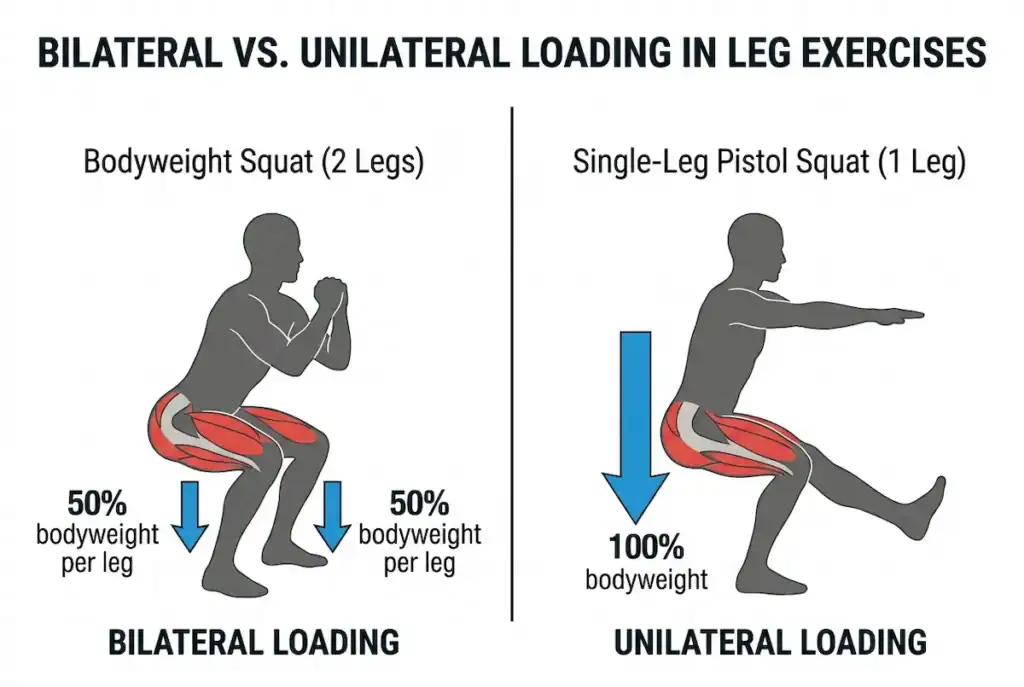
Standard squats are a bilateral movement. Both legs split the load 50/50. That’s why 100 reps starts to feel like cardio… because for your muscles, it basically is.
The fix? Physics.
Your body already weighs enough to build serious legs. The lower body houses the largest, most powerful muscles in the human body. You don’t need more resistance. You need to manipulate how that resistance loads the muscles.
The Bottom Line:
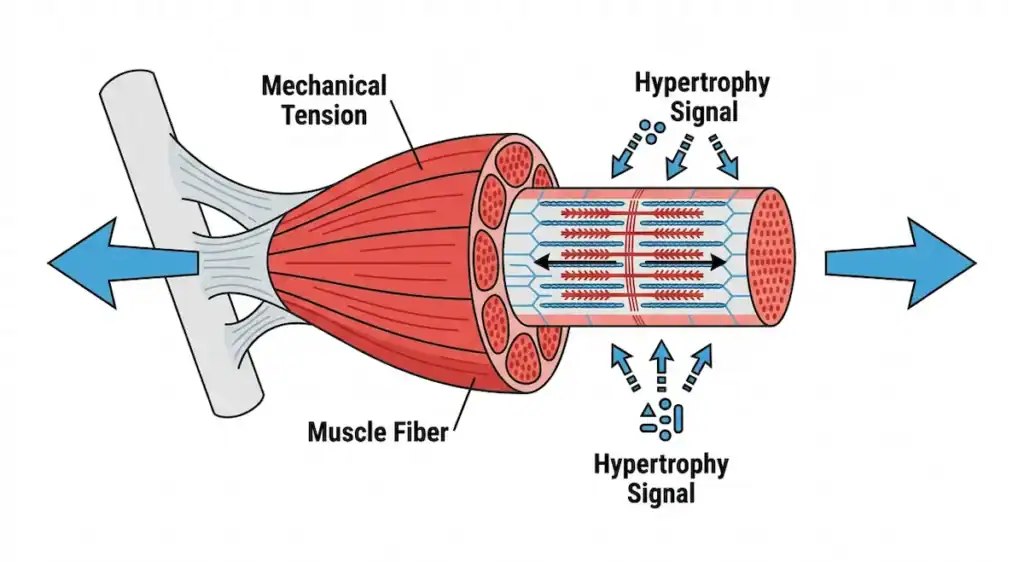
Your legs don’t care whether the resistance comes from a barbell or your own bodyweight. They only respond to mechanical tension.
Mechanical tension is the physical force or stress placed on your muscle fibers when they contract to overcome resistance or when stretched under load. It’s widely considered to be the primary driver of muscle growth.
A 2025 review in the Journal of Sport and Health Science concluded that mechanical tension is the primary and essential driver of resistance‑training–induced muscle hypertrophy, while acute hormonal spikes, metabolic stress, cell swelling, and ‘the pump’ show little evidence as independent contributors.1
The Two Mechanisms That Actually Build Legs Without Weights
Key Takeaways:
- Unilateral exercises increase force output through the bilateral deficit
- Training muscles in stretched positions increases hypertrophy potential
- Combining both creates maximal tension without adding weight
Single-leg loading (unilateral training) is the primary driver.
When you shift your entire bodyweight onto one limb, you trigger what’s called the bilateral deficit. This is when your nervous system allows for higher force output per leg when working unilaterally.
A 2021 systematic review in Frontiers in Physiology reported that several resistance‑training studies found unilateral training increased the bilateral force deficit in measures like knee extension and leg press, meaning that the sum of single‑leg efforts exceeded the force produced when both legs worked together.2
A pistol squat doesn’t just double the load. It changes how your motor cortex recruits muscle fibers entirely.
Range of motion (ROM) is the second lever. Training muscles at their longest, most stretched position triggers stretch-mediated hypertrophy. An example is the absolute bottom of a Bulgarian split squat deficit.
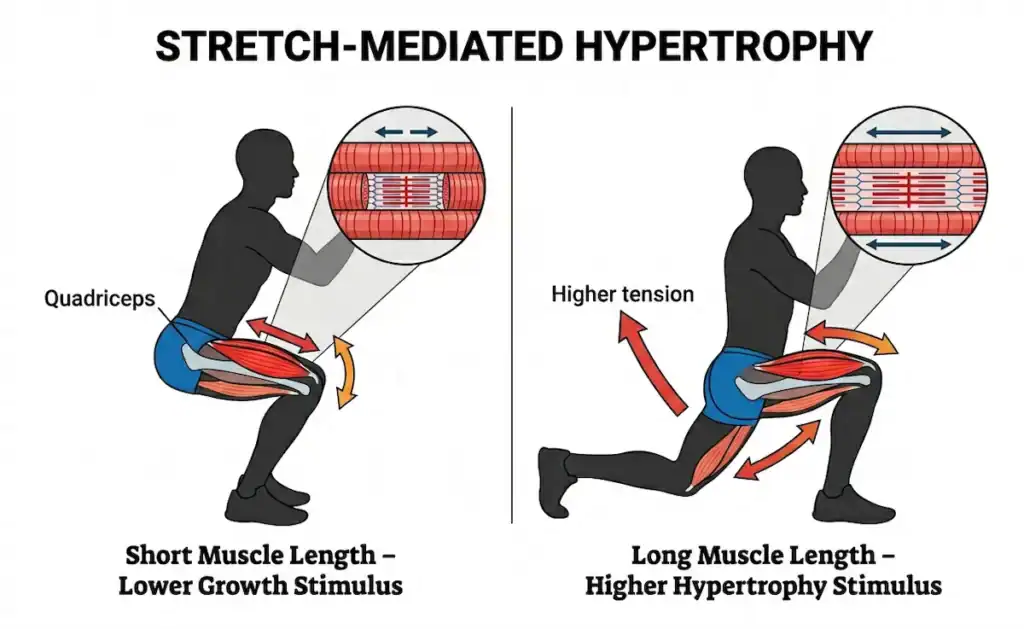
A 2023 review in Sports Medicine found that long‑duration stretching of the calves, produced increases of roughly 5–23% in muscle size, indicating that training at long muscle lengths can induce stretch‑mediated hypertrophy.3
The muscle doesn’t just get stronger. It can literally add length to the muscle fibers themselves.
The Bottom Line:
The secret to building legs with bodyweight isn’t more reps… it’s single-leg exercises performed through a deep range of motion.
How to Keep Making It Harder Without Adding Weight
Key Takeaways:
- Progress by changing leverage, not just reps
- Slow eccentrics and pauses dramatically increase tension
- Training legs more frequently can replace adding load
Progressive overload is non-negotiable, even without a barbell. This is the process of progressively making the exercise harder to keep it challenging for your body… and keep getting results.
Here’s how you apply it:
Harder leverage: Graduate from two legs to one. That’s your equivalent of adding a plate.
Longer eccentrics: A 5-second descent on a Nordic curl generates more mechanical tension and muscle damage than 10 sloppy reps ever will.
Pauses at the bottom: A 3-second dead stop eliminates the elastic bounce from your tendons. No bounce means your muscles do 100% of the work from a cold start.
More weekly volume/frequency: When reps feel easy, train legs more often. 3-5 sessions per week, instead of just doing more reps per session.
“Will 100 bodyweight squats a day actually build muscle?”
Short answer: briefly, then not much after that.
For a true beginner, yes. 100 squats will produce initial gains. High-rep work can stimulate muscle growth, but only if the set is taken close to muscular failure.
A 2017 meta‑analysis in the Journal of Strength and Conditioning Research found that low‑load (high‑rep) and high‑load resistance training produced similar muscle hypertrophy when sets were performed to or near failure. Indicating that high‑rep work can effectively stimulate muscle growth if effort is high enough.4
Early on, 100 squats are genuinely hard. Your nervous system is still learning the pattern. Your muscles fatigue faster.
But once your body adapts, 100 squats stops being a strength stimulus. It becomes an aerobic activity. Your cardiovascular system and metabolic clearance become the limiting factors… not your quads.
Fast twitch muscles fibers (the ones with the most growth potential) are never recruited if the exercise never gets hard enough to demand them. Expose your muscles to the exact same stress long enough, and they stop adapting entirely.
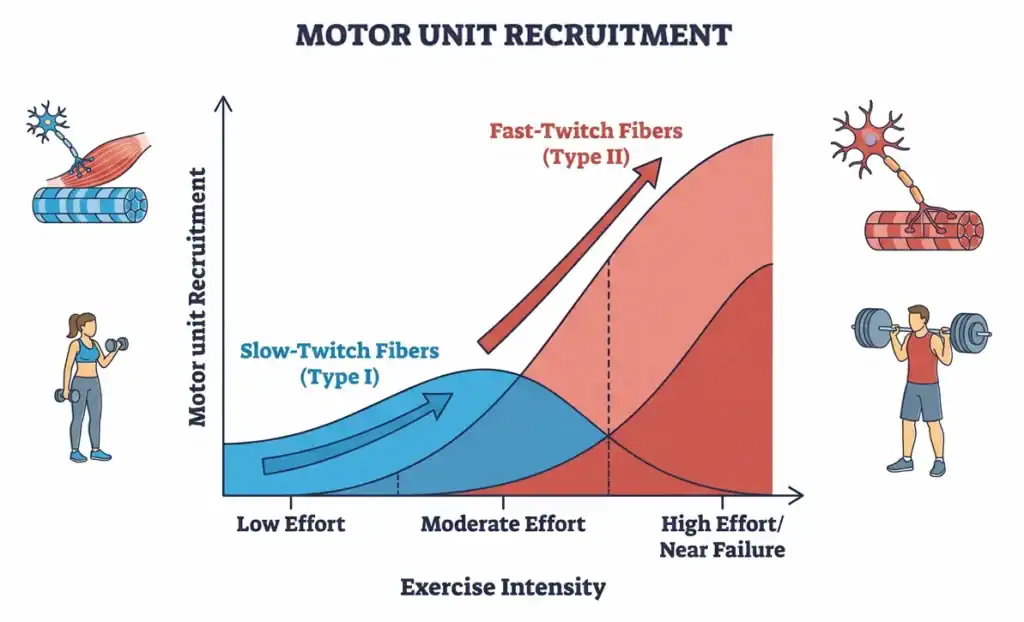
A 2014 study in the Proceedings of the Royal Society B found that selectively activating only fast‑twitch motor units or only slow‑twitch motor units produced much lower force and slower shortening than recruiting all motor units together. Reinforcing that full muscle performance depends on progressively recruiting higher‑threshold, fast‑twitch units as activation demands increase.5
The solution isn’t more squats. It’s harder to do squats.
The Best Bodyweight Leg Exercises For Every Muscle
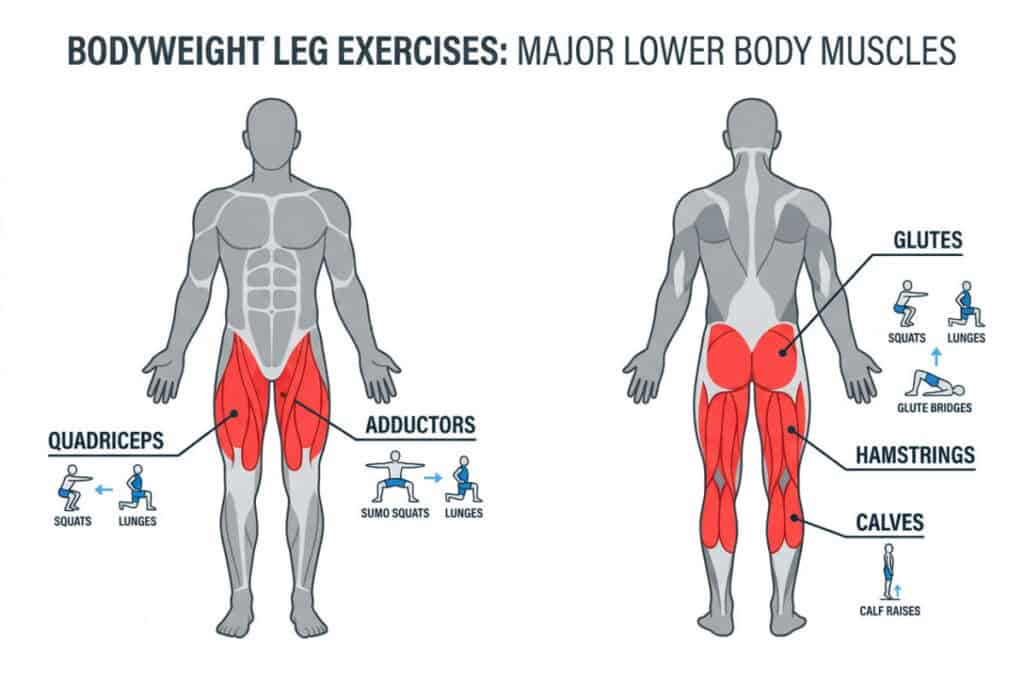
Key Takeaways:
- Bodyweight leg training should target quads, glutes, hamstrings & calves
- Most routines miss the posterior chain entirely
- The following exercises create maximum tension without weights
Most bodyweight leg routines just train quads. That’s it. The rest of your legs (hamstrings, calves, inner thighs) get a token mention and maybe a half-hearted lunge.
You’ll lose more muscle every year when you’re 40+ (sarcopenia). Muscle not only gives you strength and your body toned shape, but it’s needed to keep your independence.
A 2011 meta‑analysis in Medicine & Science in Sports & Exercise by Peterson and colleagues found that progressive resistance training significantly increases lean body mass in adults over 50, with higher training volumes producing larger gains.6
Building muscle after 40 is only half the battle. If you are also trying to lose fat, the BioTRUST GLP-1 Companion Stack can help support appetite control and lean-muscle preservation while you keep training.
A 3-part daily stack designed to support people using GLP-1 medications or losing weight naturally. It combines muscle, protein, collagen, and appetite support to help you maintain a healthier body composition as you lose weight.
- Natural GLP-1 Support: Helps support healthy appetite signals, fullness & metabolic function
- Lean Muscle Support: Helps preserve muscle, strength & healthy body composition during weight loss
- High-Protein Collagen: Adds 20 g of protein with 5 collagen types to help support daily protein intake
- Skin, Joint & Hair Support: Provides collagen peptides to support skin elasticity, joints, hair & nails
- 3-Part Weight-Loss Support: Combines muscle, protein/collagen & appetite support in one simple daily stack

How to Use This Exercise List:
- Choose 3–5 exercises per workout
- Train legs 2–4 times per week
- Progress to harder single-leg movements over time
- These leg exercises only require your bodyweight, but you can check out my best dumbbell leg exercises you if you have weights.
Quads: Knee-Dominant Moves That Build the Front of Your Thighs
You’ll need to focus on the squat pattern to build the quadriceps with just your bodyweight. It’s a fundamentally knee-dominant movement. The primary job of the four quadriceps muscles is to extend the knee joint.
Bodyweight Box Squat
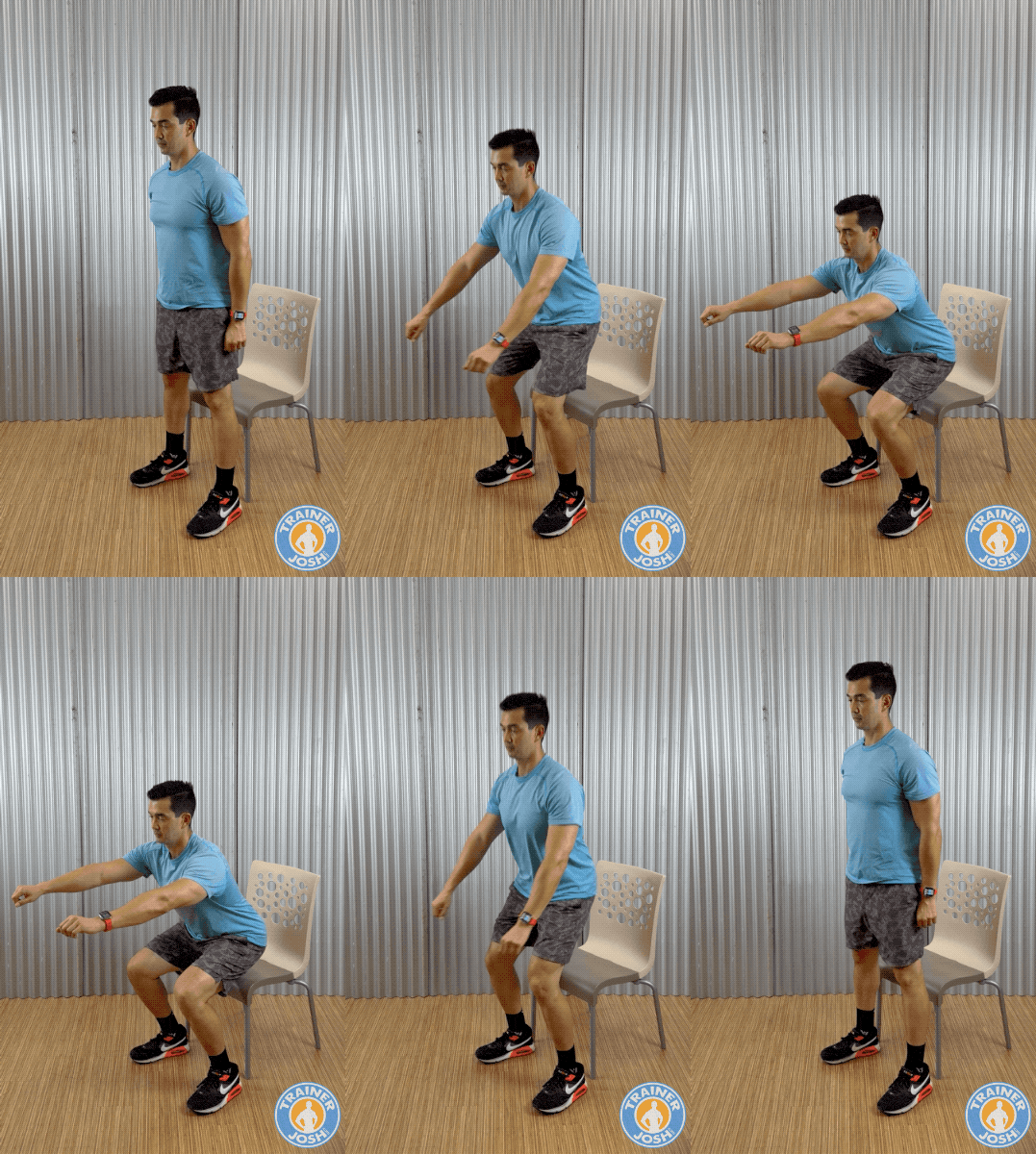
The bodyweight box squat is a fundamental movement pattern that is crucial to master before attempting other types of squats. It will teach you how to properly sit backward and engage your powerful hip extensor muscles (glutes and hamstrings) instead of relying only on your quadriceps.
By teaching you to keep your knees pushed out and your shins vertical, this exercise will spare your knee joints from the excessive stress while also building foundational strength that directly transfers for greater explosiveness, jumping and agility performance.
How to Perform the Bodyweight Box Squat:
- Stand very close to the edge of a sturdy box, chair, or bench with your feet wider than shoulder width apart. Your toes should be flared out to your preference.
- Start the descent by breaking at the hips and sitting backwards. Keep your chest up and your shins perpendicular to the floor.
- As you lower yourself, force your knees outward so that they track directly over your toes.
- Pause the moment when you are seated on the box.
- Push forcefully through your heels to rise back to a standing position. Make sure to squeeze your glutes at the top to lock out the movement.
Pro Trainer Tips:
- Adjust the Box Height: Tailor the exercise to your fitness level. Most people should start with a box height that places their thighs parallel to the ground when seated. Beginners can choose a higher box or chair. Athletic individuals can progress to a lower box (around 12 inches high) to increase the challenge.
- Drive With the Hip: Throughout the movement, purposefully sit back so your hips and glutes do the heavy lifting. This builds the posterior chain strength necessary for real-world athletic performance.
Common Mistake to Avoid:
- Letting the Knees Cave In: you have to actively force your knees outward so that they stay aligned with your toes to prevent dangerous joint stress.
- Failing to Sit Back: if your knees travel far forward over your toes and you’re not sitting back far enough, this can shift the emphasis away from your hips and onto the knees.
- Pushing Through Your Toes: always push through your heels to stand up. Raising your heels or pushing through the balls of your feet will compromise your balance and muscle activation.
Sissy Squats
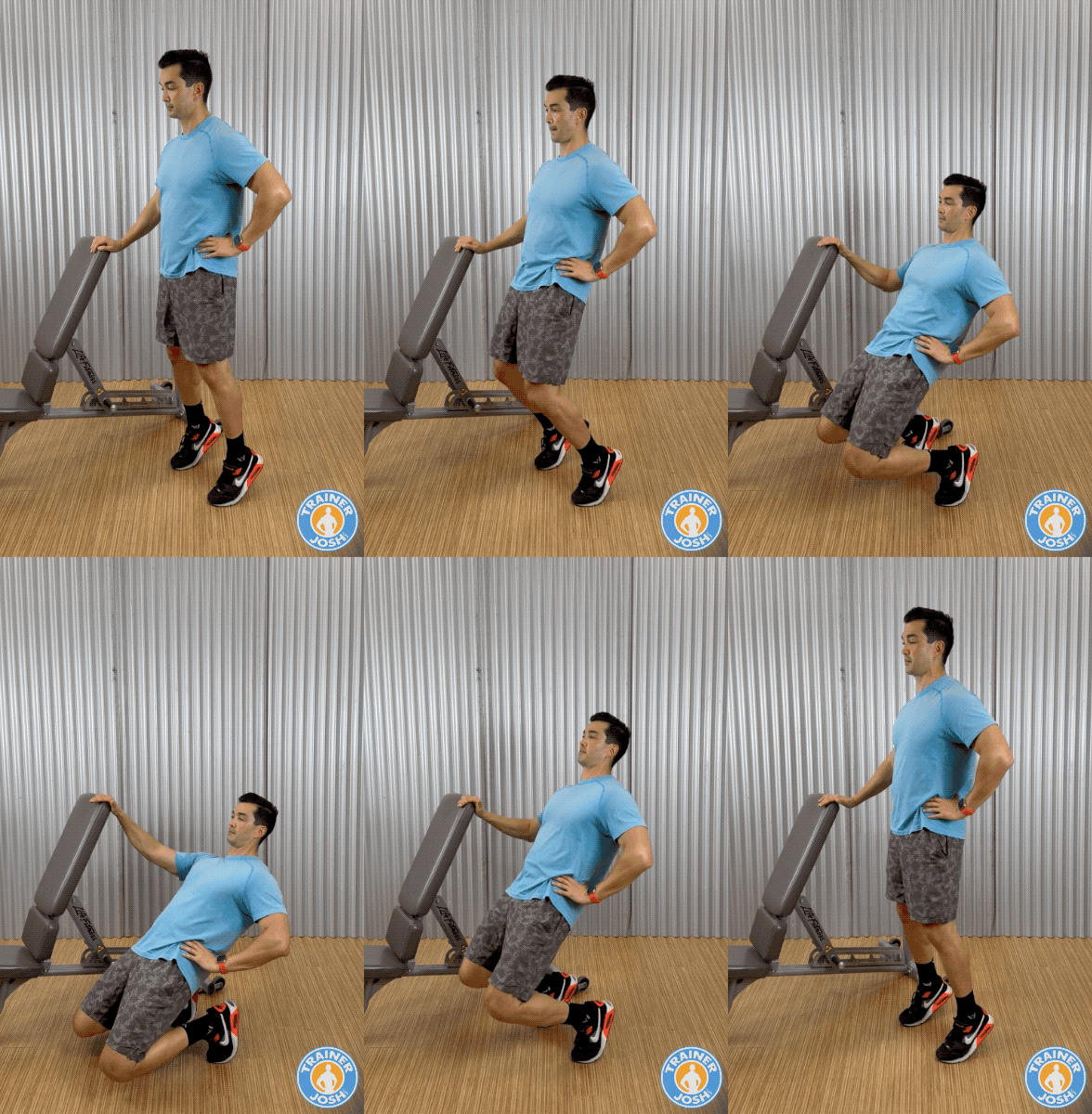
The Sissy Squat is an incredibly challenging bodyweight exercise that acts kind of like a natural leg extension machine. You will intentionally lock out your hips to force the movement to happen exclusively at the knee joint.
This exercise will eliminate the involvement of the hip flexors like your glutes and hamstrings. This extreme isolation places massive amounts of tension directly onto the quadriceps. This makes it a premier choice for building raw quad strength and size without needing a barbell.
How to Perform the Sissy Squat:
- Stand with your feet shoulder width or in a narrow stance apart. Lightly hold onto an object at waist level for balance.
- Begin to lower your body by bending only at your knees and shifting them forward.
- As your knees travel forward, at the same time lean your torso backward and rise up high onto your toes.
- Continue lowering yourself until your butt touches your heels or until you reach a depth that is challenging but comfortable.
- Keeping your body rigidly straight, use your quadriceps to push yourself back up to the standing position.
Pro Trainer Tips:
- The Straight Line Rule: you must keep your back and thighs perfectly straight line throughout the entire range of motion.
- Mind-Muscle Connection: move deliberately and attempt to feel the quadriceps actively controlling the movement during both the lowering and lifting phases.
- Progressive Depth: if you’re new to this exercise, then ease your way in. Descend only to a depth that feels comfortable. Then you can gradually increase the range of motion over time as your strength and connective tissues adapt.
Common Mistake to Avoid:
- Bend at the Hips: The Sissy Squat is not a standard squat. If you bend at your waist or stick your hips backward, then you’ll defeat the purpose of this exercise. Your hips must remain completely locked.
- Ignoring Joint Pain: Because of the extreme leverage, this exercise will put considerable pressure on the knee joints. You should never push through sharp knee pain. Always stop your descent before it becomes painful to protect the joint.
Bulgarian Split Squats
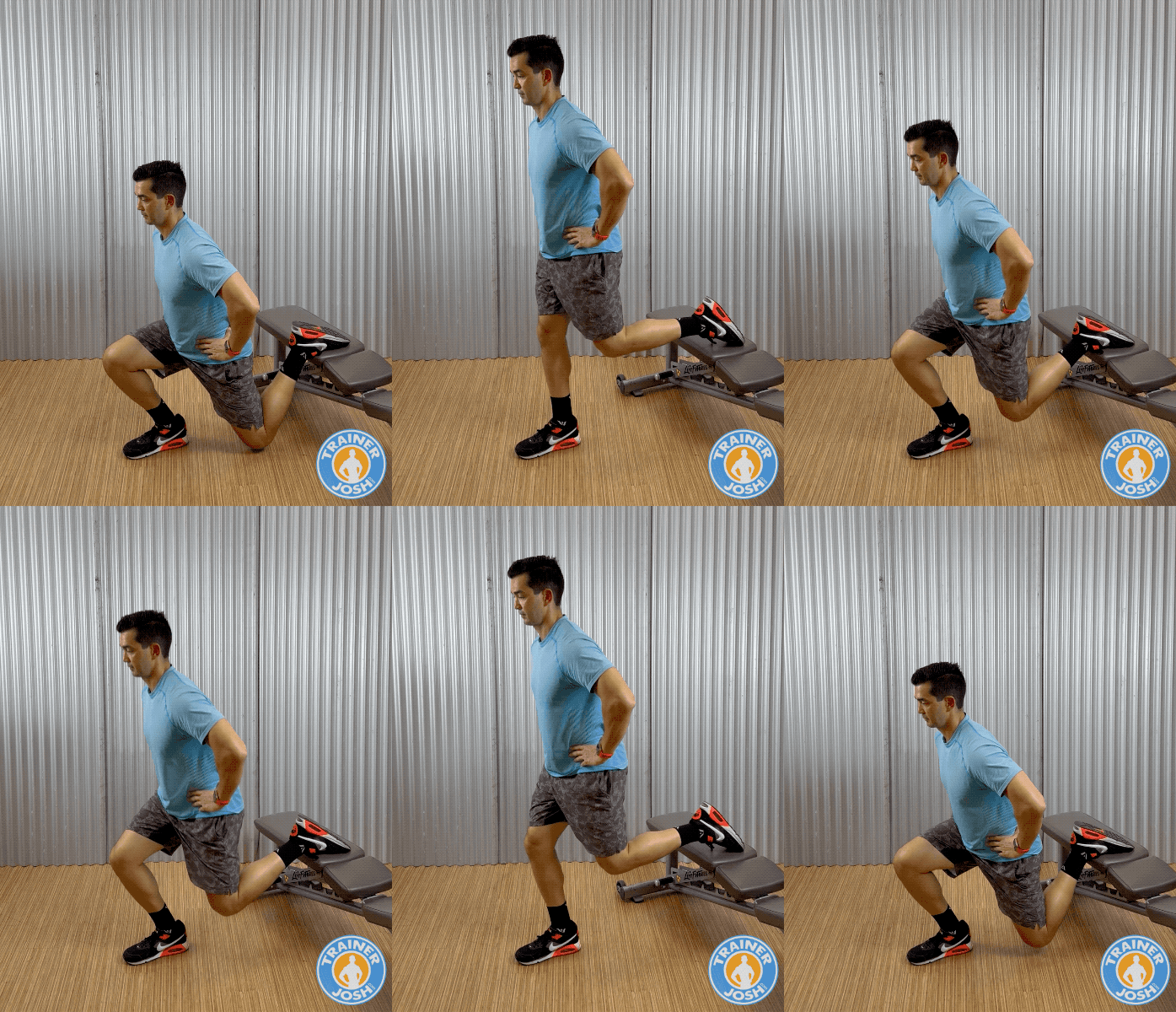
The Bulgarian Split Squat is a very useful unilateral leg exercise that builds immense strength and muscle in the quadriceps, glutes, and hamstrings. It’ll also heavily engage your stabilizing muscles like the adductors and calves.
Because it isolates one leg at a time, it’s very effective at correcting muscular imbalances, enhancing balance, and improving overall lumbopelvic stability. It also elevates the rear foot to provide a deep stretch that will significantly increase the flexibility of your hip flexors.
This makes it a premier foundational exercise to master before attempting more advanced single leg movements like the pistol squat.
How to Perform the Bulgarian Split Squat:
- Stand a couple of feet in front of a knee height surface (such as a bench, box or sturdy chair) facing away from it.
- Reach one leg back and rest the top of your rear foot laces down on the elevated surface.
- Keep your torso mostly upright and your core engaged. Bend your front knee to sink your hips straight down until your front thigh is parallel to the ground and your back knee gently hovers just above the floor.
- Pause for a moment at the bottom, then press forcefully through your heel of your front foot to return to the standing position.
- Squeeze your glutes at the top, complete all the repetitions on that leg and then you can switch sides.
Pro Trainer Tips:
- Start With Your Weaker Leg: because this exercise places a considerable stretch load on the rear leg, specifically the rectus femoris, it can weaken the second leg you train. So always start with your weaker leg first and rest about a minute before switching sides to make sure you have balance performance.
- Use a Cushion: Place a pillow or fold a towel on the floor underneath your rear knee so that it doesn’t crash against the hard ground at the bottom of the movement.
- Modify the Leverage: Hold your arms straight overhead throughout the movement to make this exercise harder and challenge your balance. You can also hold a weight like a backpack or a dumbbell.
- Create a Deficit: once you master the standard version, then try elevating your front foot on a sturdy block or step to create a “Deficit Split Squat.” This allows your hips to sink even deeper, increases the range of motion and places a massive growth inducing stretch on the glutes.
A 2020 systematic review in Sports Medicine concluded that full‑range lower‑body resistance training generally leads to greater quadriceps muscle growth than partial‑range training, supporting the idea that deep squats build more leg muscle than partial squats.6
Common Mistakes to Avoid:
- Poor Stride Length: Many struggle to find the optimal distance from the bench. If you’re too close, then it’ll cramp your movement. But if you step too far out, then you’ll overstretch the rear hip. Finding the “sweet spot” makes sure you have a smooth vertical drop.
- Letting the Front Knee Glide Too Far Forward: your front knee should track directly over your ankle and toes, but it shouldn’t aggressively push past your toes. If it does, you need to focus on sitting back and down rather than shifting your weight forward.
- Pushing Off the Back Foot: Do not use the rear leg to help bounce or blast yourself out of the bottom position. The elevated leg is primarily for balance, so force the front working leg to do the heavy lifting.
Pistol Squats (One-Legged Squat)
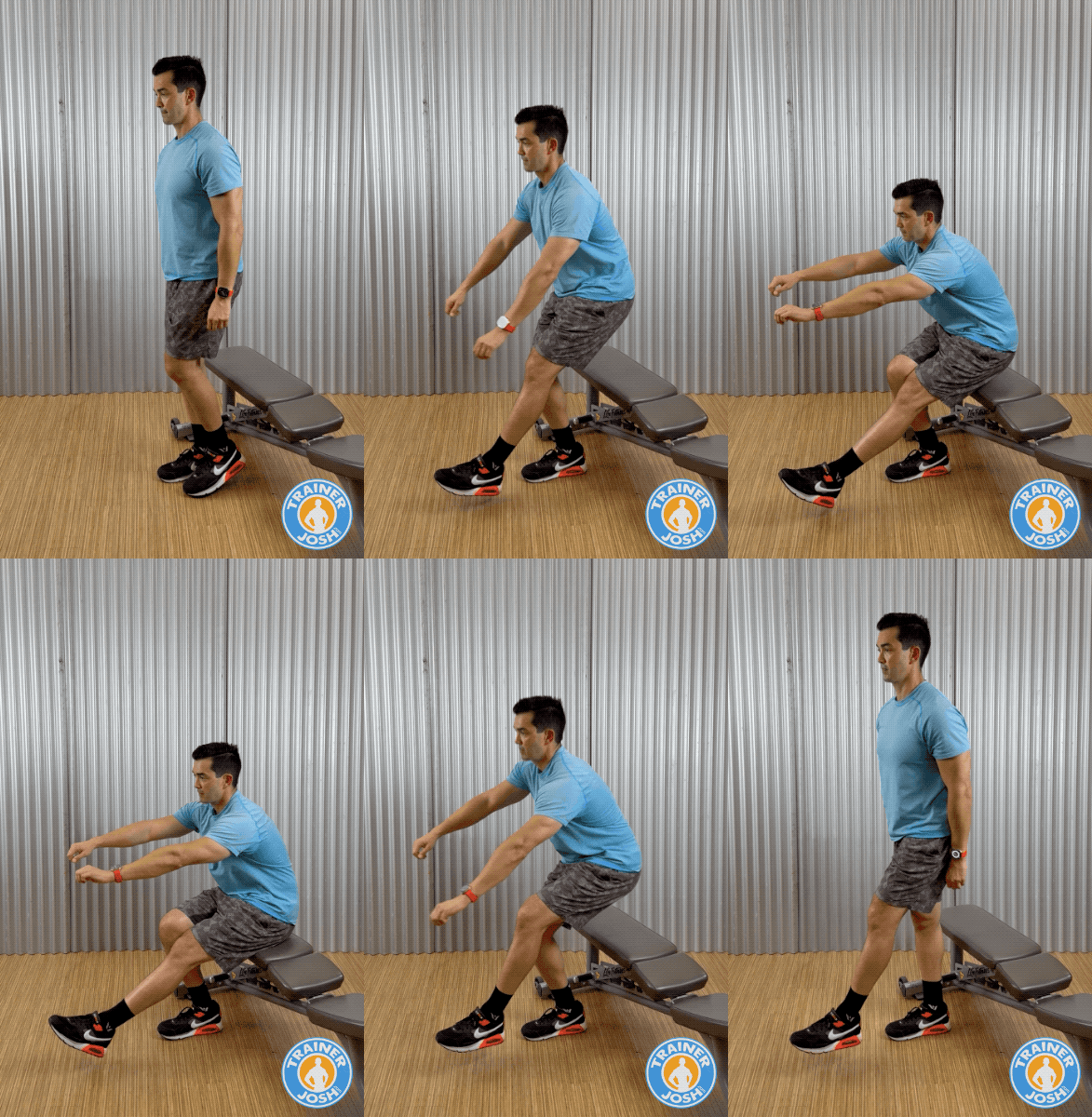
The pistol squat, one-legged squat, is widely considered the ultimate bodyweight leg exercise because it demands and develops supreme levels of raw lower body strength, lumbopelvic stability, and balance.
By forcing you to support your entire body weight on a single limb throughout an extreme range of motion, it’ll heavily recruit the quadriceps, glutes, and hamstrings while at the same time correcting muscular imbalances and increasing hip and ankle flexibility.
It essentially works every component of functional fitness without needing a barbell. This turns your legs into powerful, stable pillars.
How to Perform the Pistol Squat:
- Stand on one leg with your arms extended straight out in front of you for balance. Raise your non-working leg straight forward as high as possible.
- Lift your hips backward and bend your standing knee. Make sure to keep your planted foot flat on the floor.
- Slowly lower your body as far as you can (ideally until your hamstring touches your calf) while keeping your chest up and non-working leg fully extended.
- Hold the absolute bottom of the movement briefly to eliminate any momentum.
- Engage your core, squeeze your glutes and drive forcefully through your planted heel to push yourself back up to the starting position.
Pro Trainer Tips:
- Use a Counterweight: If you struggle with balance or constantly falling backwards, try holding a 5-10 pound weight like a dumbbell or water jug straight out in front of your chest to act like a counterbalance. This makes the exercise a lot easier to learn.
- Create Full-Body Tension: Before you descend, pretend you are gripping the floor with your toes. Brace your core tightly, “zip up” to generate maximum full body tension and stability.
- Elevate Your Heel: If you have poor ankle flexibility that’s preventing you from getting deep without falling backwards, try sliding a thin object (like a flip-flop or a small weight plate) underneath your working heel to serve as a temporary crutch until your mobility improves.
Common Mistakes to Avoid:
- Letting the Knee Cave in (Valgus Collapse): Your knee must track perfectly in line with your toes. Allowing it to buckle inward or flare wildly outward, shifts dangerous torque and shearing stress on the knee joint.
- Bouncing at the Bottom: Do not use momentum or bounce off your calf to propel yourself up. You must pause at the bottom to make sure the muscles (not momentum) are doing the heavy lifting.
- Lifting the Heel: Your working heel must remain glued to the floor at all times. Shifting your weight onto your toes, compromises your balance and shifts the emphasis away from the powerful glutes and hamstrings.
Squat Jumps
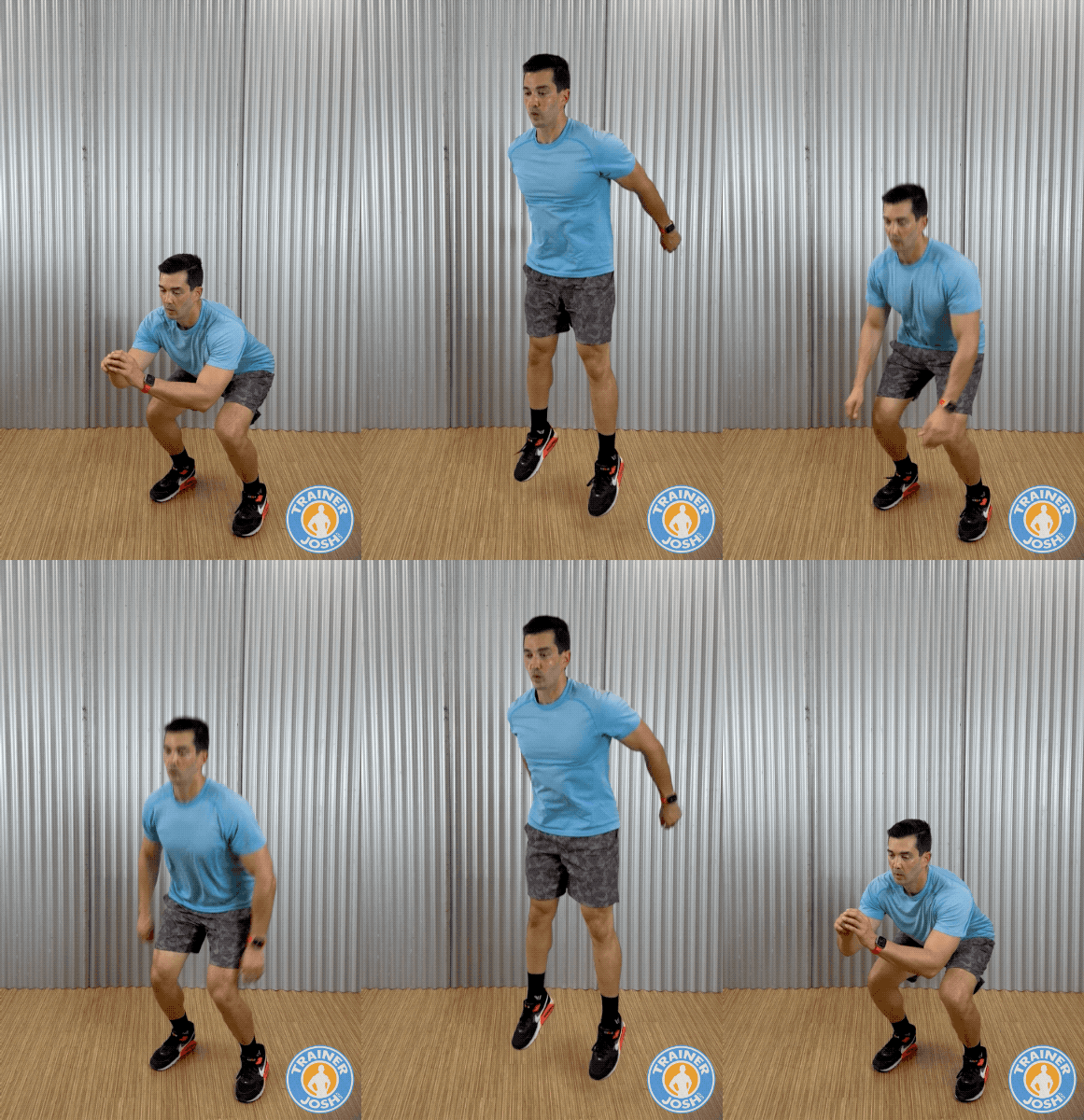
Squat Jump is a metabolic boosting plyometric exercise that demands incredible coordination. It will also improve overall leg strength, power and muscular endurance.
This movement is highly valuable because it uses the “triple extension.” This is the simultaneous extension of the hips, knees, and ankles. This generates maximum explosive power and intensely targets your quadriceps, glutes and hamstrings.
How to Perform the Squat Jump:
- Stand tall with your arms by your sides and your feet about shoulder width apart. Your chin should be parallel to the floor.
- (Place your core and inhale as you push your weight into your heels. Lower your hips into a squat until your knees form a 90 degree angle or your thighs are parallel to the ground).
- Exhale and quickly extend your hips, pushing forcefully through your heels to explode straight up into the air as high as you can.
- Land as softly and silently as possible by bending your ankles, knees, and hips to absorb the shock of the deceleration.
- Immediately transition back into the downward squat position to begin your next repetition without pausing.
Pro Trainer Tips:
- Use Your Arms: Swing your arms upward as you jump into the air to help generate maximum explosive power.
- Eliminate Momentum for a Challenge: Hold the bottom squat position for a count of four upon landing to make this exercise significantly harder. This removes all momentum and forces you to build strength out of an isolation hold.
- Pace Yourself: If you’re a beginner, then don’t try to jump as high as possible right away. Start by jumping just a few centimeters in the air until you build competence and control.
Common Mistakes to Avoid:
- Landing Stiffly: You must bend your knees and hips as you land to smoothly absorb the impact. Landing with stiff or locked legs can send dangerous shock waves through your joints.
- Losing Control: Do not let yourself fall side to side or lose balance. The movement must remain controlled throughout the entire set.
Shrimp Squats
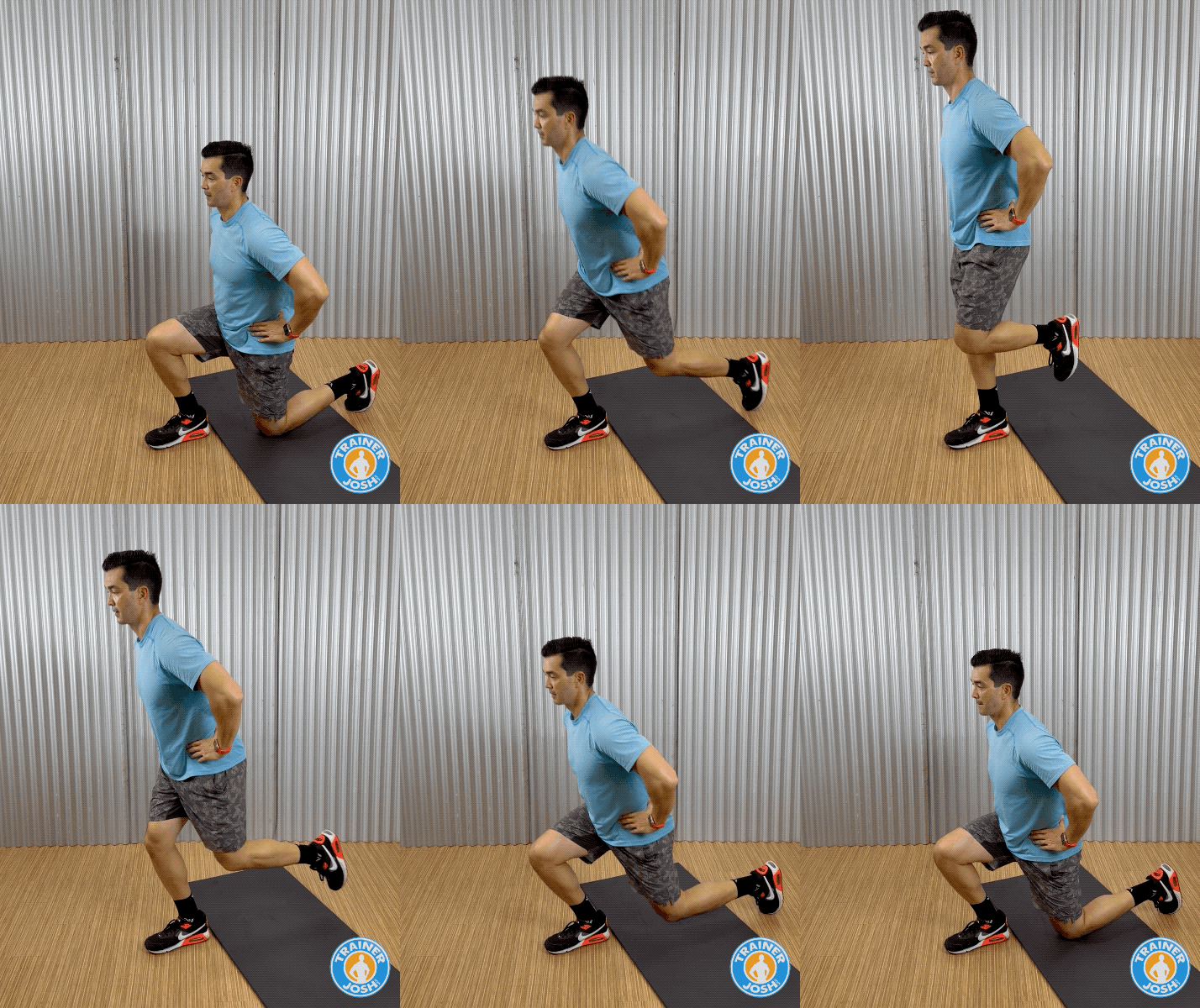
The Shrimp Squat (also known as the Airborne Lunge) is a highly advanced unilateral leg exercise that builds immense strength and muscle in the quadriceps and glutes while also burning fat.
What makes this movement so uniquely challenging is that it requires you to hold your non-squatting leg behind you rather than in front of you. This completely removes the mechanical leverage and counterbalance advantage you normally get in standard one-legged squats.
As a result, the working leg is forced to work incredibly hard. This demands superior levels of balance, flexibility, core strength and coordination to stabilize the body throughout the descent.
How to Perform the Shrimp Squat:
- Stand tall with your feet shoulder width apart, then bend one leg backward at the knee.
- Extend your opposite arm straight out in front of your body to act as a counterbalance. Or you can lightly hold a sturdy bench, chair, table, etc.
- Keeping your torso upright and your core engaged, bend the standing leg at the ankle, knee, and hip to slowly lower your body into a squat.
- Continue descending with strict control until the knee of your backward bent leg gently taps or hovers just above the floor.
- Press forcefully through your heel of the planted foot to reverse the motion and return to the standing position. Keep your rear ankle held the entire time.
Pro Trainer Tips:
- The “Jumbo” Shrimp Squat: Because your rear knee eventually hits the floor, it acts as a natural limit to your range of motion. So, to increase the difficulty, stretch, and range of motion, strong athletes can perform this exercise while standing on an elevated block or step so their rear knee can drop below the level of the working foot.
- Hold With Both Hands: To decrease your balance and leverage (which massively increases the workload on your glutes, legs, and core), hold your rear foot with both hands behind your back.
- Create Full-Body Tension: You must maintain a highly rigid body throughout the movement. If your joints are unstable, then the energy produced by your muscles can’t be efficiently transferred to complete the lift. Fix your eyes on a specific point in front of you to help lock in your balance.
- Slow the Eccentric: Intentionally slow down the lowering eccentric phase to increase your time under tension. This helps build muscle and improve your balance even faster.
Common Mistakes to Avoid:
- Crashing Your Knee: Do not drop quickly and slam your rear knee into the ground. You must descend slowly and with control so that your knee only gently touches or hovers above the floor.
- Skipping Regressions: The shrimp squat requires immense stability. Rushing into the unassisted version before you’re ready will lead to poor form and potential injury. Start by performing this movement while holding onto a sturdy post, suspension trainer or stable surface to dial in your tension control and balance.
Glutes
Glute Bridge
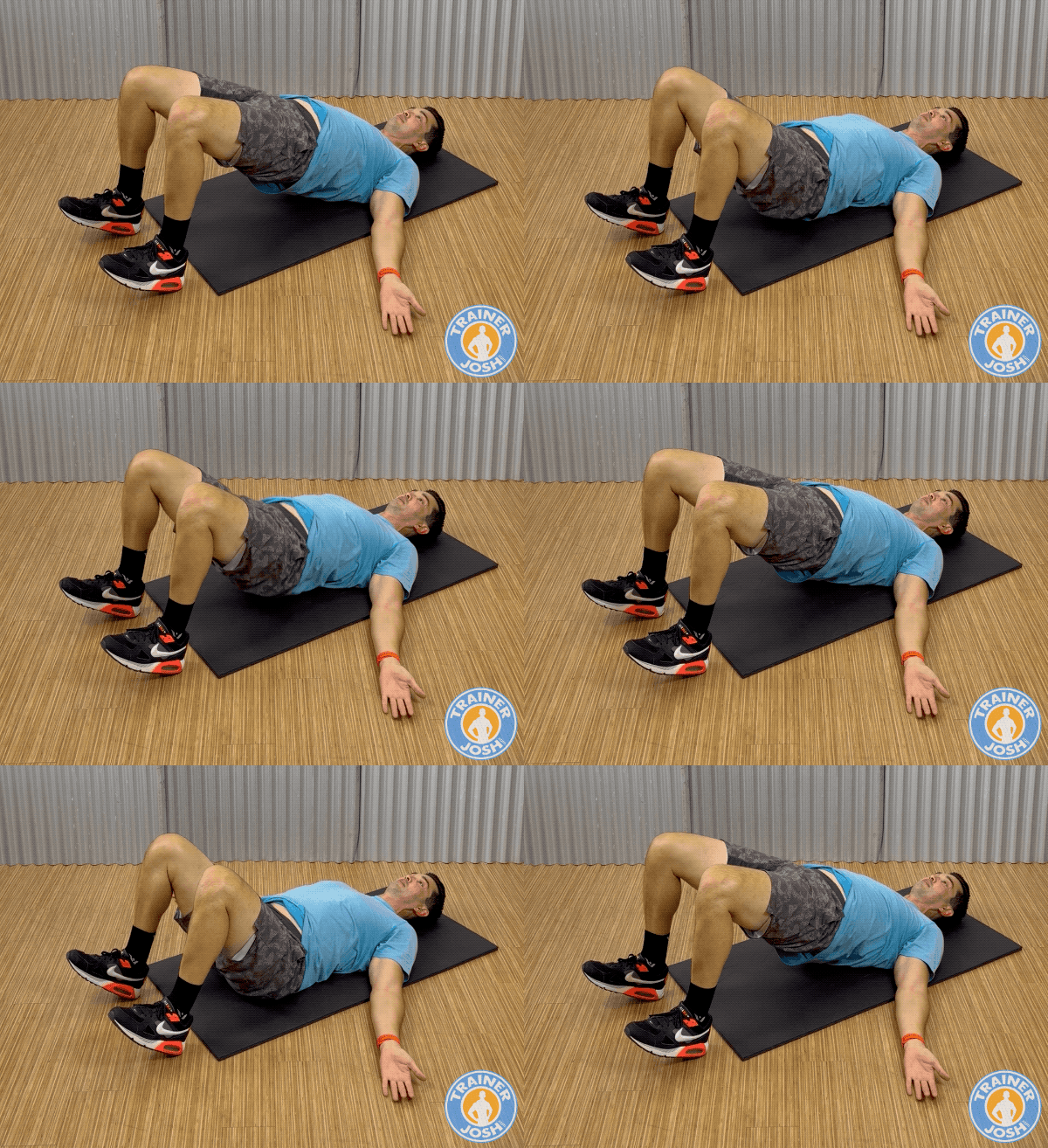
The glute bridge is a foundational floor-based hip extension movement that will effectively build strength in your gluteus maximus, hamstrings and core without requiring standing balance. I recommend regularly performing this exercise since it’s highly beneficial.
It helps to counteract the negative effects of prolonged sitting, improves hip mobility and teaches your activated glutes to prevent forward pelvic tilting and dangerous lower back overarching.
How to Perform the Glute Bridge:
- Lie flat on your back with your knees bent at a 90 degree angle, your feet flat on the ground, hip width apart and your arms resting at your sides.
- Engage your core by drawing your belly button toward your spine to stabilize your pelvis and protect your lower back.
- Push forcefully through your heels to raise your hips off the ground using your glutes until your body forms a straight line from your shoulders to your knees.
- Hold the top bridge position for one to two seconds. Focus on squeezing your glutes at the top.
- Slowly lower your hips back down to the starting position while maintaining control. Do not bounce at the bottom.
Pro Trainer Tips:
- The Knee Bend: By keeping your knees bent, you’ll actively shorten the hamstring muscles. This intentionally reduces their involvement and forces the powerful gluteus maximus to do the heavy lifting.
- Mind-Muscle Connection: Focus the movement entirely around your hip joint. Consciously try to feel the glutes raising your body instead of relying on your hamstrings or spinal erectors.
- Add Weight: Hold a pair of dumbbells in front of your hips to increase the resistance. It’s one of my best dumbbell glute exercises.
Common Mistakes to Avoid:
- Over-Arching the Lower Back: Avoid hyperextending your lumbar spine at the top of the movement. Your spine should remain in a neutral position.
- Anteriorly Tilting the Pelvis: Do not let your pelvis tilt forward. Keep your core engaged to lock your pelvis securely in place.
- Pushing Through the Toes: Make sure you’re driving strictly through your heels instead of your toes. This will properly activate your posterior chain.
Shoulder-Elevated Hip Thrust (Unilateral)
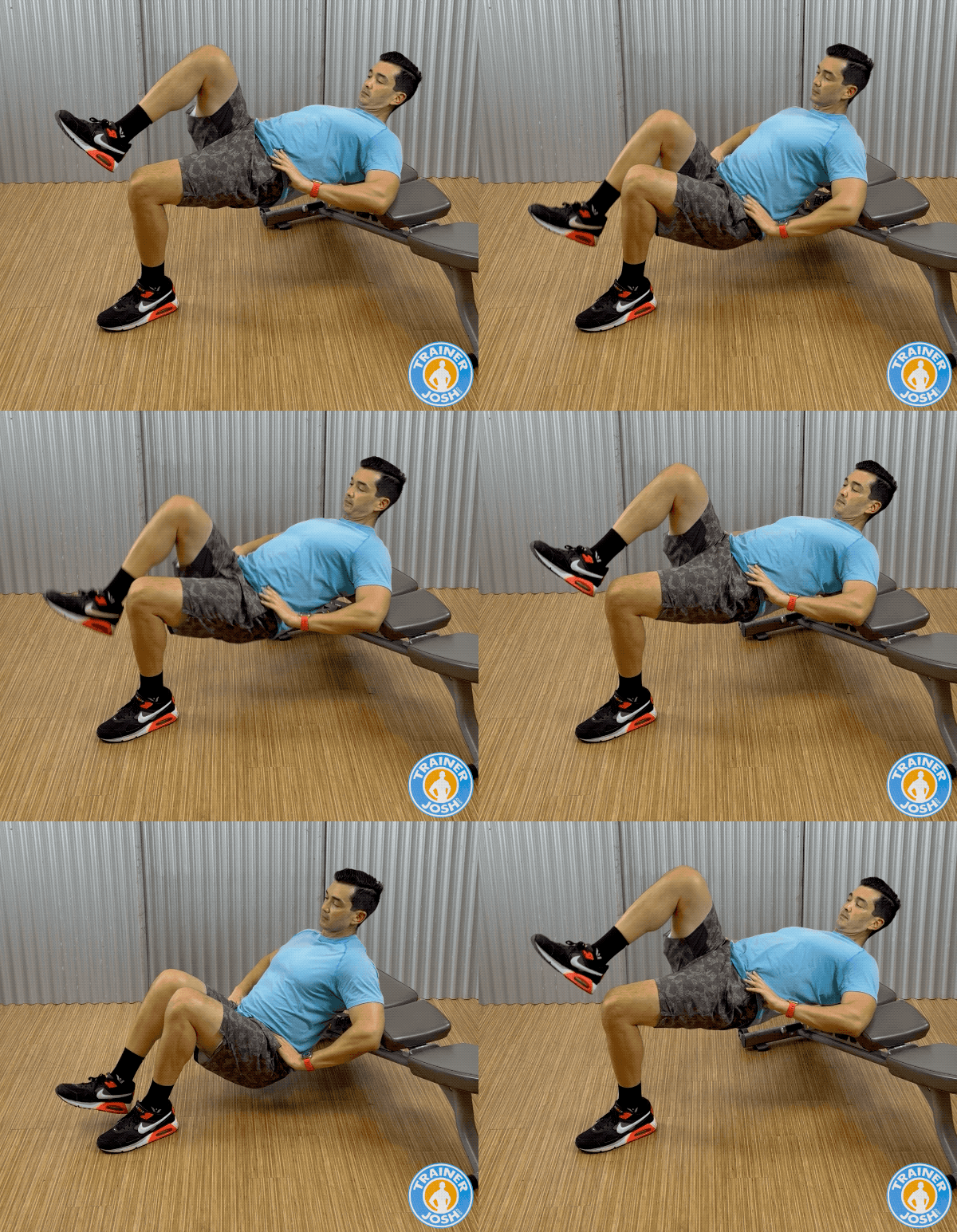
The single leg unilateral shoulder elevated hip thrust is an advanced exercise that demands considerable hip extension strength and rotary stability in the lumbopelvic region.
By elevating your upper back, you’ll significantly increase the demand placed on your hip and knee joints while at the same time moving the hips through a greater range of motion than standard floor bridge.
Building strength at the very top of this movement where the hip is neutral or slightly hyper-extended is incredibly beneficial because it directly strengthens the exact range of motion used for propulsion during running.
How to Perform the Shoulder Elevated Hip Thrusts (Unilateral):
- Face upward and rest your upper back on a sturdy chair, couch or weight bench with your feet flat on the ground.
- Place your hands on your ears and lift one leg off the ground.
- Keep your lower back in a neutral position and push forcefully through the heel of your planted foot.
- Extend your hips by squeezing your glutes and rise up as high as possible.
- Lower your hips back down to the starting position and repeat before switching legs.
Pro Trainer Tips:
- The Squat Complement: This exercise is a perfect complement to standard squats. Squats don’t require hip extension torque when you are standing in a neutral position, but this shoulder elevated hip thrust will heavily target the specific neglected range of motion.
- Push Through the Heel: Always drive your weight through your planted heel instead of your toes. This makes sure the glutes and posterior chain do the heavy lifting.
Common Mistakes to Avoid:
- Skimping on Range of Motion: Because the top of the movement is the hardest part, many exercisers cheat by not rising all the way up as their muscles get fatigued. But you must rise as high as possible on every rep.
- Arching the Lower Back: You must keep your lower back in a neutral position throughout the movement. Do not hyperextend your lumbar spine to compensate for weaker glutes.
High Step-Ups
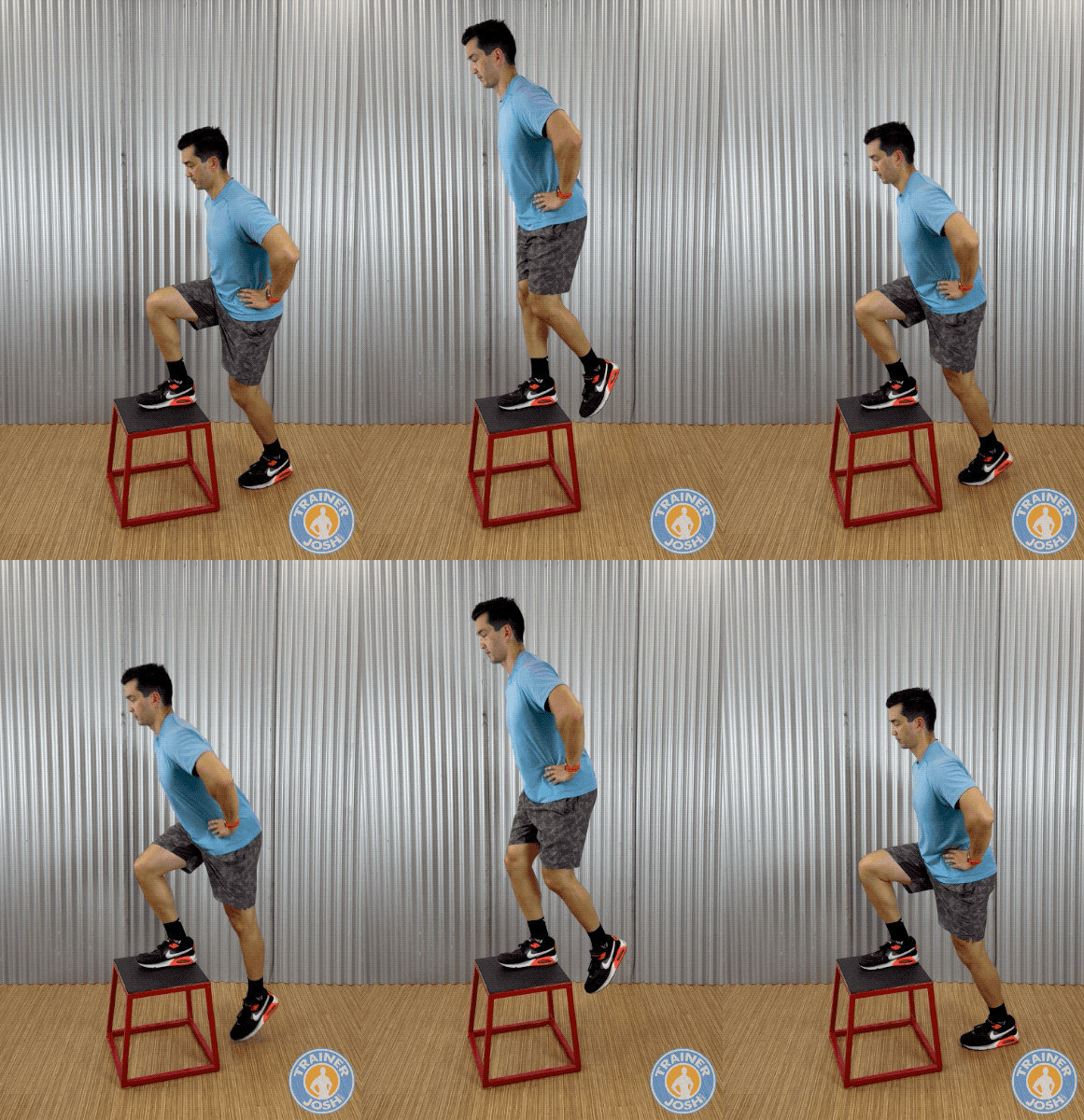
The high step-up creates an excellent single leg strengthening stimulus that targets the gluteus maximus, quadriceps, and hamstrings.
By essentially replicating the upward phase of a squat or deadlift with just one leg, it corrects muscular asymmetries between the two legs, improves proprioception and enhances first step acceleration for athletic performance.
Because it is a unilateral movement, it’s also highly advantageous for injury prevention and developing complete lumbopelvic control.
How to Perform the High Step-Up:
- Stand in front of a high-step sturdy box or chair and place your entire working foot completely flat on the top surface.
- Keep an upright posture and shift your weight forward and press forcefully into the heel of your elevated foot to lift your body upward.
- Stand tall and squeeze the glute of your working leg while at the same time driving your opposite (non-working) knee upward into the air until it’s above your hip.
- Hold the top position briefly and make sure your non-working foot does not touch the elevated surface.
- Slowly lower yourself back down to the ground under strict control. Complete all repetitions on one leg before switching sides.
Pro Trainer Tips:
- Isolate the Working Leg: Force the elevated leg to do 100% of the pulling to maximize results. Do not use your bottom leg to provide momentum or blast yourself upward.
- Adjust the Height Wisely: Progressively increasing the height of the step turns this into a premier glute builder. But never use a step so high that it forces your lower back to round or your pelvis to tuck underneath you. You must be able to maintain a neutral or slightly arched lower back.
- Push Through the Heel: Make sure your entire foot is safely on the box so you can drive your weight directly through the heel. This heavily activates the posterior chain.
Common Mistakes to Avoid:
- Bouncing Off the Bottom Foot: Using momentum from the non-working leg to jump into the movement robs the working leg of the necessary resistance and tension.
- Resting the Free Foot on the Box: If you place your non-working foot on top of the box, then it will encourage you to catch your weight into a quarter squat stance. This causes both legs to share the load instead of properly isolating the intended leg.
- Incomplete Foot Placement: Placing only the ball or front half of your foot on this step prevents you from pushing through your heel. This compromises balance and glute muscle activation.
Donkey Kicks
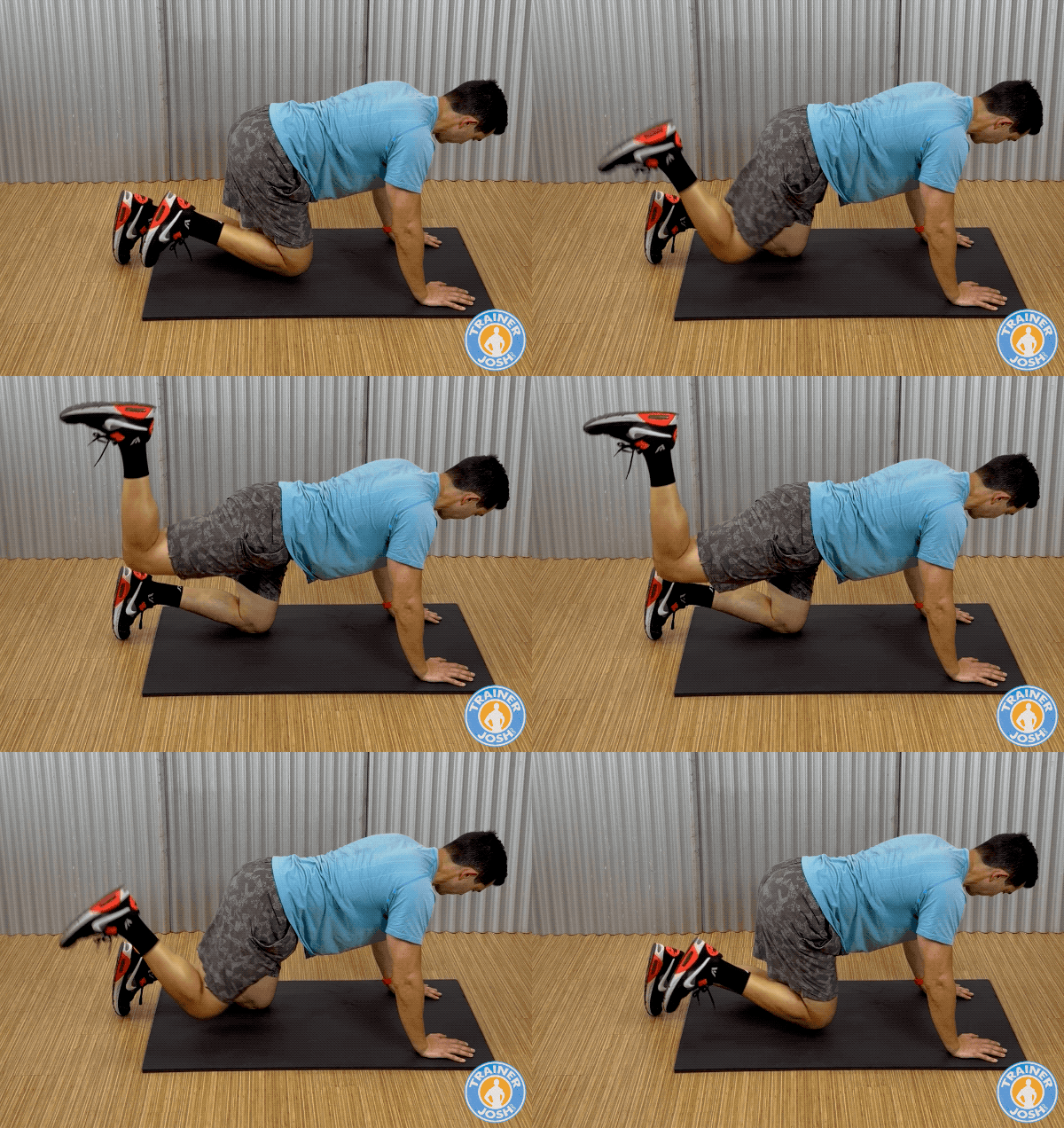
Easy kicks are a very effective, beginner-friendly bodyweight exercise that targets your lower back, core, hamstrings and legs. It specifically targets all three glute muscles and makes it an excellent alternative to the squat.
Exercise also trains your functional ability to extend your hips through a full range of motion while keeping your spine and pelvis perfectly neutral. It also requires no equipment, and it’s a convenient way to build essential lumbopelvic stability and posterior chain strength anywhere.
You can use ankle weights for this exercise to increase the difficulty (and get better results)
How to Perform Donkey Kicks:
- Start on all fours in the quadruped position on a flat comfortable surface. Then place your hands shoulder width apart directly under your shoulders and your feet directly under your hips.
- Engage your abdominal muscles to make sure your head, neck and spine form a perfectly straight neutral line parallel to the ground.
- Keeping your knee bent at a 90 degree angle, then raise one leg up and behind you until it aligns with your body and the sole of your foot is parallel to the ceiling. You can also perform this by kicking the leg to the rear until it reaches full straight extension.
- Squeeze your glutes intensely at the top of this movement and hold this peak contraction for a brief pause (or up to 5 seconds for a challenge).
- Gently lower the leg back down to the starting position and don’t allow your knee to touch the ground. Complete all repetitions on one leg before switching sides.
Pro Trainer Tips:
- The Bent-Knee Advantage: Keeping your knees strictly bent at 90 degrees while lifting the leg intentionally shortens the hamstring muscles. Because the hamstrings are placed in such a weak mechanical position, it will force your glutes to pick up the slack. This makes this variation a highly targeted glute builder.
- Standing Modification: If you’re feeling knee or wrist discomfort when on all fours, you can perform this movement standing. Just place both hands flat against the wall in front of you and kick one leg back and up.
- Continuous Burn: Do not alternate legs so you can rapidly exhaust the muscle and maximize growth. Do all your reps continuously on one leg until it burns and reaches exhaustion, and then you can switch to the opposite leg.
Common Mistakes to Avoid:
- Hyperextending the Lower Back: The most common beginner mistake is overarching the lower back (lumbar spine) and interior tilting the pelvis to get the leg higher. This creates a dangerous illusion of hip extension. You have to keep your spine completely straight and neutral. This will force your hip joint to do the actual work.
- Losing Hip Alignment: Avoid letting your hips twist, rotate or tilt to the side as you lift your leg. Your hips must remain fixed and squarely parallel to the floor throughout the entire movement.
Hamstrings
Nordic Ham Curls (Negative Hamstring Curls)
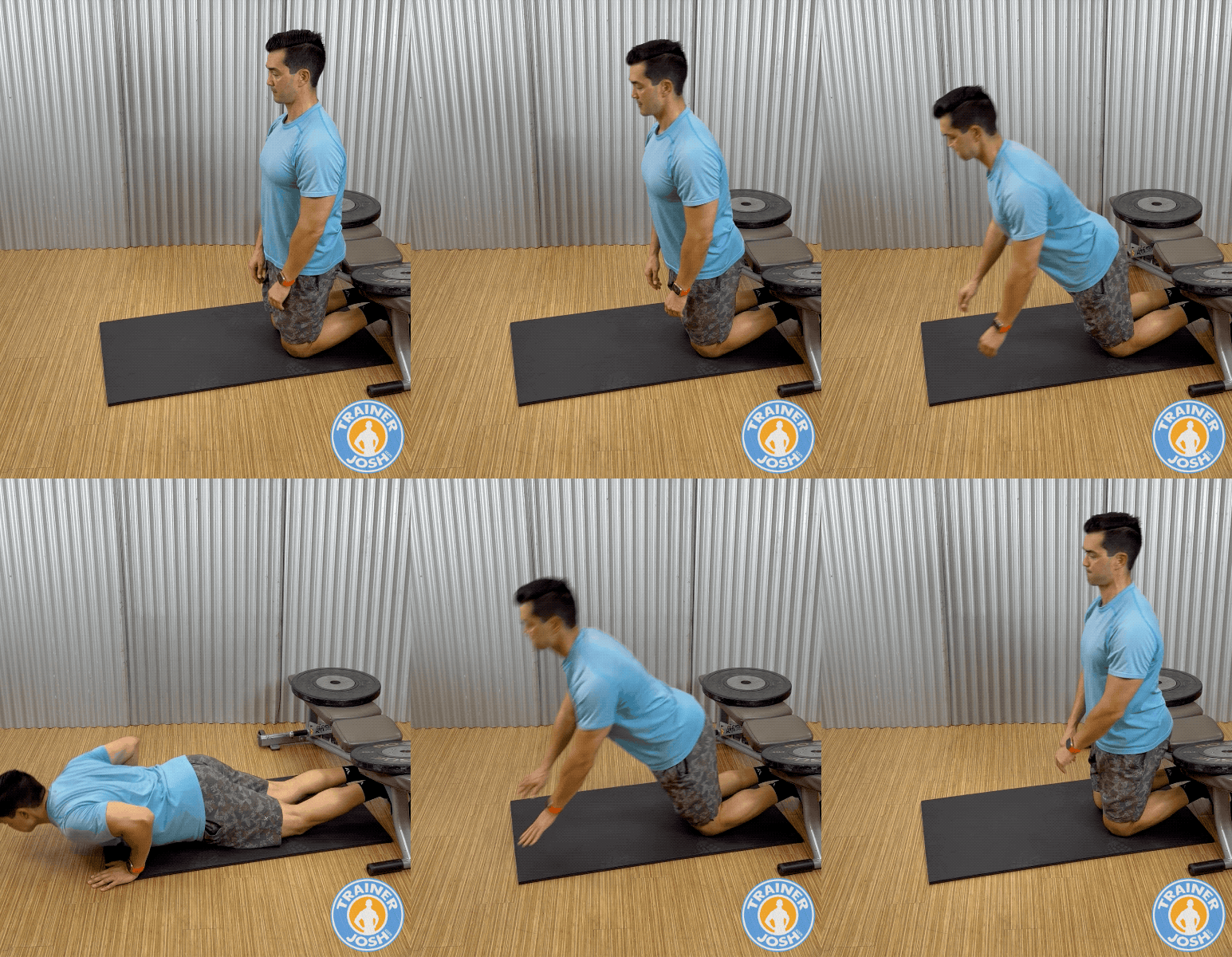
The Nordic ham curls (also known as negative hamstring curl or Russian leg curls) is a highly advanced bodyweight exercise that builds immense strength and resilience in the posterior chain using only your body weight.
By fixing your ankles in place and moving your entire body relative to your lower legs, this movement will force your hips, glutes, and spinal rectors to work an overdrive to keep your body rigid.
It also subjects your hamstrings to extreme eccentric overload lengthening under intense tension. This makes it a premier evidence-based exercise for rehabilitating chronic hamstring problems and preventing future muscle strains and tendinopathy.
How to Perform the Nordic Ham Curl:
- Kneel on a soft pillow or folded towel to protect your knees. Firmly secure your ankles under a heavy, sturdy object (like a couch or railing) or have a partner hold them down.
- Keep your torso perfectly upright and hold your hands out in front of you in a ready push-up position. Squeeze your glutes to lock your body into a straight line from your knees to your head.
- Slowly lower your body forward toward the floor by extending at the knee joint. Use your hamstrings to fight gravity and control the descent as much as possible.
- As you reach the limit of your hamstring strength, catch yourself safely on the floor with your hands.
- Explosively push off the floor with your arms while at the same time pulling with your hamstrings to return to the upright starting position.
Pro Trainer Tips:
- Focus on the Eccentric: The primary value of this exercise comes from the lowering phase, so try to descend as slowly as physically possible to maximize the muscle building and tendon strengthening benefits.
- Modify the Return: If you don’t yet have the hamstring strength to pull yourself back up, then just use your upper body to push yourself all the way back to the starting position and focus strictly on the negative part.
- The “No Hands” Progression: As you build higher hamstring strength over time, you can then progress to the highly advanced “no hands” version. Just place your hands behind your back and rely purely on your hamstrings to pull your body back to the top.
Common Mistakes to Avoid:
- Bending at the Hips: The most frequent error is breaking at the waist or sticking your hips backward to make the exercise easier. Your torso and thighs should stay in a rigid straight line.
- Anterior Pelvic Tilt: If you fail to keep your glutes squeezed during the movement, it can cause your pelvis to tilt forward. This will incorrectly shift stress onto your lower back.
- Dropping Too Fast: Do not just give up to gravity and fall to the floor. You have to actively pull yourself down and fight the lowering part to create the necessary mechanical tension in the muscle.
Sliding Leg Curls
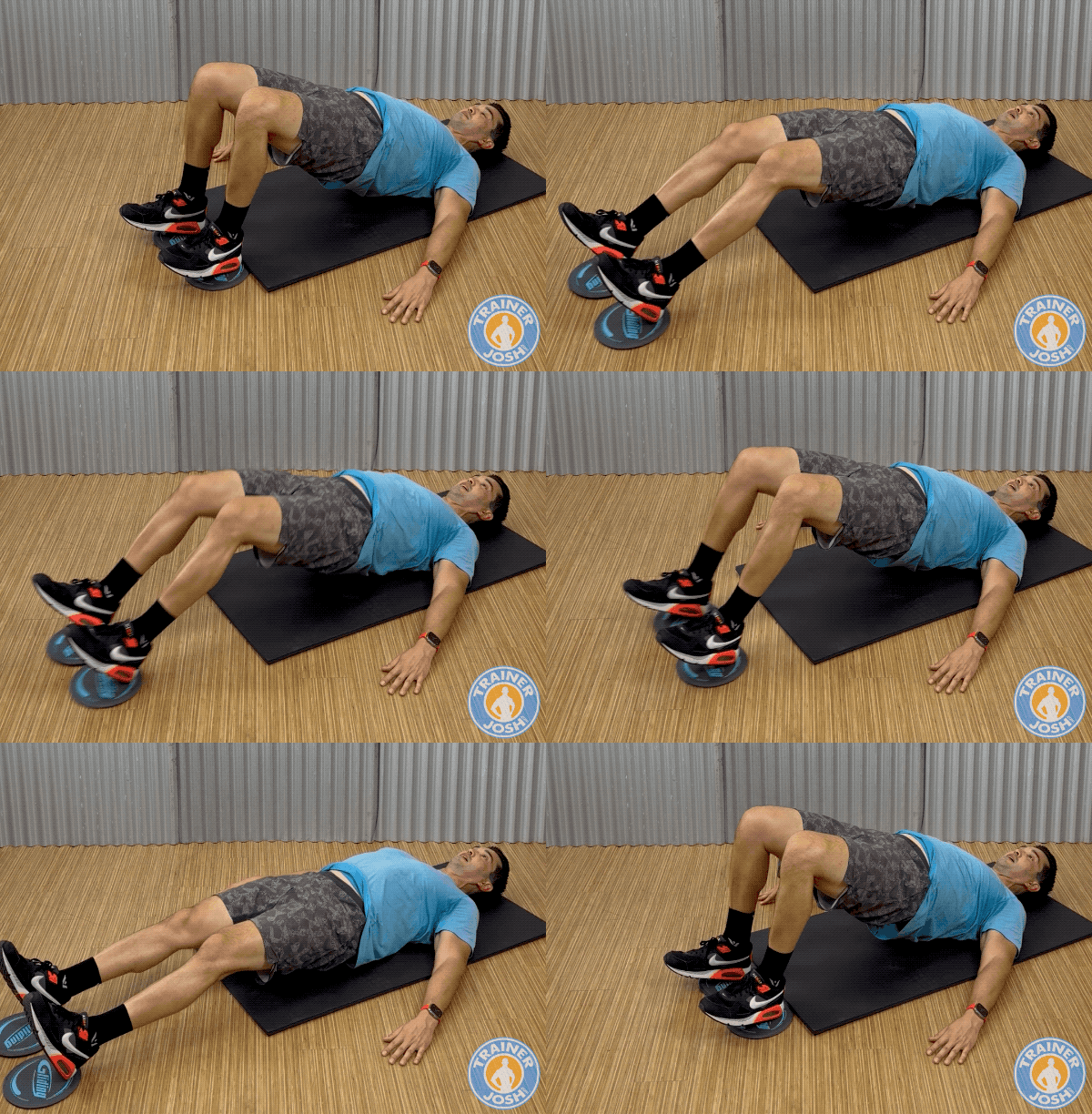
The sliding leg curl is a very effective bodyweight exercise that uniquely develops both hip extension and knee flexion strength at the same time. It’ll force you to maintain a bridge position while keeping your knees bent.
This will intensely target your hamstrings as the primary movers. It’ll also heavily recruit the gluteus maximus and erector spinae (lower back) as secondary stabilizers.
How to Perform Sliding Leg Curls:
- Lie flat on your back with your arms at your sides and palms facing down. Place your heels on two paper plates, sliding exercise discs, or small hand towels (if you are on a slick floor).
- Bridge your hips upward while at the same time pulling your heels toward your buttocks.
- Make sure your hips stay high throughout the entire pulling movement.
- Carefully slide your feet back out and lower your body back to the starting position.
Pro Trainer Tips:
- The Glute Squeeze: Actively squeeze your glutes to raise your hips to maximize the effectiveness of this exercise. Also consciously keep them contracted while the hamstrings do the work to pull your feet toward your rear end.
- Single-leg Progression: This exercise is already very hard and it is advanced level, but once you master the standard version then you can try to kick it up a notch by doing it using only one leg at a time.
Common Mistakes to Avoid:
- Sagging at the Hips: The most common mistake people make is failing to keep their hips fully extended throughout the set. It’s very tempting to let the hips drop to the floor and then simply slide the feet in and out, but this relies only on knee flexion and extension. You must fight the urge and keep your hips bridge high to get the full benefit.
Single-Leg Romanian Deadlift (RDL)
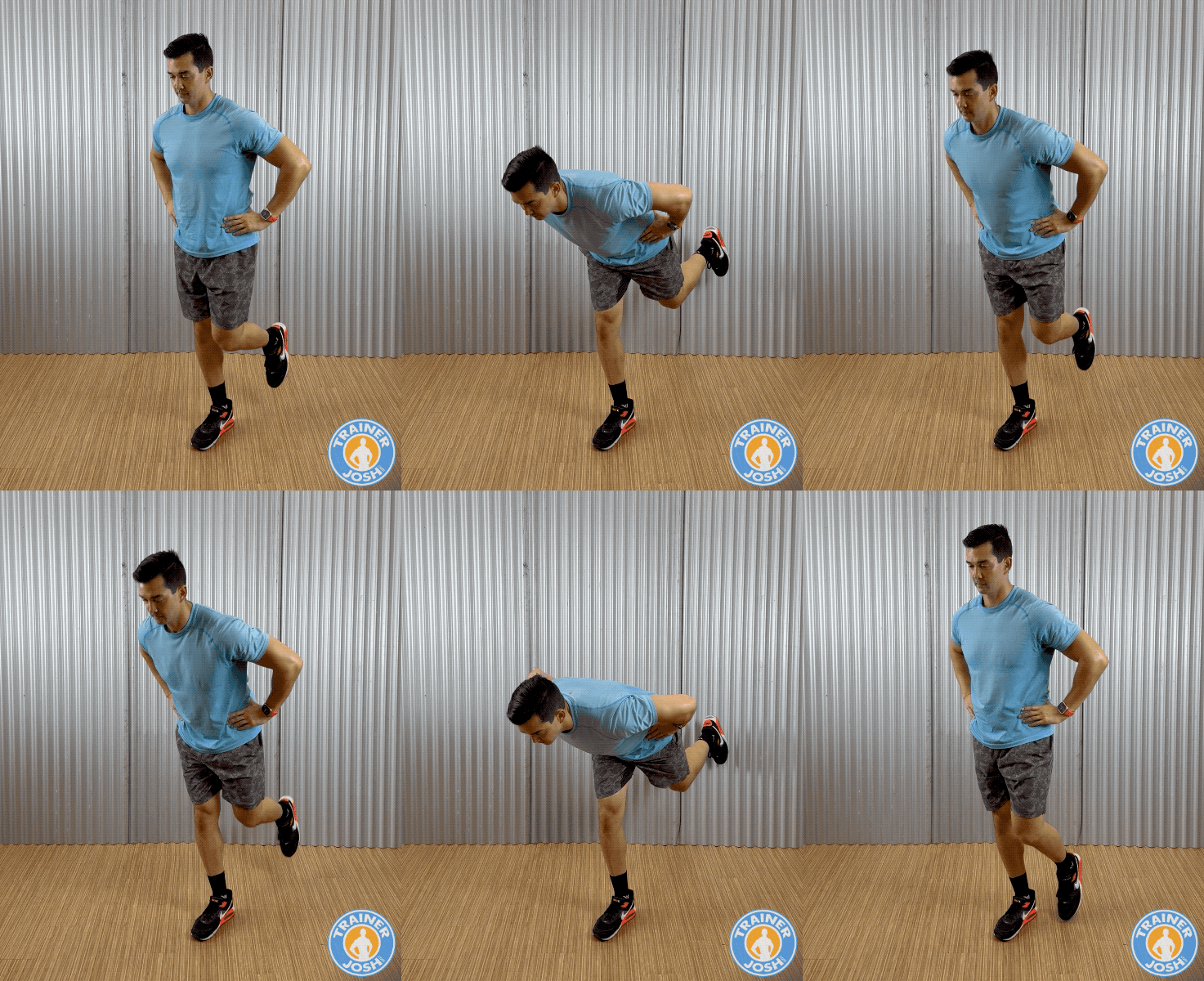
The Single-Leg Romanian Deadlift (also known as “Single-leg RDLs”) is one of the best lower-body exercises that teaches you the fundamental “hip hinging” pattern that’s crucial for safe lifting mechanics.
Single-leg RDLs force you to balance on one foot while also moving through a deep range of motion. This serves as a great sensorimotor exercise that can improve your balance, mobility, and stability. It also builds strength in your posterior chain. It targets the hamstrings, gluteus maximus and lower back (erector spinae).
How to Perform the Single-Leg RDLs:
- Stand upright on one foot and squeeze the glute of your non-grounded rear leg to lock it into position behind you.
- Start the movement by first bending at your waist and shift your weight backwards. Try to keep the knee of your standing leg only very slightly bent.
- Lower your upper body while at the same time raising your rear leg straight up behind you. Try to form a straight horizontal line from your head to your heel that’s elevated. (Should look like a “T”)
- Continue lowering yourself while keeping your chest up and looking down until you feel that deep stretch in your hamstring of the supporting leg or until your range of motion runs out.
- Finally, reverse the motion by contracting your hamstrings and glutes. Push your body back up to the starting upright position.
Pro Trainer Tips:
- Lead With Your Back Leg: Focus on lifting your rear leg instead of leaning your torso forward. Let your upper torso naturally flow, follow the leg to keep a perfectly straight line.
- Pause for Power: Hold the bottom position for 1-2 seconds to maximize muscle-building tension. Hold this position when you feel the deep stretch in your standing hamstring.
- Regress if Needed: If you’re struggling with your balance, simply set your elevated foot down on the floor between repetitions to help stabilize yourself before the next rep.
Common Mistakes to Avoid:
- Rounding the Back: You have to keep a slight arch or perfectly flat lower back. Never let your spine round forward.
- Bending the Rear Leg: You’ll break the needed tension in your body if you fail to keep the elevated leg completely straight and locked in line with your torso.
- Opening the Hips: Try to keep your toes of your elevated leg pointing straight down at the floor. If you see that your toes are pointing outward then your hips are rotating and you’re losing the proper alignment.
Reverse Hyperextensions
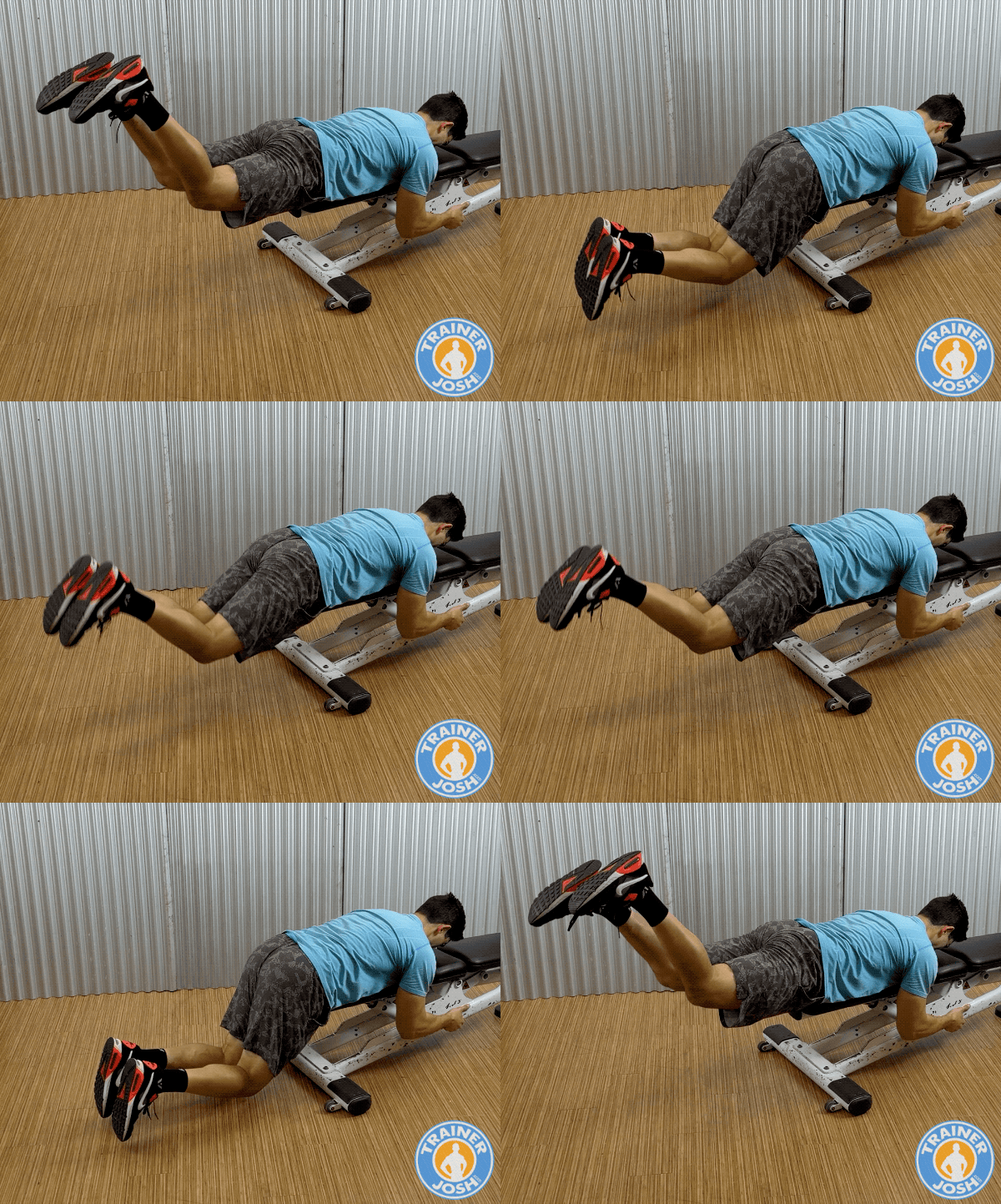
The bodyweight reverse hyperextension is a very effective exercise for your posterior chain. It works the entire backside of your body at once including the glutes, hamstrings, and lower back.
It’s an amazing lower body and core movement that’s very effective for improving spinal health. It’s used a lot for rebuilding strength and stability in the lower back.
You only need a sturdy table or weight bench to drape your body over. It’s a perfect at-home exercise to bulletproof your posterior chain without special gym equipment.
How to Perform the Reverse Hyperextension:
- Start by lying face down with your torso resting across a sturdy bench or table. Let your hips and legs hang freely over the edge.
- Hold the edges of the table with your hands firmly and to secure your upper body. Try to lock your torso into place and don’t let it move.
- Look down at the floor or at the bench, then raise both legs up in the air at the same time while keeping your knees straight.
- Squeeze your glutes with force at the very top of the movement.
- Finally, slowly lower your legs back down to the starting position with strict control. Feel a deep stretch in your hamstrings at the bottom.
Pro Trainer Tips:
- The Single-Leg Regression: If you’re having trouble with the standard double-leg version then you can start with a single-leg reverse hyper. Lift just one leg at a time is a lot easier because you’ll need less effort from the spinal erectors.
- Lock the Spine: Make sure your grip on the table is strong enough to keep your upper body completely locked in. Your torso should remain “immobile” so that the energy and movement is isolated at the hip joint.
Common Mistakes to Avoid:
- Moving at the Spine: Keep focus on moving only at your hips instead of using your spine to generate the movement.
- Hyperextending the Lower Back: Do not overextend at your lower back at the top of the movement to try and get your legs higher. Rely on squeezing your glutes to reach the lockout position.
- Rounding the Lower Back: You must keep your spine completely stable and prevent your lower back from rounding forward when you lower your legs to the starting position.
Inner Thighs
Sumo Squats
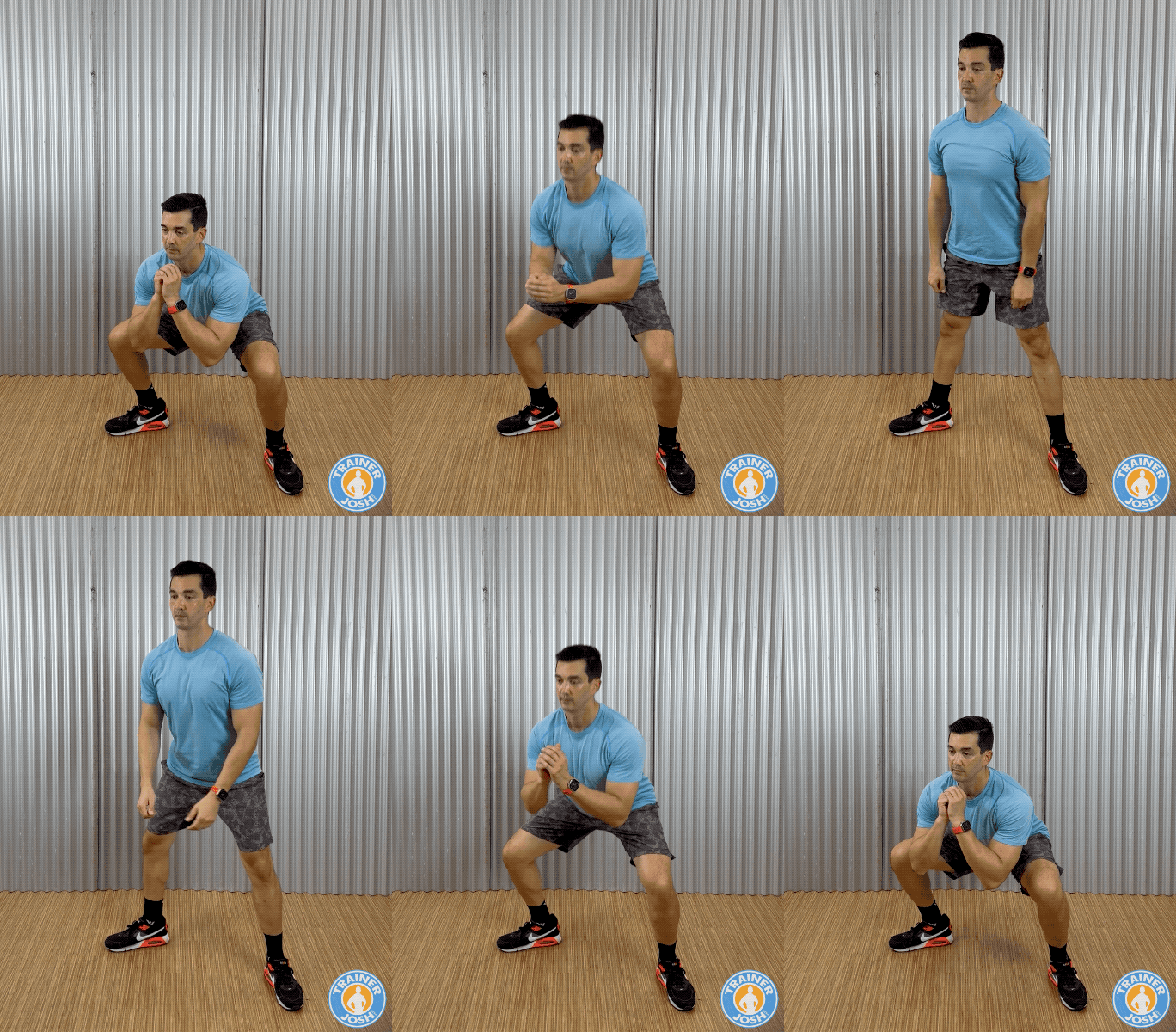
Bodyweight sumo squats are an excellent exercise that teaches you to power your leg movements with more than just your quadriceps. You’ll alter the mechanics of the standard squat to place a lot more emphasis on the thigh adductors (inner thigh muscles) by taking a wider stance with your toes out at an angle.
This is a highly efficient functional movement for building not only lower body strength but also toning the inner thighs right at the comfort of your home. It engages multiple large muscle groups at the same time and provides a deep stretch to your hip extensors.
How to Perform the Sumo Squat:
- Stay with your feet wider than shoulder width apart and point your toes out at about a 30-45 degree angle. Or can just go out to a comfortable preference.
- Start the movement by sinking your hips back and straight down like if you were sitting back into a chair. Keep your chest high and your torso straight with your core engaged.
- Continue lowering your body until your thighs are parallel to the ground or in line with your knees. Actively force your knees outward so that they track directly over your toes.
- To ascend, push your weight through your heels to stand back up into the starting position. Squeeze your glutes tightly at the very top.
Pro Trainer Tips:
- The “Toe Wiggle” Test: Briefly wiggle your toes before you begin lowering yourself. Just make sure that you’re not leaning too far forward and also so that the majority of your body weight is properly anchored in your heels.
- Use a Wall for Correct Form: If you’re struggling to straight upright then try the Therapy Sumo Squat. Face a wall with your toes about one foot away from the baseboard and your fingers gently placed behind your head. Squatting close to the wall forces you to sit backward and keep a proper arch in your back without leaning forward.
- Hold the Peak Contraction: focus on purposely squeezing your glutes at the top of the movement to maximize muscle engagement. Hold that peak contraction for a couple seconds before starting your next rep.
Common Mistakes to Avoid:
- Letting the Knees Cave In: You have to actively fight to keep your knees forced outward throughout the entire range of motion. You want to keep them pointed in the exact same direction as your toes.
- Dropping the Chest: Do not let your upper body collapse or bow forward. Keep your chin parallel to the floor and keep your chest lifted to make sure the workload stays on your lower body and core.
Lateral Side Lunges
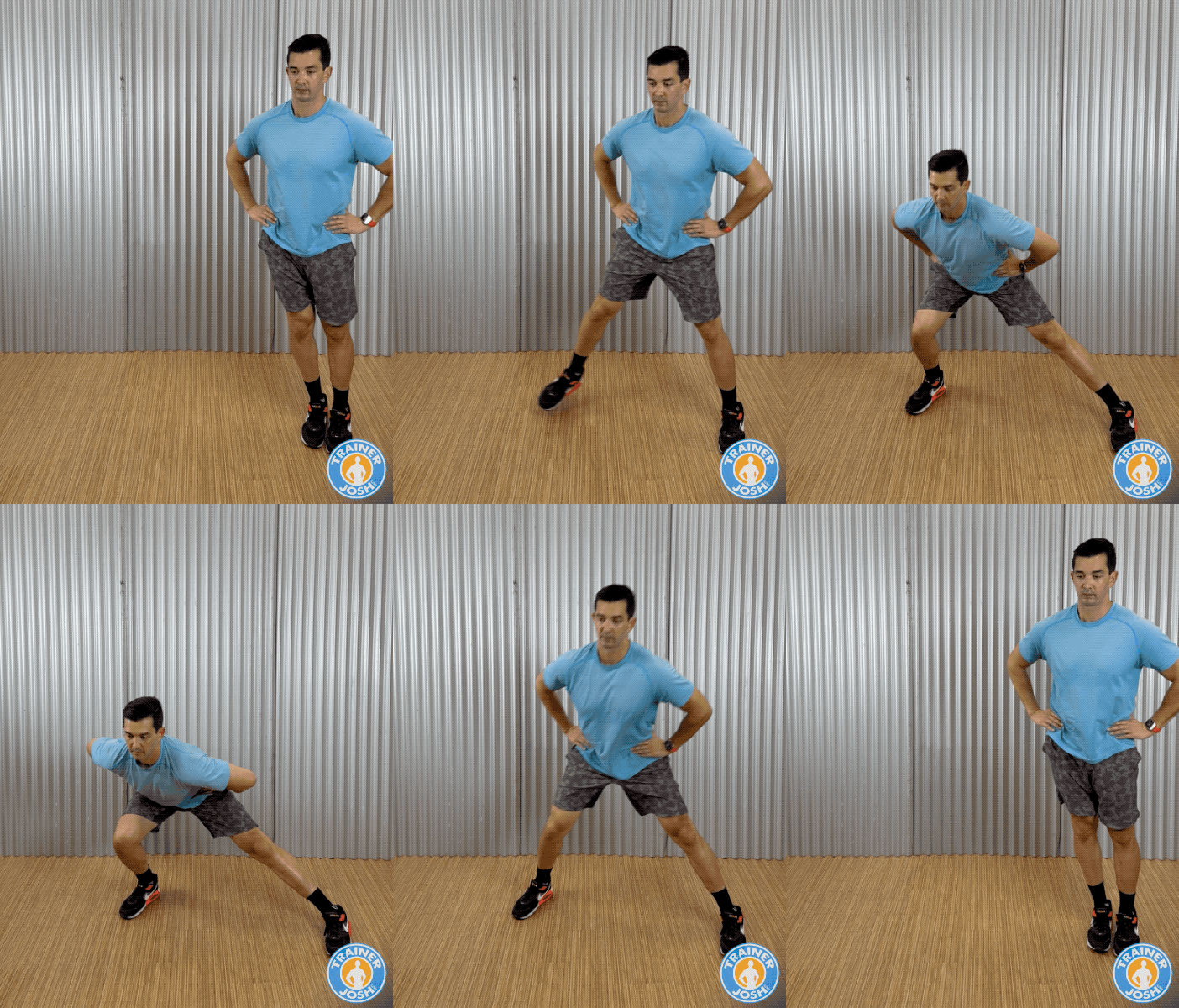
The bodyweight lateral side lunge is a functional movement that builds strength, dynamic balance, and coordination without needing any equipment. You engage the inner thighs, quads, glutes, and hamstrings by forcing the side-to-side movement instead of just forward and backward.
The straight trailing leg also gets a deep stretch that also works and tones the inner thighs. It’s one of the best exercises for improving hip flexibility and preparing the lower body for more advanced unilateral exercises like one-legged squats.
How to Perform the Lateral Side Lunge:
- Stand tall with your feet together or hip width apart. Keep your hands held straight out in front of you for balance.
- Take a wide step directly to the side with one foot. Make sure your toes are pointed straight ahead or you can have them slightly outward.
- Shift your weight onto that stepping foot while keeping your opposite trailing leg completely straight.
- Keep your upper body upright and lower your hips down and backward, like if you’re sitting into a chair. Do so until the thigh of your bent leg is parallel to the floor.
- Push forcefully off the heel of your bent leg to stand back up and return to the starting position.
Pro Trainer Tips:
- The Power Pause: To increase the muscle building tension without adding weight, try holding the bottom of the movement for 1-2 seconds before pushing back up. This is when your thigh is parallel to the floor.
- Stationary Variation: You can do these by keeping your feet planted in a wide straddle stance for the entire time if you’re struggling to keep balance and coordination. Just shift your weight and squat down on one leg, then push back to the center and switch sides.
- Add Load: When bodyweight versions become easy, you can simply wear a backpack filled with books or hold heavy household objects like water jugs to increase resistance.
Common Mistakes to Avoid:
- Bending the Trailing Leg: Your non-working legs should remain perfectly straight throughout the entire movement. You’ll lose the necessary stretch in inner thigh isolation if you bend it.
- Letting the Knee Travel Too Far Forward: Your working shin should remain vertical. Do not let your knee push forward past your toes. This can cause dangerous joint stress.
- Lifting the Heel: Always keep your weight anchored firmly in the heel of the lunging leg to properly activate the glutes. Do not push through the balls of your feet or toes.
- Bowing Forward: Avoid dropping your chest or leaning your upper body too far forward over your thigh. Do your best to keep your back straight and your head up.
Inner Thigh Side Planks
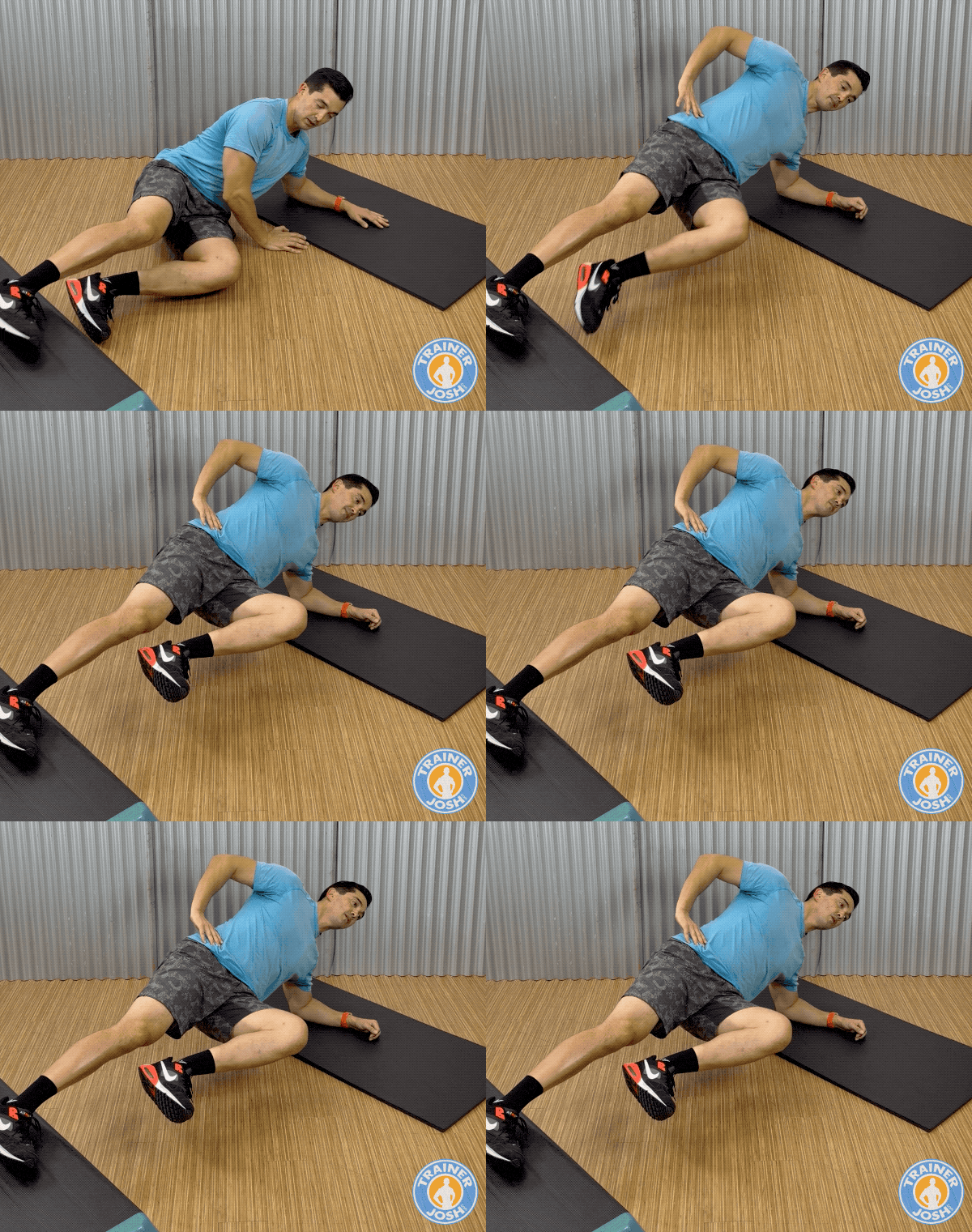
The inner-thigh side plank (also known as Copenhagen Planks) is a very effective lateral-chain exercise. It builds core stability while also isolating and strengthening your neglected inner-thigh adductor muscles.
It’s a perfect at-home movement to develop functional hip strength, correct muscular imbalances, and teach your body to connect and stabilize muscles on both sides of your core and legs.
How to Perform the Inner Thigh Side Plank:
- Lie on your side and place the inside of your top foot or ankle on an elevated step or platform (about 6-12 inches high). You can also slip into a suspension trainer strap.
- Keep your non-working (bottom) leg bent at about a 90-degree angle beneath you.
- Brace and support your upper body on your forearm. Make sure your body is in a straight line with your hips forward.
- Press down with force on the inside of your top foot against an elevated surface to lift your hips up off the ground.
- Hold this straight body position for time. Then slowly lower your hips back down to the floor and repeat with the other side.
Pro Trainer Tips:
- Progress Gradually: This exercise can be very intense on your groin. So to make it easier, you can keep your bottom knee resting on the floor to help you hold your hips up. But as you build strength, you can gradually apply less pressure on the bottom leg until you can pull it completely off the ground and put 100% of the resistance on your top inner thigh.
- Shift Your Shoulder Weight: Slightly shift your shoulder forward to prevent joint pain. This will release stress from the sharp point of your elbow and evenly distribute it throughout your entire forearm.
- Use Suspension Straps for a Challenge: You can do this exercise with your top foot and a suspension strap once a bench or step becomes too easy. It will remove the friction and stability of a hard surface, forcing your lateral chain and inner thigh to work much harder to support your body.
Common Mistakes to Avoid:
- Letting the Hips Sag: Focus on keeping a perfectly straight side plank. If your hips drop or your body starts to curve, it’ll reduce the workload on the target muscles. It will also place unnecessary stress on your joints.
- Neglecting Upper Body Tension: Do not let your supporting shoulder shrug up toward your ear. Focus on actively pulling your shoulders down and back and engaging your lats. It will stabilize your core and protect your shoulder joint.
Deficit Reverse Lunges
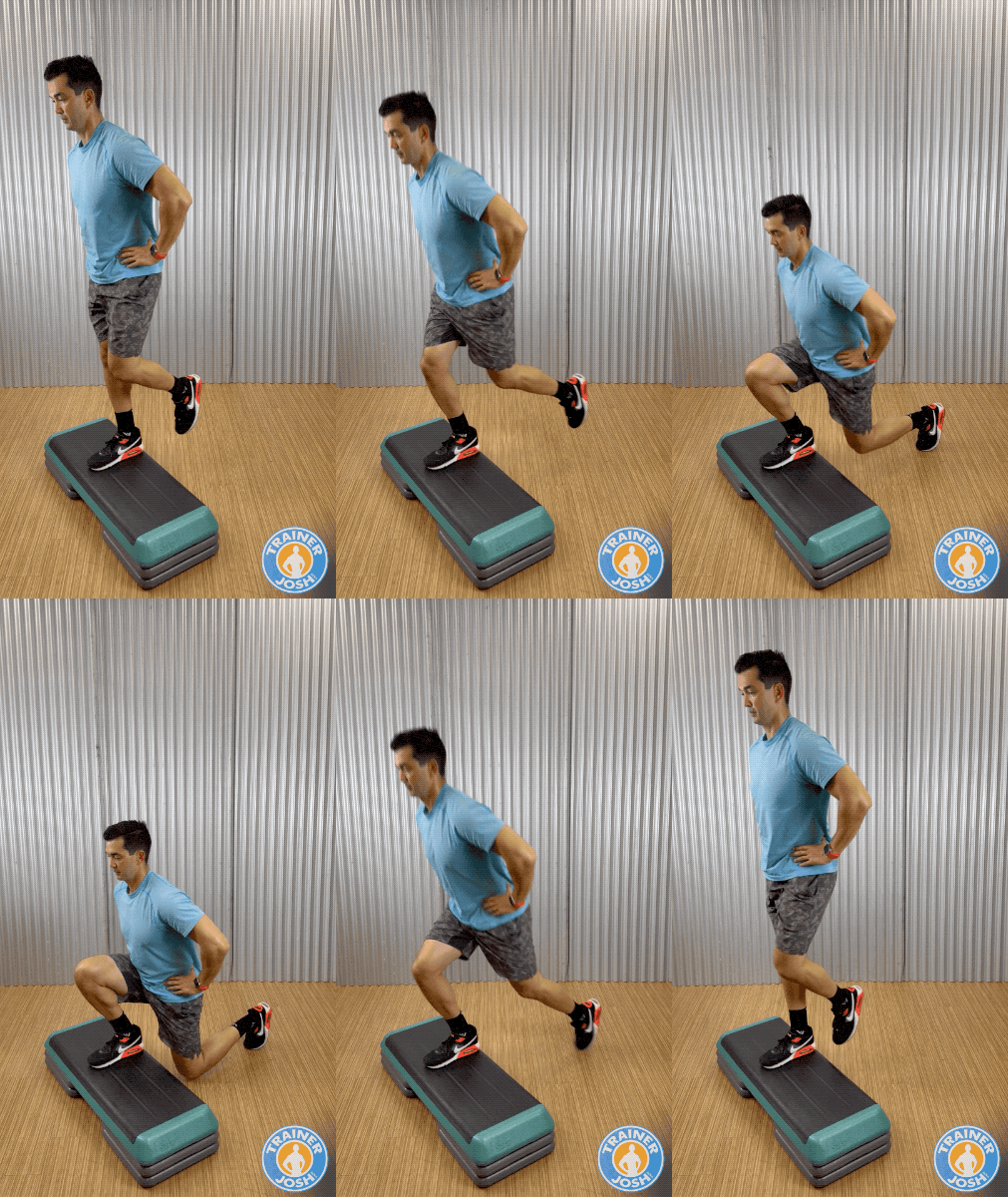
The deficit reverse lunge is a very effective variation of the standard lunge that only requires a small step or box. So this makes it a great exercise for at-home body weight leg workouts.
You’ll significantly increase your hip range of motion by elevating your front foot. This will place a massive muscle-building stretch load on your working glutes and thighs. It’ll also create an intense emphasis on your inner thighs, especially the adductor magnus, adductor longus, and adductor brevis.
This is because “down low”, the adductors are forced to act as hip extensors. This deep deficit will heavily recruit your posterior chain and inner thighs, making it a great exercise for muscle growth and functional lower-body strength.
How to Perform the Deficit Reverse Lunge:
- Stand on top of a sturdy step or box that’s about 6 to 10 inches high. Keep your feet pointed straight ahead and your hands on your hips.
- Keep the majority of your body weight anchored on your front elevated leg. Then take a step backward off the platform with your other leg.
- Lean your torso forward to about a 30 degree angle and sink into your working hip and bending your front knee.
- Continue lowering your body until your back knee starts to approach or gently touches the floor below.
- To return, drive forcefully through your heel of your elevated foot to rise back up into the starting position on the step. Repeat on the other leg.
Pro Trainer Tips:
- Embrace the Forward Lean: You should intentionally use a forward trunk lean at about 30 degrees during this reverse lunge. I know this is unlike standard squats or static lunges where you want to stay completely upright. But this specifically increases the torque loading and range of motion on the hips and glutes.
- Focus on the Pull: Try to consciously feel the glute of your front leg absorbing the force all the way down. And then actively use that same glue to spring your body back up into standing position.
- Find the “Sweet Spot”: Most make the mistake of failing to step back with the proper stride length. Take a little time to experiment and find the perfect distance for this backward step so you can maximize muscle tension but without feeling awkward.
Common Mistakes to Avoid:
- Pushing Off the Back Foot: A big mistake is to use the rear leg to blast or bounce yourself out of the bottom position. You have to force the elevated front leg to lift.
- Knee Collapse (Valgus): Do not allow your knee to buckle or cave inward, like with all lunges and squats. Your knee has to track safely in line with your toes to prevent dangerous stress on your knee joints.
Calves
Elevated Calf Raises (Straight Leg)
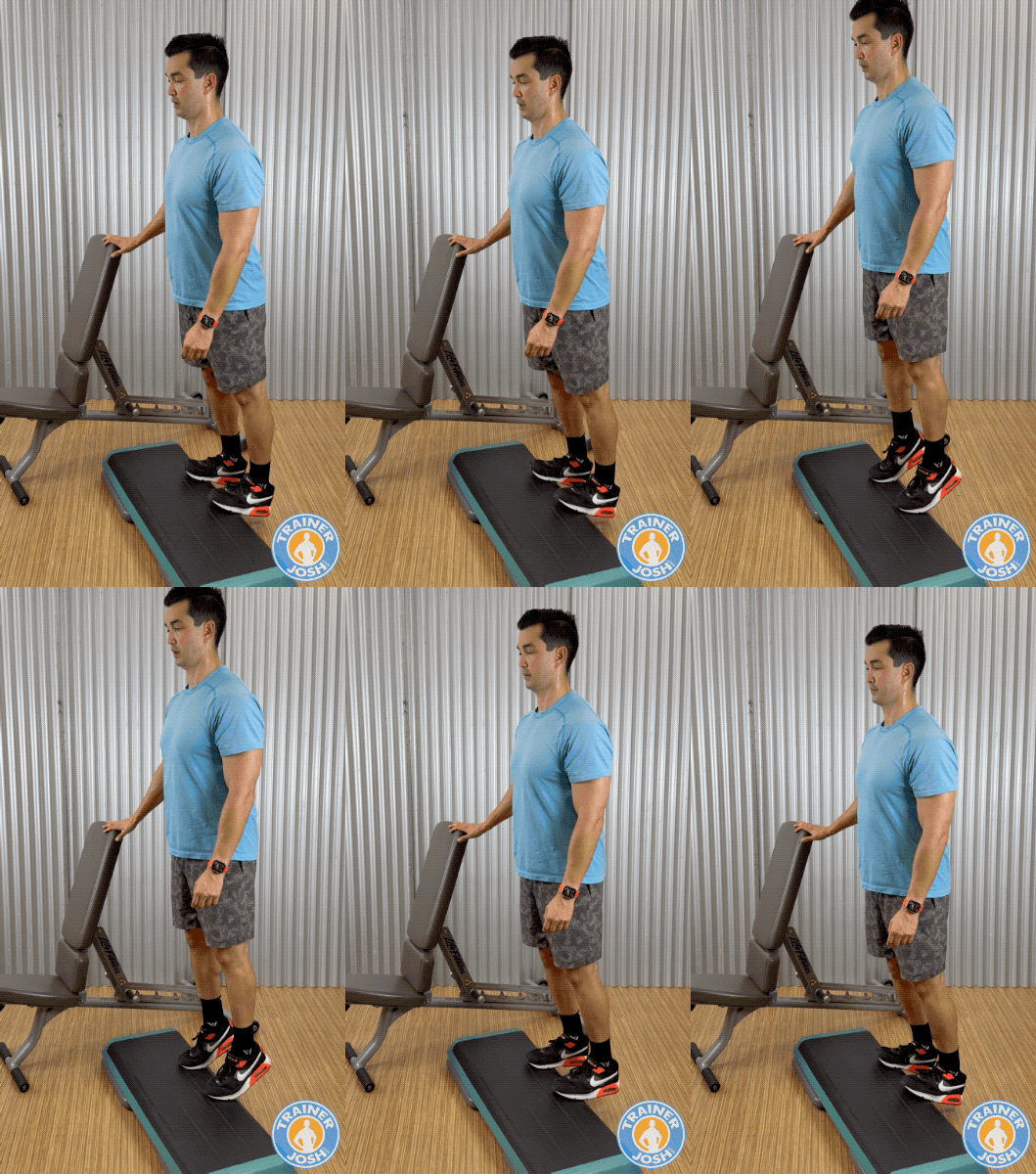
The Straight Leg Elevated Calf Raise is a very effective minimal equipment exercise that’s perfect for your at-home workouts because it only requires a step, thick book or sturdy raised platform. It’ll build lower body strength, explosive power for athletic performance, and essential ankle stability.
Our calves are used to carrying us around all day during low-intensity activities like standing or walking so they require a deep range of motion and high tension to stimulate muscle growth. As you elevate your feet and keep your legs straight, this movement will heavily target your gastrocnemius (the large visible upper calf muscle) while also engaging the soleus.
How to Perform the Straight Leg Elevated Calf Raise:
- Stand with the balls of your feet and your toes on the edge of a step, stair or sturdy platform. Let your heels hang freely off the edge.
- Lightly hold onto the wall or banister strictly for helping with your balance. Make sure your torso is upright and keep your knees in a straight line tracking over your toes, but do not rigidly lock your knees together.
- Lower your heels slowly towards the floor as far as they can comfortably stretch. At the bottom feel that deep stretch in the back of your lower legs.
- Then push up as high as possible onto the balls of your feet and toes. Drive your heels straight up as if they’re attached to puppet strings being pulled by the ceiling.
- Hold the top contracted position for 1-2 seconds before slowly lowering back down to complete the repetition.
Pro Trainer Tips:
- Change the Foot Angle: You can target different areas of the muscle by adjusting your stance. Pointing your toes slightly outward places more emphasis on the inner calves, while pointing them out slightly will more target your outer calves.
- Go Barefoot: When you do this exercise without shoes, it’ll let you distribute your weight more evenly across your toes and maximize a natural range of motion.
- Progress to Single-Leg: Once the double-leg version becomes easy, transition into a single-leg elevated calf raise. This will drastically increase the resistance and you can also wear a backpack filled with heavy books or water bottles to make i harder.
- Accentuate the Eccentric: To maximize muscle growth, slowly lower yourself during the eccentric phase instead of just letting gravity do the work or flopping down.
Common Mistakes to Avoid:
- Skimping on the Range of Motion: Do not use short, choppy motions. You have to sink as deep as possible and rise as high as possible on every single repetition.
- Dropping “Like a Bomb”: Control your descent. Do not drop rapidly or bounce out of the bottom position. This will use momentum and rob you of the muscle tension.
- Bending the Knees: If you bend your knees, then it will shift the workload away from your targeted gastrocnemius and onto the underlying soleus muscle. You have to keep your legs straight to target the upper calf.
- Rolling the Feet Outward: Keep your feet pointed straight ahead at the top of the movement. Do not let your ankles roll outward to make the exercise easier.
Squat Calf Raises
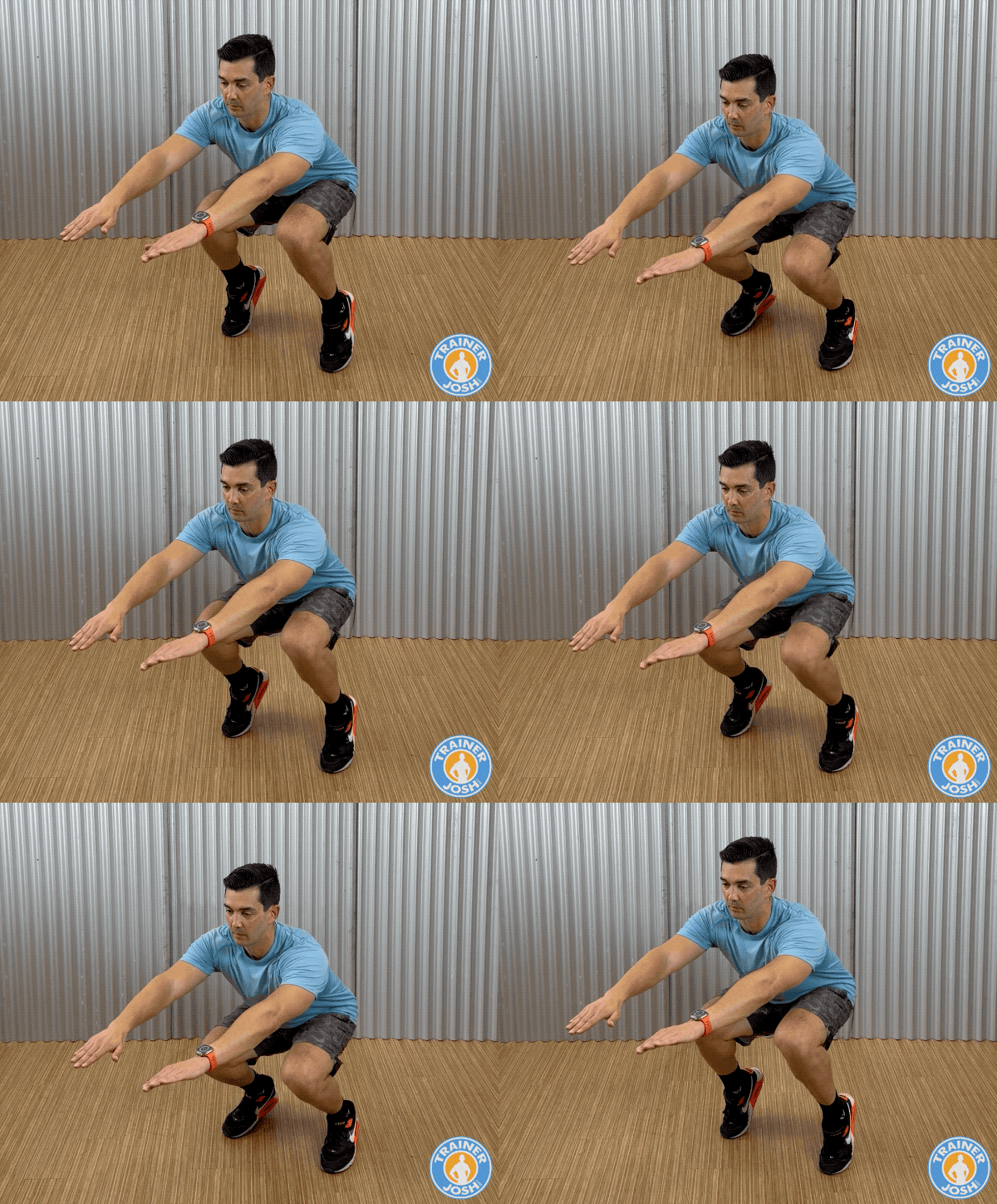
Squat calf raises isolate your soleus muscle, which lies underneath the larger, more visible gastrocnemius. The gastrocnemius crosses both the ankle and the knee joint, so by bending your knees to 90 degrees, it will mechanically shorten and inhibit it. This forces the soleus to do the heavy lifting during plantar flexion (pointing the foot downward).
And as an added bonus, holding the deep squat position will create an isometric workout for your quadriceps and gluteus maximus.
How to Perform the Squat Calf Raise:
- Sink into a parallel squat position so your knees are bent at about a 90-degree angle. Keep the weight on your toes.
- Lightly grasp a stable object in front of you like a heavy chair, door frame or wall for balance. Do not use it to assist with lifting.
- Keep your hip and knee angles completely locked in place. Lower your body strictly at the ankle joint until you feel a good stretch in your lower legs.
- Push your body up as high as possible onto your toes using only ankle plantar flexion.
- Hold the top contracted position for a one-second count. Then lower your body back down slowly to complete the repetition.
Pro Trainer Tips:
- High Repetitions: The soleus muscle has a very high percentage of slow-twitch muscle fibers (up to 88%). So this means it’s an endurance powerhouse. And this makes it respond very well to high-volume training. So you’ll have to do a high number of reps with your body weight every day to build muscle.
- Emphasize the Peak Contraction: You have to make sure you’re getting a quality contraction to optimize the benefits from this exercise. Hold the top of the movement for a full 1-2 seconds and consciously focus on squeezing the calves as hard as you can.
Common Mistakes to Avoid:
- Squatting Up and Down: The most common mistake is naturally wanting to use your hips and knees to help lift the body. But you have to fight this urge and keep your hip and knee angles completely locked in place. 100% of the movement needs to come from your ankle joint.
- Dropping Like It’s Hot: Do not let your body just yield to gravity and drop fast after reaching the top. You have to consciously and strictly control the lowering eccentric phase of the movement instead of just dropping down.
Stiff-Leg Ankle Hops (Pogo Jumps)
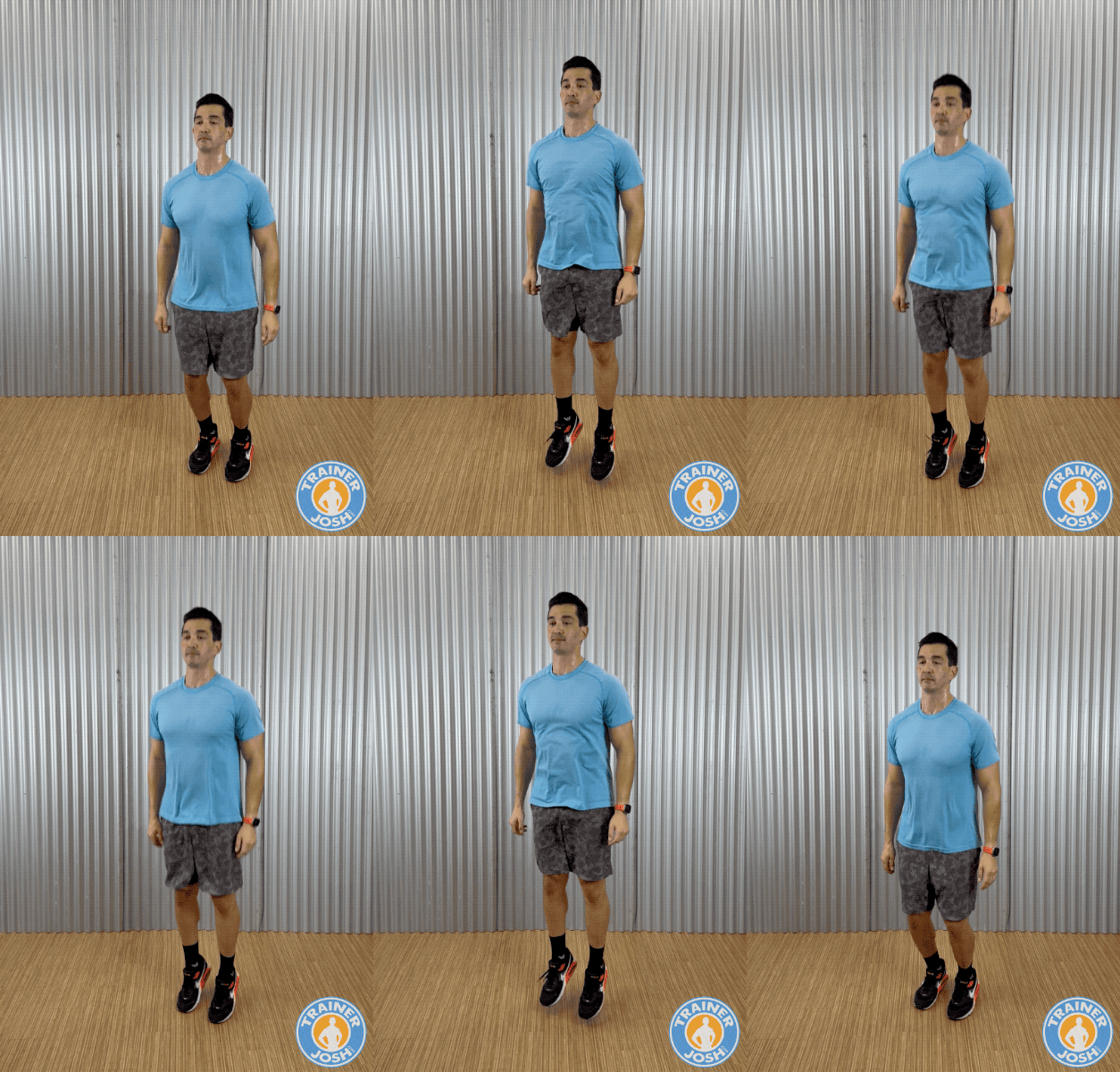
The Stiff Leg Ankle Hop (also commonly known as the Pogo Jump) is a minimal equipment plyometric exercise that builds explosive power, strength and stability in the lower legs. Because your calf muscles are naturally explosive, you’ll target the large gastrocnemius muscle and engage the underlying soleus by repeatedly and rapidly springing off the ground.
Doing this exercise regularly will be a great power builder for beginners and a dynamic warm-up for advanced athletes. This will improve the elasticity and resilience of your feet and ankles for all athletic moves.
How to Perform Stiff-Leg Ankle Hops:
- Stand upright with your feet shoulder-width apart and your hands resting on your hips or hanging down at your sides.
- Keep your knees almost completely straight and make sure you don’t rigidly lock your kneecaps.
- Act like a human pogo stick. Hop straight up and down in the air as high as you can. Rely only on your calf muscles and ankles to spring you upward.
- Land softly on the balls of your feet and immediately rebound back up. Never allow your heels to touch the ground.
- Continue hopping as quickly as possible in a continuous rhythm until you reach the time limit or rep goal.
Pro Trainer Tips:
- The “Shock” Workout Finisher: Try mixing slow and explosive movements to rapidly force your stubborn calf muscles to grow. Do 50-100 strict slow calf raises until your muscles are burning, and then immediately transition into hopping up and down, as high as possible, for 60 seconds to completely exhaust the fast-twitch muscle fibers.
- Find a Rhythm: Focus on keeping a fast continuous rhythm instead of pausing between each jump. You’ll get the most of the plyometric stretch and contract response this way.
Common Mistakes to Avoid:
- Bending the Knees & Hips: The most common mistake is bending at the knees and hips to jump. You have to keep upright and make sure your legs are pretty much straight. If you do use your knees and hips, then you’ll shift the workload away from your calves and onto the quads and glutes.
- Locking the Knees: Your legs should be “stiff”, but you do not want to rigidly lock your kneecaps since it will prevent safe shock absorption. Keep a very slight and natural softness in the joint.
- Dropping the Heels: You should stay on your toes and the balls of your feet. Don’t let your heels touch the floor during the reps. This kills the elastic tension required for the movement.
Beginner Bodyweight Leg Workout (No Equipment)
Here is a 20-minute bodyweight leg workout for beginners that’s built from these exercises.
This routine is in a superset format (pairing two exercises back-to-back) to maximize your time, keep your heart rate up, and make sure you finish within the 20 minute window.
The ordering (A1, A2) is for combo sets (or circuit training with rest). You pair exercises together to save time, rather than doing all your sets of one exercise before moving on to the next.
Perform one set of exercise A1, take your rest, and then perform one set of exercise A2. You rest again and repeat this A1-A2 cycle until you’ve completed all the sets for the “A” block.”
Repetition tempo (e.g., 2010) tells you exactly how many seconds you should spend on each phase of a repetition. The first number is the concentric (lifting phase), the second number is the top part of the movement, the third number is the eccentric (lowering phase), and the 4th number is the bottom part of the movement.
20 Minute Bodyweight Leg Workout Plan
30-Minute Bodyweight Leg Workout Plan
Advanced Bodyweight Leg Exercises (Progressions)
The pistol squat is the gold standard of bodyweight leg training. One leg. Full depth.
It requires single-leg balance, extreme hip and ankle mobility, and the raw quad strength to push your entire bodyweight out of a rock-bottom hole.
What Actually Makes Advanced Bodyweight Leg Exercises Hard
Three levers drive difficulty. And understanding them tells you exactly how to progress.
Single-leg depth doubles the load instantly. Drop to rock bottom where your hamstring touches your calf, and you’ve forced maximum tension on fibers that were coasting in every bilateral squat you’ve ever done.
Long eccentrics (taking 5-10 seconds to lower) create more muscle damage and connective tissue stress than any amount of fast reps. Slow is brutally hard.
Explosive work like jumping pistols forces your fast-twitch fibers to generate maximum power and then absorb the landing. That combination builds size and athleticism simultaneously.
The Step-by-Step Pistol Squat Progression:
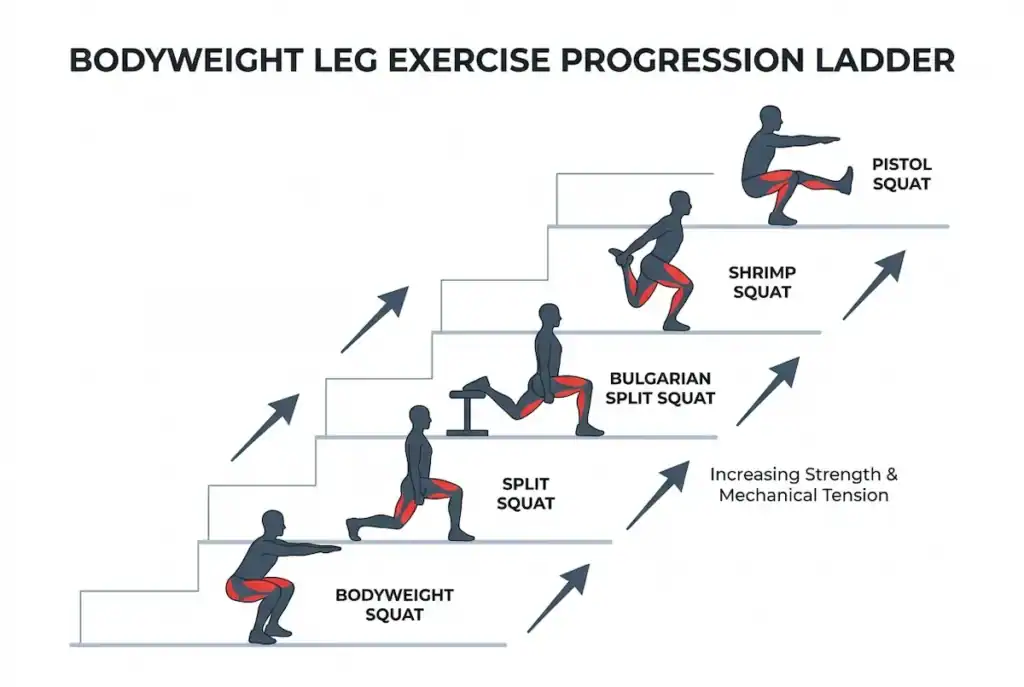
Workout through these in order. Don’t skip ahead.
- One-Legged Box Squat — Extend one leg, sit back onto a chair, and stand up. Lower the box as you get stronger.
- Split Squat
- Bulgarian Split Squat
- Shrimp Squat
- Pistol Squat
Stuck at the bottom of the Pistol Squat? Here’s the Fix:
Hold a counterweight. A 5- pound dumbbell held straight out in front acts as a counterbalance. Paradoxically, adding weight makes the pistol easier to stand from.
Candlestick rolls. From the bottom, roll backward onto your shoulders, roll forward fast, and use that momentum to stand on one leg. It’s a cheat… but it teaches your body what “standing up” feels like.
Concentric-only pistols. Squat down on two feet, extend one leg, then stand up on one. Eliminates the descent so you can train the hardest part in isolation.
Pause at your sticking point. If you fail at parallel every time, pause there for 2-5 seconds on every rep. Painful but effective.
Can’t keep the front leg up? That’s a hip flexor issue, not a quad issue. Practice lifting one straight leg over an imaginary object while seated on the floor. Not the coolest fix, but it works.
Calistenics Leg Day (How Often? How Intense?)
More is not always better. But for most people doing bodyweight leg training… It’s definitely not enough.
Here’s how to program based on your actual goal.
Frequency: Match Your Schedule to Your Goal
3x per week (full-body) is best for beginners. Bodyweight movements are highly skill-dependent. Practicing squats and lunges three times a week builds neuromuscular coordination faster than once-a-week sessions ever will.
2x per week (upper/lower split) is the sweet spot for intermediates. Once pistol squats and advanced plyometrics are introduced, full-body training becomes too taxing. Tuesdays and Fridays work well… enough volume, enough recovery.
1x per week is maintenance territory. It works, but only if intensity stays high and you don’t regress to easier exercises.
One hard rule: never train legs intensely two days in a row. Muscles grow during recovery, not during the session.
Programming by Goal
For growth: 3-6 sets of 8-15 reps. Target 40-75 total reps per exercise across your workout. Rest 60-90 seconds between sets. Control the eccentric. Train close to failure.
For performance: 1-5 reps per set of your hardest variation. Rest 3-5 full minutes between sets. ATP needs to be fully replenished for maximal power output. Don’t train to failure here.
Hard training only works if you can recover well enough to repeat it. BioTRUST Ageless Multi Magnesium combines seven forms of magnesium with L-theanine and vitamin B6 to support muscle function, cellular energy, relaxation, and recovery.
A 7-form magnesium complex designed for adults 40+ to support restful sleep, relaxation, muscle recovery, and whole-body health. Each serving provides 350mg of magnesium plus L-theanine and vitamin B6 for added nervous-system support.
- 7-Form Magnesium Blend: Combines glycinate, taurate, malate, citrate, Sucrosomial® magnesium & complementary forms
- Sleep & Relaxation Support: Magnesium glycinate plus L-theanine help support calm, relaxation & restful sleep
- Muscle Recovery & Comfort: Supports normal muscle relaxation, recovery & energy production
- Enhanced Absorption: Includes clinically studied Sucrosomial® Magnesium for high absorption & gentle digestion
- Heart, Bone & Nervous System Support: Provides 350mg of magnesium plus vitamin B6 for essential body functions

For maintenance: One quality session per week is enough to hold what you’ve built. Keep intensity high. Don’t regress the exercises.
The Plateau Fix Nobody Talks About
Here’s the trap advanced bodyweight trainees fall into…
They progress to a hard exercise (i.e., pistol squats) and can only do 3 reps per set. Three sets of 3 is 9 total reps. That’s great for strength. It’s nowhere near the 40-75 reps needed to trigger hypertrophy.
The fix: Hybrid Sets. Max out your pistol squats, then immediately drop to Bulgarian split squats or assisted pistols for 6 to 8 more reps. Same muscle, continuous tension, enough volume to actually grow.
Alternatively, just add sets. Four reps across 6 sets gets you 24 total reps. This will be far more effective than 3 sets of 4 going nowhere.
The Bodyweight Leg Routine For Runners
Most runners don’t strength train their legs until something breaks down. By then, the IT band is screaming, and the knees are barking on every descent.
Here’s what to do before that happens… and how to fix it if you’re already there.
What Runners Actually Need to Train
Running is a single-leg sport. Every stride, you’re balancing your entire bodyweight on one foot while your hip fights to keep your pelvis level.
- Skater squats directly train that — one leg, hips working in all planes, knee tracking under load.
- Single-leg Romanian deadlifts build hamstring and glute strength while training the proprioception that keeps your ankle from rolling on uneven ground.
- Reverse lunges train forward propulsion: pulling yourself up with the front glute instead of pushing off the back leg — exactly what running mechanics demand.
- Single-leg calf raises off a step (straight knee for gastroc, bent knee for soleus) and pogo jumps — hopping on the balls of your feet with stiff knees to train the Achilles stretch-shorten cycle. Runners who skip this end up with Achilles tendinopathy.
Two Routines: Pre-Run Activation + Strength Day
Pre-Run (5–7 min, continuous circuit)
- Leg swings front/back and side-to-side — 10 reps each leg
- High knees — 30 seconds
- Butt kicks — 30 seconds
- Inline lunges (heel-to-toe line) — 5 reps per leg
- Ankle flexion/extension in the air — 10 reps per leg
Strength Day (15–20 min, 3–4 sets, 60–90 sec rest)
- Jump lunges — 8 to 10 reps per leg
- Skater squats or assisted pistols — 5 to 8 reps per leg
- Single-leg RDLs — 8 to 10 reps per leg
- Straight-leg + bent-knee calf raises — 15 reps each variation per leg
Runner’s Knee & IT Band: The Real Cause
Both injuries stem from the same root problem… weak glutes and hips that let the femur drift inward under load.
Two form fixes that actually matter:
Track the knee. In every squat and lunge, your knee should line up with your middle toes. Caving inward isn’t just a power leak. It’s joint destruction over thousands of steps.
Sit back, not forward. Letting your knees glide too far over your toes during lunges shifts the load away from the glutes and onto the knee. Push your hips back first.
On volume management: tendons adapt more slowly than muscles. If you feel joint achiness rather than muscle soreness, you’re moving too fast.
If you’ve taken time off for knee or IT band inflammation, return at 40% of your previous volume and add only 10 to 20% back per week. Slow eccentric work (15-30 reps at low intensity) rehabilitates irritated tendons by pumping blood into tissue that has almost no direct blood supply.
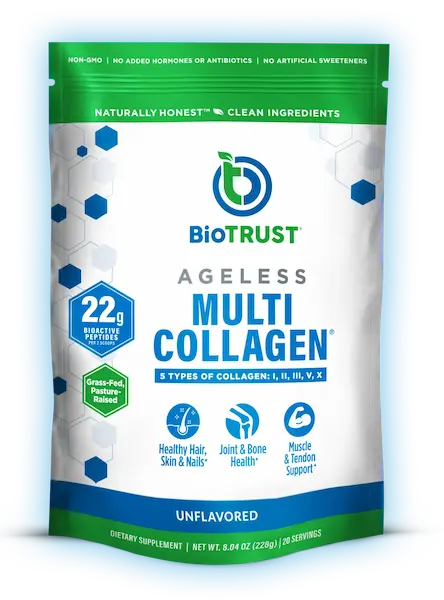
When tendons and joints are the limiting factor, training needs more than grit. BioTRUST Ageless Multi-Collagen provides five collagen types to help support cartilage, tendons, ligaments, and joint comfort as you rebuild your workload.
Powered by 5 Types of Bioactive Naturally Hydrolyzed Collagen Peptides for Full-Body Support (Odorless & Flavorless)
- Natural GLP-1 Support: Helps support healthy appetite signals, fullness & metabolic function
- Lean Muscle Support: Helps preserve muscle, strength & healthy body composition during weight loss
- High-Protein Collagen: Adds 20g of protein with 5 collagen types to help support daily protein intake
- Skin, Joint & Hair Support: Provides collagen peptides to support skin elasticity, joints, hair & nails
- 3-Part Weight-Loss Support: Combines muscle, protein/collagen & appetite support in one simple daily stack
Want Leaner, Stronger Legs After 40?
First, let’s talk about what “toned” actually means…
“Toned” is not a special type of training. It’s not light weights and high reps. Tone is the visible result of two things happening at once: building lean muscle and reducing the body fat that sits on top of it.
You can’t spot-reduce fat from your legs. Fat loss happens across the whole body when you burn more than you consume. But you absolutely can build the muscle underneath that makes legs look firm and defined.
Women lose roughly 5% of their muscle mass every decade after 30. That’s what causes the “skinny fat” look. The body weight stays the same, but the composition quietly shifts. Strength training reverses that.
Safe Bodyweight Leg Exercises for Midlife & Beyond
All four of these can be done with one hand on a wall, chair, or doorframe. Balance support is not cheating… it’s smart training.
Assisted box squats: Hold a doorframe for support, push your hips back, and briefly sit on a sturdy chair. Builds quads and glutes with zero fear of falling backward.
Assisted lunges: Hold a wall or heavy chair. Step forward or backward and lower the back knee toward the floor. Start with half-depth if full range causes knee discomfort.
Glute bridges: Lie on your back, knees bent, feet flat. Drive hips to the ceiling and squeeze. One of the most effective posterior chain exercises that exists.
Assisted calf raises: Fingertips on a wall, heels as high as possible, slow and controlled lowering. Builds lower leg strength and ankle stability simultaneously.
Knee & Back Modifications That Actually Matter
For knees: Don’t let the front knee cave inward or travel aggressively past the toes during squats or lunges. If full depth causes pain, use a half-lunge (lower only halfway). Less range, zero pain, still building strength.
For the back: Brace your core and keep your chest up throughout every squat and lunge. During glute bridges, lift with the glutes. Don’t hyperextend the lower back at the top.
Know the Difference: Good Pain vs. Stop Now
Good pain is a burning sensation in the muscle belly during the exercise, or mild soreness the next day. That’s normal adaptation.
Bad pain is sharp, shooting, or located in a joint, tendon, or bone. Stop immediately if you feel that.
Important: Never train through joint pain. A minor strain ignored becomes a chronic injury. If an exercise hurts a joint, skip it or modify the range of motion until it’s pain-free.
And before starting any new exercise routine, consult your doctor… especially with existing knee or back conditions.
Why Your Bodyweight Leg Training Isn’t Working (It’s Probably One of These 5 Things)
After 20 years of personal training, I can tell you… most people aren’t failing because of bad genetics or wrong exercises. They’re failing because of fixable habits they don’t even know they have.
Mistake #1: Only doing squats
Squats are a quad exercise. That’s it. If your entire leg day is squat variations, you’re building quad dominance — where the front of the thigh massively overpowers the back. That imbalance is one of the primary drivers of chronic knee pain. Fix it by adding hip hinges and knee flexion work: single-leg RDLs, glute bridges, and sliding leg curls.
Mistake #2: No progression plan
Same workout, same body. That’s not a motivational quote — it’s physiology. Bodyweight training requires a deliberate plan to move from easier to harder variations. Without it, you’re just maintaining. Map out your next progression before you need it.
Mistake #3: Reps forever, never near failure
100 bodyweight squats build cardiovascular endurance. It does not build legs. Muscle growth requires mechanical tension, and mechanical tension requires approaching failure. If your exercise lets you cruise through 50 reps, it’s too easy. Find a variation that limits you to 5-15 reps.
Mistake #4: Form shortcuts that wreck knees
Three to watch: knees caving inward (valgus collapse), heels lifting off the floor, and bouncing out of the bottom of squats. All three redirect force directly into the knee joint. Slow down, keep the heels planted, and pause briefly at the bottom on every rep.
Mistake #5: Inconsistent weekly volume
Sporadic training doesn’t signal your body to adapt. It signals nothing. Two to three leg sessions per week, every week, with 48-72 hours between them. That’s the structure that actually produces results. Switching programs every two weeks resets your progress to zero every time.
FAQ
Can you grow muscle with just bodyweight exercises?
Yes, you can for sure build muscle with just bodyweight exercises… but only if you apply the right principles. Pick variations that are hard enough to fatigue you in 5-15 reps. Progressively increase the difficulty by moving to single-leg movements, and consume 1.6 to 2.2 grams of protein per kilogram of bodyweight daily.
What’s the easiest leg muscle to grow?
The quadriceps are typically the easiest leg muscle to grow because squats and lunges naturally dominate them. Many people develop quad dominance without even trying.
What is the hardest muscle to grow in your legs?
The calves are the hardest leg muscle to grow because the soleus (the deeper calf muscle) is up to 88% slow-twitch fibers, making it extremely fatigue-resistant. Add 7,000 daily steps of built-in conditioning, and average workouts won’t cut it. Force growth with full range, strict 2-second pauses, and single-leg raises.
Muscle growth requires protein otherwise you’ll never maximize your results. Use my free protein calculator to instantly find your daily protein needs.