

You’re doing push-ups. You’re training legs. You’re “working out”… but your back is getting left behind. Most guys end up with rounded shoulders from doing too many push-ups and not enough back exercises.
So now you’re looking for bodyweight back exercises because you’re thinking: “Okay… how do I train my back at home when I don’t have a pull-up bar?” Or… “I can’t even do a pull-up yet.”
The good news is that you can get stronger, more muscular back with just bodyweight. But you have to stop doing the random “back-ish” moves and start using exercise progressions that work.
Here are the 10 best bodyweight exercises for your back that you can do at home. Plus, I’ll show you how to use them effectively to get the best results in the provided workout plan.
Why Training Your Back with Bodyweight Matters (Most People Get This Wrong)
Here’s what nobody’s telling you about home workouts: Push-ups are sabotaging your posture.
If you’re crushing 50 push-ups daily but skipping back work, you’re creating what physical therapists call upper crossed syndrome – rounded shoulders, forward head posture, and internally rotated arms. That “caveman” look.
The math is brutal: most at-home programs pack in horizontal pressing movements (push-ups, planks, dips) but zero horizontal pulling. This imbalance doesn’t just look bad; it’s harmful. It triggers shoulder impingement, restricts the subacromial space, and sets you up for chronic pain.
The Gravity Problem Nobody Mentions
Here’s why your back is lagging:
Bodyweight training is naturally skewed toward pushing. You can drop to the floor and bang out push-ups anywhere. But pulling? You can’t grip the ground and pull yourself anywhere. You need a bar, rings, or serious furniture creativity.
This equipment barrier is why 85% of home trainees say, “I do a lot of push-ups but my back is lagging.”
“Can I Really Build Muscle Without Weights?”
Yes – and here’s the science:
Your muscles don’t care if tension comes from a barbell or your bodyweight. They only respond to mechanical tension. Mechanical tension is the physical stress on muscle fibers when they generate force.
One study found that overhead pulling exercises like chin-ups stimulate biceps growth just as effectively as barbell curls when intensity matches:
A 2017 Frontiers in Physiology study showed that with equal training volume, multi-joint resistance exercises led to greater gains in strength (up to +19%) and cardiorespiratory fitness (+12.5% VO₂max) than single-joint exercises, while both produced similar improvements in body composition.1
Progressive overload still applies. Master standard pull-ups? Move to archer pull-ups, one-arm progressions, or front lever work. Each variation forces neuromuscular adaptation and triggers muscle protein synthesis.
The real issue? If you “feel it more in your arms than your back,” you’re hitting the Limit Factor Principle. Your grip or biceps are the weak link, stopping sets before your lats get stimulated.
The fix: focus on pulling with your elbows (not hands), use a 3-0-1-0 tempo, and consider gymnastics rings for natural wrist rotation.
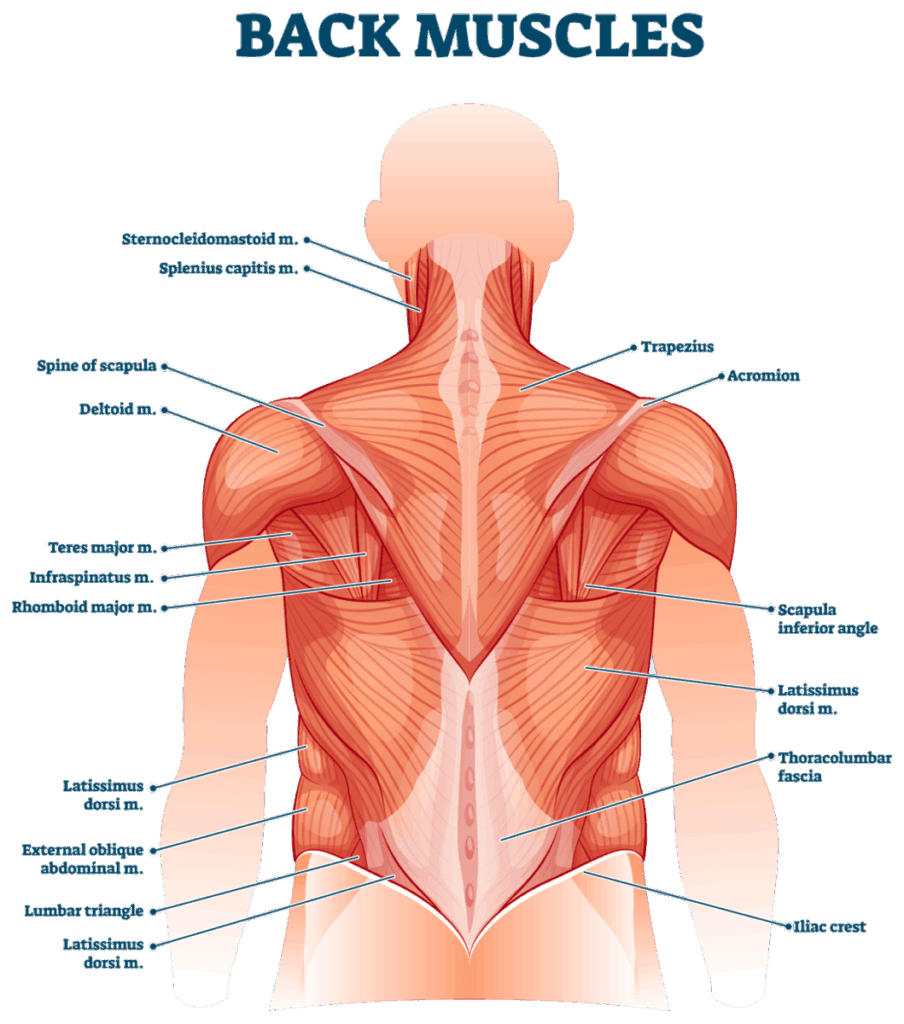
Back Muscles Explained (So You Know What You’re Actually Training)
You’re doing rows but feeling it in your biceps. Pull-ups burn out your forearms before your lats even wake up.
Here’s why: You’re training the wrong muscles because you need to understand the biomechanical roadmap.
Upper Back vs Mid Back vs Lower Back (Quick Breakdown)
Lats (Latissimus Dorsi): Width & V-Taper
These create the classic V-shape from your armpits to your lower back.
Primary function: shoulder extension (pulling elbows down from overhead) and adduction (pulling arms to your sides). This is your pull-up muscle.
Rhomboids & Mid-Traps: Thickness & Posture
These are your scapular retractors. They squeeze your shoulder blades together. They build mid-back thickness and prevent that rounded-shoulder desk posture. This is your rowing muscle.
Rear Delts: Shoulder Health
The posterior deltoids pull your elbows behind your torso. Underdeveloped rear delts = shoulder impingement and rotator cuff issues. Non-negotiable for joint stability.
Erector Spinae: Lower Back Stability
Your spinal erectors run the length of your spine, holding you upright and preventing your back from rounding under load. Weak erectors = chronic lower back pain.
Rear delts and erector spinae aren’t just for looks. They’re what keep your shoulders and lower back stable rep after rep. If joint health matters to you as you build back strength, Ageless Multi Collagen is one option I like because it combines five collagen types that support cartilage, tendons, ligaments, and connective tissue.
Powered by 5 Types of Bioactive Naturally Hydrolyzed Collagen Peptides for Full-Body Support (Odorless & Flavorless)
- Natural GLP-1 Support: Helps support healthy appetite signals, fullness & metabolic function
- Lean Muscle Support: Helps preserve muscle, strength & healthy body composition during weight loss
- High-Protein Collagen: Adds 20g of protein with 5 collagen types to help support daily protein intake
- Skin, Joint & Hair Support: Provides collagen peptides to support skin elasticity, joints, hair & nails
- 3-Part Weight-Loss Support: Combines muscle, protein/collagen & appetite support in one simple daily stack

Why Many “Back Exercises” Don’t Hit the Lats
Here’s the mechanical truth:
Elbow direction determines muscle recruitment. Pulling your elbows down toward your hips (vertical pull-ups) targets lats for width. Pulling your elbows back behind your torso (horizontal rows) shifts tension to the rhomboids and traps for thickness.
Once your elbows travel past your body, the lats can’t produce force anymore. The rear delts and scapular retractors take over completely.
Why rows feel like “arms”: You’re pulling with your hands instead of driving your elbows back. Your biceps become the limiting factor. They’re the weak link that fails before your back gets stimulated.
The fix? Pull with your elbows, not your hands.
Initiate every row by squeezing your shoulder blades together (scapular retraction) before you bend your elbows. This “wakes up” the back muscles first.
Can You Build Muscle with Bodyweight Back Exercises?
Let me kill this doubt right now:
Your muscles are dumb meat. They don’t know the difference between a 45-pound plate and your bodyweight. They only register mechanical tension.
The catch? You need smart progressions.
The Science: Tension, Effort, Failure
Research confirms that sets in a 5-30 rep range produce equal muscle growth… if you train close to failure. The key metric: within 5 reps of failure. Everything before that is just warming up the motor units.
A 2017 meta-analysis published in the Journal of Strength and Conditioning Research, analyzing 21 studies, found that high-load resistance training (>60% 1RM) produced significantly greater gains in maximal strength than low-load training (≤60% 1RM), while muscle hypertrophy was similar across loading ranges when all sets were performed to momentary muscular failure.2
Here’s what actually triggers growth: full motor unit recruitment. You hit this either by lifting heavy (80-85% of max) from rep one, or by pushing a lighter set to technical failure where your form breaks down.
The last few reps where your muscles burn and tremble? That’s where the magic happens.
Why “Is This Just for Staying Fit?” is the Wrong Question
One of my clients couldn’t do a single pull-up. We started with Australian rows (inverted rows) using a broomstick across two chairs. Eight weeks later, he hit his first chin-up. Twelve weeks after that? Five strict pull-ups with 10 pounds of solid muscle added to his back.
Bodyweight builds mass through leverage manipulation:
- Progress from bent-knee to straight-leg rows
- Advance from two-arm to one-arm variations (doubles the load)
- Lower your body angle on inverted rows (increases the percentage of bodyweight lifted)
When You Need Minimal Equipment
The gravity problem is real. You need something to pull on. A bar, rings, or a sturdy table. Once you can knock out 15+ reps, add a backpack with books or a weighted vest to stay in the growth zone.
The Bottom Line:
Muscle growth requires mechanical tension close to failure, not specific equipment. Bodyweight builds mass if you progressively increase difficulty through leverage (angles, unilateral work, external load). The 5-30 rep range works equally well – proximity to failure is what matters.
Bodyweight Back Exercises (Organized by Goal & Difficulty)
Here’s every bodyweight back exercise you need, organized by what you’re chasing.
Can’t do a pull-up yet? Start in the beginner section. Already crushing reps? Skip to advanced progressions.
Match the exercise to your current strength level.
Best Bodyweight Back Exercises for Beginners (No Pull-Ups Required)
Inverted Rows
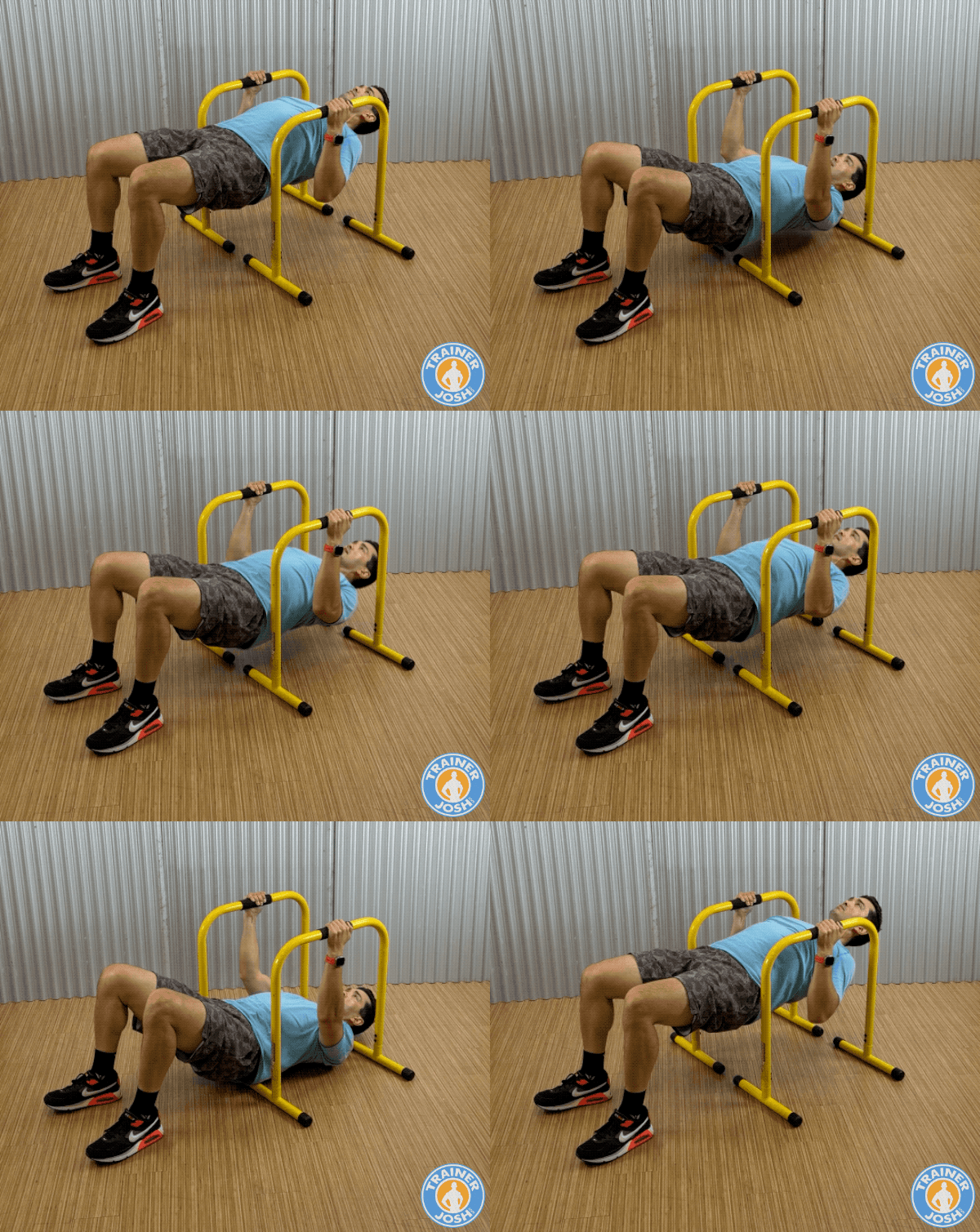
I’m using the Lebert Equalizer bars here.
Inverted rows are your antidote to rounded shoulders and desk posture. This horizontal pull targets your rhomboids, mid-traps, rear delts, lats, and biceps—building upper-back thickness while forcing your core and glutes to lock your body into a rigid plank.
It’s safer for your lower back than bent-over barbell rows and directly counteracts the forward shoulder collapse caused by excessive push-ups and sitting. If you do push-ups but skip rows, you’re building an imbalanced physique that screams, “I work from home.”
I actually prefer Inverted Rows over Dumbbell Rows despite the latter being one of the best dumbbell back exercises.
How to Perform Inverted Rows:
- Setup: Lie underneath a sturdy waist-high bar, table edge, or rings. Grab with an overhand grip slightly wider than shoulder-width.
- Create Tension: Extend arms fully and step forward with feet. Squeeze glutes and brace abs to form a rigid straight line from heels to head.
- Initiate the Pull: Retract your shoulder blades first—squeeze them together like pinching a pencil between them. Then drive elbows back toward your ribs.
- Touch Chest to Bar: Pull until your chest contacts the bar or your hands reach your ribcage. Your body stays plank-rigid—no hip thrust.
- Control the Descent: Lower yourself slowly, with arms fully extended and shoulder blades spread. Maintain total-body tension throughout.
Pro Trainer Tips
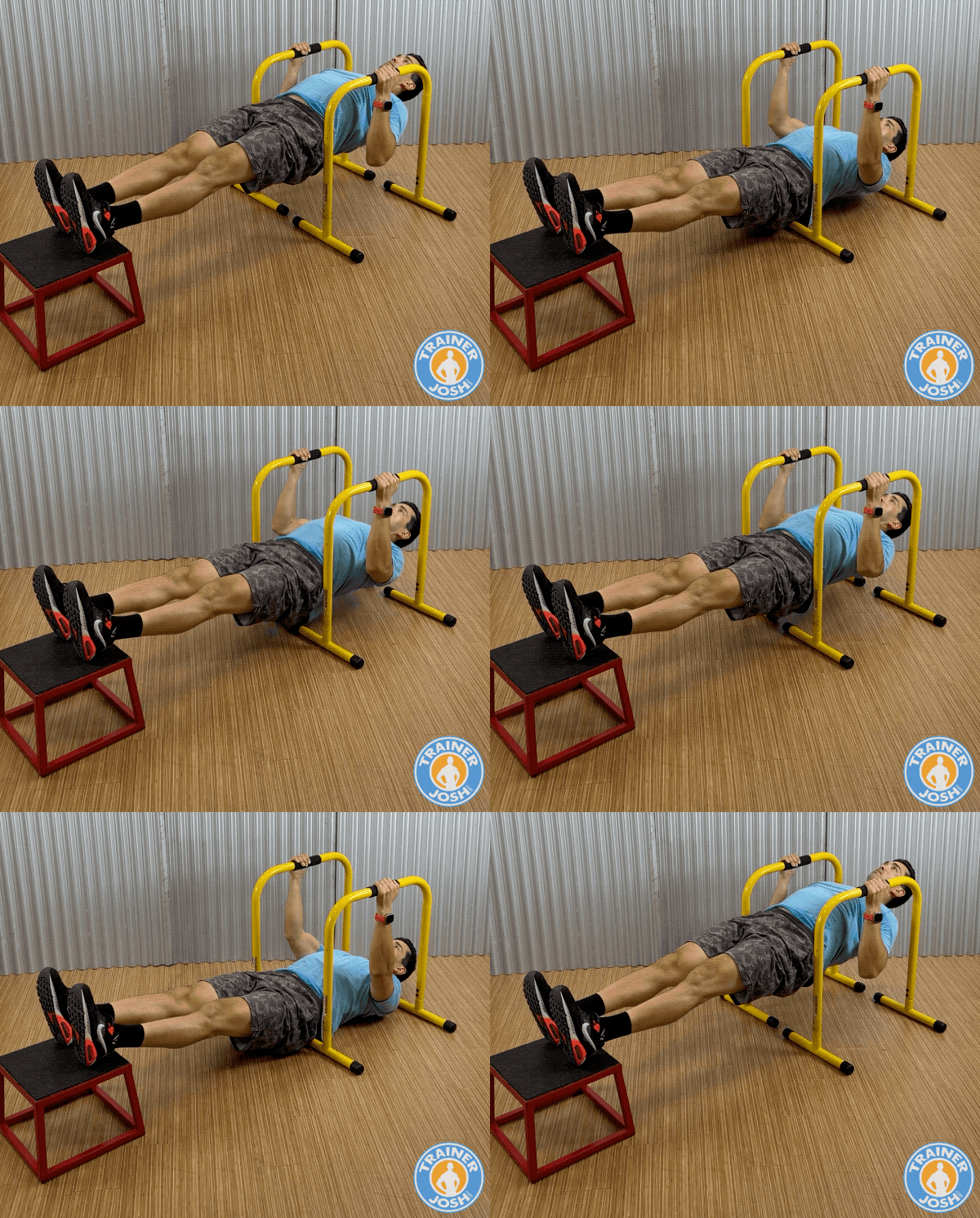
- Adjust difficulty by changing body angle. The more horizontal you are, the harder the exercise. Bend your knees or raise the bar height to make it easier. Elevate feet on a chair to increase intensity by 30-40%.
- Focus on the squeeze, not the pull. Visualize driving your elbows to your ribs rather than pulling your hands to your chest. This mental cue shifts the work from the biceps to the lats and mid-back.
- Loosen your death grip. Squeezing the bar too hard radiates tension into your forearms and causes elbow pain. Hold just tight enough to stay secure.
Common Mistakes to Avoid
- Hip sag: Letting your core go soft destroys the plank position and kills back activation. Glutes tight, ribs down, entire body rigid.
- Head jutting forward: Craning your neck to touch the bar stresses your cervical spine. Keep your head neutral, aligned with your spine.
- Shoulder shrug: Raising shoulders toward your ears recruits upper traps incorrectly. Pull shoulders down and back throughout the entire rep.
- Half-reps: Not fully straightening arms at the bottom or not touching chest to bar at the top robs you of complete muscle development. Full range of motion or it doesn’t count.
Scapular Push-ups
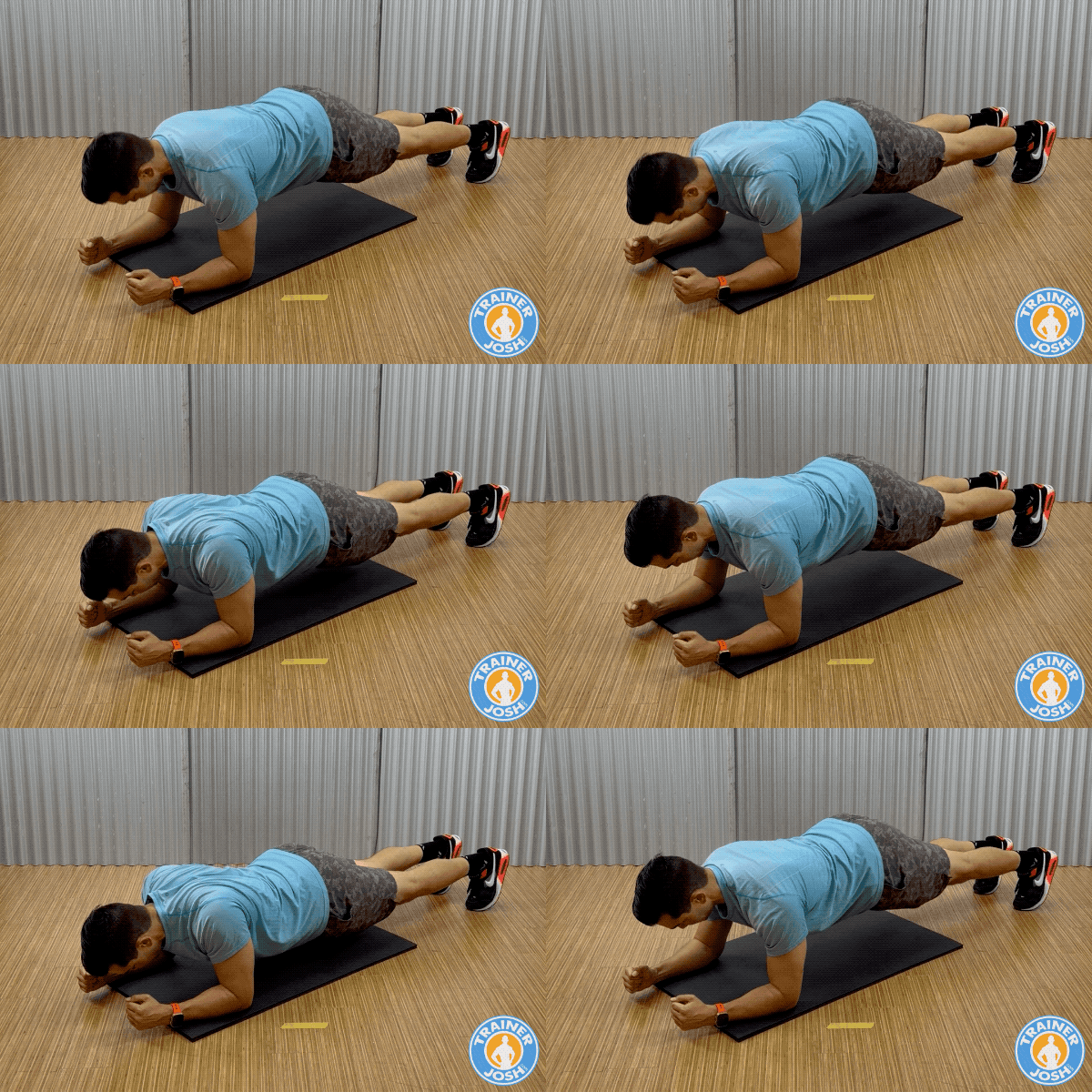
Scapular push-ups build the forgotten foundation of shoulder health—your serratus anterior and rotator cuff stabilizers. Unlike regular push-ups that hammer your chest and triceps, this movement isolates shoulder blade control, improving posture and bulletproofing your shoulders against injury.
How to Perform Scapular Push-ups:
- Setup: Assume a high plank position with hands shoulder-width apart and feet together. Lock your body into a straight line from head to heels by bracing your core and squeezing your glutes.
- Lock Your Elbows: Completely straighten your elbows and keep them rigid throughout the entire movement. No bending allowed—this isolates the shoulder girdle.
- Retract (Lower): Lower your chest toward the floor by pinching your shoulder blades together like squeezing a pencil between them. Your arms stay completely straight.
- Protract (Push Up): Push your chest away from the floor by spreading your shoulder blades apart as far as possible, rounding your upper back toward the ceiling.
- Control the Rep: Pause briefly at the top and bottom positions. Repeat for 10-15 slow, controlled reps—no rushing.
Pro Trainer Tips
- The “plus” at the top is everything. Maximum scapular protraction activates the serratus anterior. Push your hands “through the floor” to separate your shoulder blades as much as possible—you should feel your upper back round significantly.
- Scale to your knees if needed. Maintaining straight arms with a rigid core is more important than keeping your legs straight. Drop to your knees to reduce load rather than compromise technique.
- This builds straight-arm strength. You’re conditioning the connective tissues in your elbows and biceps tendons for heavy static holds. This preparatory work prevents injuries during advanced movements.
Common Mistakes to Avoid
- Bending the elbows: The second your elbows bend, your triceps and pecs hijack the movement. Keep arms locked or you’re just doing a tiny push-up.
- Sagging hips: A loose core causes lower back arch and hip drop. Your body is a single rigid plank—glutes tight, ribs down, total tension.
- Rushing the reps: Speed uses momentum instead of muscular control. Slow down and feel the distinct pinch and spread of your shoulder blades.
- Head jutting forward: Don’t reach toward the floor with your chin. Keep your head neutral and aligned with your spine throughout the entire movement.
Prone Y-T-W Raises
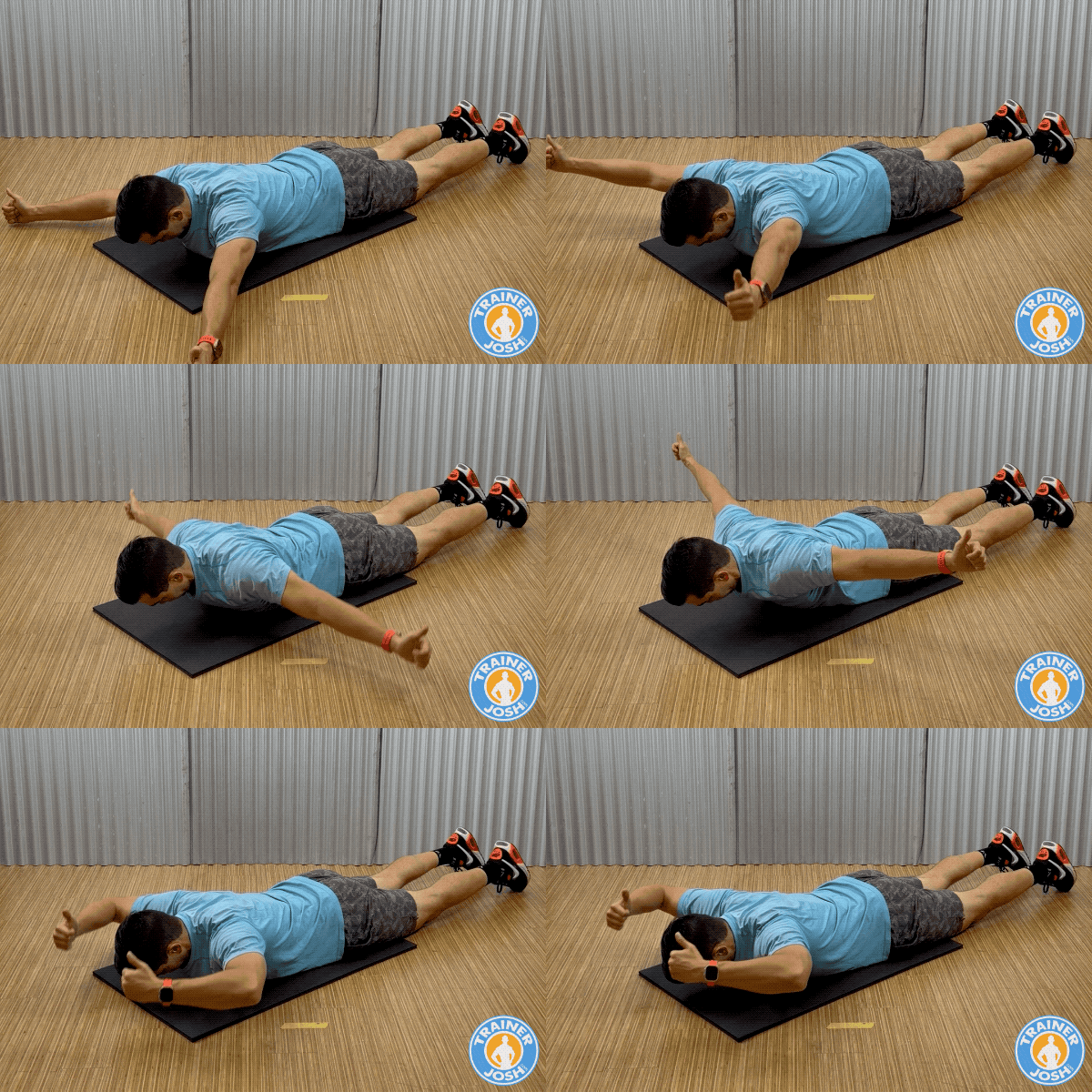
Prone Y-T-W Raises target the muscles most people ignore until their shoulders start clicking… your lower traps, mid-traps, rhomboids, and rotator cuff stabilizers. These small muscles provide the foundation for bigger lifts and prevent the rounded-shoulder “desk worker” look caused by upper crossed syndrome.
Your lower trapezius is typically the weakest link in your scapular system, and this exercise directly addresses that vulnerability. Strengthening these stabilizers doesn’t just fix your posture… it bulletproofs your shoulders against injury during heavy pull-ups and rows by ensuring proper scapular movement patterns instead of compensatory shrugging.
How to Perform Prone Y-T-W Raises:
1. Setup: Lie face down on the floor with your chin resting on the floor. For the Y position, extend arms overhead at a 45-degree angle with thumbs pointing up.
2. The Y (Lower Traps): Depress your shoulder blades down toward your hips, then lift your arms as high as comfortable. Lower with control and repeat for reps.
3. The T (Mid-Traps/Rhomboids): Move arms out to your sides, forming a T-shape, thumbs up. Lift by squeezing shoulder blades together, then lower.
4. The W (External Rotators): Bend elbows to form a W-shape. Lift arms and rotate hands/forearms backward to engage the rotator cuff muscles.
5. Complete the Series: Perform prescribed reps for each letter position or flow dynamically between all three, maintaining constant tension throughout.
Pro Trainer Tips
- Reach outward, not just upward. During the T and Y movements, push your hands as far away from your body as possible. This “reaching” motion maximizes muscle engagement and prevents you from cheating with lower back extension.
- Thumb position changes the target. Thumbs-up in the T position hits the middle trapezius. Rotate to palms-down and you shift emphasis to the rhomboids. Use both variations.
- Keep your chin on the floor. A neutral head position ensures you’re isolating upper back muscles instead of arching your lower back to compensate. Your lumbar spine shouldn’t move.
Common Mistakes to Avoid
- Shoulder shrug: Letting your shoulder blades drift upward toward your ears is a dead giveaway that you’re compensating. Keep scapulae depressed—pulled down toward your hips throughout every rep.
- Looking up: Craning your neck to watch yourself stresses your cervical spine. Keep your head neutral or tuck your chin to the floor.
- Using momentum: Jerking your arms upward defeats the purpose. Use a slow 2-second lift, a 1-second pause, and a 2-second lower tempo to ensure the small stabilizers do the work.
- Lifting with your lower back: If your chest rises significantly off the floor, you’re hyperextending your spine rather than isolating your scapular muscles. The movement is small and controlled.
Bird Dogs
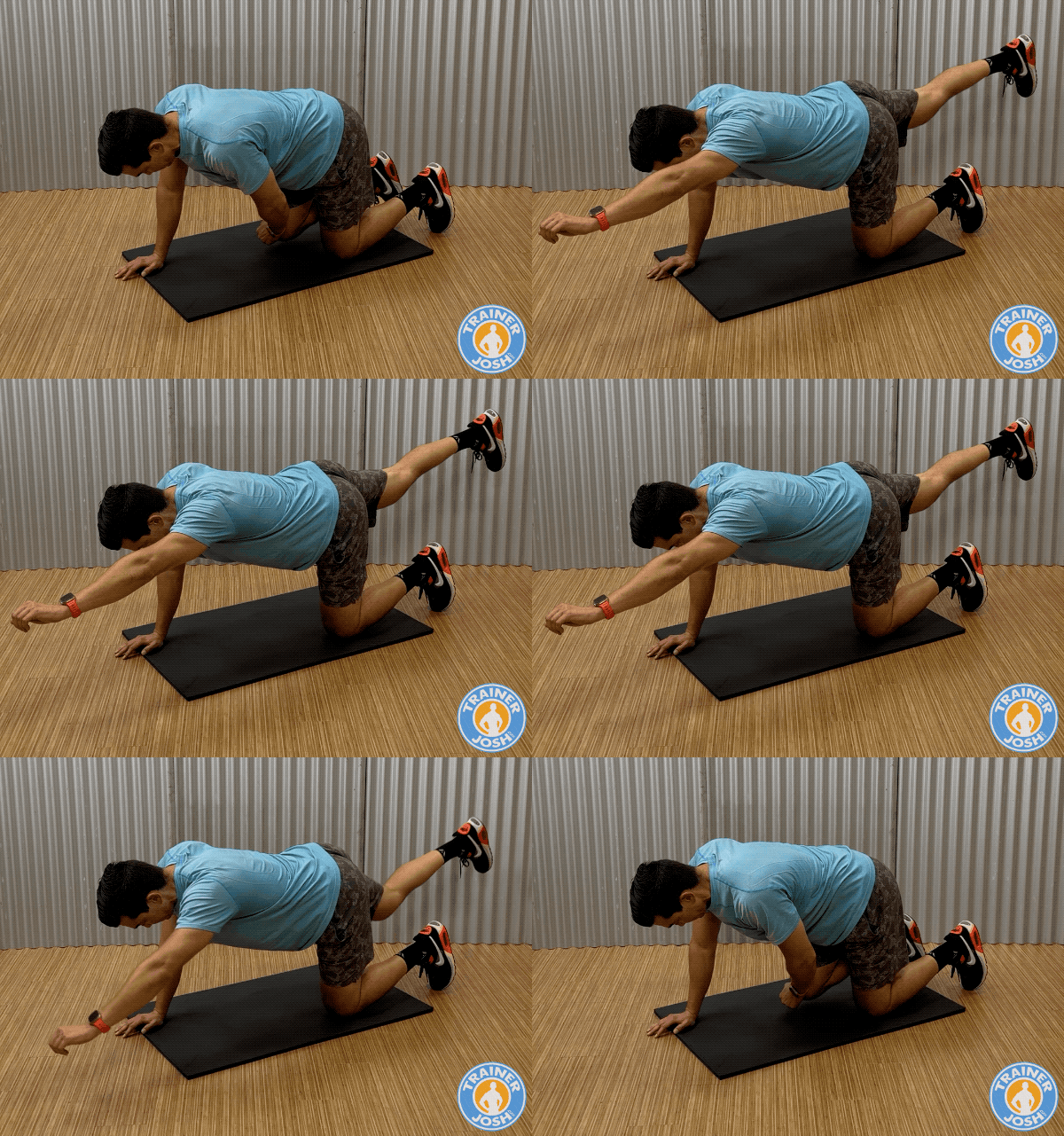
Bird Dogs are your anti-rotation insurance policy for a bulletproof lower back. This exercise simultaneously strengthens your abs and spinal erectors while teaching your core to resist rotational forces—the exact skill that prevents back injuries when you twist to grab something or turn quickly during sports.
By extending opposite limbs, you’re forcing your deep core stabilizers to lock your spine in place against asymmetrical loading, which translates directly to better posture, reduced back pain, and enhanced shoulder and hip mobility.
Bird Dogs are also one of the best bodyweight ab exercises you can do.
This isn’t a “core burner” that leaves you shaking—it’s a neuromuscular pattern that rewires how your body maintains spinal stability under movement, making every other exercise safer and more effective.
How to Perform Bird Dogs:
1. Setup: Start on hands and knees in tabletop position. Place your wrists directly under your shoulders, and your knees directly under your hips.
2. Brace Your Core: Pull your belly button toward your spine to lock your trunk into position. Your lower back should be flat, not arched.
3. Extend Opposite Limbs: Simultaneously lift your right leg straight behind you and left arm straight forward. Reach, don’t just lift.
4. Hold the Line: Pause at the top for 2-3 seconds, creating a perfectly straight line from your heel through your spine to your fingertips.
5. Return and Switch: Slowly lower your hand and knee to the starting position. Repeat with the opposite arm and leg. That’s one rep.
Pro Trainer Tips
- Visualize a broomstick on your spine. The goal is anti-rotation stability—imagine balancing a stick along your back that cannot roll off. Your torso stays completely square to the floor.
- Reach, don’t lift. Extend your arm and leg as far away from your center as possible. This “reaching” motion engages more muscle fibers than simply lifting limbs upward.
- Keep your head neutral. Your neck is part of your spine. Don’t look up at your hand or tuck your chin excessively—keep your gaze on the floor, about 6 inches in front of your hands.
- Progress by slowing down. Once bodyweight becomes easy, increase the hold time to 5-10 seconds or add ankle weights. Speed is the enemy of stability training.
Common Mistakes to Avoid
- Lower back arch: Letting your lumbar spine sag as you extend your leg screams “weak core.” Keep abs braced to maintain a flat back throughout the entire movement.
- Hip rotation: Your hips twisting or tilting defeats the entire purpose. They should remain perfectly level and square to the floor—resist that rotation.
- Rushing through reps: Blasting through bird dogs without pausing turns a stability drill into a cardio move. Slow, controlled movement with a distinct hold builds the neuromuscular control you need.
- Lifting too high: Hyperextending your leg or arm upward arches your back and breaks the straight-line position. Reach long, not high—the line matters more than height.
Best Bodyweight Upper Back Exercises (Posture & Thickness)
Reverse Bridges
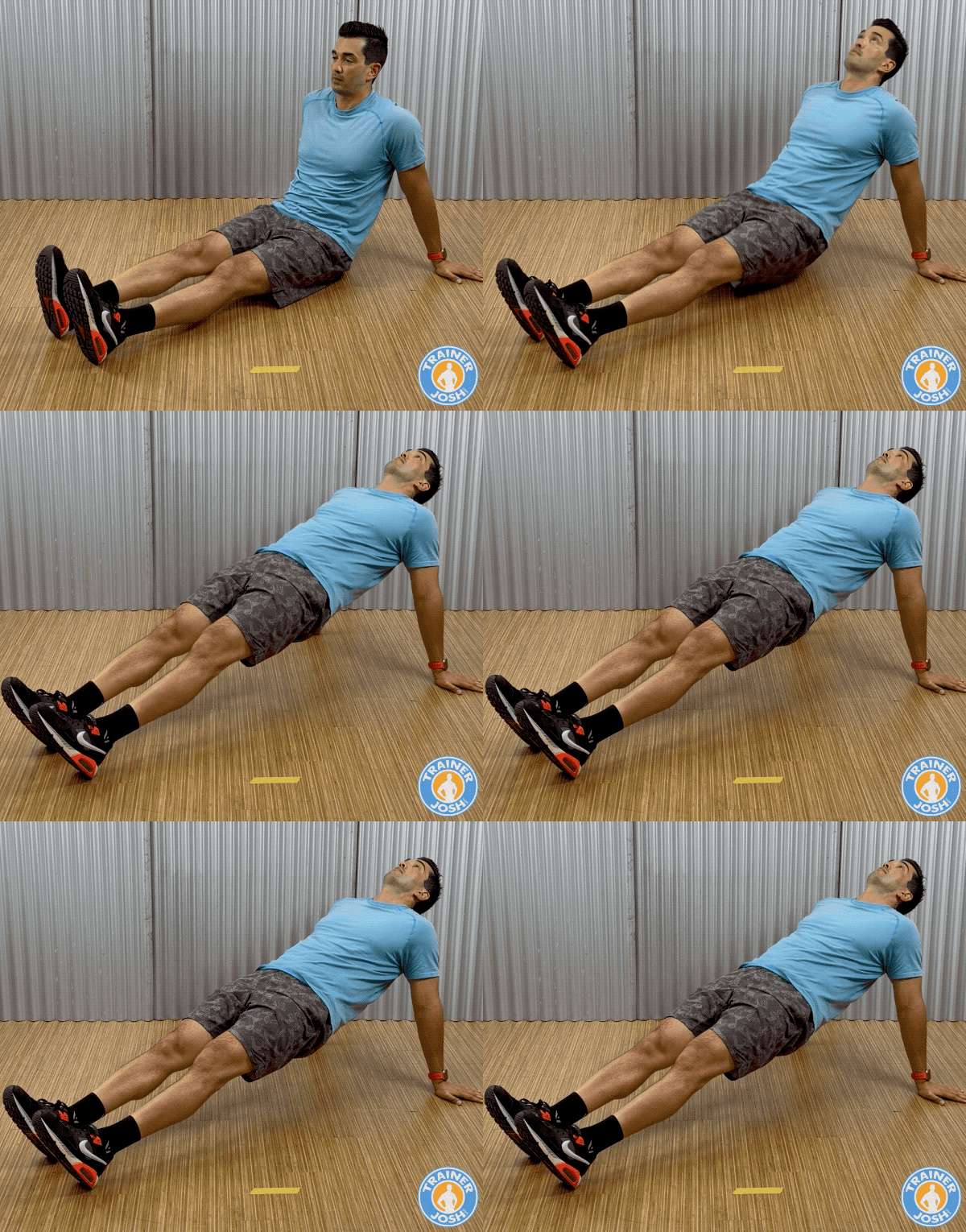
The reverse bridge, also called the straight bridge or rear support, is a powerful exercise that strengthens your entire posterior chain, including your hamstrings, glutes, spinal erectors, and upper back, while at the same time stretching your anterior deltoids and chest.
This is the polar opposite of the plank, and it works opposing muscle groups to counteract poor posture caused by prolonged sitting and forward-reaching activities. This movement also strengthens the structural integrity of the back and shoulders.
How to Perform the Reverse Bridge
- Setup: Sit on the floor with your legs fully extended in front of you and place your palms on the floor slightly behind your hips, with your fingers pointing towards your toes or out to the side, depending on your comfort.
- The Lift: Press forcefully through your palms and heels to drive your hips upward toward the ceiling.
- Alignment: Straighten your arms completely and squeeze your glutes and hamstrings to create a rigid, straight line from your shoulders to your ankles.
- Head Position: Look up at the ceiling, keeping your head neutral and neck straight. Do not let your head jut forward or drop back uncontrollably.
- Hold or Rep: Hold the top position for the desired time (isometric) or lower your hips back to the floor under control to perform repetitions.
Pro Trainer Tips:
- Hand Rotation: Most standard instructions say to point your fingers towards your toes, but you can also point them backward or out to the side. Try experimenting with your hand placement to find what’s most comfortable for your wrists and shoulders.
- Toes Pointed vs. Up: to increase the difficulty, try pointing your toes forward in plantar flexion instead of keeping them pointed up. This engages the calves and extends the line of the body.
- Scapular Retraction: actively pull your shoulder blades together and “open” your chest to stabilize the upper back and protect your shoulder joints.
Common Mistakes to Avoid:
- Sagging Hips: Failing to engage your glutes and core will cause the hips to dip. This will break the necessary straight line from shoulders to feet.
- Bent Knees: Unless you are intentionally performing a regression, like a table bridge, keep your knees locked out to maximize tension in the hamstrings and lower back.
- Holding Your Breath: Do not hold your breath. Instead, breathe rhythmically during the hold to maintain internal pressure and stability.
Scapular Wall Slides
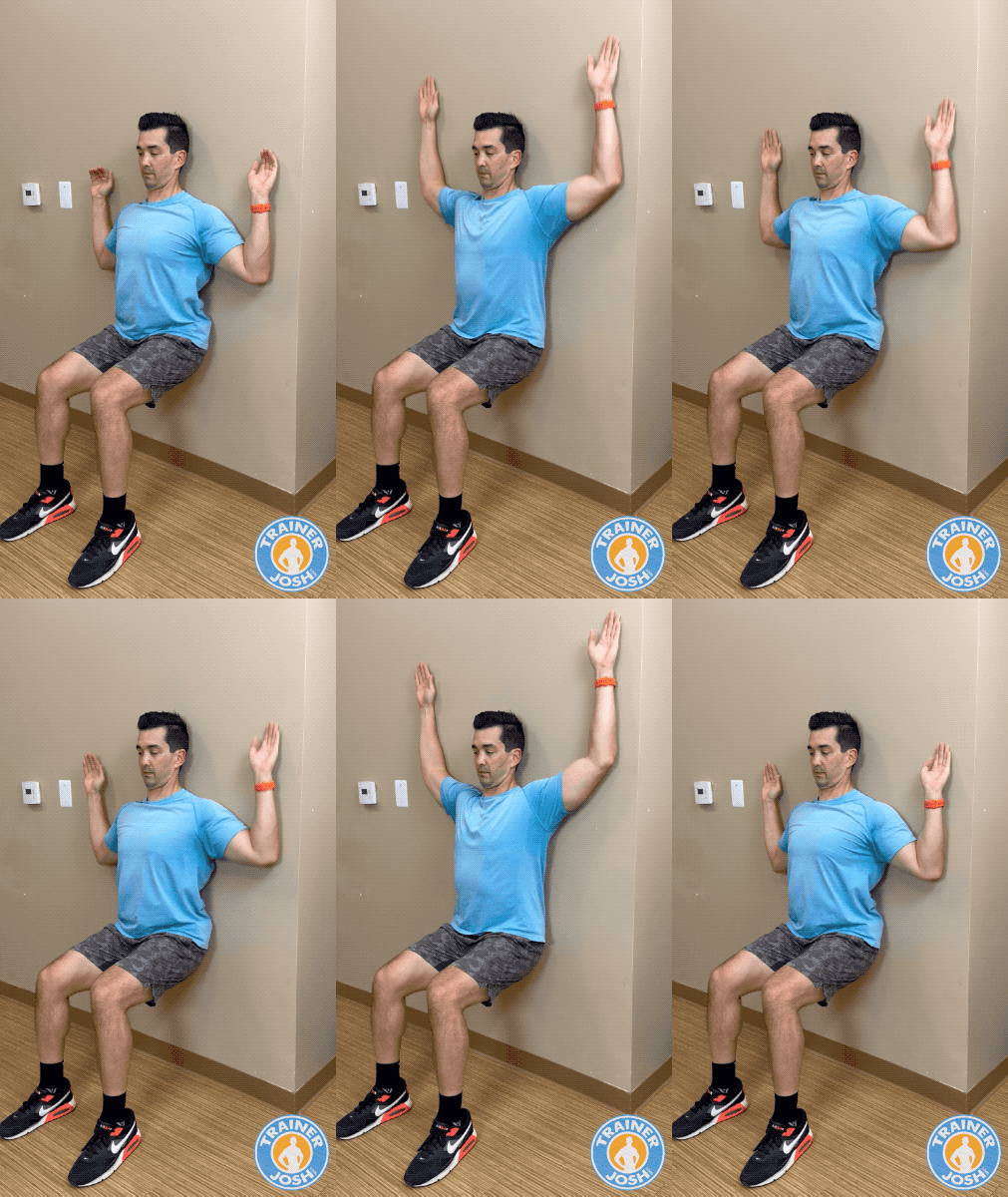
Scapular Wall Slides are an excellent tool for mobilizing the shoulder tissues by combining scapular retraction with elevation and depression. This exercise is particularly effective for improving upper-body posture and shoulder function, often serving as a corrective movement for those who cannot fully raise their arms overhead without compensating by arching their backs.
How to Perform Scapular Wall Slides
- Setup: Stand with your back against a wall, positioning your heels about 4 inches (10cm) away while ensuring your butt and shoulders touch the wall.
- Arm Position: Fully bend your elbows into a “W” position (hands in line with shoulders) with the backs of your hands and arms pressed firmly against the wall.
- Engage: Brace your core and butt to keep your lower back flat against the wall; do not let it arch.
- The Slide: Slowly slide your hands upward until they are above your head and touching, striving to keep your elbows, hands, and shoulders in contact with the wall the entire time.
- Return: Slowly lower your arms back to the starting “W” position, maintaining contact with the wall.
Pro Trainer Tips
- Scapular Rhythm: Begin the movement with your shoulder blades fully depressed (pulled down). As you raise your arms, retract (squeeze) them, and allow them to transition into elevation only as you reach the top.
- Modify for Mobility: If you find it impossible to keep your arms on the wall without arching your back, prioritize a flat back; allow your elbows to leave the wall slightly if necessary until your mobility improves.
- Foot Placement: Doing this exercise with your feet positioned slightly forward (rather than heels against the baseboard) helps alleviate arching in the lower back.
Common Mistakes to Avoid
- Arching the Lower Back: As the arms reach overhead, the back naturally wants to arch away from the wall to compensate for tight shoulders; you must fight to keep the spine neutral and against the wall.
- Losing Arm Contact: Allowing the arms or hands to drift away from the wall reduces the effectiveness of the mobilization; keep practicing until you reach the point where this does not happen.
Back Widow
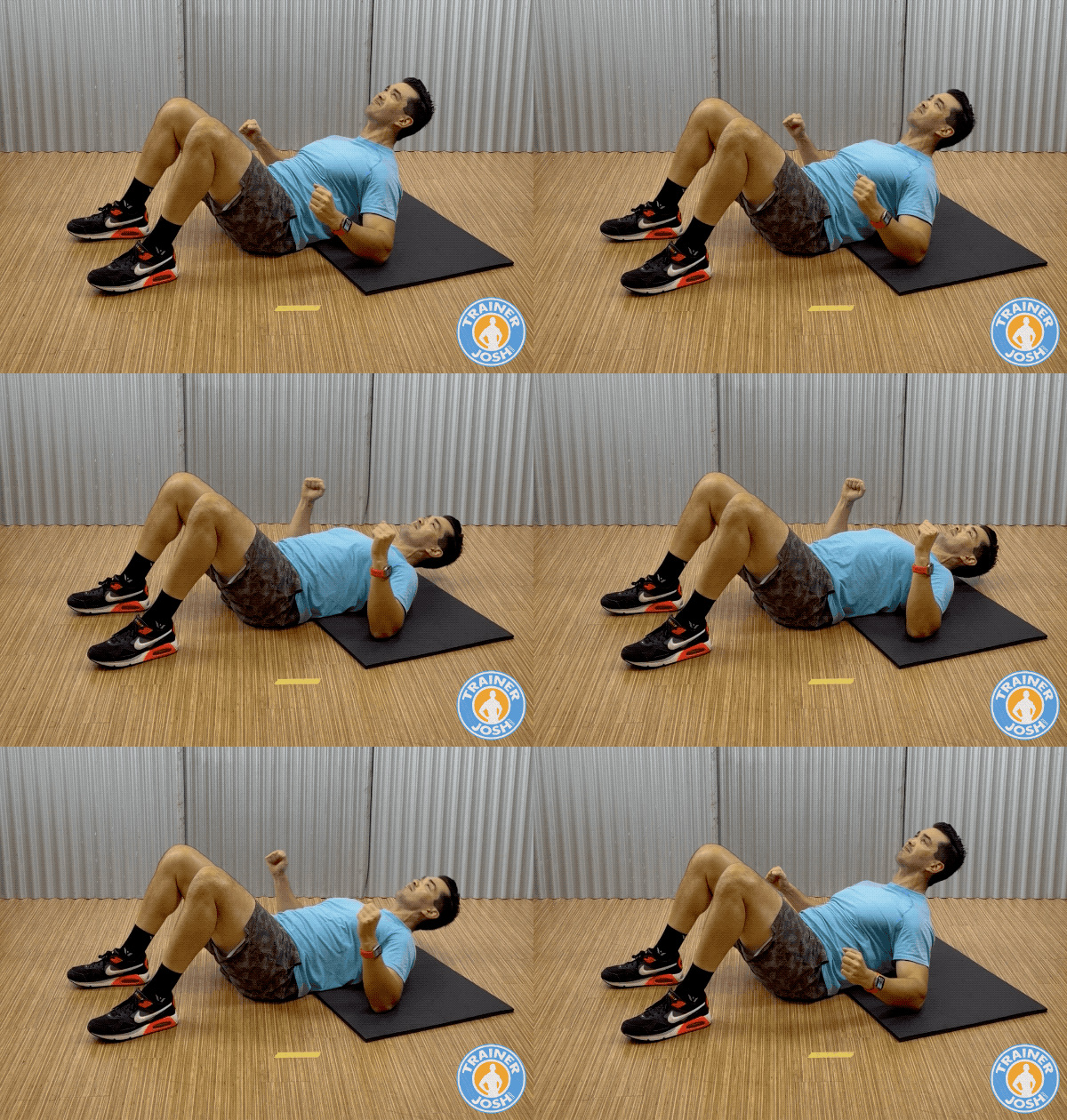
Back Widow (also known as Elbow Bridges or Reverse Elbow Pushups) is a highly effective equipment-free exercise for strengthening the upper back, specifically targeting the posterior deltoids, rhomboids, and scapular stabilizers.
Because they do not require a pull-up bar or suspension straps, they serve as an excellent floor-based alternative to inverted rows to help balance out pushing exercises like push-ups.
Regularly performing this movement helps improve posture by engaging the muscles responsible for scapular retraction, counteracting the rounded shoulders often caused by sedentary behavior or chest-dominant training.
How to Perform Back Widow:
- Setup: Lie flat on your back with your knees bent and the soles of your feet placed flat on the floor.
- Arm Position: Tuck your upper arms tight against your rib cage with your elbows touching the floor and your forearms pointing straight up (perpendicular to the ground).
- The Drive: Drive your elbows and triceps hard into the floor to lift your upper back and shoulders off the ground.
- The Squeeze: Hold the top position for a few seconds (aim for 3–10 seconds), forcefully squeezing your shoulder blades together.
- The Return: Lower yourself back down to the floor with control, resetting your scapula before the next repetition.
Pro Trainer Tips
- Mind-Muscle Connection: Focus entirely on driving the elbows down through the floor. It helps to visualize pushing the floor away from you with your triceps to elevate the torso.
- Increase Difficulty: To make the exercise harder, you can extend your legs straight out and rest only on your heels; this increases the demand on your core while you lift your upper back.
- Foot Pressure: While the focus is on the elbows, keep even pressure through your feet (connecting the heel, big toe, and little toe) to maintain a stable base during the hold.
Common Mistakes to Avoid
- Lifting the Hips: Do not lift your buttocks off the floor. This turns the movement into a glute bridge; keep your hips grounded to maintain upper back isolation.
- Crunching the Abs: Avoid using your abdominal muscles to curl your torso up. The lift must come from the posterior chain (back muscles), driving against the floor, not the anterior chain pulling you up.
- Rushing the Reps: Do not bounce off the floor. The benefit comes from the isometric hold at the top and the controlled lowering phase.
Best Bodyweight Lat Exercises (Width Without Weights)
Pull-ups
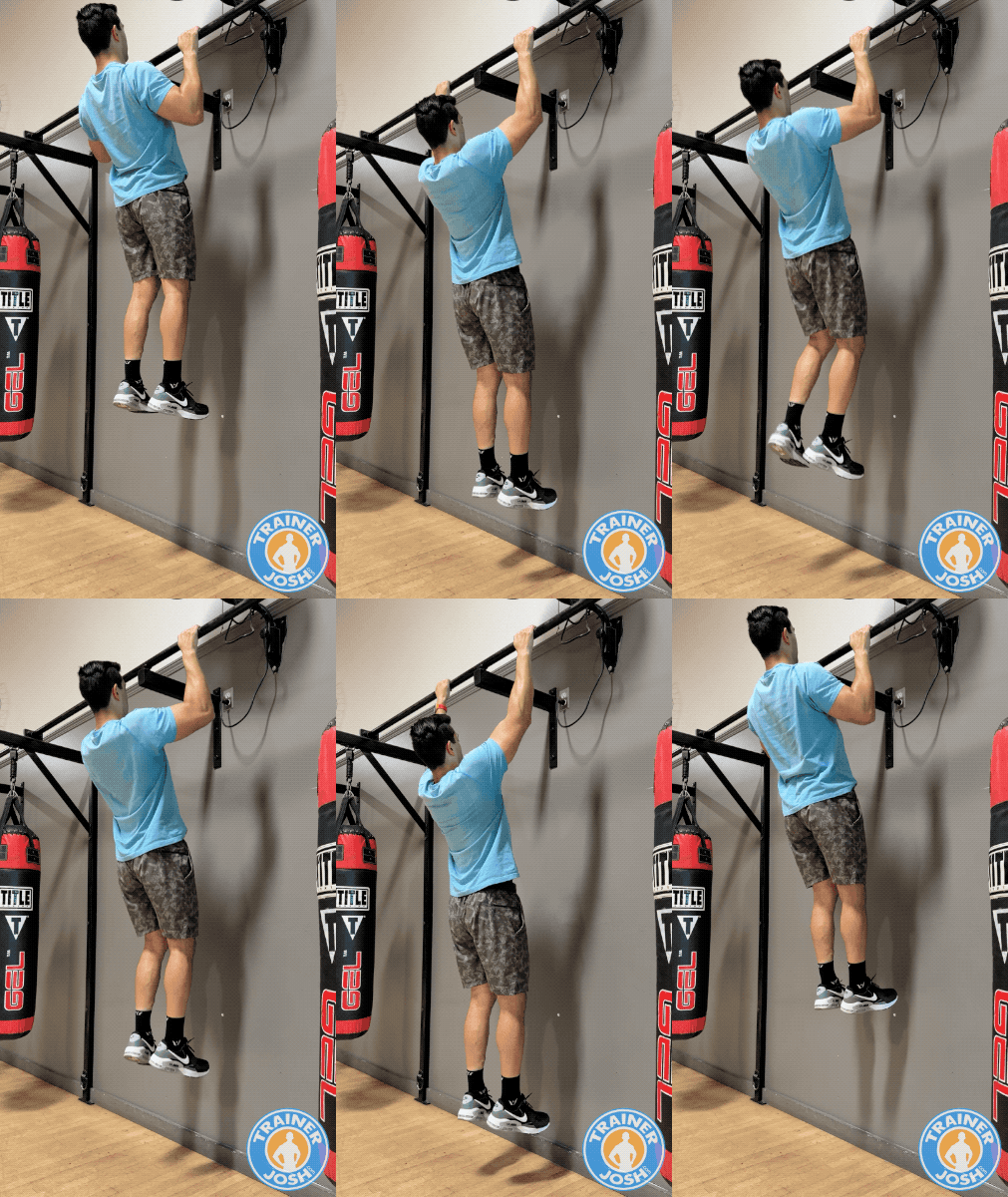
The pull-up is widely regarded as the “king” of upper-body bodyweight exercises, serving as the ultimate test of relative functional strength and a primary builder of the “V-taper” aesthetic.
This compound movement primarily targets the latissimus dorsi (“lats”) for width, but it also heavily recruits the biceps, forearms, rear deltoids, and core musculature to lift the body against gravity. Beyond building significant muscle mass and grip strength, pull-ups help decompress the spine and correct postural issues caused by gravity and sitting, provided they are balanced with proper structural training.
How to Perform Pull-Ups
- Setup: Grasp the bar with an overhand grip (palms facing away) slightly wider than shoulder-width apart, hanging with your arms fully extended in a “dead hang”.
- Engage: Initiate the movement by depressing your scapulae (pulling your shoulders down and back away from your ears) to engage the back muscles before bending your elbows.
- The Pull: Drive your elbows down toward your ribs and pull your body upward, aiming to bring your upper chest or clavicles to the bar rather than just clearing your chin.
- Top Position: Pause briefly at the top with your chest high and shoulders packed down, ensuring your chin is over the bar without reaching or straining.
- The Return: Lower yourself in a slow, controlled motion until your arms are fully straight again, ensuring a full stretch of the lats before starting the next repetition.
Pro Trainer Tips
- Elbow Drive: Focus mentally on pulling your elbows to your ribs rather than pulling your body to the bar. This cue shifts the workload from the arms to the powerful latissimus dorsi muscles.
- Hollow Body Tension: Brace your abs and squeeze your glutes to create a rigid “hollow body” position (ribs down, pelvis tucked). This prevents energy leaks and stops you from swinging.
- Irradiation: Squeeze the bar as hard as possible. This utilizes the principle of “irradiation,” where tension in the grip amplifies nerve force and contraction strength in the shoulder and back muscles.
- Active Negatives: Do not just drop from the top. The lowering phase (eccentric) builds massive strength and hypertrophy; control the descent for at least 2 seconds.
Common Mistakes to Avoid
- Partial Range of Motion: Failing to straighten the arms completely at the bottom (dead hang) or failing to clear the bar at the top cheats you out of full muscle development.
- Craning the Neck: Reaching your chin forward to clear the bar strains the cervical spine and indicates you are not pulling high enough; keep the chin neutral and aim for the chest.
- Shrugging: Letting the shoulders rise toward the ears (turtling) puts the rotator cuff in a dangerous position and disengages the lats; keep shoulders depressed throughout the movement.
- Kipping/Swinging: Unless performing a specific CrossFit variation, using momentum or kicking the legs to get up bypasses the strength-building benefits and can injure shoulders not conditioned for the force.
Chin-ups
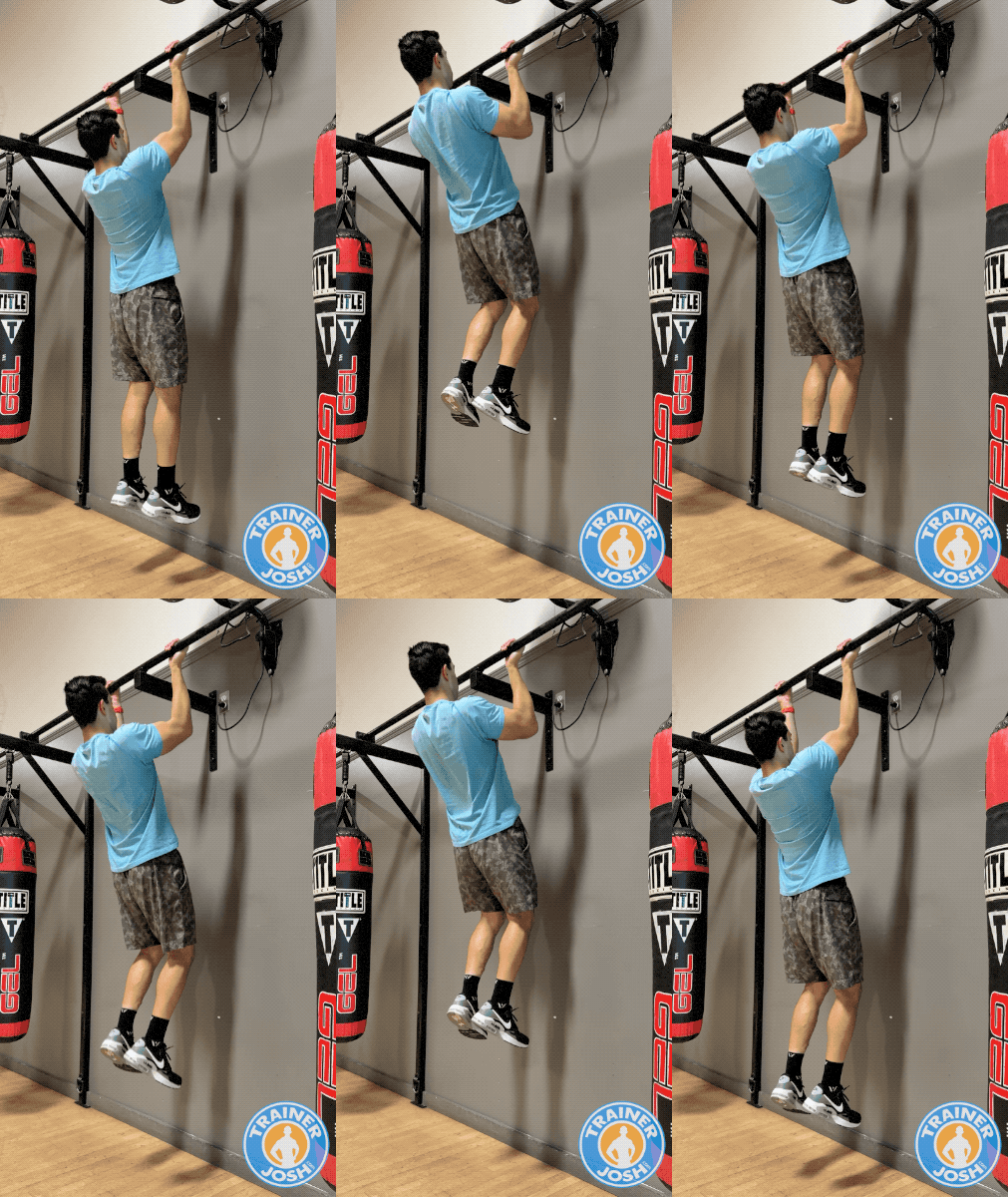
Chin-ups are a fundamental compound bodyweight exercise that builds immense upper-body relative strength, specifically targeting the latissimus dorsi (“lats”) and the biceps brachii, while also engaging the forearms, rear deltoids, and core for stabilization.
Because they utilize an underhand grip (palms facing you), chin-ups place the biceps in a mechanically advantageous position, making them generally easier for beginners than pull-ups while serving as one of the most effective exercises for building “shirt-sleeve-stretching” arm size and a strong back.
How to Perform Chin-Ups
- Setup: Grasp the bar with an underhand grip (palms facing you), shoulder-width apart or slightly narrower.
- The Hang: Start from a dead hang with your arms fully extended (or with a tiny bend to protect elbows), feet off the ground, and ankles crossed or knees bent to maintain balance.
- Engage: Before pulling, depress your shoulder blades (pull them down and back away from your ears) to engage the lats and protect the rotator cuff.
- The Pull: Drive your elbows down and back to pull your body upward until your chin clears the bar or your upper chest touches it.
- The Descent: Lower yourself in a slow, controlled motion back to the starting hang position; do not simply drop.
Pro Trainer Tips
- Elbow Safety: While a full range of motion is generally encouraged, locking out the elbows completely at the bottom of a chin-up can place unnatural twisting stress on the joints; keeping a micro-bend at the bottom maintains muscle tension and prevents tendonitis.
- Core Tension: Maintain a “hollow body” position by keeping your abs tight and glutes squeezed; this prevents energy leaks and stops you from swinging.
- Grip Pressure: Do not squeeze the bar too hard, as this radiates excessive tension into the forearms and elbows, which can cause pain; hold it securely but loosely enough to focus the work on the back and arms.
- Eccentric Focus: If you cannot perform a full rep, use a chair to jump to the top position and lower yourself as slowly as possible (3–5 seconds); this “negative” phase builds the specific strength required for the full movement.
Common Mistakes to Avoid
- Partial Reps: Failing to go all the way down or failing to clear the chin over the bar cheats the muscles of growth and true strength development.
- Kicking/Kipping: Using momentum or kicking the legs to propel yourself up bypasses the target muscles and can lead to injury.
- Shrugging: Allowing the shoulders to rise toward the ears at the top or bottom of the movement disengages the lats and stresses the neck.
- Craning the Neck: Reaching with your chin rather than pulling with your chest strains the cervical spine and indicates you haven’t pulled high enough.
Negative Pull-ups
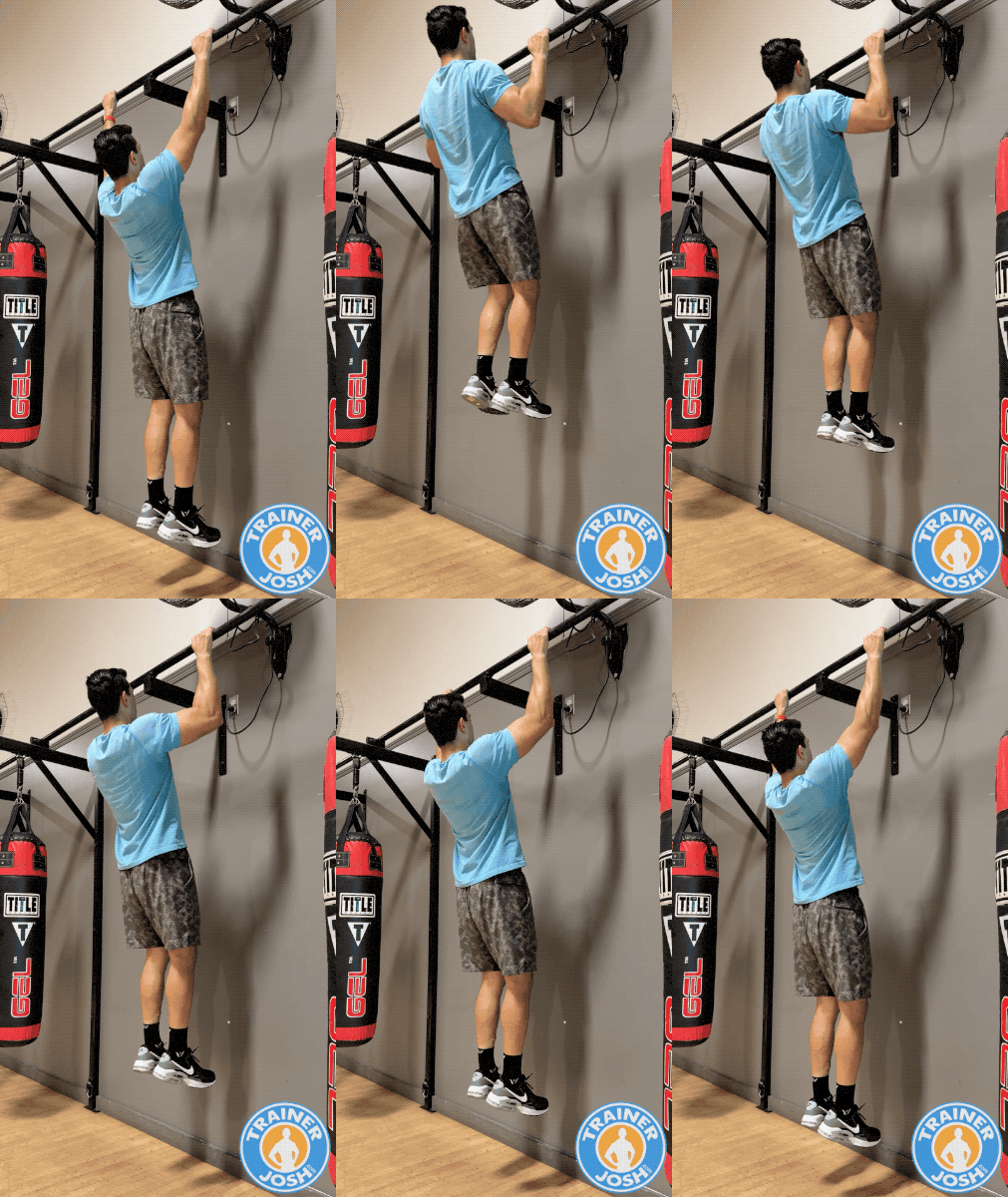
Negative pull-ups (also known as eccentric pull-ups) are widely considered the most effective method for building the specific strength required to perform a full pull-up, as well as for breaking through strength plateaus.
Because the body is naturally stronger during the eccentric (lowering) phase of a movement than the concentric (lifting) phase, this exercise allows you to overload the target muscles—lats, biceps, and forearms—and strengthen the connective tissues in the elbows and shoulders without needing the strength to pull yourself up. The negative phase generates significant mechanical tension and muscle damage, which are primary drivers for hypertrophy (muscle growth).
How to Perform Negative Pull-Ups
- Setup: Place a sturdy chair, box, or bench underneath the pull-up bar so you can reach it easily without having to jump excessively.
- Top Position: Step up or jump to the top position where your chin is over the bar and your chest is close to it; grip the bar tightly with an overhand (pull-up) or underhand (chin-up) grip.
- Engage: Before lowering, consciously depress your shoulder blades (pull them down away from your ears) and brace your core to ensure you are holding the weight with your muscles, not just your joints.
- The Descent: Lower your body in a slow, controlled motion, fighting gravity the entire way down; aim for a descent of anywhere from 3 to 10 seconds, depending on your strength level.
- Full Extension: Continue lowering until your arms are completely straight (dead hang) before stepping back onto the box to reset for the next repetition.
Pro Trainer Tips
- Uniform Speed: A critical nuance is maintaining a uniform speed throughout the descent. Avoid lowering slowly at the top (where you are strongest) and then speeding up at the bottom; you must control the movement all the way to the dead hang to prevent injury and maximize gains.
- Time Under Tension: To effectively build strength, aim for a descent time of at least 3–5 seconds. Advanced trainees can extend this to 10 seconds to further tax the central nervous system and stimulate growth.
- Scapular Control: Throughout the descent, focus on keeping your shoulder blades pulled down. Do not let your shoulders creep up toward your ears as you fatigue, as this shifts stress away from the lats and onto the traps and neck.
- Frequency: Because negatives are taxing on the central nervous system and connective tissues, use them sparingly—typically 2–3 sets of low reps (e.g., 3–5 reps), performed 2–3 times per week, is sufficient.
Common Mistakes to Avoid
- Dropping Too Fast: The most common mistake is letting gravity take over. If you drop quickly, you lose the muscle-building tension and risk injury to the elbows and shoulders.
- Partial Range of Motion: Failing to lower all the way to a straight-arm dead hang cheats you out of strengthening the initial pull phase, which is often the hardest part of the full pull-up.
- Using Momentum: Do not swing or kick your legs. The goal is a controlled, strict lowering phase to isolate the pulling muscles.
- Overtraining: Because eccentric training causes higher levels of muscle damage, performing high volumes of negative pull-ups can lead to excessive soreness and recovery issues; prioritize quality over quantity.
Isometric Pull-ups
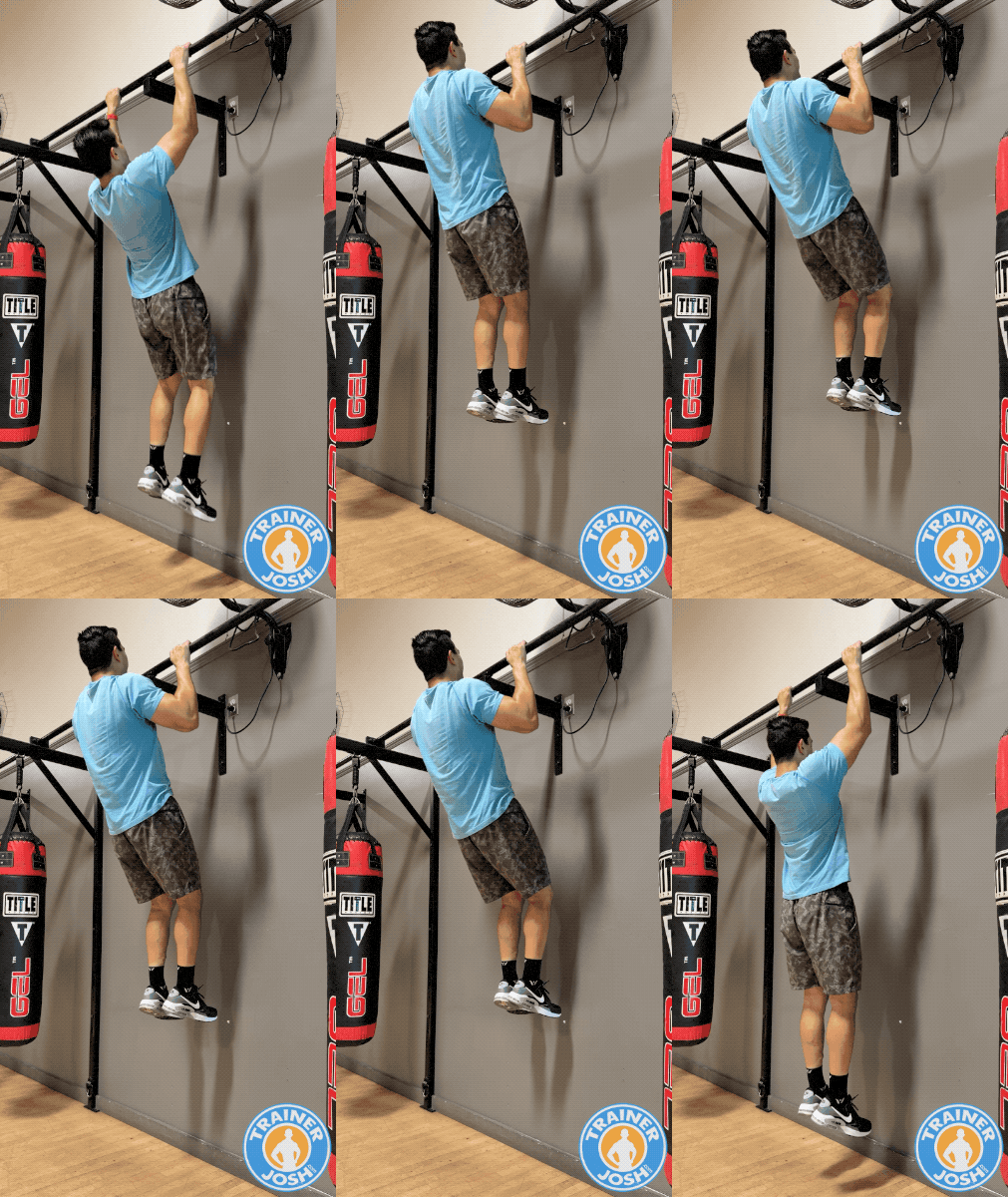
Isometric pull-ups (often called static holds or flexed arm hangs) are a powerful tool for building specific strength at particular joint angles, making them ideal for overcoming “sticking points” where a dynamic pull-up might fail.
Because isometric contractions are approximately 100–120% stronger than concentric (lifting) actions, holding a specific position allows you to overload the target muscles. This method is particularly effective for beginners building the foundation for their first pull-up, as well as for advanced athletes aiming to increase time under tension and tendon strength.
How to Perform Isometric Pull-Ups
- Setup: Place a sturdy box or chair underneath the pull-up bar so you can reach the top position easily; grasp the bar with an overhand (pull-up) or underhand (chin-up) grip.
- Positioning: Jump or step up to the specific range of motion you wish to train—typically the top position (chin over bar with elbows closed), the middle (elbows at 90 degrees), or near the bottom (elbows slightly bent).
- Engage: Generate maximum body tension by squeezing the bar tightly, bracing your core, and actively pulling your shoulders down and back away from your ears (scapular depression).
- The Hold: Maintain this static position for a prescribed time or as long as possible, fighting to keep the angle of the elbow from opening up.
- The Release: Once fatigued or the time elapses, lower yourself down in a slow, controlled manner until your arms are straight before dropping from the bar.
Pro Trainer Tips
- The “Sweet Spot” Calculation: A useful conversion formula for programming is that 1 concentric repetition is roughly equal to 2 seconds of isometric holding.
- Target Weak Angles: You are strongest at the specific angle you train. To build a full pull-up, train holds at three different angles: the top (chin over bar), the middle (90 degrees), and the bottom (just initiated). Spend more time training the angle where you are weakest.
- Irradiation: To instantly boost strength, use the principle of “irradiation” by crushing the bar with your grip and tensing your glutes and abs. This neural drive overflows into the working muscles, making the hold feel stronger and more stable.
- Training Volume: To make sure for progress without overtraining, aim to hold for 60–75% of your maximum hold time per set, rather than going to absolute failure every time.
Common Mistakes to Avoid
- Shrugging the Shoulders: A critical error is allowing the shoulders to rise up toward the ears (turtling). You must keep the scapulae depressed (pulled down) to engage the lats and protect the rotator cuff.
- Holding Your Breath: Do not hold your breath, as this can spike blood pressure. Breathe shallowly through the nose or hiss air out slowly while maintaining abdominal tension.
- Relaxing the Legs: Do not let your legs swing or hang loosely. Tensing the lower body (or holding an L-sit position) creates a “rigid block,” making the body easier to control and hold
Archer Pull-ups
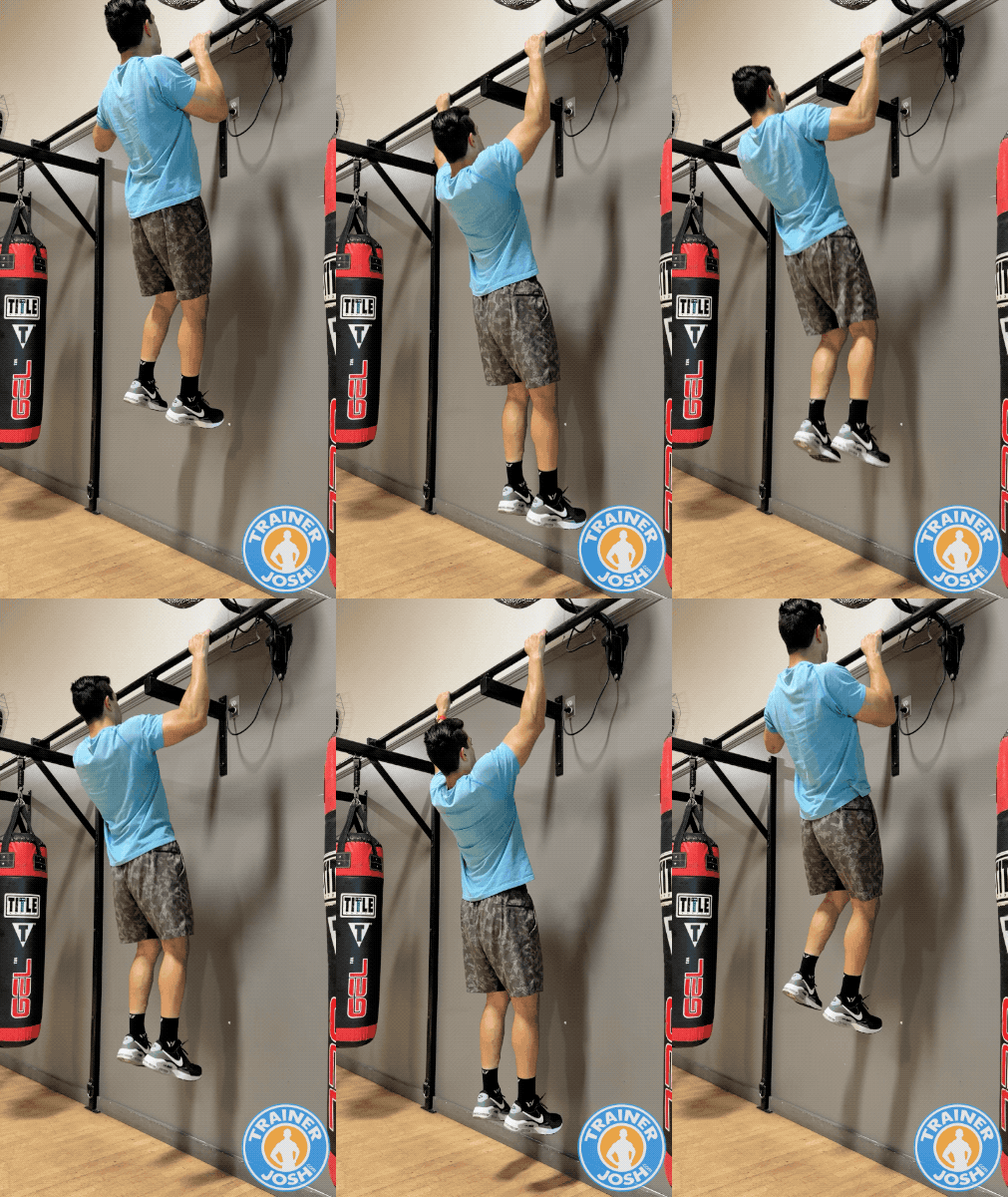
Archer pull-ups serve as a critical bridge between standard pull-ups and the elite one-arm pull-up. This allows you to build significant unilateral strength by shifting the majority of your body weight to one side.
This exercise effectively corrects muscle imbalances in the back, biceps, and shoulders, and develops the specific straight-arm strength and scapular control necessary for advanced skills like the muscle-up and the iron cross.
How to Reform Archer Pull-Ups
- Setup: Grasp the pull-up bar with an overhand grip (palms facing away) significantly wider than shoulder-width apart and hang with straight arms.
- The Pull: Pull your body up toward one side (e.g., the left), focusing on tucking your pulling elbow tight into your chest or ribs.
- The Extension: As you rise, keep the opposite arm (the non-pulling arm) straight, allowing it to extend across the bar or into a “cross” position to provide stability with minimal assistance.
- Top Position: Continue the movement until your chin clears the bar or is even with the back of your pulling hand.
- The Return: Lower yourself back down to the center dead-hang position with a slow, controlled descent, then repeat on the opposite side.
Pro Trainer Tips
- The “Half-False” Grip: As you move toward your pulling arm, transition the straight arm into a “half-false grip” (wrist resting slightly on top of the bar); this allows you to push down hard with the straight arm to keep your chin above the bar.
- Visual Cue: Visualize the motion of an archer drawing a bow to shoot an arrow. This helps coordinate the push-and-pull mechanics required for the move.
- Rotator Cuff Safety: Because the wide grip and lateral force place significant stress on the rotator cuff, avoid placing this exercise at the very end of a routine when your muscles are most fatigued.
Common Mistakes to Avoid
- Bending the Assisting Arm: The non-working arm should gently straighten over the bar. Keeping it bent provides too much assistance, reducing the load on the working side.
- Rushing the Descent: Avoid dropping quickly from the top; ignoring the eccentric (lowering) phase robs you of strength gains and control.
- Using Momentum: Do not swing or kick to initiate the movement; if you cannot perform the rep strictly, regress to an easier variation rather than performing half-reps or using momentum.
Bodyweight Lower Back Exercises (Strength Without Pain)
Superman / Prone Cobra
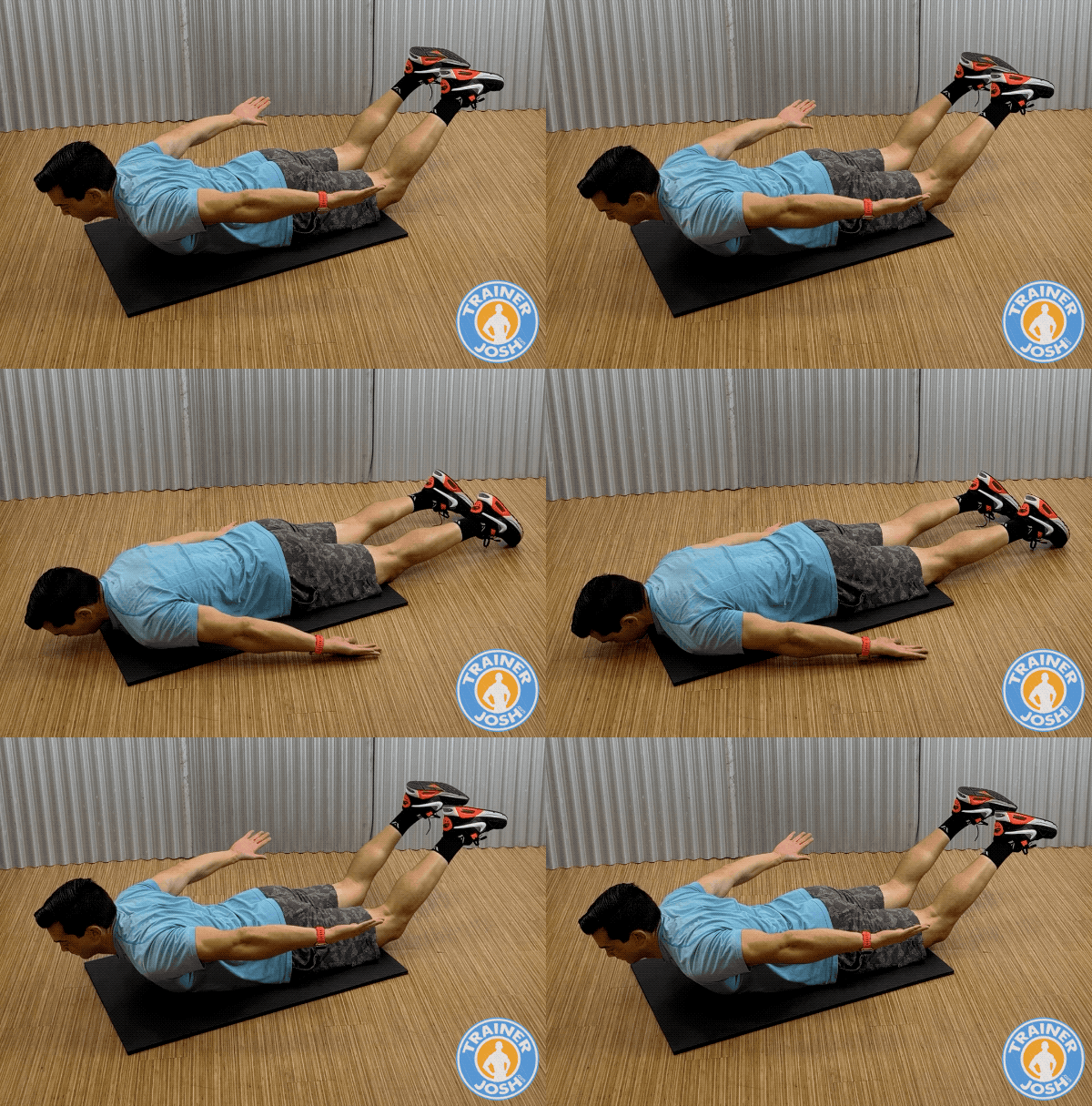
The Superman / Prone Cobra is designed to strengthen the entire posterior chain, including the spinal erectors, rhomboids, glutes, and trapezius. This helps alleviate back pain caused by weak muscles.
By engaging the core and back muscles simultaneously, this exercise improves spinal mobility, counteracts the poor posture often associated with sedentary lifestyles, and provides a strong foundation for more advanced strength training.
How to Perform the Superman / Prone Cobra
- Setup: Lie face down on the floor with your legs straight; for the Superman, extend your arms straight overhead, or for the Cobra, rest your arms by your sides.
- Engage: Inhale deeply, then as you exhale, forcefully contract your glutes and the muscles around your shoulder blades.
- The Lift: Simultaneously raise your chest, arms, and legs off the floor, aiming to hyperextend at the hips (lifting the thighs) rather than just arching the lower back.
- The Hold: Pause at the top position for a moment (or hold for 20 seconds for endurance), squeezing your glutes and lower back to maintain a shallow “U” shape.
- The Return: Slowly lower your upper and lower body back to the floor under control to complete the repetition.
Pro Trainer Tips
- The Glute Squeeze: To make the exercise more effective, limit lumbar hyperextension and instead focus on hyperextending the hips by squeezing the glutes and hamstrings to lift the legs. If you have a hyperlordotic posture (excessive curvature of the lower back), squeezing the glutes is essential to prevent over-recruiting the lower back muscles.
- Cobra Hand Position: When performing the Cobra variation, externally rotate your arms so your thumbs point up and palms face away from your body; this helps set the shoulders in a neutral alignment.
- Modify Intensity: The exercise is harder with arms extended overhead (Superman); if this is too difficult, move your arms to your sides (Cobra/Arch) to bring more weight closer to your center of gravity.
Common Mistakes to Avoid
- Looking Up: Avoid looking up toward the ceiling, which places unwanted stress on the cervical spine (neck); keep your head and neck in a neutral position throughout the movement.
- Bouncing: Do not bounce or use momentum to get into the top position; stay as still as possible once elevated to ensure muscular control.
- Holding Breath: Do not hold your breath; breathing deeply while in the held position can actually help increase the stretch.
Hip Hinge / Good Mornings
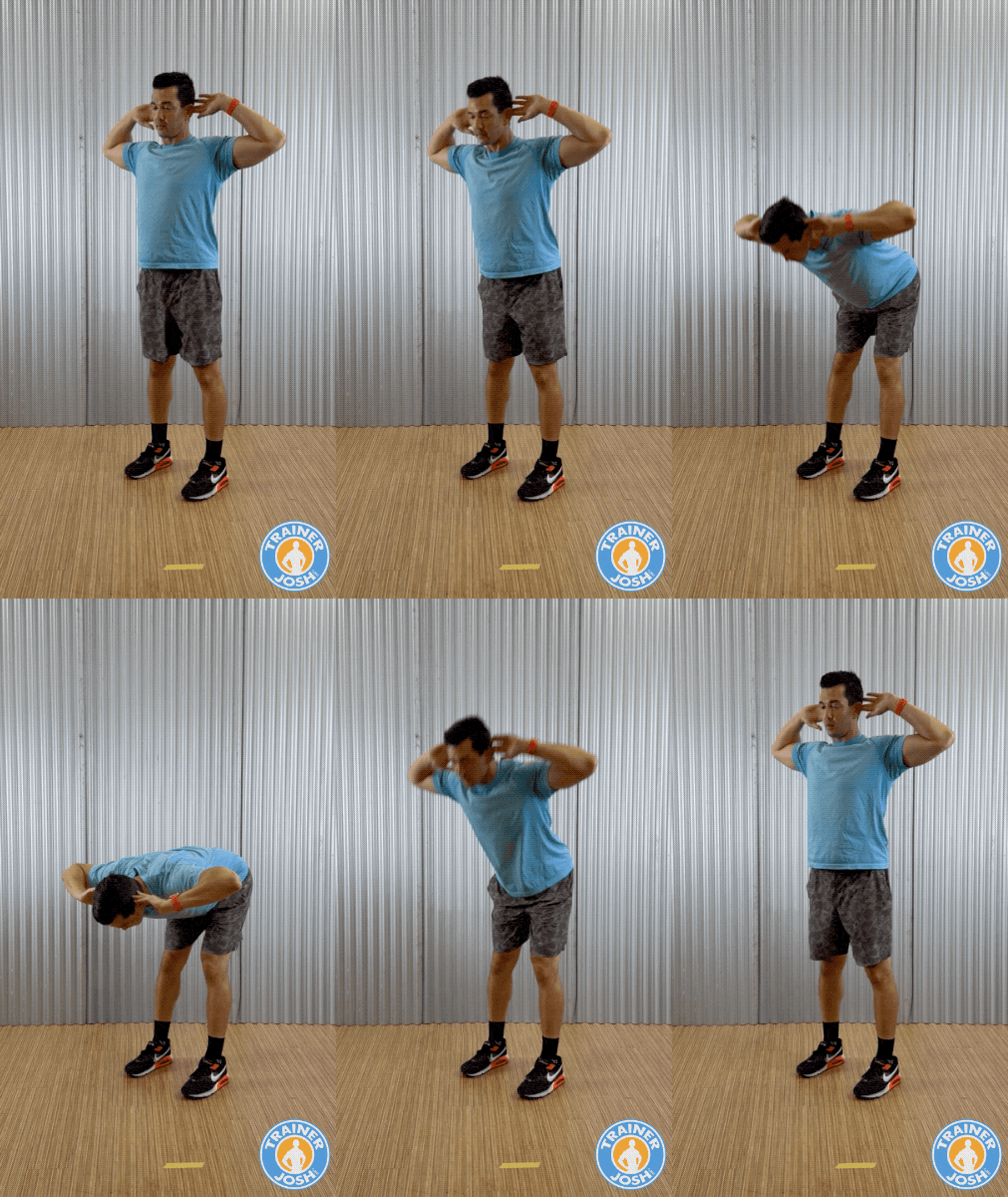
The Hip Hinge, often performed as the “Good Morning” exercise, is a fundamental movement that strengthens the entire posterior chain. It specifically targets the hamstrings, glutes, spinal erectors, and lower back.
This exercise is essential for learning how to move the hips without moving the trunk, a mechanism crucial for lifting objects off the floor safely and correcting poor posture.
How to Perform the Hip Hinge / Good Mornings
- Setup: Stand upright with your feet hip-width apart and your fingertips gently touching behind your head (or hands on your hips). Make sure your knees are “soft” (slightly bent) but not locked.
- Alignment: Pull your shoulders down and back, retract your chin slightly, and engage your core to maintain a neutral spine with a slight natural arch in your lower back.
- The Hinge: Initiate the movement by pushing your hips and butt backward while bending forward only at the waist; imagine you are trying to close a door behind you with your glutes.
- The Stretch: Continue lowering your torso until you feel a distinct tightness or stretch in your hamstrings, or until going any further would require you to round your lower back.
- The Return: Reverse the motion by squeezing your glutes and hamstrings to push your hips forward and return to the starting upright position.
Pro Trainer Tips
- Chest & Butt Out: To maintain the safety of your spine, focus on sticking your chest out and poking your butt out throughout the descent; this ensures you maintain the necessary “inverse arch” in the back.
- Use a Dowel: To master the neutral spine position, hold a dowel or stick along your back; it should maintain contact with your head, upper back, and tailbone throughout the entire movement.
- Weight Distribution: Unlike a squat where you might sit down, here you must keep your weight balanced; shifting your hips back counterbalances the torso leaning forward.
Common Mistakes to Avoid
- Rounding the Back: The most critical error is allowing the lower back to round or flex; you must stop the descent immediately if you cannot go lower without losing the arch in your back.
- Squatting: Do not bend your knees significantly during the descent; while they should not be locked, bending them too much turns the exercise into a squat and removes tension from the hamstrings.
- Sloping Shoulders: Avoid letting your shoulders slump forward toward the floor; keep them pulled back and your chest open to protect the upper back.
Reverse Hyperextensions
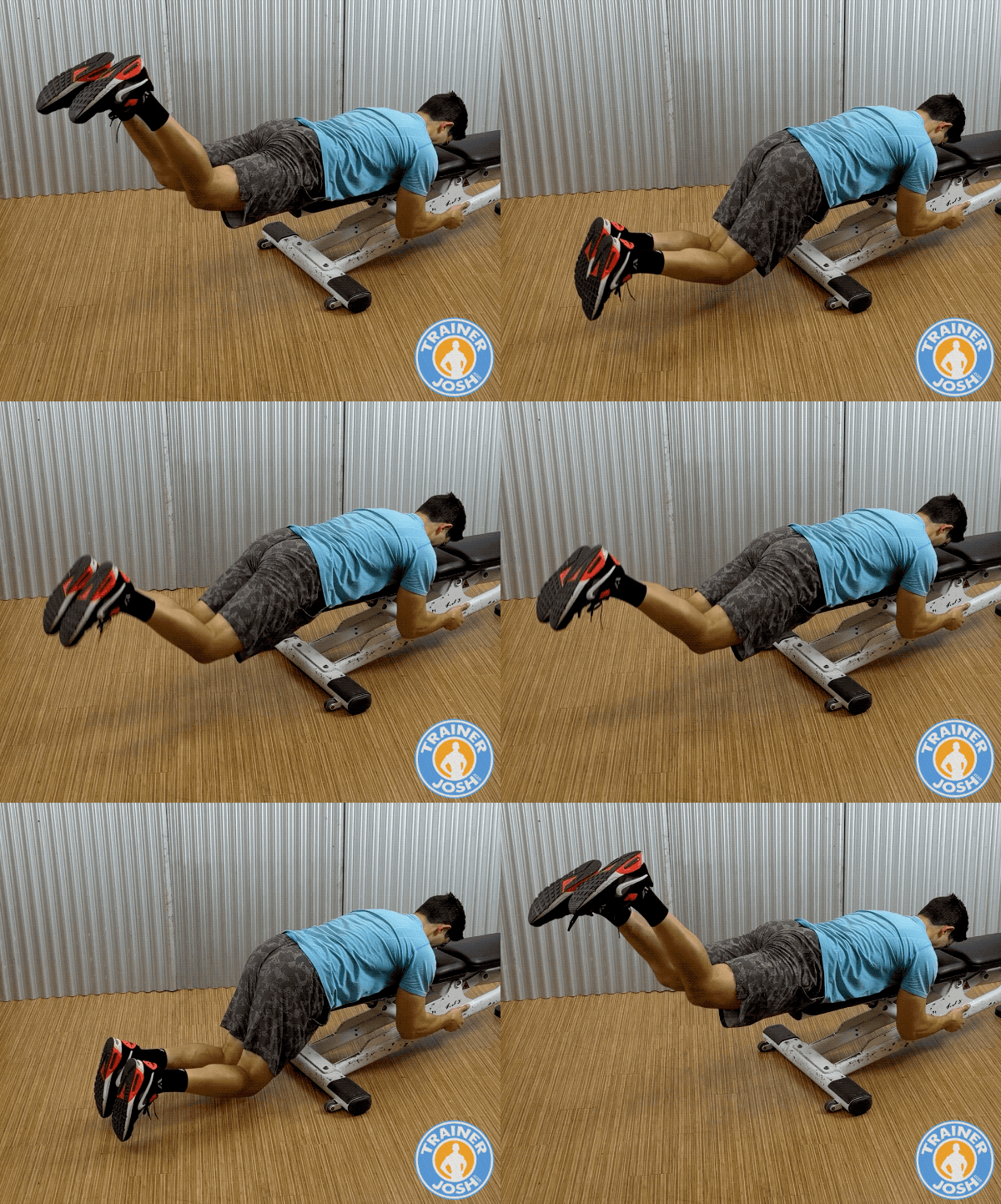
The reverse hyperextension is a hip-dominant exercise that effectively strengthens the entire posterior chain, including the glutes, hamstrings, and spinal erectors, all at once.
It’s great for rebuilding strength, stability, and hypertrophy in the lower back. Usually helping to alleviate back tightness and pain by correcting instability and weaknesses.
How to Perform the Body Weight Reverse Hyperextension
- Setup: Lie face down with your torso across a sturdy table or bench, draping your legs over the edge with your knees straight.
- Anchor: Firmly grasp the edges of the table with your hands to lock your torso and spine securely into place.
- The Lift: Keeping your upper body locked, raise your legs upward by engaging your posterior chain.
- Lockout: Squeeze your glutes forcefully at the top of the movement.
- The Return: Lower your legs back to the starting position under control, keeping the spine stable.
Pro Trainer Tips
- Head Position: Look down throughout the movement to prevent hyperextending your neck.
- Stretch & Squeeze: Focus on achieving a deep stretch in the hamstrings at the bottom of the movement and a forceful glute squeeze at the lockout.
- Single-Leg Variation: If the standard version is too difficult, you can perform the single-leg reverse hyper. This variation puts less demand on the spinal erectors and helps you focus on moving solely at the hips.
- High Repetitions: For back tightness or prehabilitation purposes, high repetitions are often effective for correcting instability and strengthening the area.
Common Mistakes to Avoid
- Overextending the Spine: Avoid arching or overextending the lower back at the top of the lift. Stop the movement when the glutes are fully squeezed.
- Rounding the Back: Do not allow the lower back to round as you lower your legs. You must maintain a stable spine throughout the descent.
- Using the Spine as the Prime Mover: The movement should revolve primarily around the hip joint; ensure you are extending from the hips rather than flexing and extending the spine itself.
Bodyweight Back Exercises — No Equipment Options
Here’s the truth about training back without a gym… You can push off the floor all day long for bodyweight chest exercises, but you can’t grip the ground to pull yourself up for back.
That’s the gravity problem every home trainer faces. And it’s exactly why your chest gets bigger while your back stays flat.
The fix? Get creative with household items to manufacture pulling angles.
At-Home Setups: Turning Your Living Room Into a Gym
The Table Inverted Row
Find a study dining table. Lie underneath it and grip the edge with your hands shoulder-width apart.
Keep your body rigid from heels to shoulders. Pull your chest to the underside of the table. This mimics the barbell bent-over row. It targets your lats, rhomboids, and rear delts in one movement.
Progression tip: Bend your knees to make reps easier. Straighten your legs or elevate your feet on a chair to increase difficulty.
But test the table first. A light table can flip onto you when you’re pulling from one side.
Door Pull-ups
Open a sturdy door halfway. Place a towel over the top edge to protect your hands. Wedge a book or doorstop underneath so it doesn’t swing.
Grasp the top edge with an overhand grip. Pull your chin over the door while your legs slide against the surface.
The friction adds resistance. This makes door pull-ups harder than standard bar pull-ups.
Critical warning: Only use solid doors. Hollow interior doors will rip off the hinges.
Towel Rows
Loop a sturdy towel over a doorknob or around a pole. Hold both ends and lean back until your arms are straight. Pull your chest toward the anchor point.
This creates the same scapular retraction you’d get from a face pull. Your traps and rhomboids fire hard.
One of my clients discovered this setup during the COVID lockdowns. He went from zero pull-ups to five in eight weeks by doing only towel rows three times a week.
What Won’t Work Well
Let’s address the elephant in the room… You cannot replicate vertical pulling without a bar.
The lats have maximum leverage during overhead shoulder extension. Floor exercises simply cannot provide this stimulus.
Your V-taper width? That comes from vertical pulls. Without a bar, door, or table, you’re severely limited.
Floor exercises excel at lower back health (spinal erectors, posture correction). But they lack the heavy resistance needed for significant upper back hypertrophy.
Think maintenance and injury prevention, not muscle building.
Progressive overload hits a wall fast. Once you’re crushing 20+ reps of table rows, adding small weight increments becomes nearly impossible without a weighted vest or loaded backpack.
I recommend getting a pull-up bar for your home.
Safety Warnings: Don’t Be That Person
Door Physics 101
Always pull toward the side that closes. Pull from the wrong side, and the latch can fail, sending you backward onto the floor.
Heavy horizontal pulling can strip hinge screws. Doors are designed for vertical loads, not your bodyweight yanking sideways.
Furniture Stability Test
Before trusting a table with your full bodyweight, test it aggressively. Light tables flip. I’ve seen it happen.
Only use heavy, sturdy desks or tables. Place them against a wall for extra stability.
Grip Safety on Smooth Surfaces
Sweaty hands on door frames or polished wood? You’re asking for a fall.
Use a towel for friction. Move slowly and controlled—no momentum.
The Bottom Line:
At-home back training works when you manufacture pulling angles:
- Floor exercises = lower back health and posture correction
- Table rows = primary horizontal pulling movement for lats and mid-back
- Door pull-ups = vertical pulling for lat width (solid doors only)
- Towel setups = face pulls and rows targeting upper back
Bodyweight Back Workout Routines (Done-For-You)
Beginner Bodyweight Back Workout
Intermediate Bodyweight Back Workout
Advanced Bodyweight Back Workout
Common Mistakes with Bodyweight Back Exercises (Why You’re Not Feeling It)
“I only feel this in my biceps.”
Sound familiar?
You’re cranking out pull-ups and rows, but your arms are screaming while your back feels nothing. Meanwhile, you’re wondering if bodyweight exercises even work for building a thick back.
They do. But you’re making one of these five critical mistakes that turn back exercises into arm workouts.
Mistake #1: Letting Your Arms Hijack the Movement
Your brain connects to muscles near your hands faster than muscles on your torso. It’s basic neurology.
So when you pull, your biceps fire first. Your lats? They’re along for the ride.
The fix: Stop pulling your face to the bar. Instead, drive your elbows down to your ribs (pull-ups) or drag your elbows back behind you (rows).
Think “elbows first, hands second.”
Grip trick: Loosen your grip slightly. A death grip radiates tension into your forearms and biceps, stealing work from your back. Hold the bar just tight enough to stay secure.
One client complained about elbow pain during rows. We loosened his grip by 30%. His lats finally engaged, and the pain vanished.
Mistake #2: Skipping Scapular Movement (The Missing Link)
Your shoulder blades are where back strength lives. No scapular movement means no muscle contraction.
Most people bend their elbows immediately from a dead hang. This bypasses the lats, traps, and rhomboids entirely.
The fix: Initiate every rep by depressing and retracting your scapulae before your elbows bend.
Pull-ups: Hang dead, then pull your shoulders down away from your ears. Pause. Now bend your elbows.
Rows: Squeeze your shoulder blades together at the top like pinching a pencil between them.
Mistake #3: Zero Core Tension (Energy Leaks Everywhere)
A loose core destroys the stability your back needs to generate force.
Sagging hips, excessive arch, flailing legs—you’re leaking energy instead of building muscle.
The fix: Treat every back exercise like a moving plank. Brace your glutes and pull your belly button inward.
The hollow body position (ribs down, pelvis tucked) efficiently transfers force from the upper to the lower body. No hollow body means wasted effort.
Mistake #4: Rushing Reps Like You’re Late for Work
Speed kills muscle growth in calisthenics. Kipping, swinging, dropping… you’re using momentum and gravity rather than muscular tension.
The fix: Control the negative. The lowering phase creates 30-40% more muscle damage than the lifting phase, which drives hypertrophy.
Tempo prescription: 1 second up, brief pause at peak contraction, 2-3 seconds down.
Stop the swing. If you kick your legs to get up, you’re spreading the workload across your back.
Mistake #5: Stuck in the Endurance Trap
You’re crushing 30+ reps of table rows. Congratulations, you’ve turned strength training into cardio.
High reps build endurance, not size. Once you’re past 15 reps, you’re spinning your wheels.
The fix: Apply progressive overload every 2-3 weeks. Change the leverage (elevate feet), switch to unilateral variations (archer pull-ups, one-arm rows), or slow the tempo to 4-0-1-0.
If your training stays the same, your physique stays the same.
The Bottom Line:
Why you’re not feeling it in your back:
- Arms dominating = drive elbows, not hands
- No scapular movement = depress and retract before pulling
- Loose core = brace like a plank every rep
- Rushed reps = 2-3 second negatives for muscle damage
- Endurance trap = progress difficulty at 12-15 reps, not volume
Fix these five mistakes and your back will feel every rep within one workout.
How to Progress Bodyweight Back Exercises Over Time
You’ve crushed 15 clean pull-ups. Now what?
This is where most people hit the wall. They keep adding reps until they’re doing 30+ rows that feel like cardio.
Wrong move.
Here’s the truth: You can’t slap a 2.5-pound plate on your spine like you would on a barbell. But you can manipulate physics, biomechanics, and time to force your back to adapt.
Progression Method #1: Leverage Changes (Your New “Weight”)
Decrease your mechanical advantage to increase the effective load.
For rows: Progress from high incline (standing) to horizontal (inverted rows) to feet-elevated rows. Each step shifts more bodyweight onto your upper body.
For pull-ups: Standard pull-ups → Archer pull-ups (one arm straight, one pulling) → Eccentric pull-ups → Eccentric pull-ups with Dead Hang
One client plateaued at 12 pull-ups for three months. We switched to archer pull-ups. His max dropped to 4 reps. Eight weeks later, he hit 15 standard pull-ups and his first one-arm eccentric.
Progression Method #2: Range of Motion (ROM)
Stretch-mediated hypertrophy is real. Training at long muscle lengths drives greater growth than training at shortened lengths.
Dead hang pull-ups: Full arm extension at the bottom with scapular protraction. Chest-to-bar at the top, not chin-over-bar half-reps.
Deficit rows: Use gymnastic rings so your chest passes through the level of your hands. This increases the stretch on your lats and rhomboids beyond what a static bar allows.
Enforce terminal consistency. If your standard keeps changing, you’re not actually progressing… you’re just cheating.
Progression Method #3: Tempo Manipulation
Speed changes the stimulus entirely.
Explosive concentric: Pull as fast as possible. This maximizes motor unit recruitment and force production for strength development.
Controlled eccentric: Lower yourself in 3-4 seconds. Your muscles are 20-60% stronger in eccentric contractions, allowing eccentric overload even when you lack concentric strength.
Can’t do a pull-up yet? Jump to the top and lower yourself for 6-10 seconds. This builds the connective tissue and strength required for the full movement.
Eccentric holds and slow negatives are exactly the kind of load that asks more of your tendons and connective tissue, not just your muscles. Giving that tissue some extra building blocks can help it keep up. Ageless Multi Collagen provides five collagen types, including Type I and Type III, that support tendons and connective tissue as you work toward that first strict pull-up.
Powered by 5 Types of Bioactive Naturally Hydrolyzed Collagen Peptides for Full-Body Support (Odorless & Flavorless)
- Natural GLP-1 Support: Helps support healthy appetite signals, fullness & metabolic function
- Lean Muscle Support: Helps preserve muscle, strength & healthy body composition during weight loss
- High-Protein Collagen: Adds 20g of protein with 5 collagen types to help support daily protein intake
- Skin, Joint & Hair Support: Provides collagen peptides to support skin elasticity, joints, hair & nails
- 3-Part Weight-Loss Support: Combines muscle, protein/collagen & appetite support in one simple daily stack
Progression Method #4: Pauses & Isometrics
Eliminate momentum to force pure muscular force production.
Dead stop reps: Pause 1-2 seconds at the bottom of pull-ups. This removes the stretch-shortening cycle (elastic energy), making every rep start from zero.
Peak contraction holds: Pause at the top with chest against the bar for 2 seconds. This strengthens your weakest point…the sticking point.
Isometric progression: For front lever holds, build to 30 seconds in each position before advancing leverage. One concentric rep equals roughly a 2-second isometric hold.
Progression Method #5: Volume vs. Intensity (Escape the Rep Trap)
Research shows that sets to failure at 30% of 1RM (about 30 reps) can build muscle. Beyond that? You’re training endurance, not strength.
A 2010 study in PLOS One by Burd found that performing leg extensions to failure with a very light load (30% of 1RM; about 24–28 reps per set) stimulated myofibrillar protein synthesis as much as a heavy load (90% of 1RM) at 4 hours post‑exercise, and uniquely kept myofibrillar synthesis elevated by about 190% above rest at 24 hours.3
The rep range model: Hit 12 reps with perfect form? Increase difficulty so your max drops to 5-8 reps. Build back to 12. Repeat.
Strength focus: 1-5 reps, 3-5 minute rest, difficult variations (weighted pull-ups, one-arm work).
Hypertrophy focus: 5-15 reps, 90 seconds to 3 minutes rest, 40-75 total reps per muscle group per workout.
If training stays the same, the physique stays the same.
The Bottom Line:
Progression hierarchy when you plateau:
- Clean up technique = eliminate momentum first
- Add volume = more sets/reps (up to 15 reps max)
- Change leverage = unilateral variations, body angle shifts
- Manipulate tempo = explosive up, 3-4 seconds down
- Add load = weighted vest or belt when leverage is maxed
Add difficulty every 2-3 weeks, or your back will never grow
Bodyweight Back Exercises for Men vs Women (What Actually Changes)
Let’s cut through the nonsense.
Walk into any gym, and you’ll see women doing endless cable rows with 10 pounds while men are cranking out weighted pull-ups.
The assumption? Women need “different” exercises to “tone” without getting “bulky.”
Complete myth.
The Exercises Don’t Change (The Biomechanics Are Identical)
A lat pulldown works the latissimus dorsi the same way regardless of your chromosomes.
Men and women should perform the exact same movements with the same intensity. Pull-ups, rows, Supermans—these are universal.
What changes: The aesthetic goal. Men typically chase the V-taper and mass. Women often train for the sculpted, defined back that looks incredible in a backless dress.
What doesn’t change: The stimulus required. Muscle fibers don’t know your gender. They only know tension, damage, and metabolic stress.
Women produce 3 times as much growth hormone as men to compensate for lower testosterone levels. The percentage increase in muscle size from training? Identical between sexes.
A 1999 study in the Journal of Applied Physiology found that women secreted about 3.7 times more growth hormone per pulse at rest than men, with higher basal secretion, overall GH production, and GH area under the curve, yet men and women showed a similar incremental GH increase with exercise despite these higher absolute levels in women.4
The Starting Point Is Different (Not the Destination)
Here’s the real difference: baseline upper body strength.
Women have roughly two-thirds the absolute upper-body strength of men. When you compare strength relative to muscle mass, that gap disappears entirely.
A 2025 review in Sports Medicine and Health Science reported that women have roughly 40–60% of men’s upper-body strength and about 60–70% of men’s lower-body strength on average.5
The gravity problem: Women generally carry more essential body fat (12% vs 3% in men) and less baseline upper-body muscle mass. This makes bodyweight pull-ups significantly harder initially.
Programming implication: Women often need longer on regressions (inverted rows, band-assisted pull-ups, eccentric-only work) before hitting their first unassisted pull-up.
One female client spent 12 weeks on inverted rows and flexed-arm hangs before her first pull-up. Her male training partner hit a pull-up in week 3. Same program, different starting strength.
Six months later? She was doing sets of 8. He was at sets of 12. The percentage gains were nearly identical.
Grip Strength: The Hidden Bottleneck
This overlooked factor sabotages female back training…
The statistic: 90% of women have weaker grip strength than the weakest 5% of men. Even elite female athletes often can’t out-grip the weakest 25% of untrained men.
In a 2007 European Journal of Applied Physiology study, national-level female athletes averaged hand-grip strength (444 N) that corresponded to only the bottom ~25% of untrained young men (average 541 N), with the authors noting that even highly trained women “will rarely surpass the 50th percentile” of untrained men.6
Why it matters: If your grip fails before your lats do, you’re training forearms, not your back.
The fix: Use lifting straps for heavy pulling movements. This isn’t “cheating”—it’s ensuring the target muscle receives the stimulus instead of your forearms failing first.
Standard Olympic bars (28-29mm diameter) are harder for smaller hands to grip. Women’s bars (25mm) reduce grip fatigue and improve performance.
The Volume Advantage (Women Recover Faster)
Women have superior fatigue resistance and muscle perfusion compared to men.
A 2010 study in Medicine & Science in Sports & Exercise found women had a longer time to task failure than men during sustained isometric elbow flexion at 50% of maximum voluntary contraction (112 ± 6 vs 80 ± 6 seconds).7
What this means: Women can handle higher training volumes and frequencies. They accumulate less metabolic stress and recover faster between sets.
Programming tweak: While a man might need 3 minutes between heavy pull-up sets, a woman might be ready in 90 seconds. Women often benefit from more sets or higher reps to achieve the same growth stimulus.
Myth-Busting the “Bulky” Fear
Myth: Heavy bodyweight training makes women bulky.
Fact: Women have 10-20 times less testosterone than men. Heavy pull-ups and rows create a lean, athletic physique—not bodybuilder mass.
Myth: Women need high reps to “tone.”
Fact: “Toning” is muscle growth plus fat loss. Doing 50 reps with pink dumbbells builds nothing. Train in the 3-12 rep range with high resistance—same as men.
Myth: Women can’t do pull-ups.
Fact: With proper progressions, women absolutely master pull-ups. It’s a programming failure, not a biological impossibility. Elite female gymnasts perform 40+ pull-ups.
The Bottom Line:
What’s the same:
- Exercises = pull-ups, rows, Superman variations work for everyone
- Intensity principles = progressive overload, tempo, leverage changes
- Muscle growth mechanisms = tension, damage, metabolic stress
What’s different:
- Starting strength = women begin with 2/3 upper body strength of men
- Grip strength = use straps to prevent forearm failure before back failure
- Recovery capacity = women can handle higher volume and frequency
The pull-up is the great equalizer. If you’re a woman who can perform one perfect pull-up, you’re in the top 1% of all women.
FAQ
Can you build a back without weights?
Yes, you can build a back without weights by using pull-ups, inverted rows, and floor exercises. Muscles respond to mechanical tension, not equipment. Progress by changing leverage (elevating feet, one-arm variations) once you hit 12-15 reps to keep building strength and size.
Are bodyweight back exercises effective?
Bodyweight back exercises are highly effective for building muscle and strength—pull-ups are considered the king of upper-body moves. They recruit more stabilizer muscles than machines. Balance every push exercise with one vertical pull and one horizontal pull to prevent imbalances.
What’s the best back exercise at home?
The best back exercise at home is the pull-up for lat width and inverted rows for mid-back thickness. Pull-ups build the V-taper, while table rows correct posture. Balance every push exercise with one vertical pull and one horizontal pull to develop a complete back.
How often should I train my back?
Train your back 2-3 times per week for best results. Beginners benefit from full-body routines hitting back 3 times weekly, while advanced lifters need 2-4 sessions. Muscle protein synthesis returns to baseline within 24-48 hours, so weekly “bro-splits” leave growth on the table.