
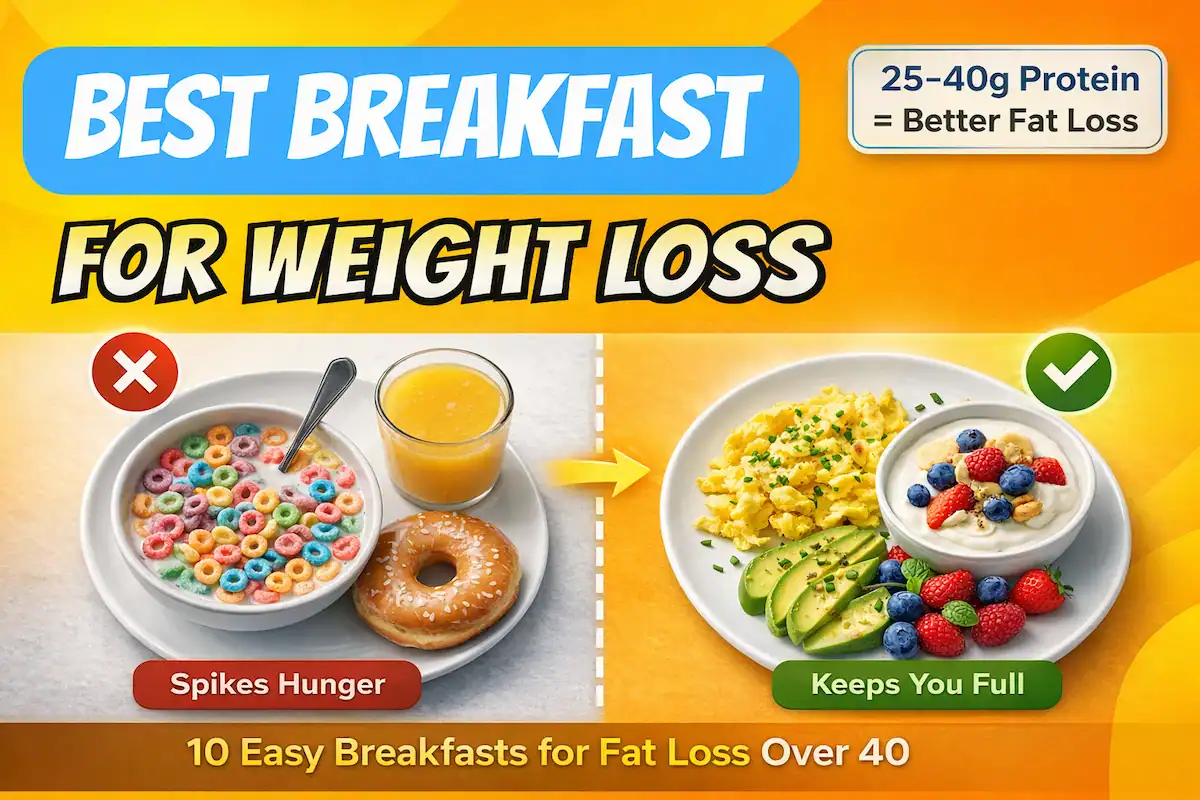

Imagine sitting down for breakfast… and actually not feeling hungry again until lunch.
You won’t have 10 am cravings or an energy crash before your first meeting. Instead, you’ll have steady focus and your body will burn fat the way it should.
It sounds simple, doesn’t it?
But here’s the problem: most so-called “healthy” breakfasts are actually working against you.
I see this often with new clients. They eat yogurt parfaits, granola, fruit smoothies, and whole wheat toast—foods they believe are healthy. But by mid-morning, they’re hungry, tired, and grabbing whatever is close by.
This isn’t about willpower, it’s about your breakfast choices.
If you’ve ever wondered, “Why am I hungry again already?” or “Should I even be eating breakfast?” you’re not alone. The advice out there is often too vague, too complicated, or doesn’t fit your lifestyle.
After years of coaching busy adults to lose weight, I’ve seen this happen again and again. The right breakfast can make a big difference, while the wrong one can slow your progress all day.
This guide will show you what makes a breakfast good for weight loss, which options keep you full, what to avoid, and a simple formula you can use every morning… even on busy days.
Best Breakfast for Weight Loss (Quick Answer)
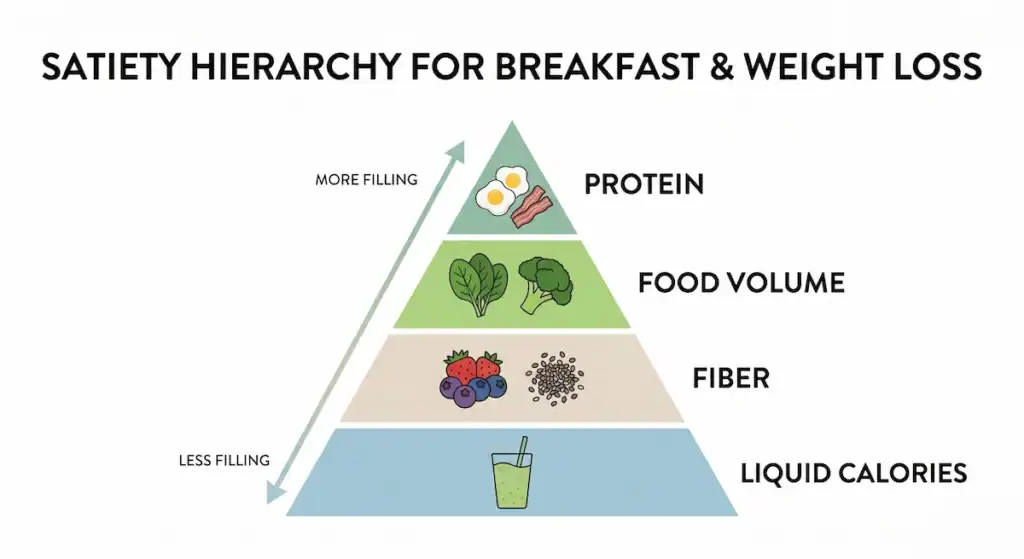
Key Takeaways:
- Food volume drives fullness — your stomach responds to stretch, not calories
- Protein controls hunger — without it, cravings persist
- Liquid calories don’t fill you up — they bypass satiety signals
You’ve tried the oatmeal. You’ve done the smoothie. You even gulped down egg whites with spinach for a month straight. And by 10:15 am, you’re already thinking about your next meal.
It’s not about willpower. It’s a satiety issue that can be addressed through understanding the drivers of hunger.
There’s no single “best” breakfast that works for everyone. But there IS a blueprint that makes almost any breakfast dramatically more filling for fewer calories. It comes down to four things your gut and brain are actually responding to.
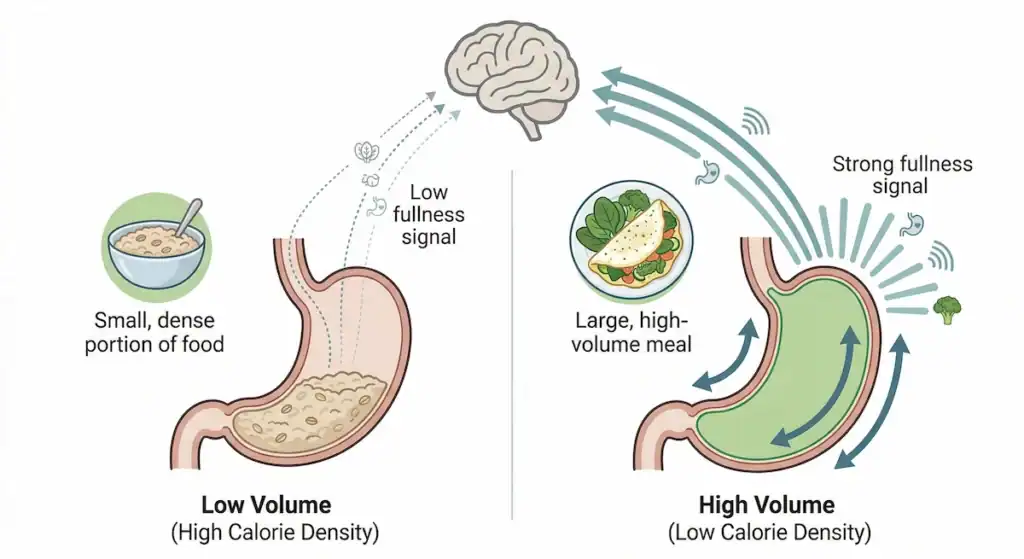
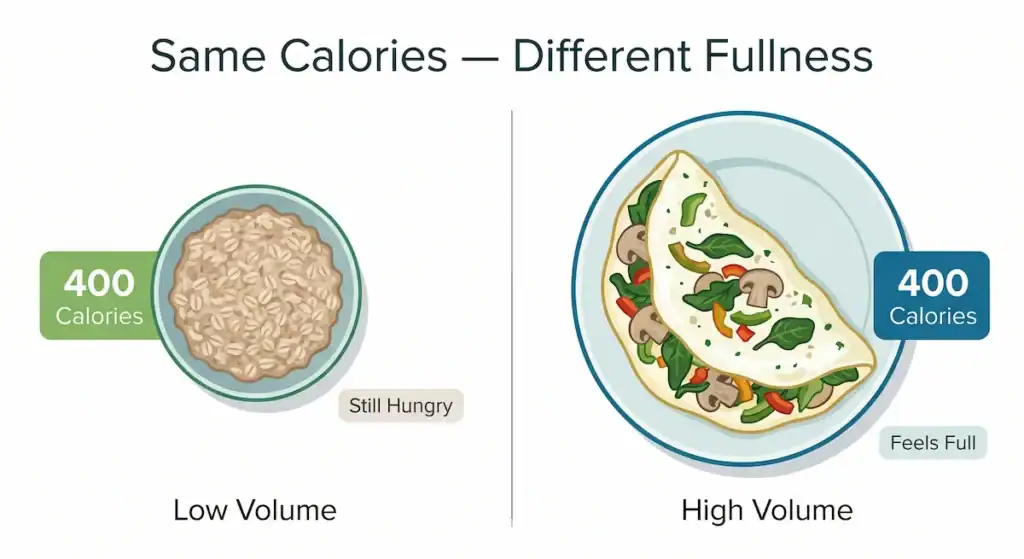
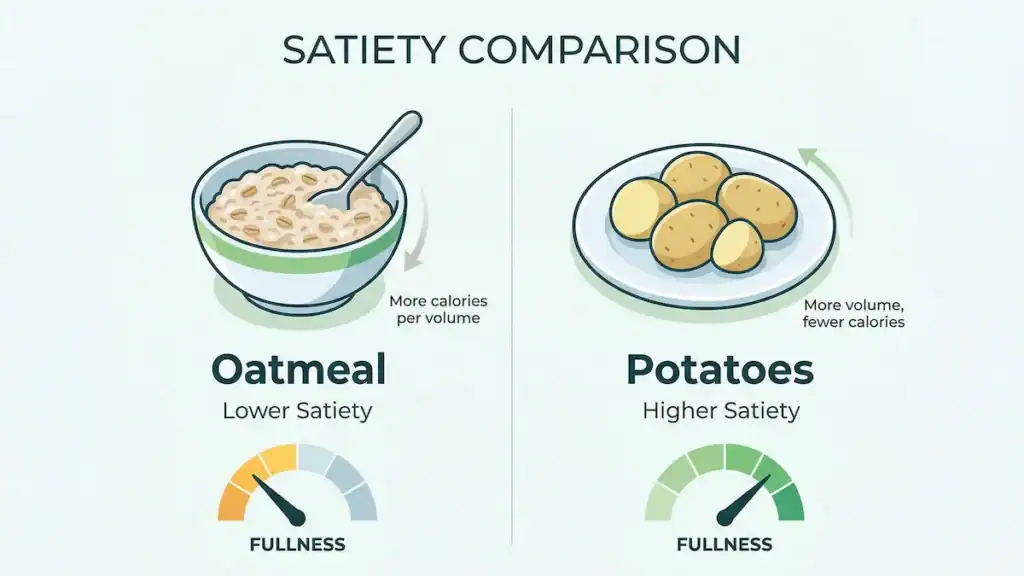
Your stomach’s stretch receptors measure volume, not calories. For example, a 400-calorie bowl of oatmeal barely registers, but a 400-calorie egg white omelet filled with vegetables sends a strong fullness signal.
A 2016 study in Cell found that stomach and intestinal stretch activates sensory neurons that signal fullness, suggesting that physical food volume is a stronger driver of satiety than calorie content alone.1
Use a carbon steel pan when making omelets instead of non-stick pans. Nonstick pans have synthetic chemical coatings that can leach into foods.
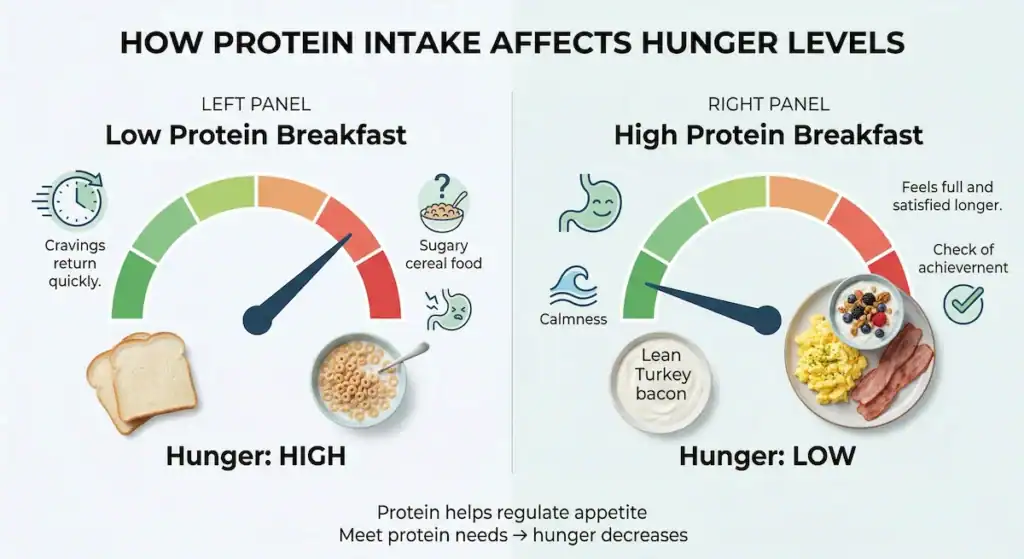
Protein triggers a biological “full” switch. Your body runs on what researchers call the protein leverage hypothesis, meaning it keeps you hungry until your amino acid needs are met. Get enough protein at breakfast, and the hunger dial turns way down. Skip it, and no amount of fiber or fat fully compensates.
A 2011 study in PLOS ONE found that reducing dietary protein from 15% to 10% of energy increased calorie intake by about 12%, supporting the “protein leverage hypothesis” that your body runs a protein‑centered appetite system.2
A 2004 review in Physiology & Behavior found that the body regulates food intake to meet protein and essential amino acid needs, and that higher-protein diets suppress appetite because protein produces stronger satiety signaling.3
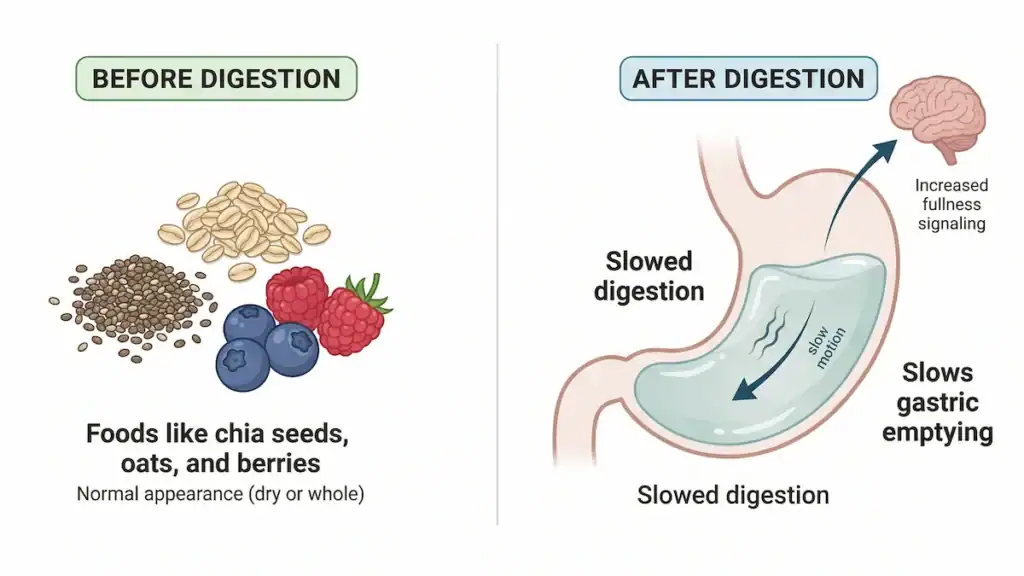
Soluble fiber provides slow-release fullness. It swells into a thick gel inside your gut, delays gastric emptying, and then ferments in your colon to produce short-chain fatty acids that travel directly to your brain and signal satiety. Berries, chia seeds, and oats all carry it.
A 2001 study in The American Journal of Clinical Nutrition found that a soluble‑fiber drink rich in oat β‑glucan swelled into a thick gel and significantly delayed gastric emptying. This supports the idea that soluble fiber “slows” digestion by forming a viscous gel in the stomach.4
A 2015 review in Obesity Reviews found that short‑chain fatty acids (SCFAs) produced by colonic fiber fermentation stimulate the gut hormones GLP‑1 and PYY, which act as satiety signals to reduce appetite and food intake.5
If your appetite feels out of control no matter what you eat, then it may not be a willpower issue. It could be your hunger hormones.
If hunger still feels hard to manage after improving breakfast, the BioTRUST GLP-1 Companion Stack is one option I like. It supports healthy appetite signaling while also helping support lean muscle during weight loss.
A 3-part daily stack designed to support people using GLP-1 medications or losing weight naturally. It combines muscle, protein, collagen, and appetite support to help you maintain a healthier body composition as you lose weight.
- Natural GLP-1 Support: Helps support healthy appetite signals, fullness & metabolic function
- Lean Muscle Support: Helps preserve muscle, strength & healthy body composition during weight loss
- High-Protein Collagen: Adds 20 g of protein with 5 collagen types to help support daily protein intake
- Skin, Joint & Hair Support: Provides collagen peptides to support skin elasticity, joints, hair & nails
- 3-Part Weight-Loss Support: Combines muscle, protein/collagen & appetite support in one simple daily stack

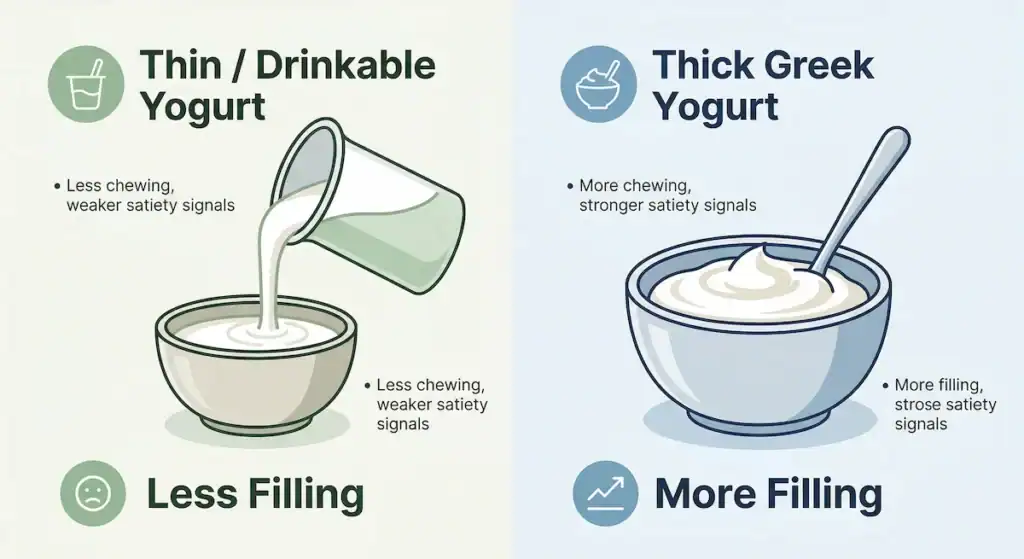
Texture matters more than people realize. The harder or thicker a food is, the more chewing it requires, and the stronger the satiety signals it sends.
One of my clients kept complaining that she was “always hungry,” even though she ate yogurt every morning. We switched her from a thin, drinkable yogurt to full-fat Greek yogurt thick enough to stand a spoon in. Same calories, same protein. She stopped being hungry by mid-morning within a week.
Liquid calories are the opposite, whether that’s juice, protein shakes, or blended smoothies. They bypass your stretch receptors almost entirely and leave your hunger hormones (including ghrelin) nearly unchanged.
A 2004 study in Obesity Research found that liquid meals suppressed hunger less effectively and for a shorter duration than solid meals of the same calories, leading to earlier return of appetite.5
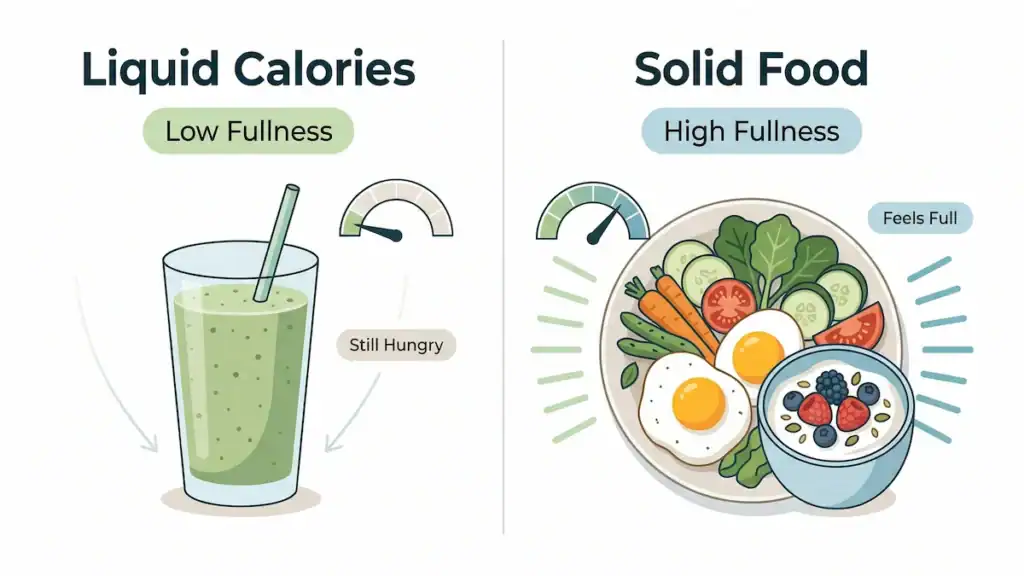
A 2007 study in Obesity found that comparable solid and liquid calories differed in hunger and fullness despite similar ghrelin and insulin responses. This supports the idea that liquid calories bypass stretch receptors and leave hunger hormones nearly unchanged.6
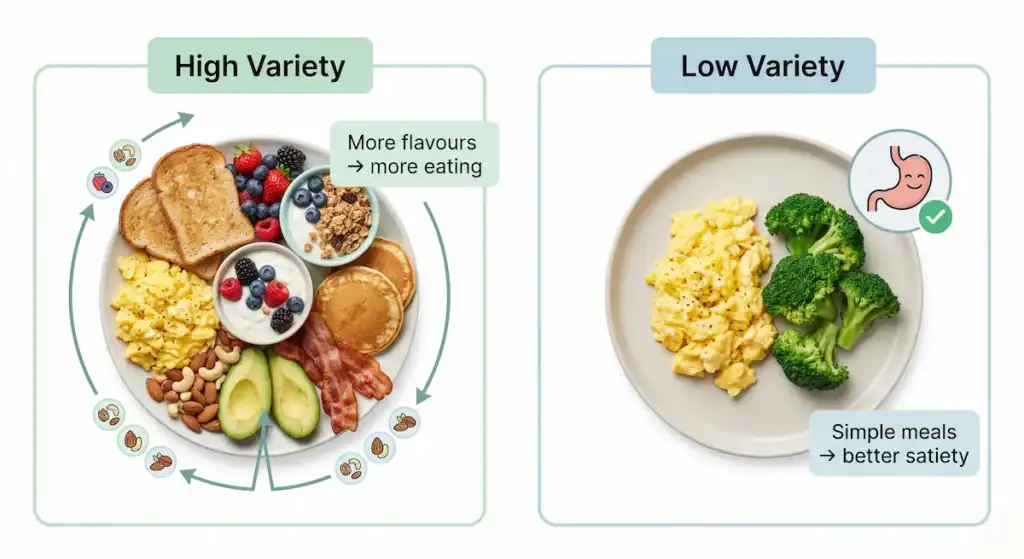
Flavor variety drives overconsumption. Your appetite is sensory-specific, meaning the more different tastes you load onto a plate, the more you’ll eat before feeling full. Keep breakfast simple: one strong protein source and one or two fibrous foods.
A foundational 1981 study by Rolls et al. established “sensory‑specific satiety,” demonstrating that people lose interest in a food they are eating while still feeling hungry for new flavors, confirming that your appetite is sensory‑specific.7
The Bottom Line:
Build breakfast around:
- High protein
- High volume foods
- Fiber-rich ingredients
- Simple meals (low variety)
- Avoid liquid calories
Want a simple done-for-you food list?
If you’re not sure what to actually eat day-to-day, I put together a simple food lsit cheat sheet that makes it easy…
CLICK HERE: Get the Food List Cheat Sheet ➔The 10 Best Breakfast Options for Weight Loss
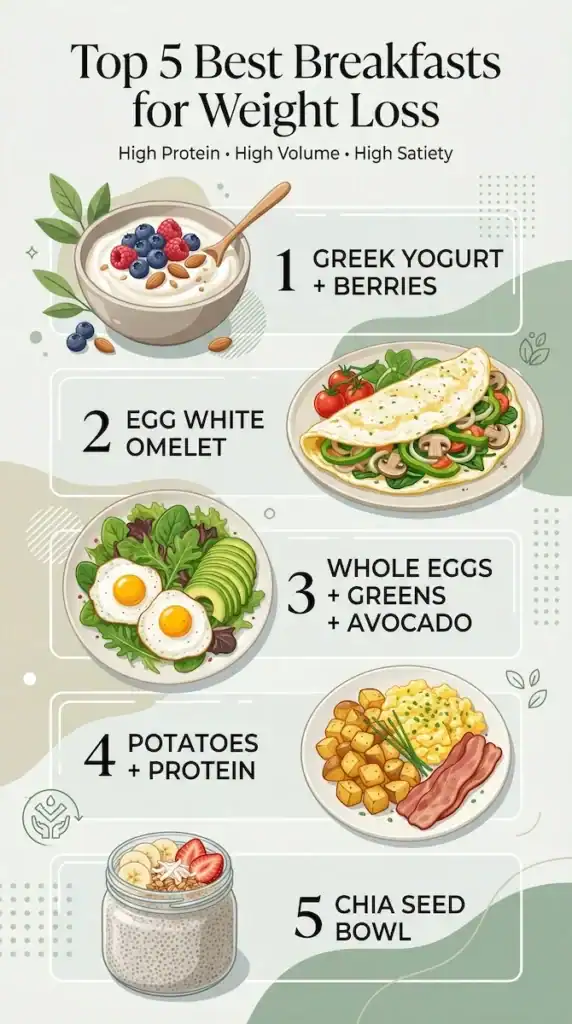
Not all breakfasts earn their calories. These options do.
Each one hits the satiety trifecta: high protein, high volume, and enough fiber or fat to delay gastric emptying and keep your hunger hormones quiet for hours. Pick what fits your morning, your appetite, and your goals.
Short on time in the morning?
If you can’t cook a full breakfast then a clean protein shake is the fastest way to stay full and avoid cravings.
1. Thick Greek Yogurt or Quark with Berries
This is one of the most underrated fat-loss breakfasts on the planet. Full-fat or 0% Greek yogurt, thick enough to stand a spoon in (I like using these glass containers), paired with strawberries or blackberries.
It’ll deliver viscous texture, soluble fiber, and a slow protein release all in one bowl. Add a calorie-free sweetener if you need the sweet hit. Keep it to two ingredients, and it stays filling instead of appetite-stimulating.
Why it works: Thick texture + protein + fiber = long-lasting fullness
2. Egg White Omelet Loaded with Vegetables
Egg whites are a top-tier satiety food, high in protein and almost calorie-free. Fill the omelet with mushrooms, spinach, and zucchini, and you get stomach-stretching volume for well under 300 calories.
One of my clients lost 18 pounds in 10 weeks by eating this exact breakfast 4 days a week. She wasn’t eating less, but she was eating smarter.
Why it works: High protein + massive volume = very low calories, high satiety
3. Whole Eggs with Greens and Avocado
Keep the yolks. They contain choline, a nutrient that helps metabolize fat and supports brain function and appetite regulation.
A 2024 study in Nutrients linked higher egg and choline intake with reduced risk of fatty liver disease, supporting the idea that egg‑yolk choline plays a key role in fat metabolism.8
2-3 pasture-raised eggs cooked in butter, served over a large portion of spinach or kale with half an avocado. It delivers protein, healthy fat, and fiber in a single plate that holds you well past noon.
4. The Primal Omelet (3 to 5 Eggs, Loaded)
Scale up the egg omelet with more eggs and more fat. Cook 3 to 5 pasture-raised eggs in butter or coconut oil. Load the pan with spinach, mushrooms, onions, and bell peppers, then top with sliced avocado.
This breakfast stabilizes blood glucose and suppresses ghrelin, your primary hunger hormone, for 4-6 hours.
5. Potatoes Instead of Grains
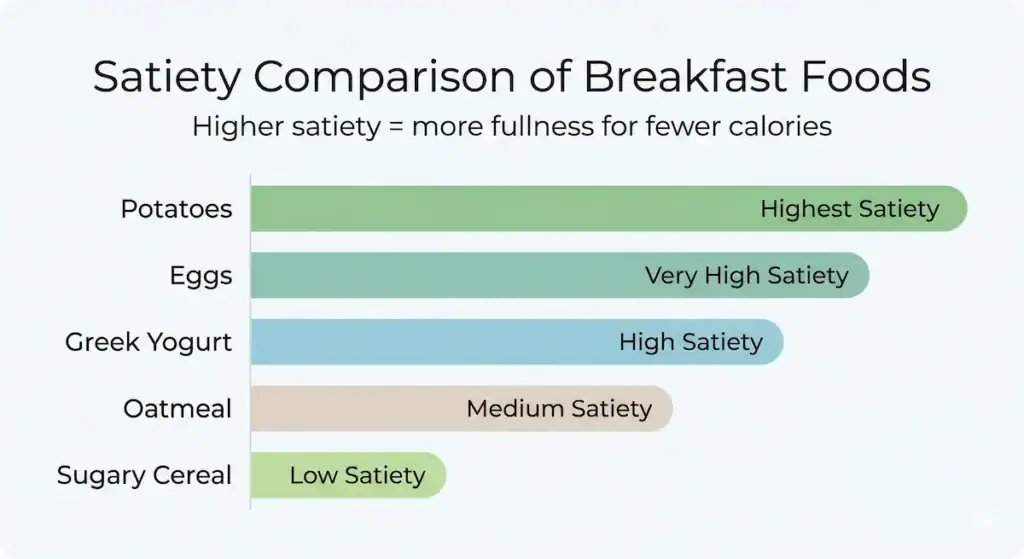
Potatoes score 155% as high as oatmeal on the satiety index. They carry less than half the energy density of most grains.
A 1995 study in the European Journal of Clinical Nutrition established the Satiety Index of Common Foods, a ranking system that later became known as “the satiety index.”12
This means you get more physical volume for fewer calories. Boiled or roasted potatoes (not fried), with eggs or a protein source, and beat oatmeal to keep you full. Use an air fryer to cook your potatoes to reduce fat intake and harmful chemicals.
A 1995 study in the European Journal of Clinical Nutrition found that boiled potatoes scored 323 on the Satiety Index compared with 209 for oatmeal.9
6. Slow-Carb Chia Bowl
Two tablespoons of chia seeds, mixed with almond or coconut milk and left to gel overnight, form a thick, viscous base that triggers fullness the way solid foods do.
Top with hemp seeds or a small handful of nuts. The soluble fiber in chia forms a gel in your gut, significantly slowing gastric emptying.
If fiber is the part you struggle to get consistently, BioTRUST Ageless Multi-Fiber is one option I like. Its six-fiber blend supports fullness, digestive regularity, and a healthier mix of gut bacteria without relying on just one fiber source.
A 6-fiber daily blend designed for adults 40+ to support regularity, gut health, and a healthier microbiome. Each serving provides 6g of fiber, including clinically studied resistant starch, in a gentle formula made for everyday use.
- 6-Fiber Blend: Combines soluble, insoluble, fermentable fiber & resistant starch for more complete digestive support
- Gut Microbiome Support: Helps feed beneficial gut bacteria and supports healthy microbial balance
- Regularity & Digestive Comfort: Supports healthy stool consistency and everyday digestive regularity
- Clinically Studied Resistant Starch: Provides 3.5g of Solnul® resistant potato starch to support gut barrier & metabolic health
- Gentle Daily Formula: Uses slow-fermenting, well-tolerated fibers designed to minimize gas & bloating

7. Sprouted Grain Toast with High-Fat Toppings
A slice of sprouted grain bread digests slowly, releasing starches gradually. Top with avocado, full-fat cream cheese, almond butter, or smoked salmon. Limit to one slice with one fat.
8. High-Fat Keto Coffee
A cup of black coffee blended with 1 tablespoon of grass-fed butter and 1 tablespoon of C8 MCT oil. It has zero carbohydrates, no insulin spike, and enough dietary fat to suppress appetite for 3 to 4 hours.
C8 MCTs are quickly converted into ketones via your liver. Ketones are what your body makes from fat stores for fuel when eating the keto diet. So by taking C8 MCTs with your coffee when fasting you’ll kickstart the same ketogenic fat burning process in your body.
A 2022 clinical trial found that C8 MCT oil significantly raised blood ketone levels within 1–2 hours, confirming that C8 MCTs → ketones → a more fat‑burning metabolic state.10
9. Dinner Leftovers (Steak, Salmon, or Chicken with Vegetables)
Drop the idea that breakfast has to look like breakfast. Leftover steak or salmon, paired with steamed vegetables and butter, is one of the most satiating, blood-sugar-stable morning meals you can eat.
I had a client in his 50s who couldn’t stick to any breakfast plan until I told him it was okay to eat last night’s chicken and broccoli. He then stopped snacking before lunch.
Glass meal prep containers are a good investment for meal prep and preserving leftovers for the next day.
10. Skipping Breakfast (Intermittent Fasting)
If you wake up without any real hunger, skipping breakfast is a legitimate fat-loss strategy. Extending your overnight fast keeps insulin low, shifts your body toward burning stored fat for fuel, and lets you easily remove 400 to 600 calories from your day without restriction. Don’t force a meal you don’t need.
A 2023 study in Obesity found that prolonging the overnight fast lowered insulin‑stimulated carbohydrate use and raised fat oxidation. This confirms that extending your overnight fast keeps insulin low and shifts the body toward burning stored fat.11
What Actually Makes a Breakfast Good for Weight Loss (Simple 3-Part Formula)
Most people choose breakfast foods that sound healthy: oatmeal with fruit. But a “healthy-sounding” breakfast doesn’t always keep you full until lunch.
A good weight-loss breakfast does one job above everything else: it fills you up for the fewest possible calories. Researchers call this the satiety index, and it’s the real scorecard your breakfast should be measured against.
Six things drive it…
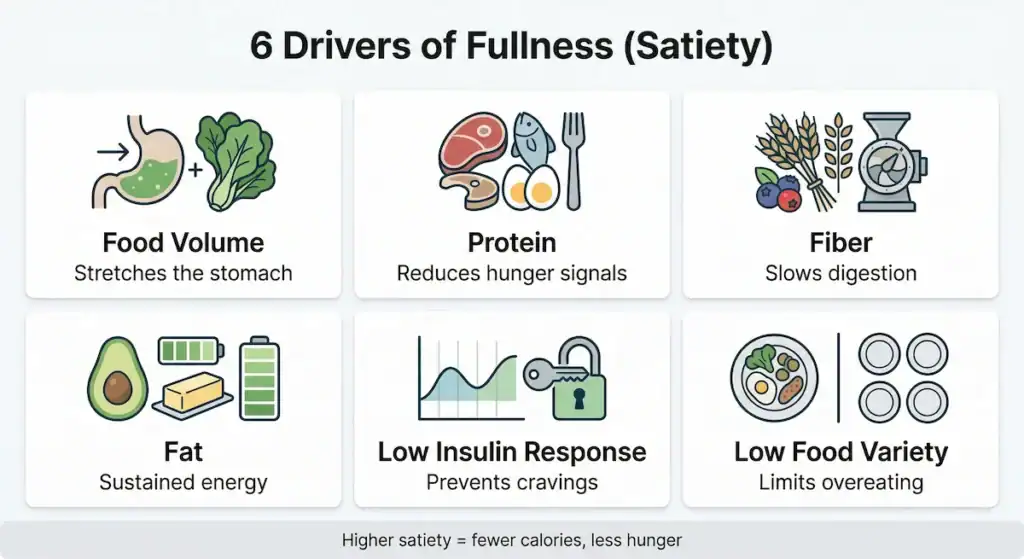
Physical volume matters more than calories. Your stomach measures pressure, not energy content. Foods that stretch it, fibrous vegetables, thick dairy, and solid proteins trigger fullness signals that liquid calories and refined carbs never will.
Low insulin response is a must. Cereal, oatmeal, bagels, toast, and juice raise blood sugar levels, triggering an insulin surge. Insulin locks fat, increases cravings, and stops fat burning. Choose breakfasts that skip these insulinemic foods.
A 2018 review in The Lancet Diabetes & Endocrinology found that insulin promotes fat storage, suppresses fat breakdown, and modulates appetite‑related pathways, providing a mechanistic basis for the concept that insulin locks fat, increases cravings, and stops fat burning.13
Clean-burning fats belong at the center of your morning plate. Butter, bacon fat, heavy cream, and coconut cream provide a steady stream of cellular energy without triggering an insulin spike. Unlike carbohydrates, healthy fats take far longer to metabolize and leave your stomach, so they don’t raise blood sugar.
They also work directly on your appetite and satiety hormones, leptin and ghrelin, making it effortless to coast to your next meal without cravings raking at you by mid-morning.
Protein satisfies your body’s amino acid requirements first. Until that threshold is reached, hunger persists regardless of the total calories consumed. Hit it, and you’ll drop the hunger dial fast.
Soluble fiber forms a thick gel in your gut that delays digestion and triggers neurological fullness signals from your colon. It’s arguably the most underused satiety tool at breakfast.
Low flavor variety is the sleeper variable that almost no one talks about. Your appetite is sensory-specific: the more diverse the tastes on your plate, the more you’ll eat before feeling full. Keep breakfast simple.
The Simple Formula
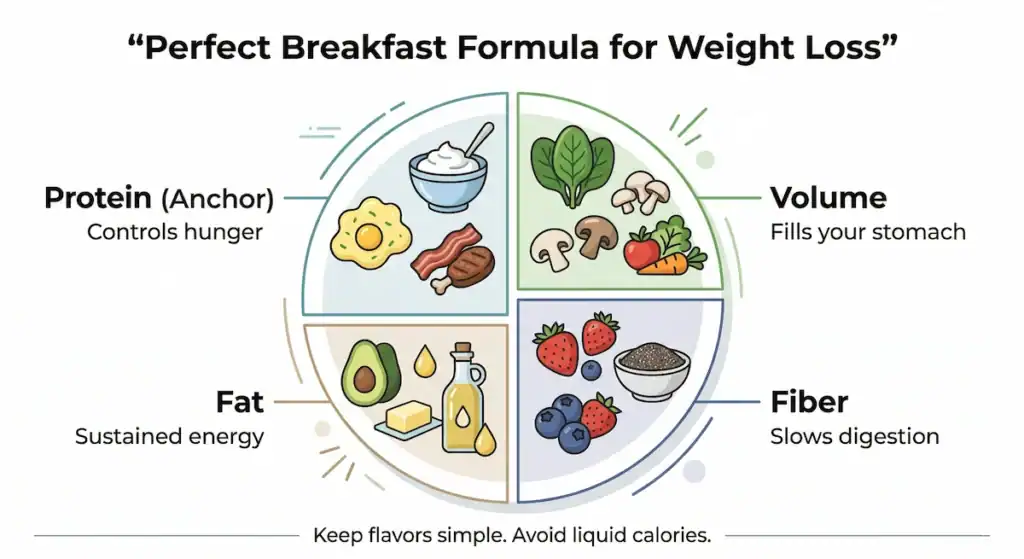
One solid protein + measured fat + one or two high-volume fillers + calorie-free liquids.
Step 1: Pick your protein (aim for 21-42 grams; 3-6 ounces). This is the base of the meal. A portion roughly the size of a deck of cards or your cupped palm gets you there.
Good options include eggs, Greek yogurt, quark, cottage cheese, or egg whites. Solid and viscous textures only; skip the protein shakes.
Step 2: Add a moderate fat (aim for 10-14 grams). If your protein source is lean or fat-free, like egg whites or low-fat Greek yogurt, you need to add fat to slow digestion and sustain satiety.
Choose stable, natural sources such as butter, heavy cream, avocado, bacon fat, or coconut cream. Measure this portion. Fat is very high in calories and easy to overeat without realizing it.
Get a food scale so you can accurately measure your food intake.
Step 3: Add 1-2 high-volume fillers. These take up physical space in your stomach for almost no calories. Fibrous vegetables like spinach, mushrooms, and bell peppers can be folded into an omelet, or high-fiber fruits like berries can be stirred into dairy.
If you want a starchy food, choose potatoes over grains. Potatoes have less than half the energy density of oatmeal or bread.
Step 4: Drink calorie-free liquids alongside the meal. Black coffee, herbal tea, or sparkling water. The fluid and carbonation add pressure to your gut’s stretch receptors, boosting satiation for zero calories.
A sparkling water maker is a good investment to stop drinking sodas.
A woman I train kept complaining that her “healthy” breakfasts left her hungry by 10 am. She was eating a smoothie and a handful of almonds. We switched her to Greek yogurt with blackberries, a splash of heavy cream, and black coffee. Same calorie range but she stopped having to snack mid-morning.
Simple formula. Consistent execution. Reliable results.
Why Your “Healthy” Breakfast Is Making You Hungrier (The Blood Sugar Trap)
Cereal. Oatmeal. A bagel. Fresh-squeezed OJ. These are the foods we’ve been told to eat for decades. They’re also the reason millions of people are ravenous again two hours after breakfast.
It’s not a willpower problem. It’s a hormone problem, and it follows a predictable sequence every single time.
Your body releases a flood of cortisol when you wake up. This is a natural mechanism for releasing stored energy and getting you moving. Eat carbohydrates during that cortisol pulse, and your pancreas is forced to pump out an exaggerated insulin response.
This is far larger than if you’d eaten those same carbs later in the day. Insulin rapidly shoves that energy into your fat cells, locks it there, and shuts down your body’s ability to burn stored fat for fuel.
Your blood sugar crashes. Your brain, starved for energy and unable to access body fat, triggers what researchers call pathologic hunger. This is the fatigue, brain fog, shakiness, and uncontrollable craving for sugar and starch.
A Harvard study led by Dr. David Ludwig made this impossible to ignore. Overweight children who ate instant oatmeal consumed 81 percent more food later in the afternoon than children who ate a vegetable omelet with the exact same number of calories.
Steel-cut oats still drove 51 percent more food intake than the omelet group. Same calories. Completely different hormonal outcome.
3 Ways Processed Breakfast Foods Worsen the Problem
Processed foods pack enormous calories into tiny physical volume, so your stomach’s stretch receptors never fire a fullness signal. Foods combining carbohydrates and fats, like buttered toast, donuts, or bacon with hash browns, are consistently the least satiating meals you can eat.
That specific combination hyper-stimulates your brain’s reward circuits in a way that neither fat nor carbs do alone. This actively drives you to overeat before you even realize what’s happening.
A 1996 study in the American Journal of Physiology found that the stomach’s volume‑based stretch, not calories, primarily controls short‑term food intake, because equal volumes of saline and nutrient solutions suppressed eating equally when the stomach was distended.4
Texture is a factor most people never consider.
Oatmeal, cereals, and liquid shakes require almost no chewing, and that matters more than it sounds. The mechanical act of chewing directly stimulates satiety signals in your brain and desensitizes food cues. Skip the chewing, and you skip a significant portion of the fullness response.
These same processed foods also strip out soluble fiber, the nutrient that swells into a thick gel inside your gut, delays gastric emptying, and sends neurological fullness signals directly to your brain.
One of my clients couldn’t figure out why she was “so hungry all the time” despite eating breakfast every morning. She was eating granola, low-fat yogurt, and a banana. We swapped it for eggs, avocado, and black coffee. And soon the mid-morning hunger disappeared.
The breakfast wasn’t the solution. It was the problem.
How Many Calories Should Breakfast Actually Be? (It Depends on One Thing)
There is no universal answer, and anyone giving you a hard number without context is guessing.
Your ideal breakfast calorie intake depends on:
- your total daily target
- your training schedule
- your natural morning appetite
- whether you actually need breakfast
Here’s how to think through it…
If you’re overweight or carb-intolerant, research supports eating a larger breakfast. Studies show that dedicating roughly 50% of your daily calories to the morning meal (around 700 calories) produces better fat loss, improved insulin sensitivity, and fewer cravings compared to eating those same calories at dinner.
Bigger breakfasts make adherence dramatically easier for people who struggle with impulsive snacking later in the day.
If you train in the morning, breakfast doubles as your pre- or post-workout meal. Allocate 50-100% more calories and protein to meals within your anabolic window than to those outside it. If you train in the evening, your breakfast sits entirely outside that window, making it a reasonable candidate to skip or shrink.
If you prefer an even distribution, divide your daily calorie target by your number of meals. On a 1,500-calorie plan, eating three meals, breakfast lands around 500 calories. On a 2,000-calorie plan, closer to 660.
If you have no morning hunger, zero calories is a legitimate and effective option. Skipping breakfast doesn’t slow your metabolism or trigger starvation mode. It simply shifts those calories to later meals where you actually want them.
One of my clients spent years forcing down a 600-calorie breakfast she didn’t want because she believed skipping it would “wreck her metabolism.” We moved those calories to lunch and dinner. She lost 11 pounds in eight weeks without changing anything else.
Composition matters more than the exact number. Build breakfast around 21-42 grams of lean protein, 10-14 grams of measured fat, and high-volume fibrous fillers. The calories take care of themselves once you get this right.
Best Breakfast for Weight Loss by Goal
Best Breakfast for Weight Loss Over 40 (Why What Worked in Your 30s Is Now Working Against You)
Your metabolism isn’t broken. It’s just operating under a different set of rules, and most breakfast advice was written for a younger body.
Two specific changes that occur after 40 are completely ignored by standard breakfast guidance.
First: anabolic resistance. Your muscles grow less responsive to protein. So the leucine threshold required to trigger muscle protein synthesis rises substantially with age.
Younger adults can preserve and build muscle on 20 grams of protein per meal. Research shows that older adults need closer to 40-45 grams per meal to get the same response.
Muscle burns seventy times more calories than fat at rest, so losing it destroys your metabolism from the inside out.
Second: declining insulin sensitivity. Carbohydrate tolerance deteriorates with age, making the standard high-carb breakfast far more damaging after 40 than it was at 25.
The morning cortisol spike your body produces naturally magnifies this, forcing an exaggerated insulin response to any starch or sugar you eat at breakfast. That insulin spike locks fat in storage and leaves you exhausted and hungry within hours.
I had a client in her late 40s eating oatmeal and fruit every morning, convinced she was doing everything right. She was gaining weight, struggling with energy slumps by 10am, and couldn’t figure out why.
We shifted her to eggs with greens, added Greek yogurt to hit her protein threshold, and cut the fruit. Her energy stabilized, and she dropped 9 pounds in six weeks without changing anything else.
The over-40 breakfast formula looks like this:
Target 40 grams of high-quality protein from leucine-rich sources like eggs, Greek yogurt, cottage cheese, or whey. Keep carbohydrates low and sourced exclusively from fibrous vegetables and small amounts of fruit. Add a moderate healthy fat from butter, avocado, or nuts to slow digestion and keep insulin flat.
After 40, losing weight without protecting muscle can make it harder to keep your strength and metabolism up. The BioTRUST GLP-1 Companion Stack combines appetite support with creatine, HMB, and convenient protein to help support lean muscle while you diet.
A 3-part daily stack designed to support people using GLP-1 medications or losing weight naturally. It combines muscle, protein, collagen, and appetite support to help you maintain a healthier body composition as you lose weight.
- Natural GLP-1 Support: Helps support healthy appetite signals, fullness & metabolic function
- Lean Muscle Support: Helps preserve muscle, strength & healthy body composition during weight loss
- High-Protein Collagen: Adds 20 g of protein with 5 collagen types to help support daily protein intake
- Skin, Joint & Hair Support: Provides collagen peptides to support skin elasticity, joints, hair & nails
- 3-Part Weight-Loss Support: Combines muscle, protein/collagen & appetite support in one simple daily stack
If you wake up without any real hunger, skip breakfast entirely. Extending your overnight fast keeps insulin low, triggers cellular repair, and forces your body to burn stored fat for morning fuel without any restriction required.
Best Breakfast for Weight Loss for Women (Why the Standard Advice Keeps Backfiring on Your Hormones)
Women’s bodies are not smaller versions of men’s bodies, and breakfast advice written for both genders equally is often quietly working against female physiology.
Three things separate an optimal female breakfast from the generic version.
Women burn fat at a higher rate than men during daily movement and low-to-moderate activity. This implies fewer carbohydrates are needed for fuel, freeing those calories up for dietary fat.
Research shows that fat is roughly 15% more satiating in women than in men, making higher-fat breakfasts a particularly powerful hunger-control tool for female clients.
Dietary cholesterol directly supports the production of female hormones. Estrogen, progesterone, and testosterone are all synthesized from cholesterol. A chronic low-fat breakfast doesn’t just leave you hungry. It quietly suppresses the hormones that regulate your cycle, mood, bone density, and metabolism.
Whole eggs, full-fat dairy, and butter aren’t indulgences for women… they’re functional nutrition.
Aggressive intermittent fasting backfires more often in women than in men. Forcing a long morning fast while hungry can trigger a hormonal stress response that disrupts thyroid function, menstrual regularity, and cortisol balance. The rule for women is simple: eat when genuinely hungry, fast only when you’re not.
A woman I train kept gaining weight despite “eating clean” every morning. She was having oatmeal, a banana, and low-fat yogurt. We switched her to whole eggs with spinach, avocado, and full-fat Greek yogurt. Her cravings dropped, her energy stabilized, and she lost 7 pounds in five weeks.
The female breakfast formula: 25-40 grams of whole-food protein, adequate dietary fat from eggs, avocado, or full-fat dairy, and fiber from vegetables or low-glycemic fruit. Keep refined carbohydrates out entirely.
Best Breakfast for Weight Loss + Muscle Gain (Burn Fat & Build Muscle at the Same Time)
Most people think fat loss and muscle gain require completely different eating strategies. They don’t. But the breakfast that serves both goals looks nothing like what most fitness advice recommends.
Burning fat requires keeping insulin low. Building muscle requires hitting a specific leucine threshold to trigger muscle protein synthesis. Your breakfast needs to do both simultaneously.
Protein is the non-negotiable foundation. Aim for 25-40 grams of high-quality animal protein, such as whole eggs, egg whites, Greek yogurt, cottage cheese, or meat.
Your breakfast needs roughly 2.5-2.8 grams of leucine to flip the muscle-building switch. Animal proteins deliver this efficiently. Plant proteins require significantly higher volumes or BCAA supplementation to match the same effect.
Fat keeps insulin flat while protein builds muscle. Pair your protein with healthy fats from butter, avocado, or nuts.
Avoid the carbohydrate-heavy “muscle-building” breakfasts like oatmeal and banana combos. They spike insulin, shut down fat burning, and deliver nothing your muscles actually need that protein and fat don’t already provide.
Texture and volume control hunger. Solid, viscous proteins like thick Greek yogurt, eggs, or casein keep you physically full far longer than protein shakes, which empty from the stomach rapidly and suppress hunger only slightly.
The formula: 25-40 grams of leucine-rich animal protein, 10-14 grams of healthy fat, fibrous vegetables for volume, and zero refined carbohydrates.
Best On-the-Go Breakfast for Weight Loss (No-Cook, Store-Bought & Meal Prep Options)
Busy mornings are where most fat-loss plans fall apart. Not because people lack discipline, but because they haven’t yet built a system.
The biggest on-the-go mistake is defaulting to convenience store carbs: bagels, granola bars, fruit smoothies, and sugary coffee drinks. These are glucose bombs that spike insulin, shut down fat burning, and leave you hungry again within 90 minutes.
Liquid calories are especially problematic. They bypass your stomach’s stretch receptors entirely and suppress hunger almost entirely.
No-cook, grab-and-go options that actually work:
- Pre-peeled hard-boiled eggs (sold bagged at most grocery stores) paired with a container of full-fat Greek yogurt
- A slow-carb chia pudding made the night before, grabbed from the fridge in 10 seconds
- Single-serve almond or macadamia butter packets with a piece of low-glycemic fruit like an apple or grapefruit
- Pre-portioned Greek yogurt topped with berries and a handful of nuts
Meal prep solutions worth the Sunday hour:
Bake a batch of egg muffins in ham cups, portion them into containers, and reheat one or two each morning. Prep overnight chia pudding in individual mason jars. Hard-boil a dozen eggs for the week.
The zero-prep option: if you’re genuinely not hungry, skip breakfast entirely. Fasting requires no planning, cuts calories effortlessly, and keeps your body in fat-burning mode through the morning.
One of my clients kept grabbing a granola bar and a latte on her commute because she “had no time.” We spent 20 minutes on Sunday prepping chia pudding jars for the week. Her mid-morning hunger disappeared, and she stopped hitting the vending machine by 10 am.
The golden rule: pick your protein first. Secure 20-40 grams of solid protein and build everything else around it.
Breakfasts to Avoid for Weight Loss
Sugary Breakfasts Destroy Your Weight Loss (“Healthy” Isn’t Always Good)
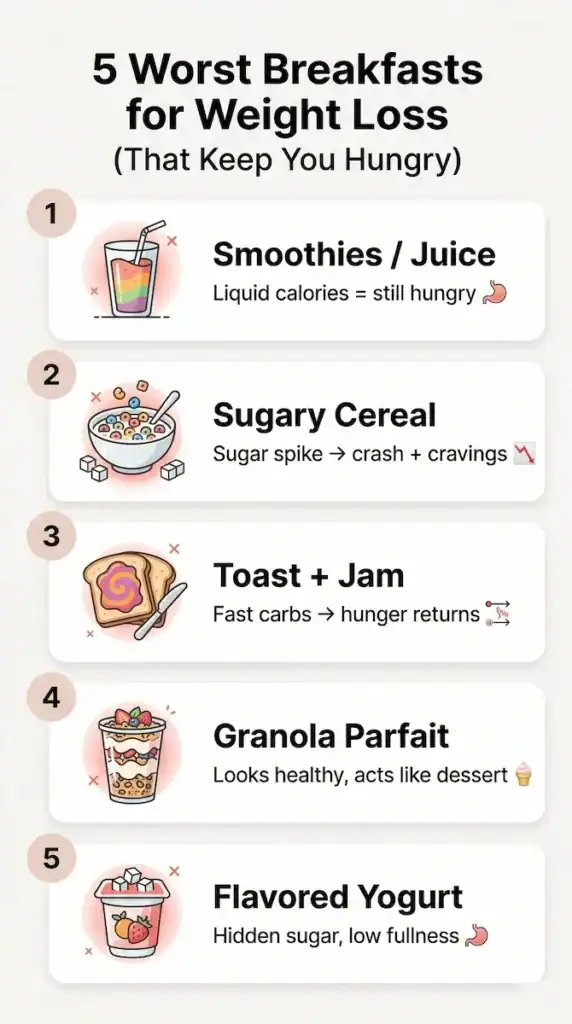
Cereal. Granola. A fruit smoothie. Low-fat yogurt with honey. These foods get marketed as smart breakfast choices, and they’re some of the worst things you can eat when you’re trying to lose fat.
Sugar has almost zero satiating effect. It doesn’t activate your stomach’s stretch receptors, doesn’t suppress ghrelin, and doesn’t slow gastric emptying. You can consume 400 calories of sugar and be just as hungry 90 minutes later as if you’d eaten nothing.
The damage runs deeper than hunger. Morning is when your body’s cortisol levels are at their peak. Eat sugar or refined carbs during that window, and your pancreas fires an exaggerated insulin surge, far larger than if you’d eaten those same carbs at dinner.
Insulin shoves that energy directly into fat storage, locks it there, and shuts off your fat-burning enzymes for hours. Your blood sugar then crashes, your brain interprets it as an emergency, and cravings for more sugar and starch hit hard.
Liquid sugars make this worse. A 24-ounce commercial fruit smoothie can carry 70 grams of sugar. Sweetened lattes and flavored coffees easily hit 40-60 grams. Liquid fructose bypasses your fullness signals entirely and heads straight to your liver, where it triggers lipogenesis (the process that converts sugar directly into body fat).
A woman I trained was genuinely confused about why she kept gaining weight despite “eating clean.” Her breakfast every morning was granola, low-fat yogurt, and orange juice. We counted the sugar, and it was over 80 grams before 8am. Swapping to eggs and Greek yogurt changed everything within two weeks.
The worst offenders to cut immediately:
- sugary cereals
- granola
- fruit juice
- commercial smoothies
- sweetened coffee drinks
- bagels
- muffins
- pancakes
- waffles
- protein bars with over 10 grams of sugar
…and any “diet” alternative sweetened with artificial sweeteners (triggers cravings without delivering satiety).
The “Healthy” Breakfasts That Are Actually Wrecking Your Weight Loss (These Three Fool Almost Everyone)
Eating clean doesn’t automatically mean eating smart. Some of the most common fat-loss saboteurs come wearing a health halo, and most people never question them.
Fruit smoothies & acai bowls look like the pinnacle of clean eating. They’re concentrated sugar delivery systems. Blending fruit destroys the physical bulk and fiber that make whole fruit satiating, leaving you with liquid calories that bypass your stretch receptors entirely and clear your stomach in under an hour.
A 24-ounce commercial acai bowl can contain 70-plus grams of sugar and 600-plus calories, with almost no protein. Without protein, your body’s amino acid requirements stay unmet, and hunger persists regardless of total calories consumed.
Plain toast, even whole wheat, metabolizes nearly identically to table sugar. The glycemic index of whole wheat bread sits at 75. Table sugar clocks in at 65. Eaten alone without protein or fat… it spikes blood sugar fast, triggers a large insulin response, and sets up a crash within 90 minutes.
Sweet oatmeal earns its health reputation from fiber, but the moment you add honey, agave, maple syrup, or dried fruit, the fiber advantage disappears. Sugar has almost no satiating effect and adds calories without triggering a fullness signal.
Combined with oatmeal’s soft texture, which requires minimal chewing and therefore stimulates almost no satiety signaling in the brain, you’ve built a meal that leaves you hungry and over-calorie before 9 am.
One of my clients ate an acai bowl every single morning for six months and couldn’t lose a pound. She really believed she was eating well. We swapped it for Greek yogurt with berries and a scoop of protein. She dropped 8 pounds in the first month.
The fix for all three: never eat carbohydrates naked. Add 25-40 grams of protein to any of these meals, and the blood sugar response, hunger, and cravings change dramatically.
6 Most Common Breakfast Mistakes That Keep You Hungry, Tired & Stuck
Most people aren’t failing at weight loss because they lack discipline. They’re making the same breakfast mistakes over and over without realizing it.
Eating carbohydrates alone. A plain bagel, toast, or bowl of oatmeal without protein or fat digests rapidly, spikes blood sugar, and triggers a crash within 90 minutes. Carbohydrates eaten naked have no “chaperone” to slow gastric emptying. Add protein and fat, and the entire metabolic response changes.
Drinking their calories. Fruit juice, sweetened lattes, and protein shakes pass through the stomach rapidly and suppress hunger only slightly. Liquid calories bypass the stretch receptors and chewing mechanisms that generate fullness signals. You can consume 400 calories and feel exactly as hungry as before you ate.
Loading up on flavor variety. Appetite is sensory-specific. You get full of a specific taste, not food in general. A breakfast buffet or a meal with multiple highly palatable flavors artificially resets hunger with each new taste. Keeping breakfast to one protein and one or two fillers prevents this entirely.
Forcing breakfast when not hungry. Research shows that natural breakfast skippers who force themselves to eat often consume more total daily calories, not fewer. If you have no genuine morning appetite, skipping breakfast is a legitimate fat-loss strategy, not a metabolic risk.
Choosing low-fat options. Manufacturers replace fat with sugar to restore flavor. Low-fat yogurt, reduced-fat granola, and fat-free creamers deliver more carbohydrates and less satiety than their full-fat counterparts. Fat slows gastric emptying; removing it accelerates hunger.
Skipping vegetables entirely. Fibrous vegetables like spinach, mushrooms, and bell peppers provide a large volume in the stomach for almost no calories. Folding them into eggs is the simplest way to double a meal’s satiety without adding meaningful calories.
10 Easy Breakfast Ideas (Quick List)
1. Eggs 101 Ways: Cook 1 to 3 eggs any way you like (such as poached, scrambled, or hard-boiled) in clean-burning fats like butter or bacon fat. For ultimate convenience, buy pre-peeled hard-boiled eggs from the store and eat them with melted butter and salt.
2. Avocado Toast: Top one slice of toasted sprouted-grain or sourdough bread with sliced avocado, salt, pepper, and an optional drizzle of coconut cream or “everything bagel” seasoning.
3. Type C Toast (Smoked Salmon): Spread real grass-fed cream cheese on a slice of toasted sprouted-grain or dark Bavarian rye bread, and top it with smoked salmon. You can also add fresh tomato slices or capers.
4. Slow-Carb Yogurt Parfait: Portion out 6-8 ounces of plain, whole-milk regular or Greek yogurt. Add a splash of heavy whipping cream, and top with healthy fats like nuts and a very minimal amount of fresh berries or melon.
5. Slow-Carb Chia Bowl: Mix 2 tablespoons of chia seeds with ½ to ¾ cup of almond nut, coconut, or cow’s milk. Let it sit in the fridge until it forms a thick gel, then top it with hemp seeds, nuts, or spices like cinnamon.
6. High-Energy Breakfast Smoothie: Skip the sugary fruit and processed protein powders. Instead, blend 1 cup of whole milk or unsweetened almond milk with 2 to 3 tablespoons of heavy dairy cream or coconut cream. Flavor it with cocoa powder, vanilla extract, and stevia.
7. Cinnamon Butter Toast: Spread 1 tablespoon of grass-fed butter and 1 tablespoon of natural peanut butter or almond butter onto a slice of healthy sprouted-grain toast, and sprinkle it with cinnamon.
8. Upgraded “Fatburn” Bars: Grab a store-bought, low-carb bar that relies on healthy fats instead of toxic vegetable oils. Aim for “upgraded” bars with fewer than 10 grams of net carbs, such as Primal Kitchens or Keto Bars.
9. Coffee with Real Cream: Simply mix black coffee with ⅛ to ¼ cup of heavy dairy cream, half-and-half, or coconut milk. Avoid commercial creamers and, if desired, sweeten them with a stevia drop.
If you are not hungry, just skip breakfast! Intermittent fasting is effortless, requires zero preparation, and naturally forces your metabolism to tap directly into your stored body fat for its morning fuel.
7-Day Breakfast Plan for Weight Loss
If you want to succeed at losing weight fast then your morning meal must keep your insulin low and your body in fat-burning mode by avoiding starchy and sugary “carb bombs” during your natural morning cortisol pulse.
Instead, a fat-burning breakfast should be built around clean-burning fats, very low carbohydrates, and low-to-moderate whole-food protein.
Here is a simple, highly effective 7-day breakfast plan to help you lose weight:
Day 1: Eggs 101 Ways Cook 1 to 3 eggs any way you prefer (scrambled, poached, or boiled) in a clean-burning fat like butter or bacon fat. Eggs are rich in natural cholesterol, which acts as a strong appetite suppressant (“satiety on steroids”) to keep you comfortably full for hours.
Day 2: Sprouted-Grain Toast with Savory Toppings. Toast one slice of a sprouted-grain bread, such as Ezekiel bread, which acts as a “slow-digesting carb” that prevents blood sugar and insulin spikes. Top it heavily with healthy fats, such as sliced avocado with a drizzle of coconut cream, or grass-fed cream cheese with smoked salmon.
Day 3: Slow-Carb Yogurt Parfait Portion out 6 to 8 ounces of plain, whole-milk regular or Greek yogurt (or full-fat cottage cheese). Add a splash of heavy whipping cream, and top it with healthy fats like nuts and a very minimal amount of fresh berries (less than an eighth of a cup).
Day 4: Coffee with Real Cream (or High-Octane Milk). Black coffee actively helps you burn fat. Mix your morning cup with ⅛ to ¼ cup of heavy dairy cream, half-and-half, or coconut milk, and optionally sweeten it with a stevia drop.
If you don’t drink coffee, you can make “High-Octane Milk” by adding heavy cream plus a sprinkle of cinnamon or nutmeg to a cup of whole cow’s milk or unsweetened almond milk.
Day 5: High-Energy Breakfast Smoothie Skip the sweet fruit and processed protein powders, which absorb too quickly and spike your insulin. Instead, blend 1 cup of whole milk or unsweetened almond milk with 2 to 3 tablespoons of heavy dairy cream or coconut cream. Flavor it with cocoa powder, vanilla or almond extract, and stevia.
Day 6: Slow-Carb Chia Bowl Mix 2 tablespoons of chia seeds with ½ to ¾ cup of almond, coconut, or cow’s milk and let it sit in the fridge to form a thick, satiating gel. Top it with a tablespoon of hemp seeds and your favorite seed-oil-free nuts.
Day 7: No Breakfast At All (Fasting) If you wake up and are not truly hungry, the absolute best option is to simply skip breakfast. Fasting effortlessly cuts your daily calorie intake and forces your brain and metabolism to tap directly into your stored body fat for energy in the morning.
FAQ
Is porridge a good breakfast for weight loss?
Standard porridge is generally not good for weight loss because your body converts its starches into sugar quickly. Morning cortisol spikes make this worse, triggering excess insulin that locks body fat in storage. If you eat porridge, use steel-cut oats soaked overnight and add butter or cream for sustained energy.
Are eggs or oatmeal better for weight loss?
Eggs are significantly better for weight loss than oatmeal. Oatmeal spikes insulin in the morning—locking fat in storage and causing mid-morning crashes. Eggs provide protein and healthy fats with zero blood sugar spike, keeping you full for hours on just 180 calories. Dr. Shanahan recommends 1–3 eggs cooked in butter.
Is skipping breakfast good for weight loss?
Skipping breakfast is an excellent weight loss strategy if you wake up without hunger. It avoids the morning cortisol-insulin clash that locks fat in storage, effortlessly reduces daily calories through intermittent fasting, and boosts adrenaline to tap stored body fat—leaving you energized and focused for hours.
What if I’m not hungry in the morning?
If you’re not hungry in the morning, simply skip breakfast—your body doesn’t need it. Forcing yourself to eat, especially starchy “light” meals, triggers an insulin spike that shuts down fat-burning. Enjoy black coffee or tea instead, and eat your first meal when you’re truly hungry—even if that’s just 1–2 meals daily.
Is toast bad for weight loss?
Standard toast is bad for weight loss—even one slice can raise blood sugar by 35 points, triggering insulin that locks fat in storage. Sprouted-grain bread like Ezekiel is the better choice, as sprouting converts starches into fiber and slows digestion. Always top it with healthy fats or protein to cut the blood sugar spike in half.
What’s the best breakfast before a workout?
The best pre-workout breakfast is no breakfast at all—exercising fasted maximizes fat burning. Eating sugar or protein before training immediately shuts down fat oxidation, so you burn dietary calories instead of stored fat. After your workout, wait at least 1 hour before eating to keep your metabolism in fat-burning mode.
The Bottom Line: The Best Breakfast for Weight Loss Is the One You’ll Actually Stick To
You don’t need a perfect breakfast. You need a consistent one.
Everything in this guide points to the same core truth: the best breakfast for weight loss is the one that keeps you full, keeps insulin stable, and keeps you out of the vending machine by 10 am. That’s it.
One solid protein source, one or two high-volume fillers, calorie-free liquids alongside, and zero refined carbohydrates. Repeat it most mornings, and the results follow.
Simplicity beats perfection every single time. A client who eats Greek yogurt with berries and black coffee five mornings a week will outperform someone who spends Sunday prepping an elaborate meal plan they abandon by Wednesday.
The goal isn’t the most optimized breakfast on paper. It’s the one that fits your life, satisfies your hunger, and doesn’t send you falling into cravings before lunch.
If you’re over 40, prioritize protein harder than you think you need to. If you’re a woman, don’t fear dietary fat. If you’re not hungry in the morning, don’t force it. And if your current breakfast leaves you hungry two hours later, that’s your signal to change something, not to white-knuckle through it on willpower.
The research is detailed. The formula is simple. The execution is yours. If your breakfast keeps you full until lunch, you’re already ahead of 90% of people trying to lose weight.
