

Motivation is overrated. Let’s be honest.
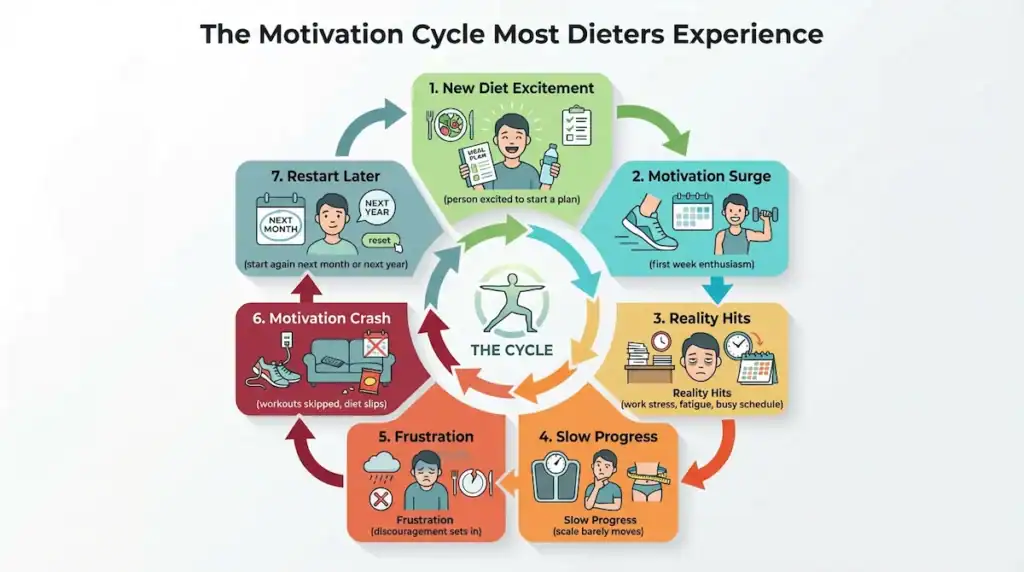
Every article promises “top tips for motivation.” You try them each January: download the app, set the goal, feel excited… but it only lasts a couple of weeks.
Then life gets in the way. Work is tough, you feel tired, and the scale barely changes. Suddenly, motivation is gone.
I see this pattern with new clients all the time. People who are genuinely trying, doing the “right things,” but still feeling stuck. They don’t have a laziness problem. They don’t have a willpower problem. They have a system problem.
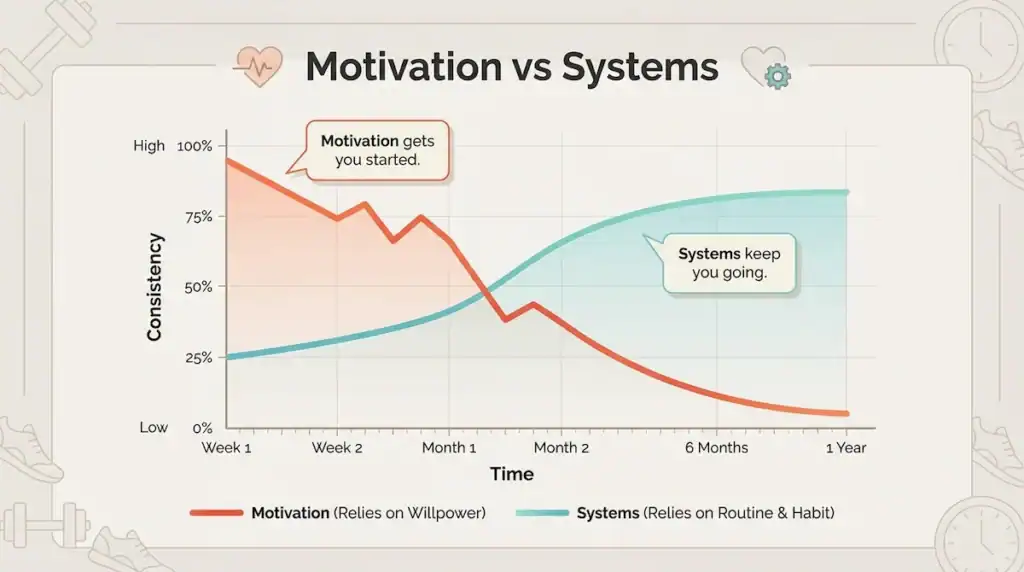
Most people don’t realize motivation isn’t supposed to last forever. It’s what gets you started, not what keeps you going. People who lose weight and keep it off aren’t more motivated—they just don’t depend on motivation to keep showing up.
That shift makes all the difference. If you’re tired of starting over again and again, or if you feel like your body is working against you, you’re not broken. You just need a better system.
In this guide, you’ll learn why motivation fades (which is totally normal), practical steps to build a better system, and how to keep going even on your toughest days.
In this guide, you’ll learn:
- Why motivation fades, and the biological reasons your brain starts working against you after the second week
- How to build systems that work automatically, so healthy choices happen without needing willpower
- Habit stacking and micro goals, which are small-win strategies that help you build lasting momentum
- Environment design: how your kitchen, schedule, and surroundings influence your diet more than you might think
- Flexible goal-setting, and why strict rules often lead to yo-yo dieting—and what you can do instead
- Intrinsic motivation and identity shifts: how to become someone who doesn’t want to return to old habits
- Accountability strategies, including partners, coaches, and communities that help you stay consistent when motivation fades
- How to deal with plateaus, burnout, and comparison (the main motivation killers) and how to fix them
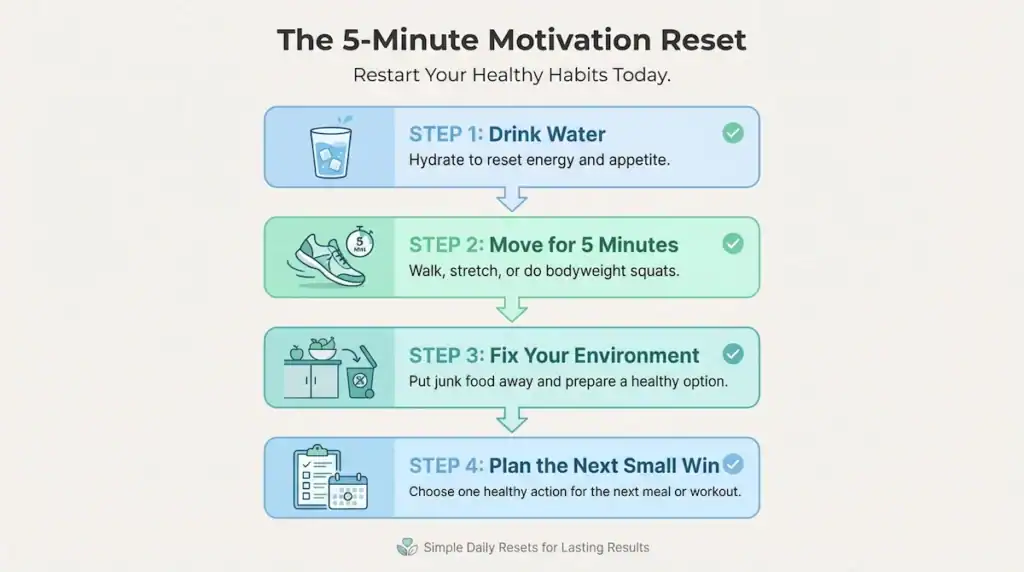
- What to do when motivation is completely gone, including a 5-minute reset plan you can use right away
- Real client success patterns: what actually set apart the people who kept the weight off from those who didn’t
The Real Secret to Staying Motivated to Lose Weight
Here’s the real reason you quit, and it’s not because of your willpower.
You’re not lazy, you’re not weak, and there’s nothing wrong with your “motivation gene.” The real problem is that you’ve been fighting the wrong battle.
Every time you push yourself through a diet, you use up your brain’s decision-making energy, which researchers call decision fatigue.
A 2013 study published in PLOS ONE found that individuals who chronically restrict their eating (dieters) show signs of reduced self-control capacity over time. When their self-control resources are experimentally depleted they consume significantly more ice cream in a taste‑and‑rate task than non‑depleted participants.1
Every skipped meal, every craving you resist, and every “good choice” you force yourself to make drains your mental energy.
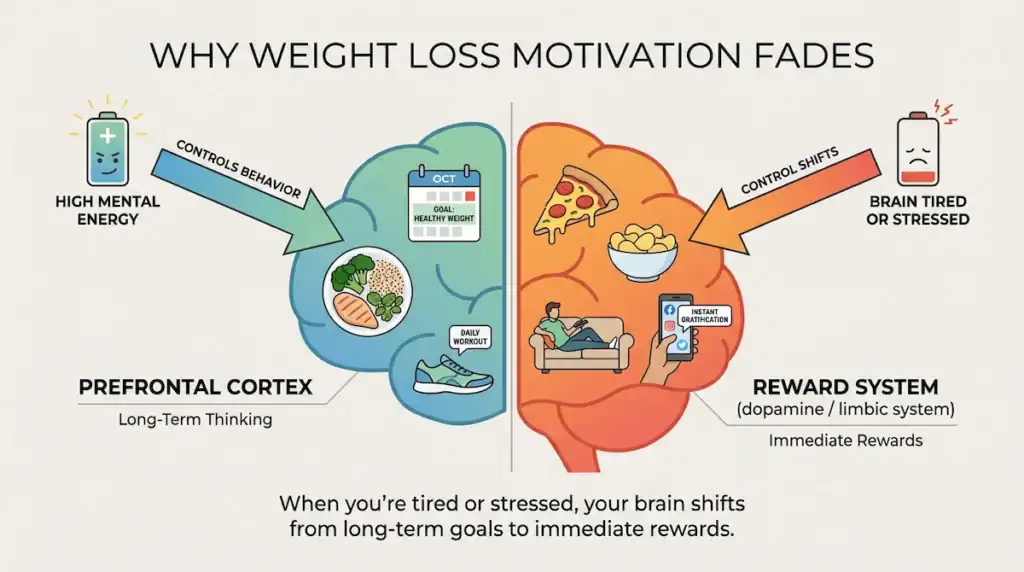
After a long 10-hour shift, your brain stops thinking clearly. It goes into survival mode, and in that state, you want chips instead of salad.
Neuroscientists have looked for a physical “willpower reserve” in the brain for decades, but they haven’t found one.2 Willpower doesn’t run out like a gas tank. Instead, when your brain is tired or unhappy, it shifts from long-term goals to seeking quick rewards.
A 2000 study in Psychological Science reported that people with chronic inhibitions about eating showed reduced self-regulation after being exposed to tempting snack foods. This is consistent with the view that repeatedly resisting cravings and forcing ‘good choices’ temporarily drains the mental energy needed for later self-control.3
That’s not a personal weakness… it’s just how biology works.
Motivation Isn’t the Problem (The System Is)
Having a good system always works better than relying on motivation.
Think about the most consistent people you know… the ones who keep their weight steady and still go to the gym, even when they’re tired.
They aren’t more motivated than you; they’ve just created better systems.
About 95% of what you do each day is habit (it happens automatically). If your environment isn’t well set up, motivation won’t help. But if you make healthy choices the easiest ones, staying consistent gets much easier.
“Environment is stronger than willpower.” This isn’t just a catchy saying… it’s a real strategy you can use.
You can’t eat junk food if it’s not in your house. You’re more likely to go to the gym if your gym bag is packed and ready by the door. You’ll eat better if your meals are prepped and easy to see.
These glass meal prep containers make it much easier. And I’ve found some people find it helpful to write meals on a weekly meal planning pad so the decisions are already made.
The goal isn’t to boost your motivation. It’s to set things up so you don’t need as much motivation in the first place.
Why You Start Strong But Crash Every Time
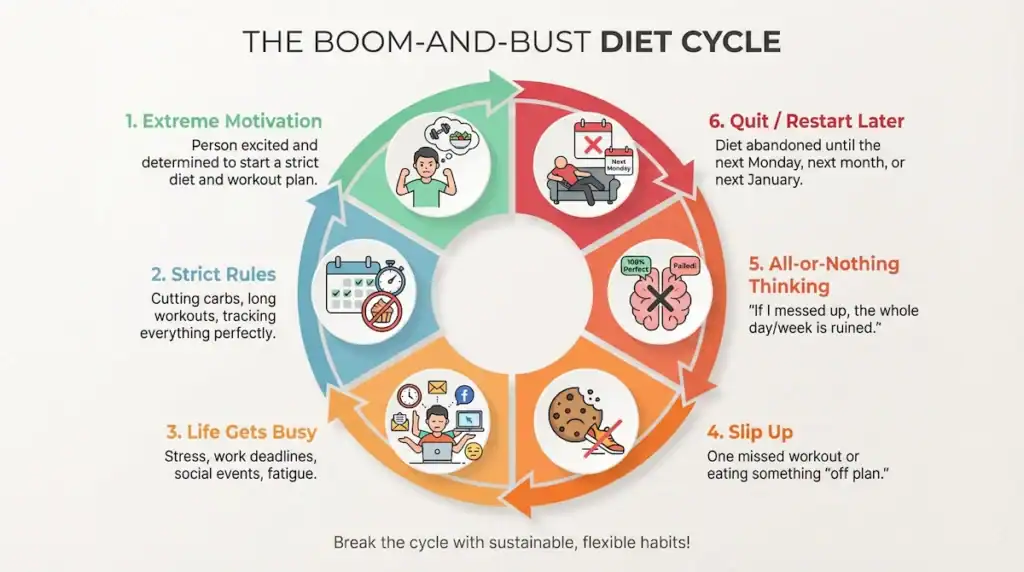
Does this sound familiar? You push yourself for a couple of weeks, then something comes up (a stressful week, a birthday dinner, or just plain exhaustion) and everything falls apart.
That’s not a personal flaw… it’s the all-or-nothing trap.
When your diet has strict rules (like “this food is bad, this food is good”) one mistake can feel like a disaster. Your brain sees it as total failure.
Research shows that people who are flexible with their diets are more satisfied, binge less, and have lower BMI than those who follow strict rules, even if they eat the same number of calories. The freedom that comes with flexibility isn’t a loophole; it’s what actually stops the binge-restrict cycle from starting again.
A 1999 study published in Appetite found that people who use flexible, non‑rule‑bound dieting strategies report less overeating, lower body mass index (BMI), and fewer mood problems. Whereas those who follow rigid, highly restrictive rules show higher BMI, more frequent binge‑eating episodes, and greater disinhibition.4
Implementation intentions: specific if-then action plans like “if I miss my Monday workout, I’ll do a 15-minute home session on Tuesday morning.”
This helps reduce decision fatigue and connect your actions to automatic triggers. When you’ve already decided what to do, you don’t need as much willpower.
How to Stop Losing and Regaining the Same 15 Pounds
Yo-yo dieting isn’t a metabolism problem. It’s a behavior problem.
Most people treat diets as temporary suffering with a finish line. They reach their goal, exhale, and slide right back into the habits that caused the weight gain in the first place.
To break this cycle for good, you need to link your healthier behaviors to something that actually matters to you… not just a number on the scale.

Ask yourself these questions honestly:
- When you imagine yourself a year from now, still stuck in the same cycle… how does that feel? Sit with that discomfort for a moment. That feeling is information.
- What do you want to be physically capable of that you currently can’t do? Keep up with your kids without getting winded. Climb stairs without your knees aching. Feel comfortable in your own skin at a family event. Get specific.
- Who in your life is watching you? A child who mirrors your habits. A spouse you want to grow old and healthy with. A younger version of yourself who deserved better.
- What’s the health outcome you’re quietly afraid of? The diabetes diagnosis. The doctor’s warning. The moment you realized you were avoiding mirrors. Name it.
The clients I’ve worked with who kept the weight off permanently weren’t motivated by a dress size or a beach vacation. They were motivated by the fear of becoming the person they were heading toward. One client told me he’d never once seen a fat 75-year-old out in public. And that observation lit a fire that no meal plan ever could.
Your why doesn’t need to sound inspirational. It just needs to be true.
Once you find it, write it down. Put it somewhere you’ll see it on a Wednesday night when you’re exhausted and the couch is winning. Because that’s exactly when it matters most.
Energy to keep up with your kids. Not being the person who has to sit out of activities because their knees hurt. Feeling like yourself again, not just a worker or a parent or a patient.
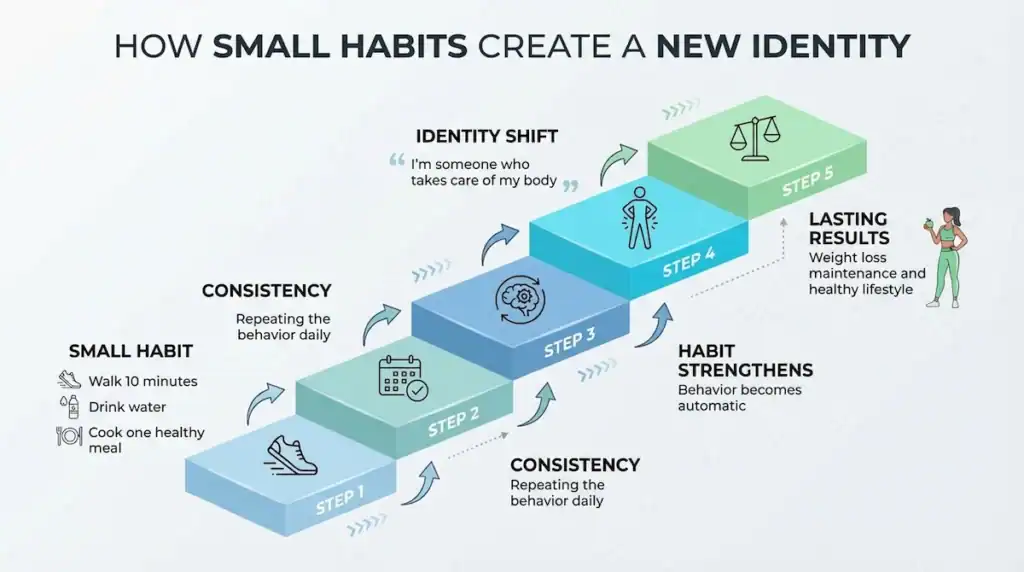
When your identity shifts… when you start seeing yourself as someone who moves and eats well. The behaviors stop feeling like a sacrifice. They feel like self-respect.
Stop waiting for motivation. Start today by building your system. Take one action now to make healthy choices automatic, even on your worst days.
Why Weight Loss Motivation Fades So Quickly
The “Motivation Dip” Is Real. And Your Biology Is Driving It
You start strong. You’re fired up, you’re tracking everything, you’re meal prepping on Sunday like a professional.
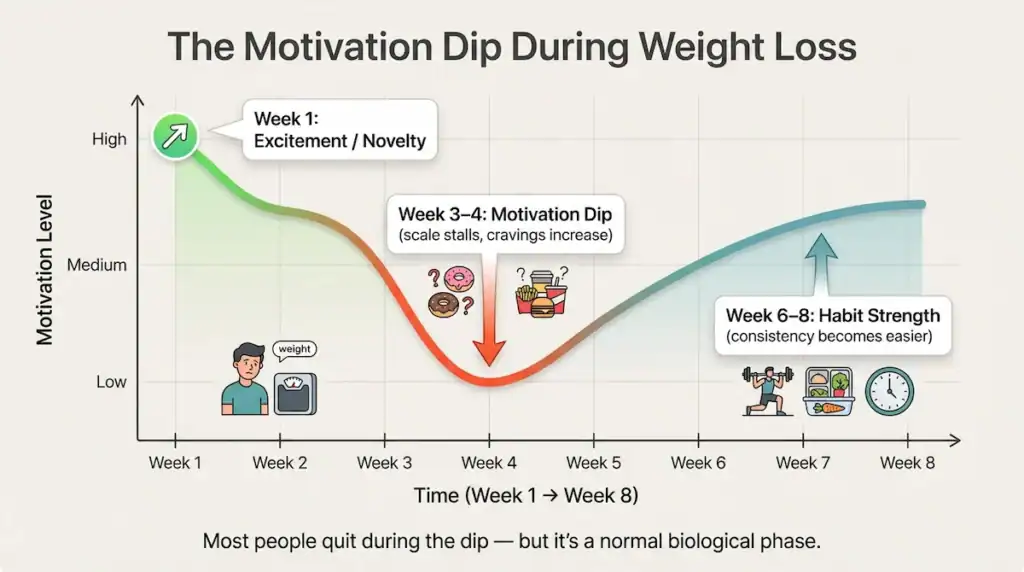
Then week three hits. The scale stalls. Life gets loud. And suddenly the whole thing feels pointless.
Here’s what’s actually happening: that initial flood of enthusiasm isn’t true motivation… it’s novelty. And novelty has an expiration date.
As your body gets leaner, your fat cells produce less leptin. This is the hormone that signals fullness to your brain. Appetite surges. Cravings get louder. Your rational, goal-focused mind starts losing the argument with your primitive, comfort-seeking brain.5
A 2008 follow‑up study published in the Journal of Clinical Investigation found that leptin levels declined by roughly 70–80% after significant weight loss. This reduction in leptin production by fat cells helps explain increased hunger and slower metabolism as the body gets leaner. This confirms that less body fat directly corresponds to lower leptin output.6
Daily weight fluctuations are almost never fat. A 2–3 pound overnight spike is usually a hydration shift, food mass in your digestive tract, or glycogen stored from carbs. It means nothing about your actual progress. But emotionally it can wreck you.
A 2017 study published in Obesity reported that short‑term changes in body weight are largely composed of water and glycogen‑bound water rather than fat. This is why daily weight fluctuations on the scale almost never reflect actual fat gain or loss.7
The deeper issue is biology. Your brain has zero foresight for future rewards. It only understands right now. Waiting weeks or months to see a physique result is genuinely difficult for the human brain to stay motivated by. Especially when a bag of chips delivers pleasure in 30 seconds.
Diet Culture Sold You an Impossible Timeline
“I thought I’d see results in two weeks.” I hear this constantly from people who’ve been grinding for a month and feel like failures.
Diet culture is built on promises of rapid transformation. The industry hands you complicated, extreme plans — cut all sugar, track every macro, train six days a week — and then acts surprised when you quit.
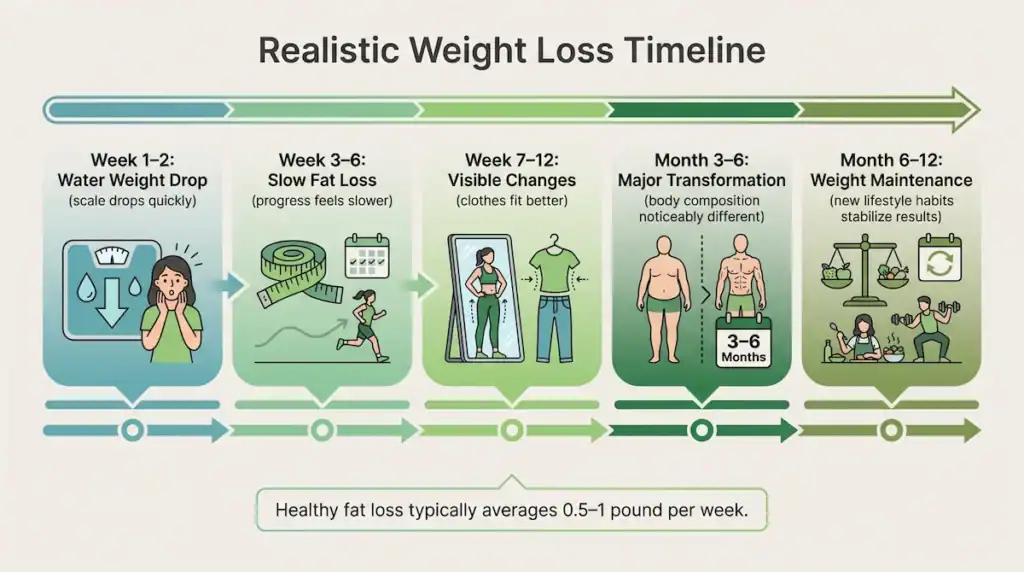
And those before-and-after photos you see on social media? Lighting, posture, water retention, and glycogen levels may create a more dramatic visual difference than actual months of fat loss. You’re comparing your real, unfiltered progress to a staged photograph.
Tracking portions with a simple digital food scale can help you understand what and how much you’re actually eating.
Beginners also consistently underestimate how much total weight they need to lose before visible leanness or abdominal definition appears.
A 2017 review in Obesity Reviews reported that a substantial proportion of people with overweight or obesity do not recognize their own excess body fat. This suggests that beginners consistently underestimate how much weight they need to lose before visible leanness appears because their internal ‘normal’ body size no longer matches their actual adiposity.8
The fitness industry exploits this by selling rapid-transformation timelines that don’t account for the physiological reality of fat distribution or the baseline body fat percentage needed to see muscular definition.
Extreme restriction also backfires neurologically. Banning specific foods creates a “forbidden fruit” effect. Your brain fixates on exactly what it can’t have, ratcheting up cravings until the dam breaks.9
A 2012 fMRI study published in NeuroImage found that self‑imposed caloric deprivation increases activation in attention, reward, and motivation areas of the brain in response to images of palatable food. This suggests that extreme dietary restriction neurologically amplifies food cravings and can backfire by making it harder to sustain long‑term weight control.10
Your Brain Is Full… And Your Diet Is Paying the Price
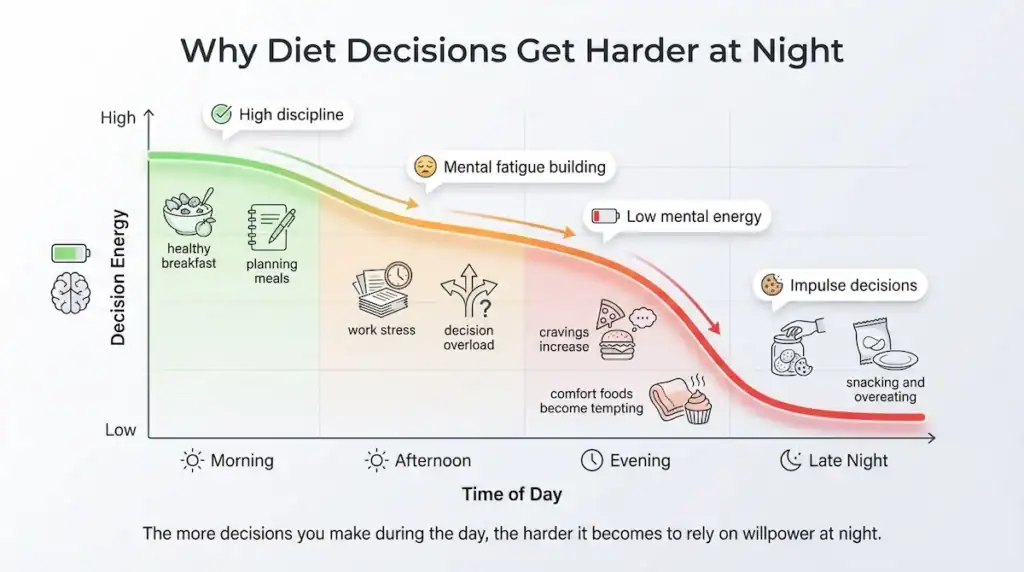
Every food decision you make consciously like eat this, skip that, track this, resist that costs cognitive resources.
Since about 90% of what you do each day is automatic, trying to make every food choice on purpose is a losing battle. By midday, your brain is already tired of making decisions. By 9pm, it’s barely working.
A 2025 study published in Psychology & Health found that about 65% of daily behaviors are triggered automatically by habit and 88% are carried out with minimal conscious control. This supports the idea that nearly 90% of what you do each day is automatic.11
That’s not a willpower failure. That’s an architecture failure.
The same thing happens with tracking calories. If you do it too much, it stops being helpful and starts to feel stressful, especially if it makes you worry about every bite or ruins social events.
When Life Gets Heavy, So Does Your Diet
Chronic psychological stress doesn’t just hurt your mood. It actively hijacks your appetite. Under prolonged stress, your brain releases cortisol, which drives intense cravings for calorie-dense comfort foods as a neurological self-soothing mechanism.
A 2017 study published in Psychoneuroendocrinology found that higher baseline cortisol and chronic psychological stress each predicted greater food cravings and short‑term weight gain over six months.12
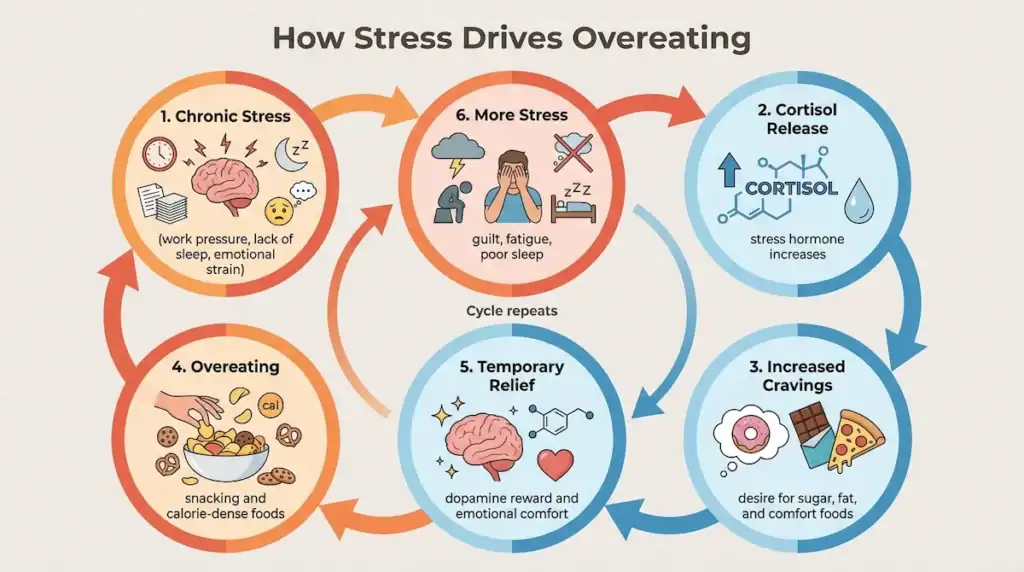
Feeling down makes it worse. When you’re sad or worn out, your brain reacts even more strongly to food, so junk food feels even better on your hardest days.
A 2012 fMRI study published in the Journal of Cognitive Neuroscience found that inducing negative mood increased activity in the orbitofrontal cortex and ventral striatum in response to appetizing food images.13
And after a long shift or brutal workday? That’s not hunger… that’s exhaustion. Your brain is flooding your system with hunger hormones such as leptin and ghrelin, even though what your body actually needs is sleep.
Improving sleep (even with something as simple like a blackout sleep mask) can help reduce late-night cravings.
A 2004 study published in PLOS Medicine found that people who slept only about five hours per night had 14.9% higher ghrelin and 15.5% lower leptin than those who slept eight hours.14
The Bottom Line: Your motivation isn’t broken, your system is. Identify your main trigger (like fatigue, scale anxiety, or tracking overload), then create a practical, single step or habit that eliminates this barrier. For example, prepping healthy snacks if you tend to overeat when tired.
15 Proven Ways to Stay Motivated to Lose Weight Long-Term
1. Stop Chasing the Number. Focus on Habits Instead
The scale is a poor motivator. Here’s why… Your body can build muscle and lose fat simultaneously when you’re strength training.
A 2024 study published in Nutrition Sciences reported that an 8‑week supervised exercise and nutrition program led to significant reductions in body‑fat percentage and fat mass while increasing muscle mass and basal metabolic rate.15
Since muscle is denser than fat, your weight can stay flat (or even go up) while your body is completely transforming. If you’re letting that number dictate your drive, then you’re measuring the wrong thing.
Even basic equipment like a set of adjustable dumbbells at home can help you build muscle while dieting. I recommend this adjustable dumbbell set for men and this one for women.
Research is clear on this: there’s no link between the weight people hope to lose and the weight they actually lose.16 Goals like “lose 10 pounds” are just wishes with a number.
What actually works? Implementation intentions: specific if-then action plans. Not “I’ll go to the gym more.” Instead: “On Sunday night, I’ll pack my gym bag, so I can go straight there Monday morning.” That’s an action you can execute and win every single day.
If your goal is to work out daily and all you do is show up, put your shoes on, look around, and leave… you still win. The habit stays intact. The momentum keeps building.
When people lose weight they forget about joint health, skin elasticity and recovery. One supplement I personally like and take is Ageless Multi-Collagen that provides multiple types of collagen peptides to support joints, skin, connective tissue, and recovery.
Powered by 5 Types of Bioactive Naturally Hydrolyzed Collagen Peptides for Full-Body Support (Odorless & Flavorless)
- Comprehensive Collagen Blend: Types I, II, III, V & X to boost skin elasticity, joint & bone strength
- Hydrolyzed Peptides: 10 g per serving for rapid digestion & max absorption
- Skin, Hair & Nails: Promotes smoother, more youthful skin, glossy hair & strong nails
- Gut & Joint Care: Supports healthy connective tissue & gut lining
- Zero Taste or Smell: Dissolves instantly in hot or cold drinks—no clumps, no fuss

The Bottom Line: Ditch the scale obsession. Track your daily actions instead, and let the results follow.
2. Set Smaller “Micro Goals” Instead of One Big Goal
Use the “one small win” strategy to build unstoppable momentum.
Most people set massive goals and then wonder why they quit. “Lose 50 pounds. Cut all sugar. Work out every day.” That’s not a goal. That’s an overwhelm spiral about to happen.
Micro goals are what actually work. Pick one or two small behaviors to change this month. Just one. Then execute it daily until it’s automatic.
Not “lose 5 pounds this month.” Instead, “I will swap my afternoon dessert for a piece of fruit.” That’s a behavior you can win at today.
Or even simpler, commit to walking “at least 5 minutes a day.” The phrase at least is doing serious work there. It sets the bar low enough that your brain offers zero resistance. And once you’re moving, you almost always do more.
That’s how momentum builds… not through giant leaps, but through tiny wins stacked daily.
Each small win triggers a dopamine release, rewarding your brain for the behavior. Over time, your brain stops fighting the habit and starts craving it.17
The goal isn’t perfection. The goal is a daily win small enough that skipping it feels weird.
The Bottom Line: Pick one micro goal this week (something laughably small) and hit it every single day until it needs zero willpower to execute.
3. Build Intrinsic Motivation Instead of Relying on Rewards
Cheat meals. Progress photos. Gold stars on a habit tracker. None of it works long-term. Here’s why.
External rewards only motivate you until they don’t. The moment the process gets genuinely hard (and it will) no treat is worth the grind. What keeps people going for years isn’t a reward system.
It’s intrinsic motivation: doing it because it means something. According to Self-Determination Theory, intrinsic motivation is built on three pillars: competence, autonomy, and relatedness.18
Competence comes from getting visibly stronger and seeing real results. Nothing drives motivation like actually getting better at something.
Autonomy means reframing your diet as choices you make, and not rules you’re forced to follow. You’re not “banned” from pizza. You’re choosing to trade it for a leaner body. That shift in language changes everything.
Relatedness is why CrossFit gyms retain members better than solo treadmill routines. Mutual struggle creates accountability no app can replicate.
But the deepest motivator of all? A reason why that hits harder than vanity. Wanting to look better rarely survives a brutal Wednesday. Wanting to be alive and mobile when your kids are grown? That one doesn’t quit.
The Bottom Line: Ditch the cheat meal rewards. Find the one intensely personal reason why getting healthy is mandatory, and let that drive the system.
4. Build a Routine That Runs on Autopilot
Stop relying on motivation. Start relying on this instead…
The goal isn’t to stay motivated. The goal is to build a routine so ingrained that you don’t need motivation.
Since about 90% of daily human behavior runs on autopilot through habits the real strategy is to use your initial drive to engineer a system. And then let the system carry you.
Working out at the same time every day is important. Your body runs on a daily schedule, so training at a set time helps you sleep better and recover faster. Pick a time, stick to it, and keep going until it feels like a normal part of your day.
Having the same grocery routine protects your diet. Never shop when you’re hungry. Always stick to your list. Shop the outer aisles, where the healthy food is.
And remember: if it’s not in your house, you can’t eat it. Sometimes, being lazy helps you eat better.
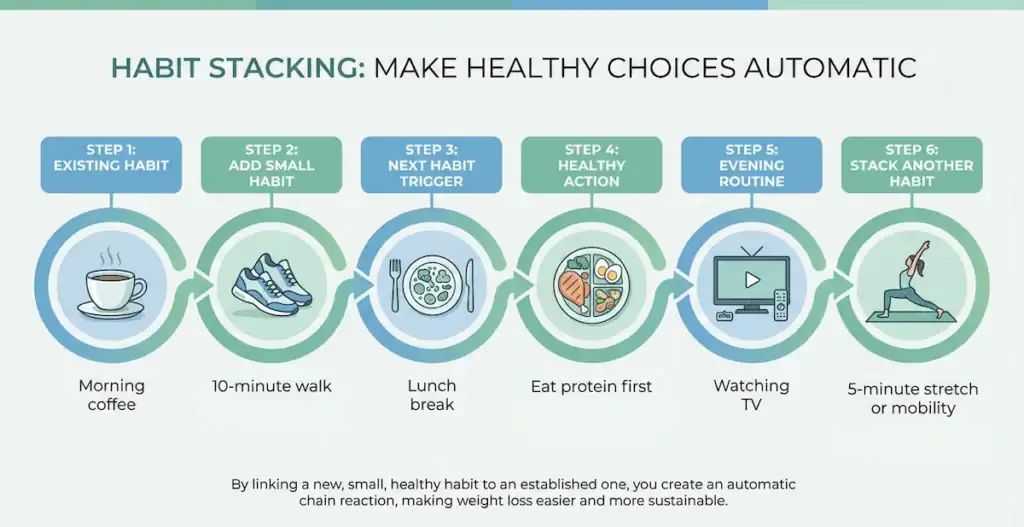
Habit stacking means linking new habits to things you already do. For example, “After my morning shower, I make my healthy breakfast.” You don’t have to think about it, then one action leads to the next.
When the routine runs itself, willpower becomes irrelevant.
The Bottom Line: Lock in one fixed workout time, automate your grocery list, and stack one new habit onto something you already do daily. Then watch consistency stop feeling hard.
5. Adopt a Growth Mindset & Flexible Control
Here’s what the research actually shows: flexible control is consistently more predictive of long-term fat loss than strict dieting.
Not more discipline. More flexibility.
Rigid “good food vs. bad food” thinking almost always ends in the same place. A binge, a spiral of shame, and starting over from scratch. That’s not a character flaw. That’s the predictable outcome of an all-or-nothing system.
Instead, think of your calories like a budget, not strict rules. If you eat too much one day, think about why, and get back on track the next day. No crash diets or punishment. Just learn and move on.
Being flexible means how you think about your diet, not eating anything you want. Having no limits at all often leads to unhealthy choices and eating too much.
The goal is to make smart choices because you want to, not because you have to follow strict rules. This way of thinking makes dieting much easier.
The same idea works for your mindset. Let go of random goals like “lose 15 pounds by March” and focus on getting stronger, leaner, or just better. Focusing on what you do each day takes away the stress that makes people quit when progress is slow.
And keep things as simple as possible. The best plan is the one you can stick with, not the most perfect one. “Be active every day” works better than any complicated diet plan that’s hard to follow.
Slip-ups aren’t failures. They’re pebbles in the road. Keep walking.
The Bottom Line: Ditch rigid food rules, treat slip-ups as data (not disasters) and focus on daily process rather than distant outcomes.
6. Remove Friction From Healthy Choices
Make the healthy choice the only easy choice.
Here’s a fact that might change how you set up your kitchen: people who keep junk food out where they can see it weigh 26 pounds more than those who don’t.
A 2015 study published in Health Education & Behavior found that women who kept soft drinks and cereal visible on their kitchen counters weighed roughly 20 to 26 pounds more than women who kept those foods out of sight.19
Your environment is running your diet more than your willpower ever will. So stop fighting your environment and start engineering it.
Keep only healthy foods where you can see them, like fruit on the counter and ready-to-eat meals in the fridge. Never shop for groceries when you’re hungry, and always bring a list.
Shop the outer aisles, since the middle aisles are set up to make you buy things you don’t need. If it’s not on your list, don’t buy it… this way, you don’t have to fight with yourself in the store.
Do the same with your workouts. Pack your gym bag the night before. Set your clothes out. Give yourself full permission to put them on and do absolutely nothing else. Because once you’re dressed, your brain’s “going to the gym” routine fires automatically.
Simple systems beat optimized ones every time because simple systems actually get followed.
The Bottom Line: Engineer your environment so the healthy choice requires zero willpower. Then let the system do the heavy lifting.
7. Make Workouts More Enjoyable
Why “no pain, no gain” is unknowingly destroying your consistency. It’s one of the most common side effects of exercise.
People who perceive their workouts as stressful chores are significantly more likely to reward themselves with extra calories afterward. You suffer through the workout. Then you unconsciously compensate for the suffering. Net result? Zero.
The best exercise is the one you’ll actually do consistently, without dread. It’s not brutal HIIT sessions for most people. It’s walking. Walking is time-flexible, easy on joints, doesn’t interfere with muscle growth.
And when given a free choice, most people naturally prefer lower-intensity movement anyway. Just be sure to track your steps with a simple fitness tracker or Apple Watch.
If you genuinely enjoy hiking, recreational sports, or group classes, do those instead. Organized team sports are especially powerful because a third party sets the schedule, removing the daily willpower decision entirely. Surrounding yourself with people who move regularly makes healthy habits feel normal rather than heroic.
For workouts you do alone, combine your exercise with something you already enjoy. Studies show that music makes workouts feel easier (lower ratings of perceived exertion). Podcasts help too. If you already listen to one every day, try listening while you walk instead of sitting down.
Enjoyable movement compounds. Punishing movement quits.
The Bottom Line: Swap punishing workouts for movement you actually enjoy. Consistency over intensity wins every single time.
8. Use Accountability
Why who you’re around matters more than how hard you try. Willpower runs out. Social pressure doesn’t.
Think about it… people push themselves to their absolute limits in team sports, military training, and high-stakes jobs. Not because they’re more motivated than you. Because someone is watching and something is on the line.
Weight loss is usually a solo journey with zero consequences for quitting. That’s the problem.
A workout partner converts a personal resolution into a social commitment. You’re not just letting yourself down when you skip… you’re letting someone else down. That shift in stakes is powerful when your internal drive is running on empty.
A coach or trainer helps for a reason most people don’t expect. It’s not just their workout plans or knowledge. Studies show that feeling truly understood and supported is a bigger motivator than any advice a coach gives. Find someone who cares, not just someone who tells you what to do.
Online communities and group classes do something even deeper: they rewire your identity. Once you start identifying as “someone who trains,” healthy choices stop feeling like effort. They feel like a sense of agreement with who you are.
You become the average of who you spend time with. Choose accordingly.
The Bottom Line: Add one layer of external accountability this week (a partner, a coach, or a community) and watch consistency become automatic.
9. Track Streaks & Consistency
Why counting your wins works better than counting calories.
People who maintain a consistent diet across the full week (including weekends) are 1.5 times more likely to keep the weight off than those who eat well Monday through Friday, then go off-script on weekends.
A 2004 study based on the National Weight Control Registry found that people who kept their diet consistent on weekends and weekdays were significantly more likely to maintain their weight loss.21
Consistency isn’t just helpful. It’s the mechanism.
The worst habit-building mistake? Picking and choosing which days you show up. Every skipped day makes the next skip easier. So when your motivation dips and you can only manage one minute of pushups, do the one minute. Not for the fitness benefit, but to protect the streak.
Track your actions, not your outcomes. Count gym visits per week. Log your morning weight daily as objective feedback, not emotional judgment. If you’re not measuring, then you’re not managing.
Most people who lose weight and keep it off eat about the same foods every day. Trying lots of new things feels fun at first, but sticking to a routine is what really works.
Make the game winnable daily. Then keep playing.
The Bottom Line: Track one daily action this week. Gym visits, steps, or morning weight, etc. and protect that streak like it’s your most important asset.
10. Recognize Tiny Victories
These are the non-scale victories that actually keep you motivated. The scale is one data point. And it’s often the worst one to fixate on.
Here’s what actually tells you your system is working: your jeans fit differently. You lifted heavier this week than last. You no longer needed a second coffee to get through the afternoon.
Those are real wins. Celebrate them like it.
Clothing fit and waist measurements are far more reliable progress indicators than scale weight. Because muscle is denser than fat, your body can recompose entirely (visibly leaner, noticeably stronger) while the number barely budges.
Getting better at exercise is one of the best ways to stay motivated. Lifting more weight, doing more reps, or just moving more easily shows you’re making progress in a way the scale can’t. Slow, steady improvement makes your brain feel good and keeps you coming back.
Having more energy and better health are your real wins. Losing fat lowers inflammation in your body, helps control blood sugar, and makes you think more clearly.
Getting stronger also lowers stress and boosts your mood and confidence. For most people, these are the main reasons they stick with it.22
The Bottom Line: Pick one non-scale metric to track this week like clothing fit, reps lifted, or daily energy… and let that be your proof of progress.
11. Design Your Environment for Success
Your environment is either working for your weight-loss goals… or against them.
Food environment first. Clear out the junk. Stock only what you’d be fine eating on autopilot. Keep pre-cut carrots, celery, and cucumbers at eye level in the fridge. When you wander into the kitchen out of boredom (and you will) healthy is the only easy option.
Kitchen habits compound the effect. Use smaller plates to trigger the Delboeuf illusion. Your brain reads a full smaller plate as a larger portion, signaling satiety sooner. Serve conservatively, knowing you can go back for seconds.
Research shows humans eat an average of 92% of whatever is placed in front of them, regardless of actual hunger, so the amount you serve is largely the amount you’ll eat.
A 2014 aggregate analysis in the International Journal of Obesity found that adults eat about 92% of the food they serve themselves. This confirms that people tend to finish almost everything put on their plates.23
Prep meals in bulk on weekends so there are no decisions to make after a 10-hour day.
Home gym setup is about cues, not equipment. When you feel too drained to train, put your workout clothes on anyway, and give yourself full permission not to exercise. The physical sensation of the clothes triggers your brain’s exercise routine automatically.
Add friction to bad habits. Remove it from the good ones.
The Bottom Line: Spend one hour this weekend redesigning your food environment. Clean the counters, prep the fridge, set out your workout clothes… and let your surroundings do the motivating.
12. Eliminate Physical Hunger
Hunger isn’t a willpower problem. It’s an engineering problem.
When you’re physically hungry, the cognitive conflict between your rational brain and your primitive brain registers as mental fatigue. The hungrier you get, the faster your self-control collapses. That’s no weakness, but that’s biology winning.
Maximize food volume first. Your stomach has stretch receptors that measure physical fullness… not calories. Fibrous vegetables like zucchini, spinach, and cauliflower stretch those receptors for almost zero caloric cost. Eat more, stay fuller, consume less.
Every 14 grams of fiber you add naturally reduces your daily calorie intake by roughly 10%… without tracking, without restriction, without willpower.
A 2001 review in Nutrition Reviews reported that increasing dietary fiber intake by about 14 g per day under ad libitum eating conditions is associated with an average 10% reduction in energy intake and roughly 1.9 kg of weight loss over about four months.23
Soluble fiber forms a viscous gel in your gut that delays gastric emptying and sends direct satiety signals to your brain via short-chain fatty acids.
Choose viscous, hard textures. The harder or thicker a food is, the more satiating it is. Highly viscous or solid foods, such as thick Greek yogurt, cottage cheese, or solid meats, require more oral processing and chewing, which actively stimulate satiety signals.24
On the other hand, be sure to eliminate liquid calories… juices and sodas pass through your stomach rapidly with almost zero satiating effect.25
Limit intra-meal variety. Your appetite is “sensory-specific.” You don’t just become generally full, you become full of a specific flavor. A wide variety of highly palatable foods in a single meal resets your appetite with each new flavor. Limit each meal to a single high-quality protein and one or two filler foods.
Protein is your hunger killswitch. Your body will keep you hungry until its amino acid requirements are met. Hit roughly 1.6 grams per kilogram of bodyweight daily, and hunger drops significantly. Miss that target, and no amount of willpower keeps you on track.
Use my free protein calculator to instantly find your daily protein needs to get results.
And if you’re ravenously hungry despite eating well? Check your sleep. Just 4–7 hours instead of 8 increases daily appetite by 20–22%. Getting 7.5–8 hours is mandatory.
Here are three sleep changes that make an immediate difference:
Set a non-negotiable bedtime. Your body’s hunger hormones (leptin and ghrelin) are regulated on a 24-hour circadian rhythm. Going to bed at the same time every night, even on weekends, stabilizes that rhythm and considerably lowers next-day appetite. Inconsistent sleep timing is one of the most underrated causes of chronic cravings.
Cut screens 30–60 minutes before bed. Blue light from phones and laptops suppresses melatonin production. This is the hormone that signals your brain it’s time to sleep.
Even 30 minutes of screen-free wind-down time measurably improves sleep quality plus reduces the time it takes to fall asleep. Replace it with something low-stimulation, such as reading, stretching, or a few minutes of focused breathing.
Keep your bedroom cold and dark. Core body temperature needs to drop roughly 1–2 degrees Fahrenheit to initiate and maintain deep sleep. A cool room (around 65–68°F) accelerates that drop.
Blackout curtains or a sleep mask eliminate light cues that keep your brain in a less deep sleep stage. Meaning more time in the deep, reparative sleep that controls hunger hormones properly.
Fix the sleep, and the hunger often fixes itself.
The Bottom Line: Engineer hunger out of your diet by loading up on fiber, hitting your protein target, and protecting your sleep like it’s your most important fat-loss tool.
13. Start Big for Quick Psychological Wins
Everyone tells you to ease in. Start slow. Be gradual. Here’s what research actually says…
People who lose a lot of weight at the start of their diet are more likely to keep it off long-term than those who go slowly. It’s not just about motivation, but it’s how your mind works.
Right now on day one, week one your motivation is at its absolute peak. That energy is a finite resource. The smartest thing you can do is capitalize on it immediately, not save it for later.
Here’s the counterintuitive part: starting with an aggressive deficit sets a high benchmark for difficulty. So everything that follows feels easier by comparison.
But if you ease in and slowly tighten restrictions week by week, every adjustment feels like a new punishment. Your brain gets locked into one conclusion: this is only going to get harder.
Think about going into an ice-cold shower, then into lukewarm water after. Endure the hardest part first (while your drive is peaking) and the rest of the journey seems manageable.
Quick results at the start also do something willpower can’t: they build real confidence. Seeing changes in the first few weeks helps you believe you can do it, and that belief keeps you going.
The Bottom Line: Strike hard while your motivation is highest. Rapid early results build the self-efficacy that sustains you when initial enthusiasm fades.
14. Use Visual Reminders of Your Goal
Visual reminders work, but most people use them in ways that backfire.
Progress photos first. Lighting, posture, water retention, and glycogen levels can produce a more dramatic visual difference than actual months of fat loss.
A “bad” photo shot under different conditions can destroy your motivation for a result that’s actually working. If you use photos, standardize everything: same time, same lighting, same pose.
Vision boards have a hidden problem. Fixating on a distant physique outcome keeps you locked in a state of “pre-success failure.” Perpetually falling short of a finish line that’s months away. That chronic gap feeling quietly drains motivation.
Instead of static outcome imagery, use episodic future thinking: vividly imagine yourself executing tomorrow’s habits. Imagine making your high-protein breakfast. Imagine the walk. Your brain responds to vivid near-future visualization by making the behavior feel inevitable.
Progress charts are a great visual tool. Tracking your average weight or waist size over a week gives you real feedback. Watching the numbers change, even slowly, helps you feel like you’re getting better. This proves your plan is working, even if you can’t see it yet.
The Bottom Line: Ditch the outcome vision board. Chart your daily actions and use near-future visualization to make healthy behavior feel automatic.
15. Reward Yourself, But Not With Food
Here’s the hard truth about reward systems: studies show that using outside rewards like new gear or gifts doesn’t help you stick with diet and exercise for long.
People who motivate themselves with tangible rewards are typically the same ones who sign up in January and quit by March. When the process gets genuinely hard, no reward is worth the grind.
What actually works is building motivation that doesn’t require a prize attached.
Your workout clothes aren’t a reward, they’re a trigger. Whenever motivation is zero, don’t negotiate with your brain. Just put the clothes on. Give yourself full permission not to exercise.
The physical sensation of being dressed for it acts as a Pavlovian cue that automatically boots up your brain’s exercise routine. Energy follows.
Immediately pair your workout with a predictable non-food reward. Reading articles you’ve been saving, a cup of coffee, a specific podcast episode.
By placing guaranteed pleasures at the end of exercise, you can help your brain develop a strong neurological association between physical exertion and feeling good. Over time, this makes the routine chemically addictive rather than something you have to force.
Gamification creates continuous intrinsic rewards for free. Your brain releases a small dopamine hit every time you complete a workout or prep a healthy meal with attention and efficiency. Turn your daily habits into a game by tracking points, protecting streaks, leveling up. And the effort starts feeling genuinely good without costing you anything.
The ultimate reward isn’t something you buy. It’s more energy, less joint pain, and a body that moves the way it’s supposed to. When that becomes the reward, going back feels like the sacrifice.
The Bottom Line: Stop bribing yourself with gear and gifts. Use your workout clothes as a motivation trigger and gamify your daily habits for continuous dopamine rewards instead.
The Psychology of Weight Loss Motivation
Key Takeaways:
- Extrinsic motivation (appearance goals, milestone rewards) consistently fails when the process gets hard.
- Identity-based motivation. “I’m someone who takes care of my health” removes the need for willpower entirely
- Daily systems create continuous dopamine feedback loops. Goals only deliver the reward at the end.
Intrinsic vs Extrinsic: Which Type of Motivation Actually Lasts
People who sign up in January and quit by June all have one thing in common: they’re running on extrinsic motivation.
A target weight. A deadline. A reward waiting at the finish line. These are appearance-based, outcome-driven goals… and they trap you in a state of continuous pre-success failure.
Every day you haven’t hit the number, your brain registers it as falling short. That feeling is heavy. It drains you quietly until quitting feels like relief.
Intrinsic motivation works differently. When your goal is internal like being someone who moves daily, eats well, has energy then you win every single time you execute the system. The behavior itself becomes the reward.
“Wanting to look a little better in the mirror” rarely survives a hard stretch. But wanting to be alive and mobile when your kids are grown? That one doesn’t quit.
Identity-Based Motivation: The Fastest Way to Make Healthy Choices Automatic
One of the strongest human motives are the desire to remain consistent with how we define ourselves.
Stop saying “I’m trying to lose weight.” That phrase implies a temporary struggle against your true nature.
Start saying “I’m not the kind of person who eats like that.” Say it until you believe it. Because once the identity locks in — once you genuinely see yourself as someone who takes care of their health — the daily decisions stop requiring willpower. You’re just acting like the person you already are.
The word “diet” literally comes from the Greek diaita, meaning a way of life. Not a punishment phase. Not a temporary suffering period. A way of life.
Dopamine & Progress Feedback: Why Tiny Victories Are Neurologically Powerful
Dopamine is the chemical currency your brain uses to pay for effort. Goals starve you of it. The reward only comes at the end of a long journey. Daily systems flood you with it continuously.
If your system is simply “be active every day,” you get a dopamine hit whether you crushed a workout or just took a walk. Both count. Both reinforce the loop.
This creates a self-reinforcing progress cycle: action produces results, results improve mood and perceived effort, and elevated mood drives more action.
Once this loop is running, motivation stops being something you have to manufacture and starts being something the system generates automatically.
Track tiny victories. Measure daily. Let the feedback feed the loop.
What to Do When You Lose Motivation Completely
Once motivation crashes, the system is what saves you.
Every consistent person you admire has had days (weeks, even) where motivation was completely gone. The difference isn’t that they felt more motivated. It’s that they had a plan for when they didn’t.
The Two-Day Rule: Never Let One Skip Become Two
One missed workout isn’t the problem. It’s what happens next.
Missing once is human. Missing twice builds a new habit… the wrong one. Diet consistency is one of the strongest predictors of long-term weight-loss maintenance. A single skip becomes dangerous only when you let it set the new standard.
When you fall off, don’t compensate with a crash diet or a punishing “make-up” session. Reflect on why it happened, then return to your normal routine the next day. Treat it as a data point, not a moral failure.
Reduce the Goal. Don’t Quit It
Whenever motivation tanks, your brain isn’t broken. It’s fatigued.
Here’s what most people don’t know: humans suffer from a projection bias. We incorrectly assume our current feelings of sluggishness will persist during the workout.
Research shows that even a brief warm-up can completely eliminate mental fatigue. The feeling before the workout is almost never an accurate prediction of how you’ll feel five minutes into it.
Commit to five minutes. A short walk counts. One minute of pushups counts. The point isn’t the fitness output… it’s reinforcing that the daily behavior still occurred.
Something always beats nothing.
Restart With the Simplest Plan Possible
If motivation has completely collapsed, your previous plan was probably too complicated.
Complicated systems have too many failure points. When restarting, be a simplifier, not an optimizer. Pick one habit change for the next 30 days (just one). Cut the afternoon dessert. Walk after dinner. Make a high-protein breakfast after your morning shower.
Give it a full month to become automatic before adding anything else. One locked-in habit beats five half-executed ones every time.
Reconnect to Your Original Reason (The Real One)
Surface-level goals don’t survive hard stretches.
“I want to look better” falls apart under stress. But “I don’t want to be the person who’s housebound or dead at 75”… now that one holds.
Once motivation fades, write down the long-term pain of quitting: the future disease risk, the low energy, the joints that won’t cooperate. Then consciously connect your healthy habits to what they actually deliver… energy, mobility, confidence, presence for the people who need you.
When the why is deep enough, the daily habits stop feeling like a sacrifice. They feel like the most obvious thing in the world.
The Bottom Line: Whenever motivation disappears, don’t overhaul everything. Do one tiny thing today, protect the streak tomorrow, and reconnect to the reason that actually matters.
How to Stay Motivated to Work Out When You Really Don’t Feel Like It
Key Takeaways:
- Mental fatigue before a workout is psychological, not physical. Start with five minutes, and the resistance usually disappears.
- Pre-planned implementation intentions (same time, packed bag, clothes out) replace willpower with automatic behavior.
- Pairing exercise with entertainment or social connection removes the “chore” perception that drains long-term motivation.
The mindset shift that changes everything: the right amount of exercise today is whatever makes you look forward to being active tomorrow.
Not the most calories burned. Not the most impressive session. The one you’ll actually repeat.
Short Workouts Count
The all-or-nothing mindset is the single biggest consistency killer in fitness.
You planned 45 minutes. Life gave you 10. So you skip entirely and “start fresh Monday.” But here’s what’s actually happening biologically… the mental fatigue you feel before a workout doesn’t impair your muscles at all. It’s your brain, not your body, resisting. And the best way through that resistance is a smaller door.
One minute of pushups. A five-minute walk. A single set of squats in your living room. The fitness return is modest. But the habit return is enormous.
Even light exercise at just 15% of maximum effort has been demonstrated to significantly increase muscle protein synthesis. Something always beats nothing… for your body and for your momentum.
Remove the Decision Entirely
What almost never works: “I’ll exercise when I have spare time.”
Most adults haven’t had spare time in years. And when you’re already decision-fatigued from a full day of work, the mental debate about whether to train burns the last reserves of self-control you had left.
The fix is pre-decision. Schedule the same time every day. Pack the bag the night before. Set the clothes out. Once you’re dressed, your brain’s exercise routine fires automatically.
Implementation intentions are specific if-then plans like “after my morning shower, I go straight to the gym” turn showing up from a daily debate into a default behavior.
Pair It With Something Your Brain Already Loves
Self-control rarely fails when you’re doing something you genuinely enjoy.
If your workout feels like a chore, your motivation will leak constantly. But pair low-intensity movement with a podcast you’re hooked on, and suddenly the walk is something you look forward to. The physical movement becomes the price of admission for content you already want.
Social workouts serve a deeper purpose than accountability. Humans naturally imitate the people around them. Train with fit people consistently, and their habits start to feel normal… not aspirational, just normal. Join a group class or team sport, and a third party sets your schedule, eliminating the daily willpower decision entirely.
Make the workout the most enjoyable part of your day, and consistency stops being a struggle. It becomes the obvious choice.
The Bottom Line: Lower the bar, remove the decision, and make movement enjoyable. Because a five-minute workout you repeat daily destroys a perfect program you abandon within three weeks.
Common Motivation Killers (And How to Fix Them)
Key Takeaways:
- Plateaus happen because your body adjusts and hunger hormones change. Not because you’re not trying hard enough. Track your progress over time, not just day by day.
- Burnout is almost always mental tiredness, and not your body being overworked. Adjust how much you do based on how you feel, instead of forcing yourself to do more.
- Safe weight loss is about 0.5% to 1.5% of your body weight per week. Losing weight faster than that usually means you’re losing muscle, not just fat.
Plateau Frustration: When the Scale Stops Moving
Here’s what’s actually happening when fat loss stalls, and it’s not what most people think.
As you get leaner, your body turns on adaptive thermogenesis: your metabolism becomes more efficient, your spontaneous movement drops, and your fat cells produce less leptin (the hormone that suppresses hunger).
Your body is literally fighting back. The plateau isn’t failure. It’s biology doing exactly what it evolved to do.
The fix isn’t to panic or crash-diet. First, understand that chronically elevated cortisol from dieting stress causes water retention that masks real fat loss… until it drops suddenly in a “whoosh effect.”
Track a 7-day moving average of morning weight combined with waist measurements. That trend line tells the truth when the daily scale doesn’t.
Overtraining & Burnout: The “No Pain, No Gain” Trap
Real overtraining is very rare. Most of the time, what people call burnout is just being mentally tired. And treating it like a physical problem only makes things worse.
Here’s the rule: the right amount of exercise is whatever makes you look forward to being active tomorrow. Push so hard you can barely move the next day, and the soreness becomes a psychological penalty. Your brain will eventually talk you out of going back.
Use Autoregulatory Volume Training. Let the performance of your first set dictate your total training volume that day. On poor recovery days, your body self-regulates naturally.
And when strength stalls… use reactive deloading (reduce sets or shift to speed work) instead of stubborn grinding or arbitrary rest weeks.
Comparing Yourself to Others: What Social Media Doesn’t Show You
Lighting, posture, muscle pumps, and temporary water and glycogen manipulation can yield a more dramatic visual difference in a photo than months of actual training progress. You’re not comparing yourself to a person. You’re comparing yourself to a staged image optimized for maximum impact.
The fix is building an internal locus of control. The answer is to believe your results come from your own actions, not from comparing yourself to others online.
Studies show that people who think this way find fitness photos motivating rather than discouraging. Track your own progress and let your results guide you.
A body composition scale can give you better feedback than the bathroom scale. It’ll show you your body fat percentage so you can see if you’re gaining muscle while burning fat.
Unrealistic Timelines: The Math That Protects Your Motivation
A safe maximum weekly fat loss rate is
- 1.5% of body weight if you’re overweight
- 1% if average, 0.7% if athletic
- 0.5% if already lean
Push faster than those numbers, and you’re almost certainly losing muscle, slowing your metabolism, and making everything harder down the line.
Set process-based expectations, not deadline-based ones. Systems don’t have finish lines. They just compound under the radar until the results become undeniable.
Real Success Stories: What Actually Worked for People Who Finally Lost the Weight
After working with hundreds of clients over the years, I can tell you one thing with certainty: the people who succeed long-term don’t have better genetics, more time, or stronger willpower than the people who quit.
They just figured out what actually worked for them… and built a system around it.
The Catalyst That Changed Everything
Almost every client who achieved lasting results had one thing in common: a singular moment that flipped the switch from “I should” to “I have to.”
For some, it was a doctor’s visit. An A1c number that smashed like a ton of bricks. The fear of an insulin-dependent life was enough to make every food choice feel different overnight.
For others, it was simpler… and more haunting. One client told me he’d never once seen a fat 75-year-old out in public. “They’re either dead or housebound,” he said. “And I wasn’t going to let that be me.”
That kind of clarity is more powerful than any meal plan I could write.
They Stopped Trying to Be Perfect
The clients who kept the weight off weren’t the ones who never slipped. They were the ones who stopped treating a slip-up like a catastrophe.
One client I have is a nurse working 13-hour shifts, and she used to blow the entire week every time she ate something “off plan.” Once she switched to viewing her calories as a weekly budget instead of a daily pass-fail test, everything changed.
She stopped the spiral. The weight came off steadily over eight months and stayed off.
The shift wasn’t discipline. It was flexibility.
They Engineered Their Environment Before They Needed Willpower
The clients who struggled most were the ones who kept junk food in the house “for the kids” and tried to resist it through sheer resolve every single night. That’s not a diet strategy… that’s a willpower endurance test you’re guaranteed to eventually lose.
The clients who succeeded made one decision once: they cleared the kitchen. A manager I worked with told me his single biggest key factor was bringing his gym bag to the office and leaving it on his desk. “It stared at me all day,” he said. “I couldn’t pretend I forgot it.”
The environment set the decision before exhaustion could undo it.
They Found Movement They Actually Liked
Not a single long-term client of mine maintained a workout they hated.
One client I have is a dad in his late 40s with chronically aching knees. He had tried and quit the gym three times before we worked together. We dropped the treadmill entirely.
He started walking after dinner and doing bodyweight work in his living room before the kids woke up. He lost 34 pounds in seven months. His joints stopped aching. He told me he finally felt like himself again for the first time in years.
The secret wasn’t a better program. It was finding movement his body tolerated, and his brain didn’t dread.
They Measured Something Other Than the Scale
The clients most likely to quit were those whose entire motivation resided in a single number on the scale.
The clients who stayed consistent tracked different things: energy levels, how their clothes fit, and how many flights of stairs they could take without stopping.
One client reversed her Type 2 diabetes with A1c dropped from 8.1 to 5.9 over fourteen months. The scale moved too, but that wasn’t what kept her going. Feeling functional again was.
Non-scale victories aren’t consolation prizes. For most of my long-term clients, they’re the whole point.
The Bottom Line: Find your real “why,” engineer your environment before you need willpower, and measure the wins that actually matter to your daily life… not just the number on the scale.