

If getting on the floor is impossible, standing workouts feel risky, or your knees won’t tolerate traditional exercise, chair exercises may be just what you need.
And before you write them off as “too easy” or “not real exercise,” consider this.
Done right, chair exercises can build genuine strength, improve your mobility, support your balance, and make the everyday stuff like getting up from the couch, carrying groceries, walking with more confidence… noticeably easier. These aren’t just gentle stretches to pass the time. They’re a legit starting point that gets real results.
This guide is written specifically for seniors over 60, 70, and beyond. Whether you’re a complete beginner, dealing with arthritis, managing knee pain, recovering from surgery, or just getting back to movement after a long break. If limited mobility has made you feel like exercise isn’t really an option anymore… this is for you.
Inside, you’ll find the best chair exercises to start with, how often you should be doing them, and ready-to-use routines in 5-, 10-, 20-, and 30-minute formats so you can fit movement into your day no matter how busy or fatigued you feel. You’ll also get clear safety tips and easier or harder modifications so every exercise works for your body—not someone else’s.
Let’s get started.
↓ Jump to ExercisesQuick Start: The Best Chair Exercise Routine for Seniors
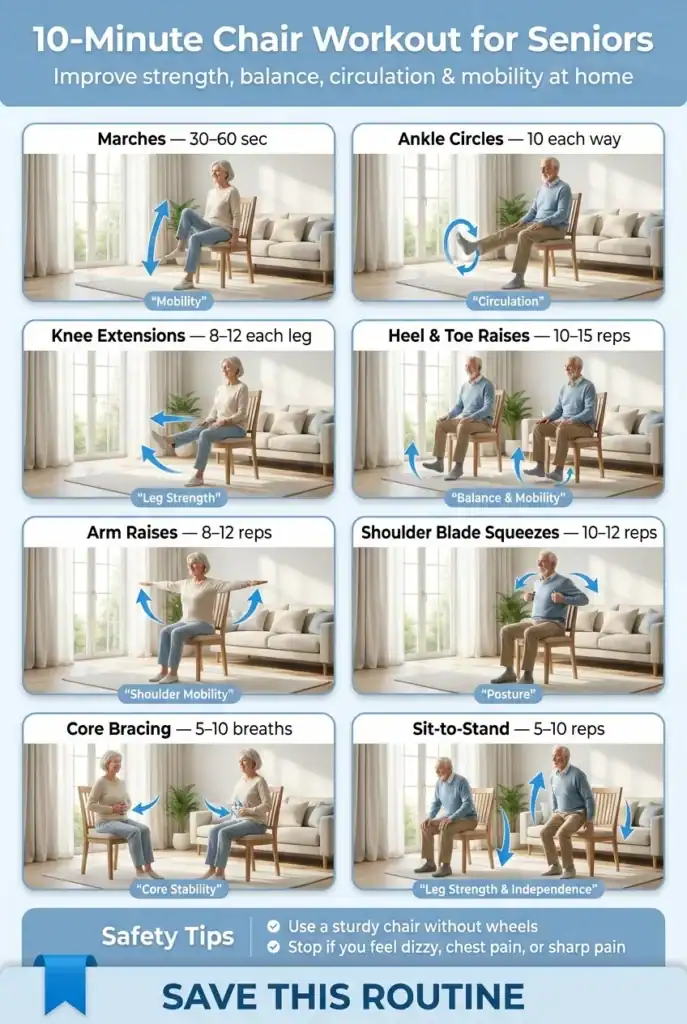
If you’re not sure where to start, begin with this simple 10-minute chair workout routine.
It’s designed for beginners, older adults with limited mobility, or anyone returning to exercise after a long break. These seated movements help improve circulation, leg strength, posture, mobility, and confidence without putting excessive stress on your joints.
Start slowly, move at your own pace, and focus on smooth, controlled movement rather than speed.
10-Minute Beginner Chair Workout Routine
This simple chair workout helps improve circulation, leg strength, posture, balance, and mobility in about 10 minutes.
| Exercise | Time/Reps | Main Benefit |
| Seated Marches | 30-60 sec | Warm-up/cardio |
| Ankle Circles | 10 each way | Ankle mobility |
| Seated Knee Extensions | 8-12 each leg | Thigh strength |
| Seated Heel & Toe Raises | 10-15 | Calves/ankles |
| Seated Arm Raises | 8-12 | Shoulder mobility |
| Seated Shoulder Squeezes | 10-12 | Posture/back |
| Seated Core Bracing | 5-10 breaths | Core stability |
| Sit-to-Stand | 5-10 | Leg strength/balance |
Safety Tips:
- Start with one round. Stop if you feel dizzy, sharp pain, chest pain, or unusual shortness of breath.
- Use a sturdy chair without wheels.
Do Chair Exercises for Seniors Really Work?
If you’re wondering if chair exercises make a difference… then you’re not the only one.
A lot of people call chair exercises “better than nothing.” But that view is wrong and holds seniors back.
Chair exercises aren’t a consolation prize. They’re a lower-impact option that can boost strength, function, and confidence for older adults.
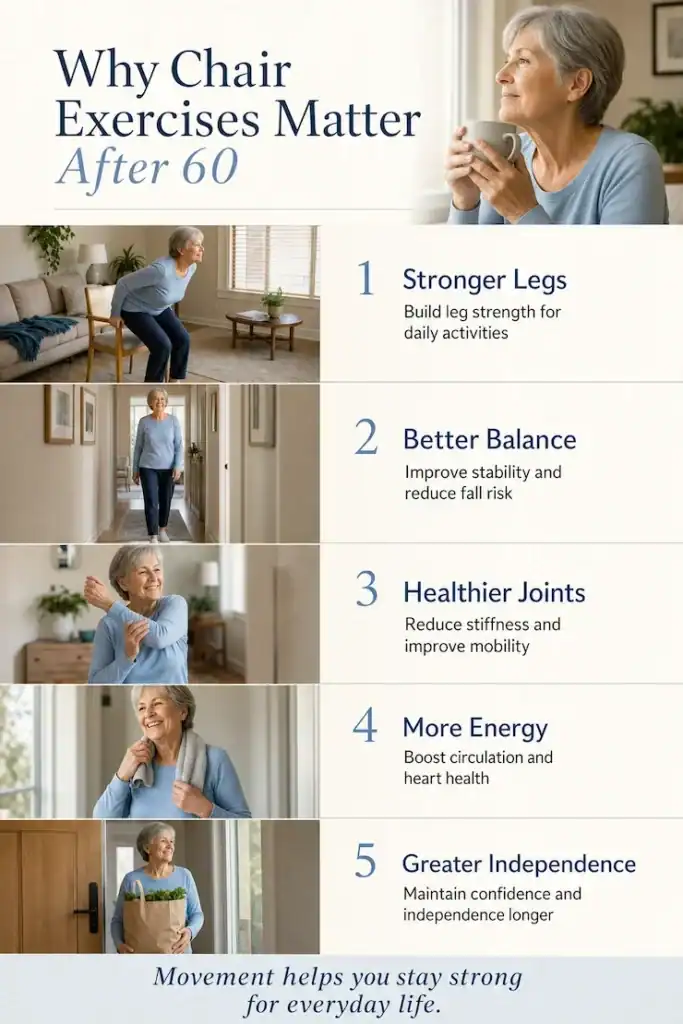
Here’s what the research shows:
A 2021 systematic review and meta-analysis reported in the International Journal of Environmental Research and Public Health found that chair-based exercise programs in 1,388 adults aged 50+ improved upper-extremity function, including handgrip strength and the 30-second arm curl test by 2.82 reps, plus lower-extremity function on the 30-second chair stand by 2.25 reps.1
Chair-based exercises are most helpful for strength outcomes, especially in short- to medium-term programs (2 weeks to 6 months).
A 2013 systematic review published in BioMed Research International found that chair-based exercise programs in frail adults aged 65+ produced mixed outcomes, with 4 out of 6 trials reporting some improvements in mobility, cardiorespiratory fitness, or mental health, while 2 showed no measurable benefit.2
Chair-based training may offer modest gains for low-mobility seniors, but evidence is limited by small studies and quality issues.
A 2018 study published in AgingResearch Reviews found that adults begin losing skeletal muscle mass at a rate of about 0.8–1% per year from middle age, with severe cases reaching up to ~50% total muscle loss by the 8th–9th decade of life, driven by both muscle fiber atrophy and fiber loss.3
This matters because the gradual loss of muscle directly increases the risk of weakness, frailty, and loss of independence as you age.
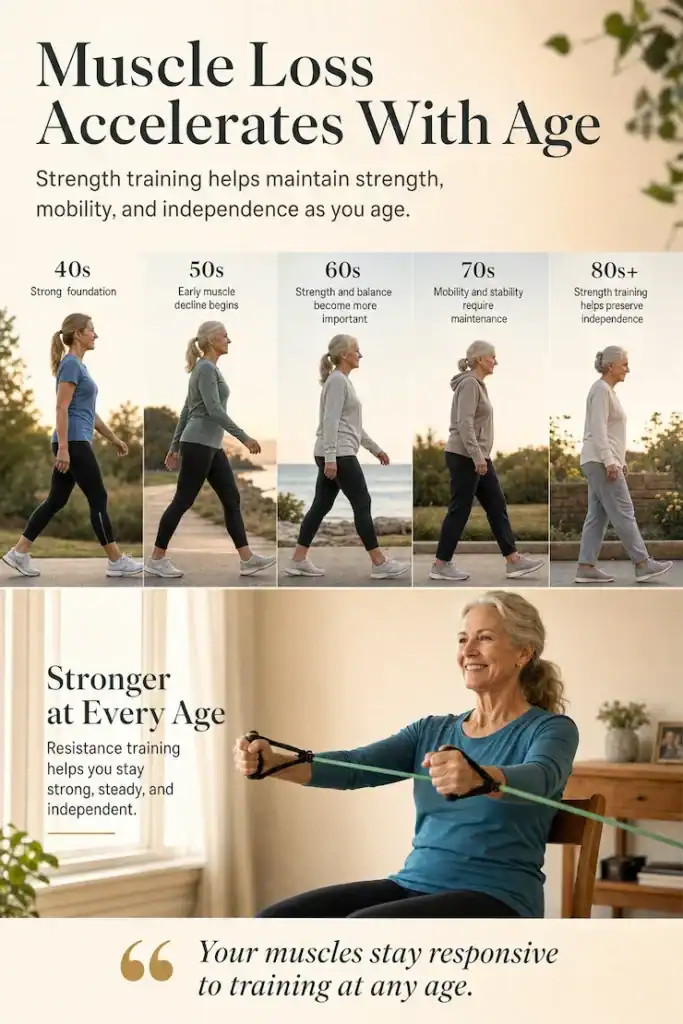
That’s not a little. It’s a quarter of the strength needed for everyday life. Chair resistance work (with bands or light dumbbells) helps rebuild lost muscle.
And stronger muscles don’t just look better—they make getting out of a chair, carrying groceries, standing up from the toilet, and climbing stairs much easier.
Applying resistance to your muscles during seated training not only develops them but also supports maintaining or improving bone density. This is especially important if you have concerns about osteoporosis or fractures, as stronger bones reduce the risk of injury.4
How Chair Exercises Rebuild Confidence & Independence
Dynamic seated routines increase muscle contractions, heart rate, and circulation. You’ll raise your heart rate with less joint impact than many standing cardio options.
Completing a routine, even a short one, can boost mood, build confidence, and produce a sense of accomplishment. These mental benefits are supported by exercise-related changes through brain chemistry.
That psychological win matters more than most trainers talk about. Fear of falling can keep many older adults sedentary. Prolonged inactivity may contribute to further muscle loss.6
Muscle loss is associated with a higher risk of falls.7 It’s a loop that gets harder to break the longer it runs. A reinforcing cycle over time.
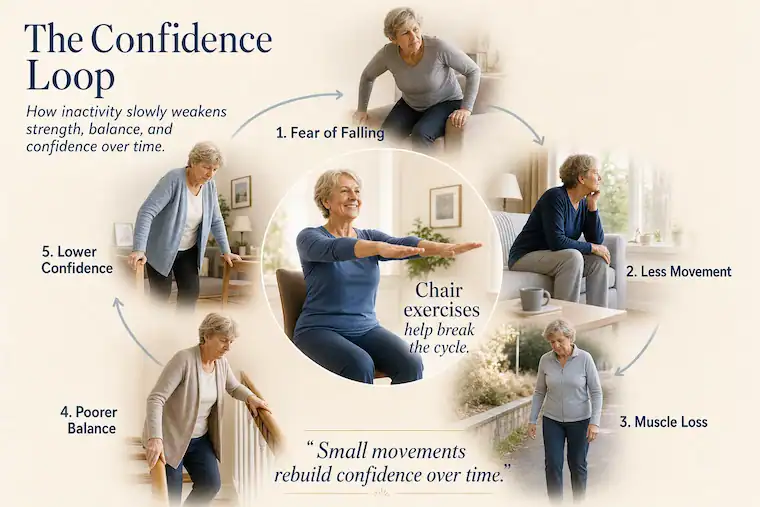
Chair exercises interrupt that loop from the safest possible starting point. They’re a lower risk starting point for some older adults. Think of chair exercises as training wheels, not your endpoint. The chair provides stability so you can focus on moving and building strength.
As your strength and confidence improve, you can progress to standing exercise. This may further boost balance and help maintain independence.
What Chair Exercises Can (and Can’t) Do for Your Body
Chair exercises often get tossed to the side, but they deliver important physical and mental benefits.
Seated workouts can help build muscle, increase joint flexibility, improve balance, and boost confidence in your body. After a few weeks of chair exercises, one client could stand from the couch without grabbing the armrest for the first time in years. That’s no small thing.
Here’s what the research shows…
Building and Maintaining Muscle
Sarcopenia is a common condition among seniors. It’s the gradual loss of muscle mass and strength.
A 2022 systematic review and meta-analysis released in the Journal of Cachexia, Sarcopenia and Muscle found that the prevalence of global sarcopenia ranged from 10% to 27% across 151 studies.8
Aging is a key factor, but inactivity and poor nutrition also drive muscle loss. Sarcopenia stems from aging, hormone and neural changes, inflammation, genetics, and lifestyle.
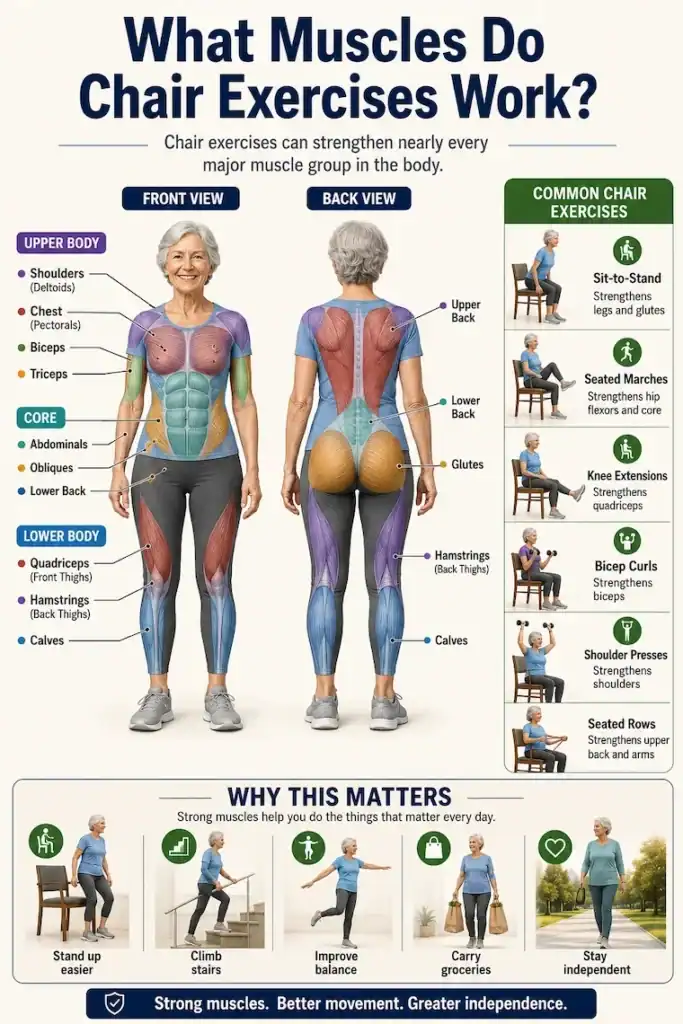
Sedentary behavior and inadequate protein intake are major contributors to age-related muscle loss. Your muscles stay highly responsive to training even in your 70s, 80s, and 90s.
Older adults can gain muscle and strength at similar relative rates to younger adults when they follow comparable resistance-training programs. Studies show that older adults (including those over 70) often increase muscle size and strength by similar percentages as people in their 20s.9
One thing many adults notice after 60 is that maintaining muscle becomes harder, even if activity levels stay the same. Age-related muscle loss can gradually affect strength, balance, mobility, metabolism, and overall independence over time.
That’s why I like combining resistance training and chair exercise with nutrients specifically researched for support muscle health as we age. Ingredients like HMB, creatine, betaine, and vitamin D may help support muscle preservation, strength, and recovery as we age.
If keeping muscle gets harder as appetite and protein intake drop, the BioTRUST GLP-1 Companion Stack is one option I like. It combines HMB, creatine, and convenient collagen-based protein to support strength, recovery, and lean muscle as you age.
A 3-part daily stack designed to support people using GLP-1 medications or losing weight naturally. It combines muscle, protein, collagen, and appetite support to help you maintain a healthier body composition as you lose weight.
- Natural GLP-1 Support: Helps support healthy appetite signals, fullness & metabolic function
- Lean Muscle Support: Helps preserve muscle, strength & healthy body composition during weight loss
- High-Protein Collagen: Adds 20 g of protein with 5 collagen types to help support daily protein intake
- Skin, Joint & Hair Support: Provides collagen peptides to support skin elasticity, joints, hair & nails
- 3-Part Weight-Loss Support: Combines muscle, protein/collagen & appetite support in one simple daily stack

A landmark randomized controlled trial published in JAMA tested high-intensity resistance training in 10 frail nursing home residents, averaging 90 years old (up to 96). Participants trained their quadriceps three times weekly for 8 weeks at 80% of one-repetition maximum, achieving average strength gains of 174% ± 31%, mid-thigh muscle area increases of 9.0% ± 4.5% (measured by CT scan), and 48% faster tandem gait speed.10
Chair exercises (with bands or light dumbbells) slow and reverse the strength loss from inactivity and aging. Moves like seated leg extensions, bicep curls, and chair push-ups target muscles for daily tasks.
Improving How Your Joints Move
Moving your limbs while seated triggers your joints to self-lubricate. That’s not a metaphor. Synovial fluid, the liquid that cushions your joints, moves when you move.11
Seated exercise can improve range of motion, reduce stiffness, and increase flexibility. It is often gentler on joints than standing moves. That’s why chair training can help people with arthritis or those easing back after surgery regain mobility and comfort.
One of my clients was 63, had both knees replaced, and felt stuck between “too fragile for a gym” and “too capable to just sit still.” We started with seated leg lifts and resistance band rows. Within six weeks, she was walking around her neighborhood without stopping to rest.
Movement is one of the best things you can do for stiff, achy joints. In many cases, the less people move, the worse their joints start to feel.
I also like combining regular movement with nutrients that support healthy inflammation levels and joint comfort. That combination often helps older adults move more comfortably and stay more consistent with exercise long term.
Extended periods of joint immobilization (for example, after an injury or casting) have been shown to increase joint stiffness and limit the range of motion.12
Moving your joints through their range of motion increases loading and fluid movement across the cartilage surface. This helps stimulate synovial membrane activity and maintain healthy synovial fluid-based lubrication.13
Meta-analyses show that strength training improves joint range of motion as much as stretching.14 When doing chair exercises, it’s best to perform them through a full range of motion to act as weighted, dynamic stretching.
Increasing the strength and coordinated activation of the muscles around a joint enhances mechanical stability. It also allows more of the mechanical load to be borne by the muscle-tendon system instead of the passive joint structures.15
Regular strength training provides a direct mechanical stimulus for connective tissues. Tendons change by becoming stiffer and, in some cases, increasing their cross-sectional area. Bones also respond to the higher loads by increasing or preserving bone mineral density and structural strength where trained.16
Build Confidence in Movement
Fear of falling is extremely common in older adults and is a major reason many people begin to restrict or avoid physical activity. But this leads to reduced movement and deconditioning.17
Chair exercises remove that fear by giving you a stable platform. When the movement feels safe, then you’ll do more of it.
One of the most important health benefits of building and maintaining muscle mass and strength in older age is protection against frailty. Low muscle mass and weakness are key components and predictors of frailty and disability.18
The Pygmalion effect explains how other people’s expectations can become self-fulfilling prophecies. They improve or worsen performance depending on whether those expectations are positive or negative.
In older adults, research on self-perceptions of aging shows that seeing aging as a time of continued growth and believing you can influence your own future is linked to better health, greater resilience, and more positive health behaviors. But viewing yourself as fragile and ‘ at the mercy of old age’ can lead to worse outcomes through reduced motivation and self-efficacy.19
Burning Calories and Supporting Metabolism
It’s a common myth that aging destroys your metabolism. When researchers account for body size and muscle mass, metabolism appears to stay essentially flat from your 20s through your 50s. Even after 60, the natural decline in metabolism doesn’t exceed 20%.20
The primary reasons metabolism slows down in older adults are simply inactivity and age-related muscle loss.
Because resting metabolic rate is largely dependent on how much lean mass you carry… resistance training that builds muscle (including chair-based workouts) can increase the number of calories your body burns at rest.21
Seated cardio movements like marching in place and arm circles also raise your heart rate and increase daily calorie burn.
Strengthening Your Balance Foundation
It’s rarely a neurological balance issue when seniors experience loss of balance or have trouble standing up straight without shaking. Physically, the problem is usually that the person cannot produce enough muscular force during the desired movement.
This lack of force production is essentially the exact same obstacle as simply not having enough strength. Improving lower-body strength is key to enhancing balance and reducing fall risk in older adults, especially when strength training is combined with balance-challenging exercises.22
Sitting tall without leaning on the backrest will engage your core, hips, and lower back. This is where balance actually starts. Strengthening those muscles from a chair is one of the safest ways to reduce fall risk over time.
What Chair Exercises Can’t Do
Spot-Reduce Belly Fat
Chair exercises won’t spot-reduce belly fat. Most well-controlled studies have not found that any exercise can meaningfully spot-reduce fat.
Exercise science studies have repeatedly shown that training a specific body part does not selectively burn fat from that area. So chair exercises which target your core will strengthen the muscles, but won’t specifically ‘spot-reduce’ belly fat.
Spot reduction is largely a myth for the average person. So doing seated core twists or chair crunches won’t preferentially burn fat around your midsection.
When you consistently burn more energy than you consume, your body draws on stored fat throughout the body. This is what leads to overall fat loss rather than highly localized ‘spot’ fat loss.23
You’ll get a slim midsection by stripping away the fat covering the abs through a calorie deficit, and not via localized exercise.
Replace All Walking/Cardio (If Able)
Strength training can provide many of the same health benefits as cardio. Including improvements in cardiac health and a reduction in markers of chronic inflammation.24
But light chair exercises cannot entirely replace the benefits of walking or traditional cardiovascular activity if you’re physically able to do them.
Walking is an ideal, low-impact activity that burns calories without causing the “interference effect.” When high volumes of endurance plus strength training are combined, research shows a small “interference effect” where muscle fiber hypertrophy is slightly reduced.25
If you can walk and stand safely, chair exercises shouldn’t permanently replace weight-bearing movement. Standing and walking balance exercises train your nervous system to use the same rapid, automatic reactions (like corrective steps and posture adjustments) that help you recover your balance if you trip.
Chair work is a bridge to get there, not a permanent stop.
Fix Serious Pain Without Medical Guidance
Active recovery is generally better than complete rest for most minor injuries. Research shows that after a day or two, gentle, controlled movements are favored in place of strict bed rest. This is because prolonged inactivity could slow healing and make you weaker and stiffer.26
But chair exercises aren’t a cure-all.
Chair exercises can’t maximize bone density. Weight-bearing and resistance activities that load your skeleton against gravity provide the mechanical stimulus that drives bone remodeling. This is what helps to keep or increase bone density.27
They won’t cure chronic ailments such as rheumatoid arthritis either. The goal is better symptom management and improved daily function, not elimination of the underlying condition.
Sharp pain, post-surgical recovery, or severe joint damage needs medical guidance first. Stop any exercise that causes sharp discomfort and check with your doctor or physical therapist.
You should seek medical attention if you experience serious symptoms such as loss of joint movement, significant swelling or discoloration, or symptoms that don’t improve after a few days.
Myth: Chair exercises are only for frail seniors.
Fact: They’re scalable and useful for beginners, people recovering from injury or surgery, anyone handling joint pain, and older adults at any fitness level. Many people graduate to standing exercises over time as strength and stability improve.
Safety First: How to Set Up for Chair Exercises
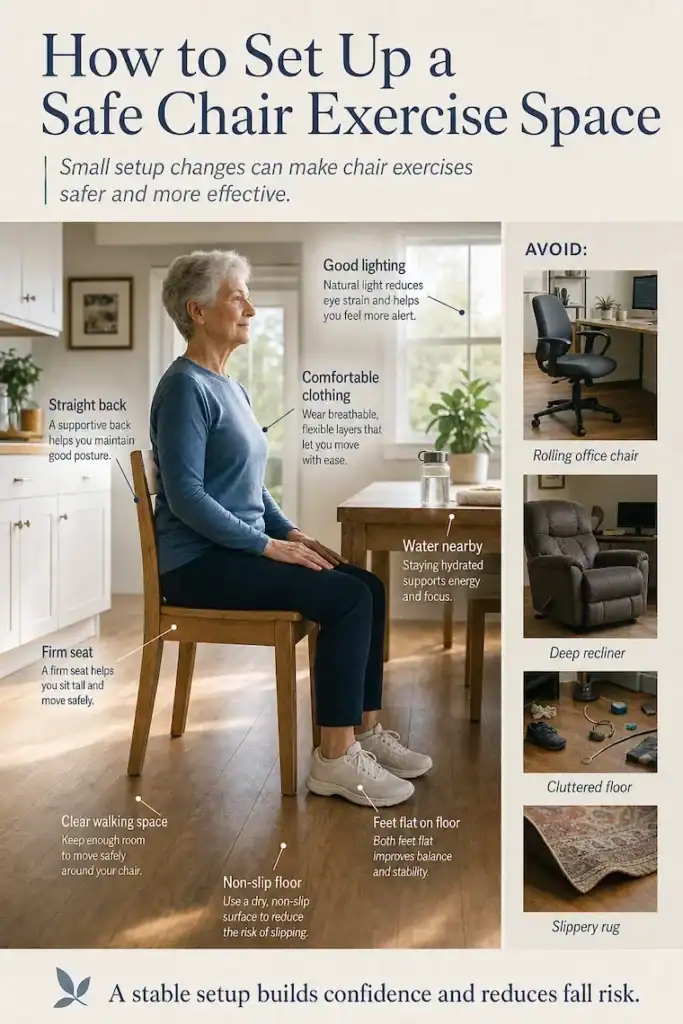
Your setup matters more than most people realize before you start any chair exercise routine.
The right chair, a safe environment, and knowing when to stop can make the difference between building confidence and risking a setback. A few small adjustments upfront will help you move more comfortably, protect your joints, and exercise with better stability and control.
Choose the Right Chair
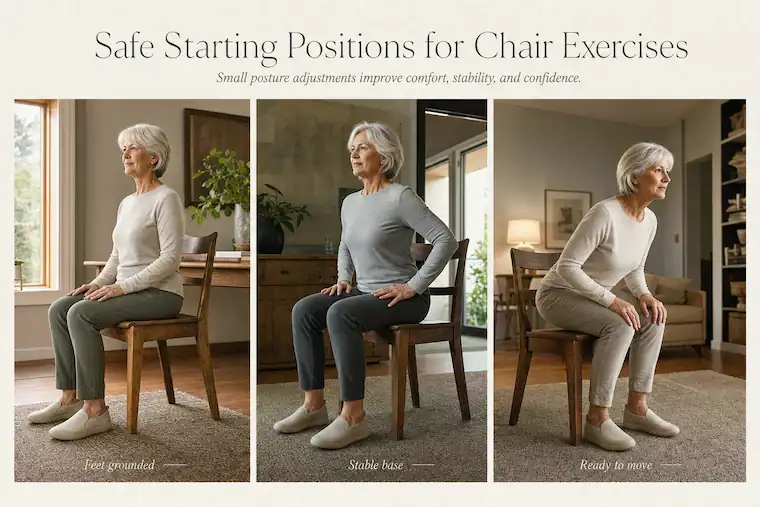
Most people grab the nearest chair and get started. That’s fine for casual stretching, but the wrong chair can turn a safe workout into a fall risk.
For older adults, unstable or poorly designed chairs (such as those that are too low, on wheels, or without armrests) can increase the difficulty and risk of sitting down or standing up. This can turn an otherwise safe exercise session into a potential fall hazard.28
A good kitchen or dining chair is usually your best option.
For safety and good mechanics, choose a sturdy chair with a firm, level seat that lets your feet rest flat on the floor, and your knees bend to about a right 90-degree angle. You should feel stable and be able to stand up without straining.
What to Look For…
The chair needs four non-negotiables:
- a stable frame
- non-slip feet
- a firm seat
- a straight backrest
A very soft, soft cushion lets your hips sink, and your pelvis roll backward. This tends to flatten the natural curve in your lower back and promote a slumped, collapsed sitting posture.29
No wheels. Even locked wheels are a hazard during exercise. Leave the office chair at the desk.
Armless chairs are often preferred because they give your arms a full range of motion and open up more exercise options. That said, if you have significant balance concerns or struggle to push up to standing, a chair with sturdy armrests is the safer choice.
If sitting for longer periods feels uncomfortable, a firm supportive seat cushion can make chair workouts significantly more comfortable on the hips and lower back.
What to Avoid…
Deep, soft recliners and couches usually lack firm lumbar support and are set low to the ground. This tends to rotate the pelvis backward and place the spine in a rounded, slumped position rather than a neutral, supported posture.
Rolling office chairs shift under load. Wobbly dining chairs do the same. If the chair moves when you press into it, it’s not safe for exercise.
One of my clients started her routine on a padded dining chair that had more give than she realized. She kept losing her posture mid-set and couldn’t figure out why. We switched her to a firmer chair, and the difference was immediate.
Before You Start Chair Exercises, Check These 7 Things First
Most people skip this part. Don’t.
A brief check‑in with your medical professional before starting a new exercise program is recommended in major guidelines. This is especially true if you have health conditions or risk factors, because it helps make sure the plan is safe and appropriately customized to your body.30
It’s about making sure the plan fits your body right now, so you’re not guessing. Talk to your doctor or physical therapist before starting if any of these apply to you:
After a recent surgery. Whether a joint replacement, abdominal operation, or another procedure—guidelines recommend getting clearance from your surgeon before starting or progressing exercise. This is so they can tell you which movements and loads to avoid while tissues and repairs are still healing.
Chest pain. Chest pain, pressure, or unexplained tightness (especially if it’s related to exertion) should be evaluated by a health professional before you increase your exercise intensity. No exceptions.31
Severe dizziness. Feeling lightheaded or faint when changing positions can be tied to medication side effects, dehydration, or inner ear issues. Know the cause before you work out, or you’re adding a balance risk on top of an existing one.
Uncontrolled blood pressure. If your resting blood pressure is very high (for example, around or above 180 mmHg systolic or 110 mmHg diastolic), it should be evaluated and managed by a health professional before you increase your exercise intensity.32
Once it’s managed and cleared by your provider, you can typically begin exercising safely.
Recent falls. A fall history isn’t just about the fall itself. It points to a root cause, whether that’s balance, weakness, medication, or vision. A professional assessment finds the weak link, so you start at the right point.
In fall‑prevention programs like the CDC’s STEADI initiative, a history of falling is treated as a red flag that usually reflects one or more underlying problems. This includes impaired balance, lower-body weakness, side effects from medications, or vision difficulties… rather than being ‘just an accident.’33
New or worsening joint pain. Chronic stiffness and arthritis respond well to movement. But a joint that’s sharp, swollen, or “hot to the touch” needs to be checked before you load it. Exercising on an actively inflamed joint can delay recovery and worsen symptoms.34
Major balance problems. If you feel unstable even while seated, a physical therapist can build you a supervised starting point before you go it alone at home.
One of my clients waited months to start because she was afraid the exercises would make her knee pain worse after a replacement. Her surgeon told her movement was exactly what she needed. She just needed someone to tell her which moves to skip.
That’s the whole point of checking in. Not to get permission. To get a plan that works for your specific body.
Having any of these conditions does not disqualify you. In most cases, your doctor will push you to move. The check-in just takes the guesswork out of where to start.
Stop the Exercise Immediately If You Feel Any of These Warning Signs
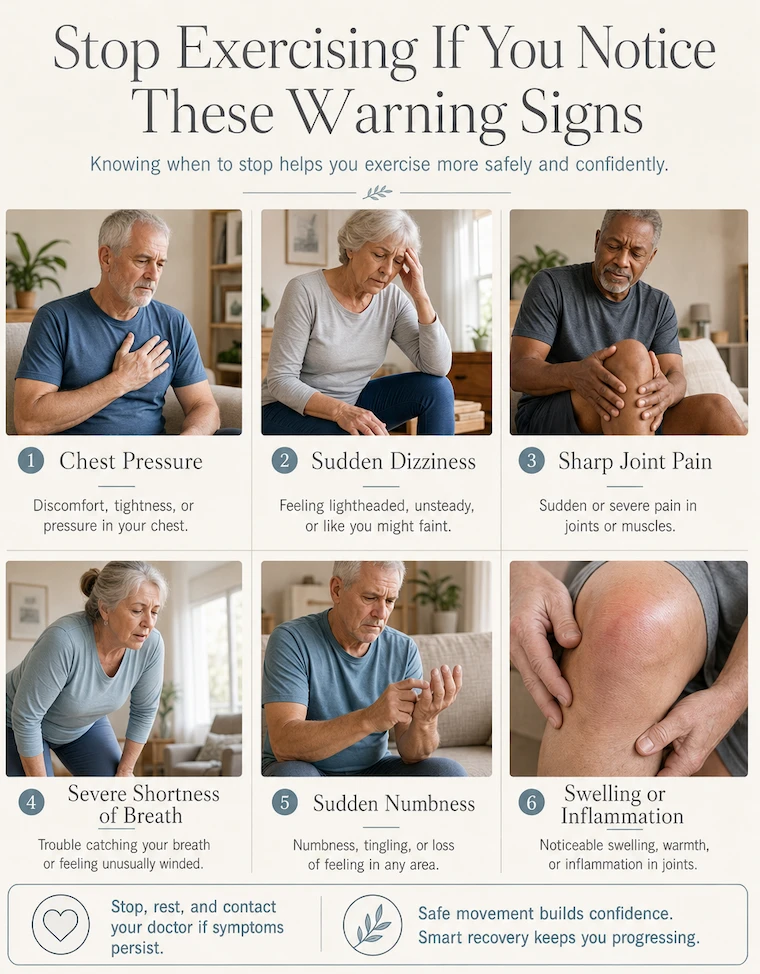
Your body talks during a workout. Knowing which signals to ignore and which ones to respect is what separates smart training in place of setbacks.
Mild muscle fatigue, slightly faster breathing, and next-day soreness are all normal. They mean the work is landing.
It’s normal to experience mild muscle fatigue and faster breathing during the workout (with appropriate challenging exercise). As well as mild next-day muscle soreness (DOMS), as your muscles repair and adapt.35
These next six signals are different. Stop and rest if any of them show up.
Sharp pain. Mild tension during a stretch is expected. A sudden, stabbing pain inside a joint is not. This is not a normal training sensation and should be treated as a warning sign to stop and get it checked.
Stop that specific movement immediately. Your body is flagging a mechanical problem, not asking you to push harder.
Chest pressure. Any new tightness, fullness, or pressure in your chest during exercise is a warning sign. It ought to prompt you to stop and seek medical evaluation, especially if it doesn’t quickly ease with rest.
Sit quietly and rest. Do not walk it off or wait to see if it passes on its own.
If you have blood pressure concerns or are restarting exercise after a long break, monitoring your blood pressure at home can help you exercise more confidently and safely.
If you have blood pressure concerns or are restarting exercise after a long break, monitoring your blood pressure at home can help you exercise more confidently and safely. A blood pressure monitor can be a wise health investment.
Sudden dizziness or feeling faint. A frequent cause is holding your breath during exertion. It drops blood pressure fast. Stop, sit still, and breathe normally.
Dehydration can also cause dizziness or lightheadedness by lowering your blood volume and blood pressure. This happens especially when you stand up or move suddenly.
Numbness. A pins-and-needles sensation or sudden loss of feeling in your arms, legs, or face is not a normal exercise response. Stop and assess how you feel before continuing.
Unusual shortness of breath. Your breathing rate climbing during exercise is a good sign. Gasping, struggling to form a full sentence, or feeling like you cannot get air in is not.
Back off and let your breathing return to normal before deciding whether to continue.
New swelling or severe joint pain. Gentle movement lubricates arthritic joints and reduces stiffness over time.
But a joint that becomes swollen, hot to the touch, or intensely painful mid-workout needs rest, not more reps. Exercising an actively inflamed joint can worsen symptoms and delay recovery.
One lady told me that she pushed through a sharp knee ache during seated leg extensions because she thought it was just stiffness. It wasn’t. Two days of rest and ice would have fixed it. Two weeks of aggravated inflammation did not.
A simple rule to keep in your back pocket: Many coaches use simple checklists to keep things safe and clear. One easy version is to use the ABCD framework for exactly this.
Stop if you notice an:
- Abnormal heart rhythm
- Breath that’s unusually short
- Chest discomfort
- Dizziness
Four signals. One word to remember them.
Stopping when your body flags something is not a setback. It’s what keeps you training next week, next month, and next year.
The 10 Best Chair Exercises for Seniors
Jump directly to the exercise:
Sit-to-Stand
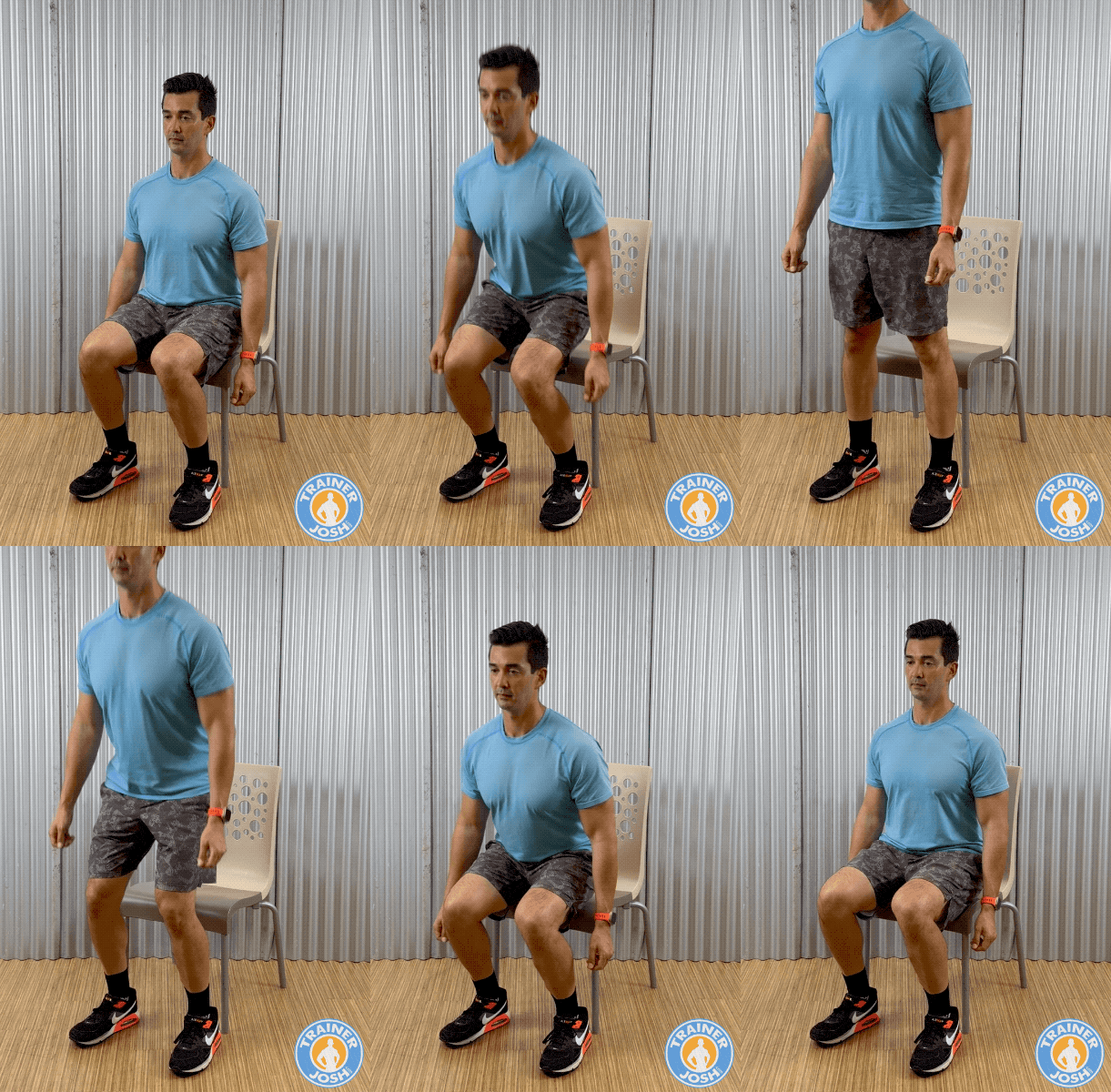
The “sit-to-stand” exercise works because it is the ultimate functional movement—it directly mirrors the exact physical demands of your everyday life, training your body to safely shift its center of gravity and transfer power from your lower body to your core.
By regularly practicing this movement, you build vital strength in your major lower-body muscles, including your quadriceps, hamstrings, glutes, and abdominals.
This translates into profound real-world benefits: it improves your balance and dynamic stability, effectively combats age-related muscle loss, and makes sure you retain the power necessary to confidently get out of a chair, rise from the toilet, or get out of bed without needing to rely on your arms or ask for assistance.
How to Properly Perform the Sit-to-Stand
- The Setup: Sit toward the front edge of a sturdy, armless chair with your feet planted flat on the floor, about hip-width to shoulder-width apart, and your toes pointing slightly forward or outward.
- The Posture: Sit up tall, keep your chest lifted, engage your core muscles by gently pulling your belly button in, and fold your arms across your chest (or leave your hands resting by your sides).
- The Upward Drive: Hinge your torso slightly forward from the hips (bringing your “nose over toes”) and shift your body weight onto your heels. Exhale and push forcefully through your heels to stand up completely straight.
- The Controlled Descent: Inhale as you slowly and deliberately lower your hips back down into the chair, maintaining control the entire way.
What You Should Feel (and NOT Feel)
- What to feel: You should feel your thigh muscles (quadriceps) and buttocks (glutes) engaging, contracting, and working hard to lift your body weight. You should also feel your weight grounded firmly in your heels as you push upward.
- What NOT to feel: You should not feel sharp, stabbing pain in your knees or joints. While dull muscle fatigue or mild exertion is normal, any sharp pain is a signal to stop the exercise immediately to prevent injury.
How to Make it Easier or Harder
- To make it easier: If you find the exercise too challenging, use a chair with armrests and gently push off them with your hands to assist your legs. You can also place a firm cushion or pillows on the chair seat to raise your starting height, which decreases the distance you need to travel to stand.
- To make it harder: Once you can easily complete the bodyweight version, increase the intensity by holding a weight (like a dumbbell, medicine ball, or a heavy household object like a water jug) close to your chest. You can also try a hovering technique where you do not let your body fully rest on the chair between repetitions, or hold the bottom squat position for 2 to 3 seconds before standing back up.
Pro Trainer Tips to Maximize Results
- Squeeze the Glutes: To kickstart your muscle training and maximize engagement, actively squeeze your glute (butt) muscles together as you rise to your feet.
- Use Props for Progression: If the exercise is too difficult to perform unassisted, you can modify it by placing firm pillows or cushions on the chair seat to raise your starting height, or you can use a chair with armrests to gently help push yourself up.
- Knee Alignment: Keep a close eye on your knees as you stand. They should drive outward slightly from the midline of your body; never allow them to cave or fold inward toward each other.
Common Mistakes to Avoid
- Dropping into the Chair: Do not simply let gravity take over and fall heavily back into the seat. Controlling your downward descent (the eccentric phase) is where you build a tremendous amount of strength.
- Holding Your Breath: Never hold your breath during the exertion phase. This can dangerously increase the pressure in your chest and spike your blood pressure. Always exhale on the way up and inhale on the way down.
- Rounding the Back: Avoid slouching or rounding your lower back when you lean forward. Always hinge directly from the hips while maintaining a straight, neutral spine.
Seated Marches
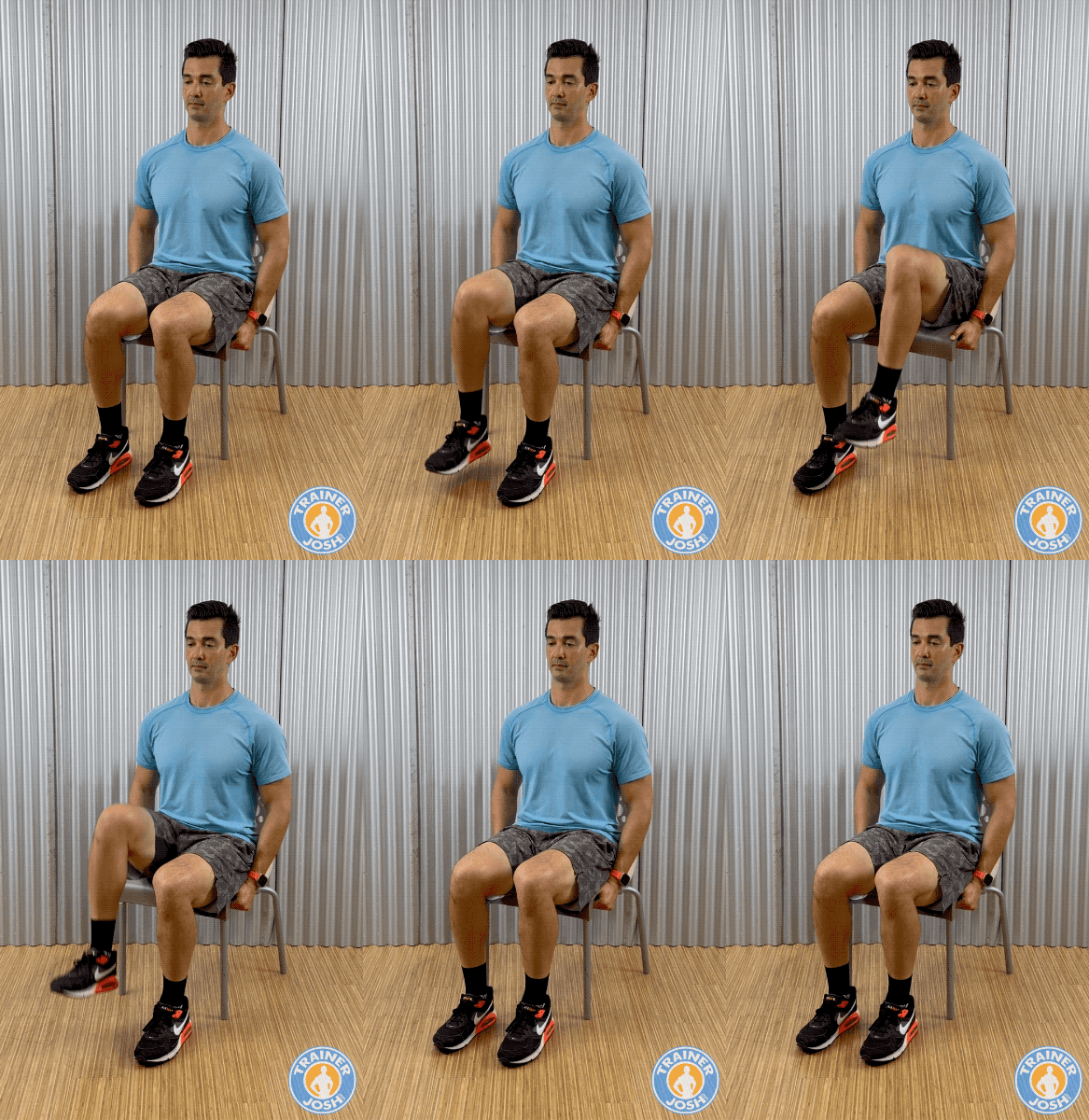
The seated march works as the perfect light cardiovascular entry point because it elevates your heart rate and promotes healthy circulation without placing any jarring impact on your knees or hips.
By rhythmically lifting your knees and pumping your arms, you force your tissues to pump oxygen-rich blood and vital fluids throughout your body, actively combating age-related stiffness and joint pain.
In daily life, the improved hip mobility and lower-body strength (specifically in the quadriceps, hamstrings, and calves) gained from this exercise make navigating uneven terrain, walking for longer distances, and confidently climbing stairs feel significantly easier and more stable.
How to Properly Perform Seated Marches
- The Setup: Sit tall in a sturdy chair with your feet flat on the floor, engaging your core muscles and maintaining a straight back without leaning backward against the backrest.
- The Lift: Exhale and lift your right knee toward your chest as high as is comfortable, using a slow, controlled motion while keeping your torso perfectly upright.
- The Descent: Inhale and lower your right foot back to the floor with control, making sure to lower the heel all the way to the ground to properly absorb shock.
- The Alternate: Lift your left knee in the exact same manner, continuing to alternate legs to mimic a continuous, rhythmic marching motion.
- The Arm Swing: As you march, actively swing your bent arms (opposite arm moving forward with the opposite leg) naturally forward and backward to engage your upper body and increase your heart rate.
What You Should Feel (and NOT Feel): You should feel your thigh muscles, hip flexors, and core working, alongside an elevated heart rate and slightly heavier breathing. You should not feel sharp pain in your hip joints, nor should you feel your lower back rounding or straining as you lift your leg.
How to Make it Easier or Harder
- To make it easier: Lift your knees only slightly off the ground, use a smaller range of motion for your arms, or hold onto the sides of the chair for extra support.
- To make it harder: Lift your knees higher, perform the march at a slower pace to increase the time your muscles are under tension, add light ankle weights, or raise your opposite arm overhead with each step.
Pro Trainer Tips to Maximize Results
- Energetic Elbows & Loose Hands: To maximize the cardiovascular and aerobic benefits, swing your elbows energetically. However, keep your fists and hands loose and relaxed to encourage good blood circulation.
- Lift Straight Up: Fix your gaze forward and level. Make sure you are lifting your leg straight up (as if being pulled by a string) rather than letting your knee drift across the midline of your body.
Common Mistakes to Avoid
- Stomping: Avoid dropping your feet heavily or stomping on the floor, which can cause foot injuries. Touch your feet down lightly and with control.
- Rocking the Torso: Do not use momentum or rock your upper body back and forth to help lift your legs. Your core should remain tight and your torso completely still.
- Marching on Toes: Make sure you bring your heel all the way down with each step. Marching solely on your toes does not provide adequate shock absorption for your body.
Seated Knee Extension
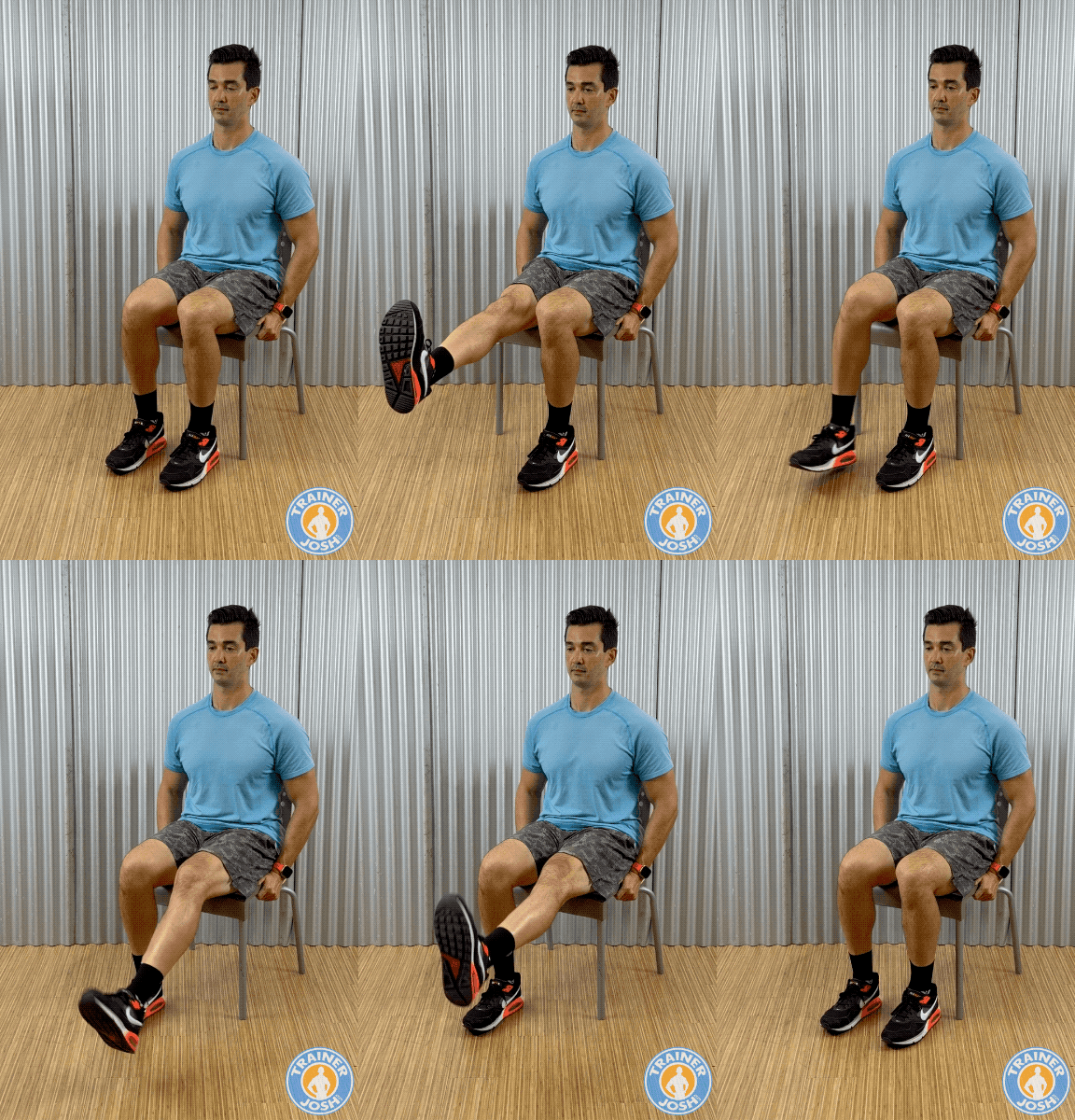
The seated knee extension works by directly isolating and targeting your quadriceps (the large muscles on the front of your thighs), acting as a primary builder of knee stability and joint protection.
By fortifying these essential muscles without placing heavy, weight-bearing stress on the joint, this exercise ensures that your knees remain stable and supported during exertion.
Regular practice translates to profound real-world benefits, allowing you to effortlessly climb stairs, hike uphill without premature fatigue, and easily rise from seated positions with newfound agility and power.
How to Properly Perform Seated Knee Extensions
- The Setup: Sit tall in a sturdy chair with your feet flat on the floor and hip-width apart. You can scoot your buttocks all the way to the back of the chair for maximum lower back support.
- The Posture: Engage your core (pulling your belly button toward your spine), keep your chest lifted, and hold onto the sides of the chair for added stability.
- The Extension: Exhale and slowly extend one leg straight out in front of you until it is as straight as comfortably possible, ensuring your toes are flexed and pointing up toward the ceiling.
- The Hold: Pause and hold this extended position for 1 to 2 seconds, intentionally squeezing the muscles in the front of your thigh.
- The Descent: Inhale and slowly lower your foot back to the floor with deliberate control, avoiding letting the foot simply drop.
What You Should Feel (and NOT Feel): You should feel a strong contraction and effort in your upper thigh muscles (quadriceps) working to lift and hold the weight of your leg. You should not feel sharp, stabbing pain inside the knee joint, nor should you feel a strain in your lower back from leaning or slumping.
How to Make it Easier & Harder
- To make it easier: Decrease your range of motion by not fully extending your knee at the top of the movement, or use your lower (non-working) leg to gently support and assist the lifting leg if you experience arthritis pain. You can also hold the sides of the chair and lean back slightly to reduce the demand on your core.
- To make it harder: Increase the intensity by strapping on ankle weights or looping a resistance band around your foot, hold the fully extended position for a longer duration of 3 to 5 seconds, or increase the number of repetitions.
Pro Trainer Tips & Common Mistakes to Avoid
- Never Lock the Knee: Never hyperextend or vigorously “lock” your knee joint completely straight at the top of the movement. Always keep a “soft” micro-bend in the joint to make sure the tension stays on your thigh muscles rather than placing dangerous stress on your ligaments and cartilage.
- Don’t Use Momentum: It is a common mistake to swing the leg up quickly or let gravity pull it down. Focus on using slow, controlled muscle power to do the work.
- Avoid Leaning Backward: As your leg gets tired, you may feel the temptation to lean backward in the chair to compensate. Keep your back straight, maintain an upright posture, and focus strictly on using your thigh muscles.
Seated Arm Raises
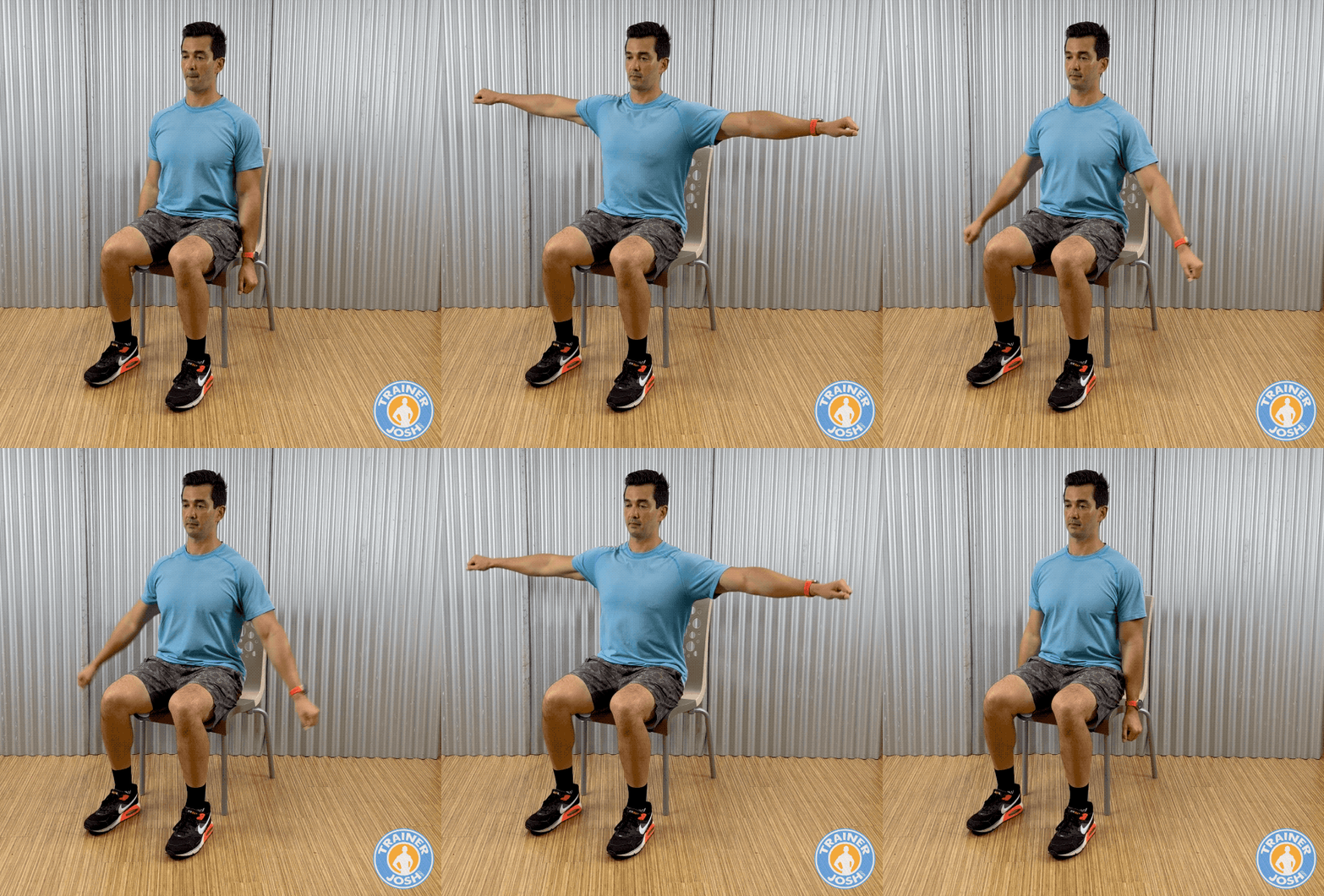
The seated arm raise (often called a front shoulder raise) works by directly isolating and strengthening your anterior deltoids (front shoulder muscles) and upper back. This acts as a crucial builder for upper-body mobility and joint preservation.
By fortifying these muscles from a secure, seated position, you safely build the functional power necessary for effortless overhead mobility. In your daily life, this translates into profound benefits:
- it makes reaching for objects on high shelves
- putting away groceries
- performing household chores significantly easier
All while actively protecting your vulnerable shoulder joints from future strains and injuries.
How to Properly Perform Seated Arm Raises
- The Setup: Sit up straight in a sturdy chair with your feet flat on the floor, engage your core (pulling your belly button in), and let your arms hang straight down by your sides holding light weights or water bottles.
- The Raise: Exhale and slowly lift both arms straight out in front of you until they reach shoulder height (parallel to the floor), keeping your palms facing down or inward.
- The Hold: Pause and hold your arms steady at the top for 1 to 2 seconds.
- The Descent: Inhale and slowly lower your arms back down to your sides with deliberate control.
What You Should Feel (and NOT Feel): You should feel a muscular contraction and effort in the front of your shoulders and upper arms. You should not feel a sharp, pinching pain inside your shoulder joint, nor should you feel strain in your neck or lower back.
How to Make it Easier or Harder
- To make it easier: Use no weights at all (just the weight of your arms), limit your range of motion by not lifting your arms quite as high, or perform the exercise lifting just one arm at a time.
- To make it harder: Increase the intensity by using heavier dumbbells, hold the contracted position at the top for a longer duration of 3 to 5 seconds, or progress to performing the exercise from a standing position to challenge your balance.
Pro Trainer Tips to Maximize Results
- Anchor your shoulder blades: Before you lift your arms, visualize placing your shoulder blades “back and down in your back pocket,” and keep them there throughout the exercise to maintain proper form and prevent neck strain.
Common Mistakes to Avoid
- Using swinging momentum: Do not swing your arms upward or let gravity simply drop them back down. A fast, jerky motion takes the workload off the muscle. Maintain a slow, controlled pace during both the lifting and lowering phases.
- “Pouring the pitcher” hand position: When raising your arms, make sure your pinky fingers do not rise higher than your thumbs. Rotating your arms inward in this manner at the top of the movement can cause unnecessary shoulder discomfort and impingement.
Shoulder Blade Squeezes
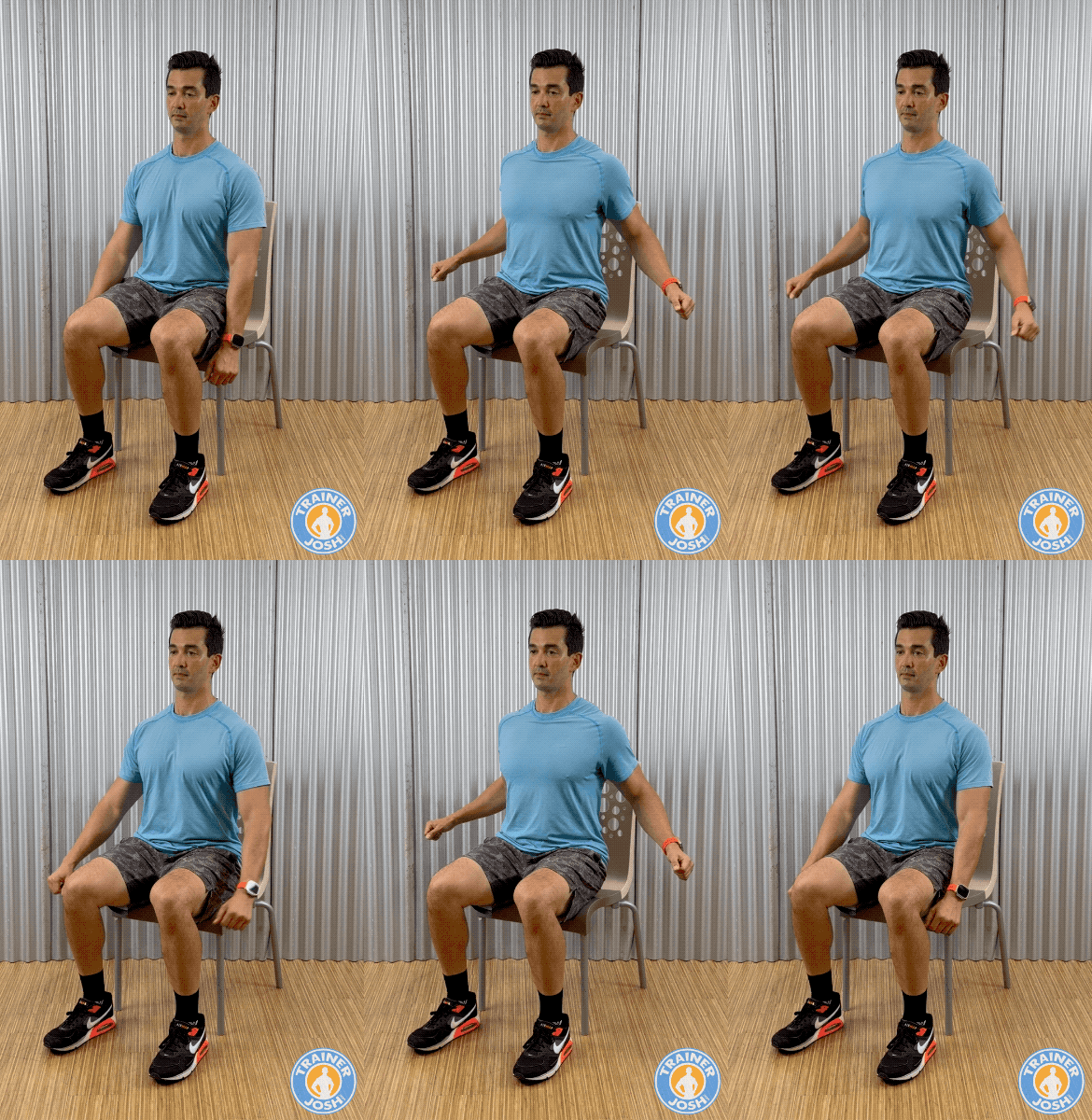
The shoulder blade squeeze works by acting as a powerful “internal brace” for your upper body, directly strengthening the rhomboids and trapezius muscles to counteract the age-related tendency to slouch and round your shoulders forward.
By fortifying this often-neglected area, you naturally pull your posture upright, which actively alleviates built-up tension, stress, and discomfort in your neck and shoulders. In your daily life, this translates to standing taller with newfound confidence, breathing more efficiently as your chest opens up, and performing any tasks that require upper-body stability with a secure, pain-free foundation.
How to Properly Perform Shoulder Blade Squeezes
- The Setup: Sit tall in a sturdy chair with your feet planted flat on the floor, keeping your neck neutral and your gaze fixed straight ahead.
- The Arm Position: Bend your elbows beside your body at a 90-degree angle so your forearms are parallel to the floor (you can also hold light weights in your hands),.
- The Squeeze: Exhale and slowly drive your elbows backward, forcefully squeezing your shoulder blades together,,.
- The Hold: Pause and hold this contracted position for 1 to 10 seconds,,.
- The Return: Inhale and smoothly return your arms back to the starting position,.
What You Should Feel (and NOT Feel): You should feel a gentle stretch across your chest muscles and a strong, deliberate contraction in the muscles directly between your shoulder blades,. You should not feel strain in your neck or lower back.
How to Make it Easier or Harder
- To make it easier: Perform the exercise without holding any weights, limit how far back you pull your elbows until your shoulder mobility improves, or reduce the hold time,.
- To make it harder: Hold light dumbbells or water bottles in your hands, increase the number of repetitions, hold the squeezed position for a longer duration (3 to 10 seconds), or try performing the movement while standing up to challenge your balance,,,.
Pro Trainer Tips and Common Mistakes to Avoid
- Shoulders “Back and Down”: Throughout the entire exercise, visualize placing your shoulder blades “back and down in your back pocket”. This crucial tip prevents you from accidentally shrugging your shoulders up toward your ears, which can cause neck strain,.
- Keep Your Head Level: Do not look up at the ceiling or down at your feet. Your head and neck must stay perfectly aligned in a straight line with your back,.
- Don’t Arch Your Back: It is a common mistake to compensate for tight shoulders by arching your lower back as you pull your arms backward. Keep your core engaged and your spine neutral so the movement isolates your upper back muscles.
Seated Bicep Curls
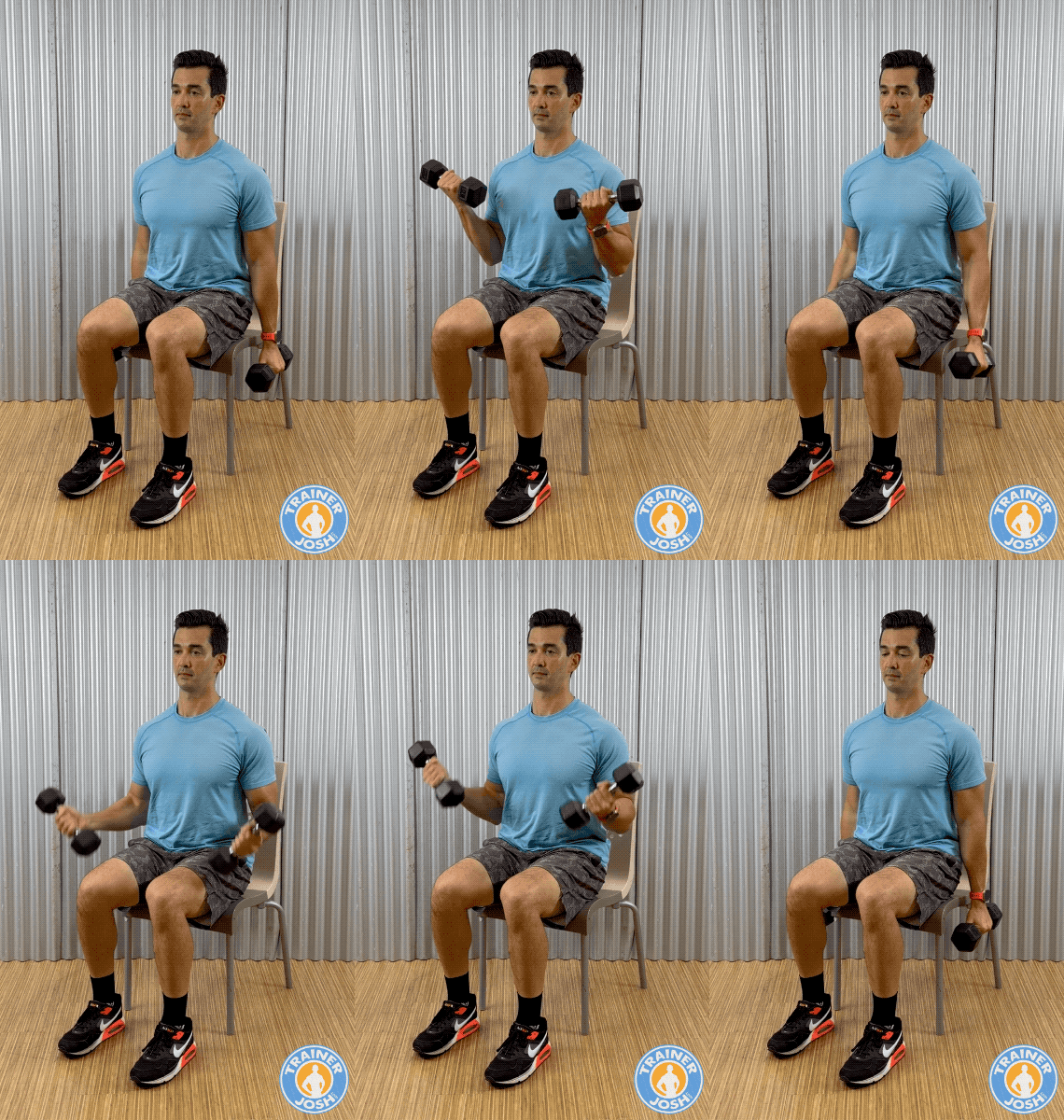
The seated bicep curl works by directly isolating and strengthening your biceps, forearms, and grip strength from a highly stable, supported position, and building the essential pulling power of your arms.
By fortifying these specific muscles, you gain profound real-world benefits that make everyday activities. These include lifting heavy grocery bags, carrying laundry, pulling weeds in the garden, or confidently picking things up from the floor. It’ll make it significantly easier and much less fatiguing.
How to Properly Perform the Seated Bicep Curl
- The Setup: Sit tall in a sturdy chair with your feet planted flat on the floor, holding a light dumbbell (or household item) in each hand with your arms hanging naturally at your sides.
- The Posture: Keep your back straight, your chest lifted, and engage your core, turning your hands so your palms are facing forward.
- The Curl: Exhale and slowly bend your elbows to lift the weights toward your shoulders, ensuring your upper arms remain completely stationary and “glued” to your sides.
- The Squeeze: Pause for 1 second at the top of the movement and actively squeeze your bicep muscles.
- The Controlled Descent: Inhale and slowly lower your hands back down to the starting position until your arms are straight, keeping tension on the muscle the entire way down.
What You Should Feel (and NOT Feel): You should feel a strong contraction and muscular effort in the front of your upper arms (biceps) and your forearms as you control the weight. You should not feel strain or arching in your lower back, nor should you feel sharp pain in your elbow joints.
How to Make it Easier or Harder
- To make it easier: Use lighter weights (like soup cans or water bottles), lean your back against the chair’s backrest for extra torso support, or alternate lifting one arm at a time to conserve energy and protect your lower back.
- To make it harder: Use heavier weights, use a resistance band to provide constant tension throughout the movement, or progress to performing the exercise from a standing position (or even balancing on one leg) to actively challenge your core and stabilizer muscles.
Pro Trainer Tips & Common Mistakes to Avoid
- Turn the Pinkies Up (Supination): To fully engage and maximize the contraction of the bicep muscle, slightly turn your pinky fingers upward as you curl the weight toward your shoulder.
- Don’t Swing: Avoid using swinging momentum or jerking your torso backward to heave the weight up. It can be very tempting to swing, but this takes the workload off the muscle and dilutes the benefits of the exercise.
- Lock the Elbows: Do not let your elbows drift forward or lift up as you curl. Your elbows must act as a fixed hinge, staying tightly tucked against your ribs throughout the entire movement.
Seated Pillow Squeeze or Ball Squeeze
The seated pillow or ball squeeze works by turning a simple household object into a powerful tool to simultaneously activate your inner thighs and deep core muscles.
By actively squeezing a prop between your knees, you build essential strength in your hip adductors (inner thighs) and pelvic floor, which are critical components for stabilizing your hips and maintaining trunk stability.
In your daily life, fortifying these specific muscle groups provides a stronger, more secure foundation when walking on uneven surfaces, makes sure for better upright posture while sitting, and translates to increased confidence and ease when getting in and out of a car or a low chair.
How to Properly Perform the Seated Pillow or Ball Squeeze
- The Setup: Sit tall toward the front edge of a sturdy chair with your feet flat on the floor, hip-width apart. Place a small pillow, rolled-up towel, sponge, or rubber ball directly between your knees.
- The Posture: Engage your core by gently pulling your belly button in, keep your chest lifted, and rest your hands on your thighs or grip the sides of the chair for support.
- The Squeeze: Exhale deeply and squeeze your knees together firmly, pressing actively into the pillow or ball.
- The Hold: Hold this squeezed position steadily for 3 seconds, making sure your core remains engaged and your posture stays tall.
- The Release: Inhale as you gently release the tension without dropping the object, pausing briefly before beginning your next repetition.
What You Should Feel (and NOT Feel): You should feel a strong, intentional contraction in your inner thigh muscles and your deep core working together to hold the pressure. You should not feel strain or arching in your lower back, nor should you feel any sharp pinching pain in your hip joints.
How to Make It Easier or Harder
- To make it easier: Keep your hands planted firmly on the chair seat for added support, decrease how hard you are squeezing, or reduce the hold time to just 1 second. You can also use a softer, thicker pillow or sponge that requires less effort to compress.
- To make it harder: Lean your torso back slightly from the hips (without letting your back touch the chair’s backrest) to perform a “Chair Lean Back,” which vastly increases the demand on your core muscles. You can also extend your arms straight overhead or hold the knee squeeze for a longer duration with added pressure.
Pro Trainer Tips & Common Mistakes to Avoid
- The “Zip Up” Cue: To maximize your core engagement while squeezing the ball, imagine you are zipping up a tight pair of low-rise pants. This visual helps simultaneously activate your pelvic floor and deep abdominal muscles to create incredible trunk stability.
- Don’t Hold Your Breath: It is super common to hold your breath when squeezing an object with maximum effort, but this can dangerously increase chest pressure and spike your blood pressure. Always remember to exhale on the exertion phase (the squeeze) and inhale as you release.
- Don’t Slouch: Avoid the temptation to round your lower back or let your chest collapse forward as you press your knees together. Maintaining a tall, neutral spine ensures the workload stays safely on your inner thighs and core muscles rather than placing stress on your vertebrae.
Seated Core Bracing
The seated core bracing exercise works by acting as a natural “corset” or “belt” that creates intra-abdominal pressure to stabilize and protect your entire spine from the inside out.
By consciously activating the deep muscles of your trunk, you build the foundational strength needed to safely transfer force between your upper and lower body.
In your daily life, this translates to improved upright posture, better balance, and significantly less back pain when performing everyday tasks like carrying heavy groceries, getting out of bed, or reaching for objects.
How to Properly Perform Seated Core Bracing
- The Setup: Sit tall and upright near the edge of a sturdy chair with your shoulders pulled back, refraining from slouching, and plant your feet flat on the floor.
- The Inhale: Inhale gently through your nose into your belly, letting it expand naturally.
- The Brace: As you exhale slowly, gently pull your belly button in toward your spine and draw your lower ribs in. Brace your midsection as if you are about to be gently tapped in the stomach.
- The Hold: Maintain this firm tension around your midsection for 5 to 45 seconds while continuing to breathe calmly and rhythmically.
- The Release: Relax your abdominal muscles completely (you can even allow your body to relax its posture momentarily) before resetting to perform the next repetition.
What You Should Feel (and NOT Feel): You should feel a 360-degree circle of tension engaging the front of your abdomen, your sides, and your lower back. You should not feel yourself holding your breath, nor should you feel strain or arching in your lower back.
How to Make It Easier or Harder
- To make it easier: Start with a very light contraction and reduce the hold time to just 3 to 5 seconds until you build more endurance.
- To make it harder: Increase the hold time up to 45 seconds, or progress to a “Chair Lean Back” by maintaining your brace and hinging slightly backward from the hips without letting your back touch the chair’s backrest.
Pro Trainer Tips to Maximize Results
- The “Zip Up” Cue: To maximize deep core and pelvic floor activation, imagine you are zipping up a tight pair of low-rise pants as you pull your belly button in.
- Use it everywhere: Your ultimate goal is to make this bracing action automatic. Practice bracing your core like this right before you do other balance exercises, stand up from a chair, or lift objects in your daily life.
Common Mistakes to Avoid
- Sucking in your stomach: Do not simply suck your belly in as if you are flexing for a mirror. True bracing requires tightening the muscles to create structural stability, not just hollowing out your stomach.
- Holding your breath: This is the most common error. Holding your breath while bracing increases internal pressure dangerously. You must practice breathing normally while keeping the core tight.
- Slouching: Avoid letting your chest collapse or rounding your back while bracing. You must maintain a tall, neutral spine for the exercise to be safe and effective.
Ankle Circles
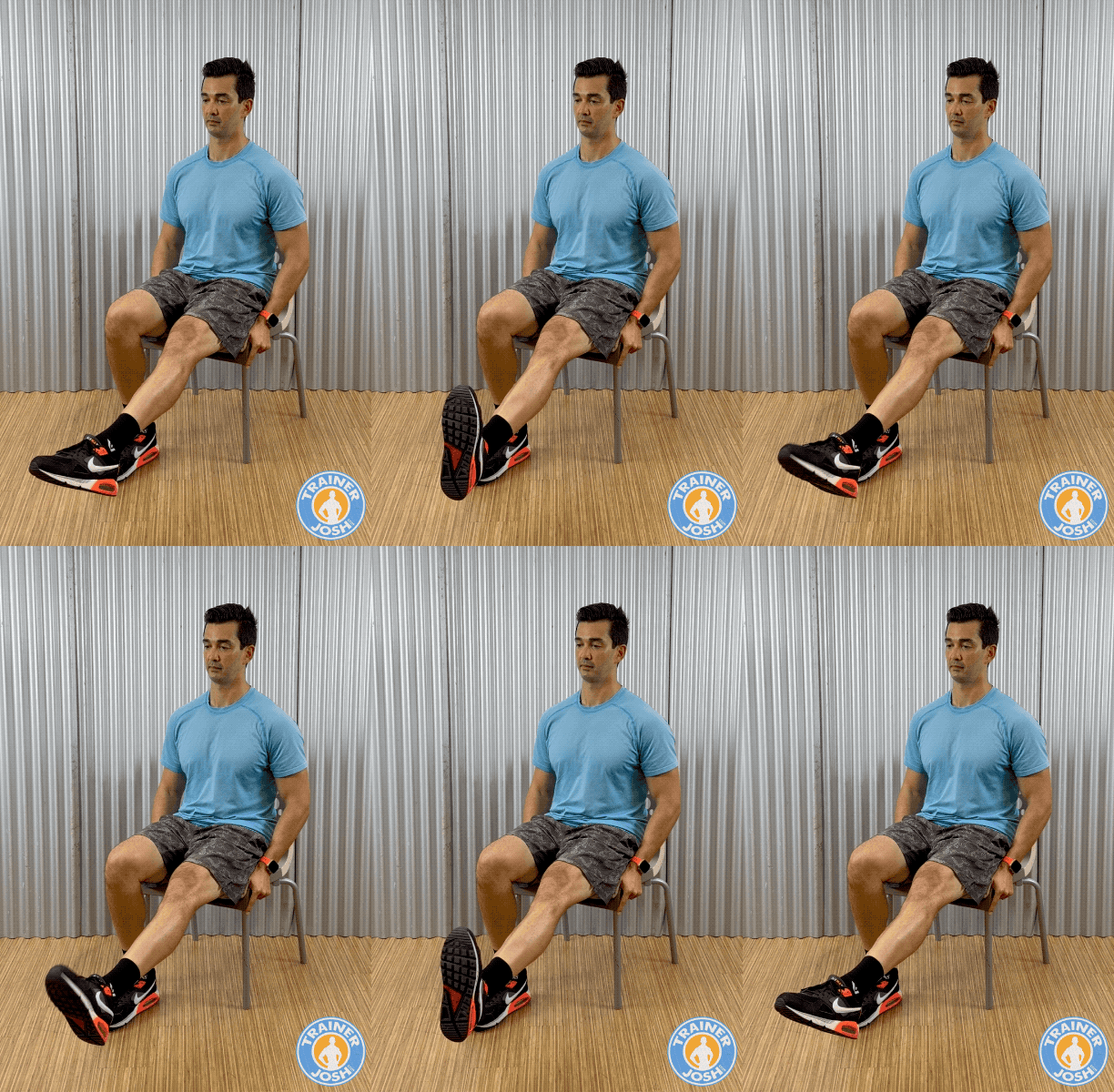
The ankle circle works by acting as a powerful joint-lubricator and circulation-booster, directly targeting the small stabilizing muscles and ligaments that control your foot’s mobility.
By systematically moving the ankle through its full range of motion, this exercise increases blood flow to your lower extremities (which helps reduce stiffness and the risk of blood clots) while strengthening the foundation of your body’s balance system.
In your daily life, fortifying your ankles translates to a significantly reduced risk of tripping or spraining an ankle. This makes it much easier and safer to navigate uneven surfaces, walk with a confident stride, and maintain your overall independence.
How to Properly Perform Seated Ankle Circles
- The Setup: Sit upright in a sturdy chair with your feet flat on the floor, hip-width apart, and your hands resting comfortably on your thighs for support.
- The Lift: Engage your core for good posture and lift one foot slightly (about 1 to 2 inches) off the ground, keeping your knee bent.
- The Rotation: Slowly and deliberately rotate your lifted foot in a circular motion, moving your toes up, out, down, and in. Complete 10 to 15 slow circles in a clockwise direction.
- The Reverse: Pause briefly, then reverse the direction, completing another 10 to 15 slow, controlled circles counterclockwise.
- The Switch: Lower your foot back to the floor with control, and repeat the exact same sequence with your opposite foot.
What You Should Feel (and NOT Feel): You should feel a gentle stretch and muscular engagement in your lower leg, ankle, and foot as you mobilize the joint. You should not feel any sharp, stabbing pain in your ankle or strain in your knee or hip. The rest of your body should remain completely relaxed and still.
How to Make it Easier or Harder
- To make it easier: Keep your heel resting lightly on the floor while circling your ankle, or simply make the circles smaller until your flexibility improves.
- To make it harder: Extend your leg completely straight out in front of you while making the circles, intentionally draw larger circles, or strap light weights around your ankles for added resistance.
Pro Trainer Tips to Maximize Results
- Alphabet Toes: To challenge your mobility from different angles and keep the exercise fun, pretend your big toe is a pen and “write” the alphabet, your home address, or uplifting words in the air instead of just making circles.
- Isolate the Ankle: Make sure that only your ankle is moving. Focus heavily on keeping your knee and thigh completely stationary to get the most out of the exercise.
Common Mistakes to Avoid
- Moving Too Fast: Avoid jerky, rapid, or abrupt motions. The key to building strength and adequately lubricating the joint is slow, deliberate, and controlled movement.
- Moving the Whole Leg: A common error is letting the entire leg sway or allowing the knee to drop in and out. Lock your thigh in place so the ankle is forced to do all the work.
- Holding Your Breath: Do not hold your breath as you concentrate on the movement. Maintain a steady, relaxed breathing pattern throughout the rotations.
Heel Raises & Toe Raises
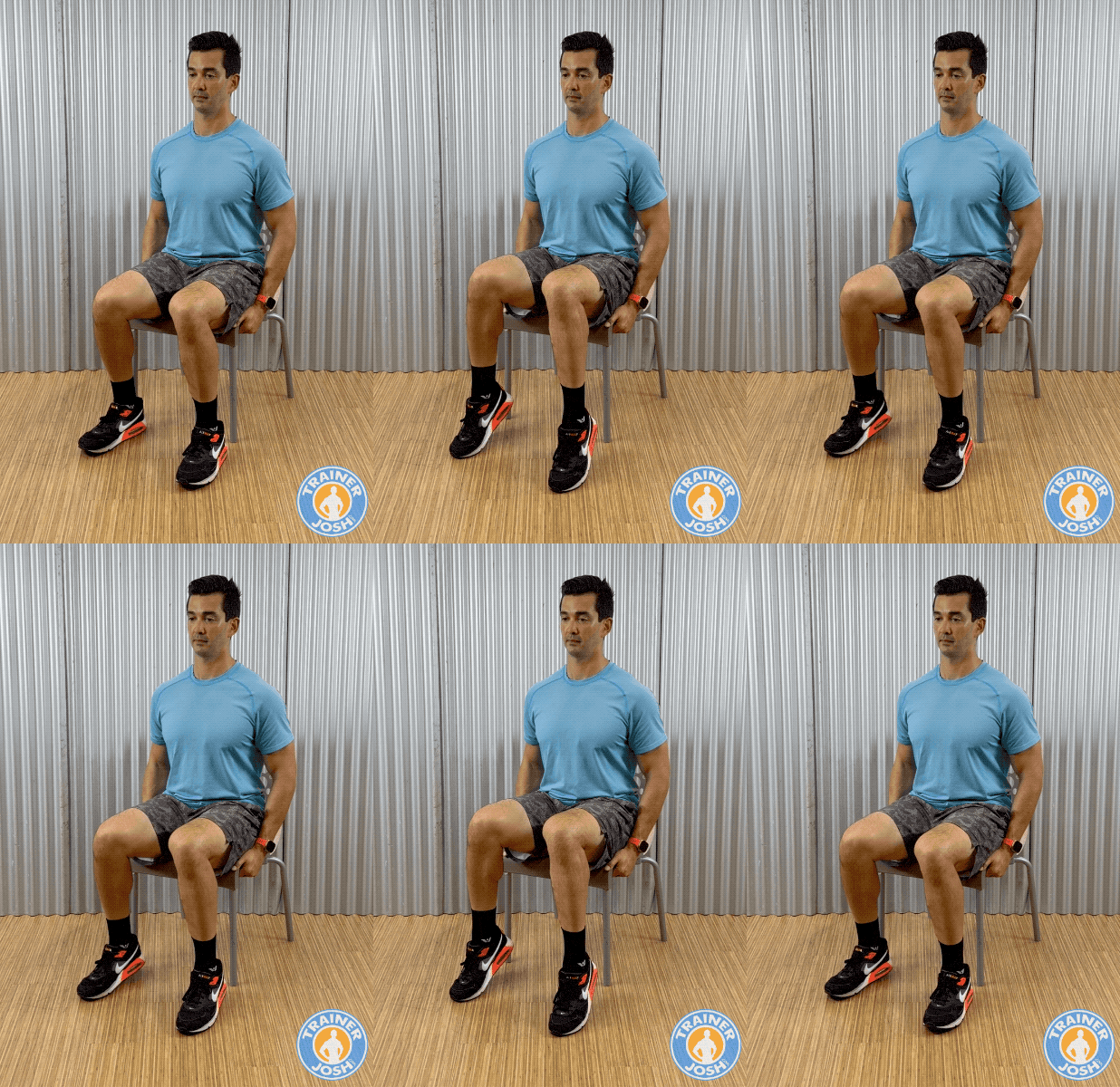
Combining seated heel raises and toe raises works by acting as an active “pump” for your lower extremities, simultaneously combating poor circulation and fortifying the crucial stabilizing muscles of your lower legs.
This paired movement reduces lower leg swelling, cramping, and shin splints by directly targeting the calves (gastrocnemius and soleus) and the front of the shins (tibialis anterior). In your daily life, building strength and flexibility in these often-neglected ankle and foot muscles translates to a significantly reduced risk of developing an unsteady, shuffling gait.
You will find yourself able to walk with a more confident stride, easily navigate uneven terrain or adventurous paths, and dramatically lower your overall risk of tripping and falling.
How to Properly Perform Seated Heel & Toe Raises
- The Setup: Sit tall in a sturdy chair with your back properly supported (or sitting upright without leaning back for more core engagement), keeping your feet flat on the floor and your knees bent at a 90-degree angle.
- The Heel Raise: Exhale and slowly push through the balls of your feet, lifting your heels as high as comfortably possible toward the ceiling.
- The Descent: Inhale and slowly, with control, lower your heels back down until your feet are flat on the floor.
- The Toe Raise: Once your feet are flat, exhale and lift your toes upward toward the ceiling, shifting your weight onto your heels.
- The Return: Inhale and gently lower your toes back to the floor to complete one repetition.
What You Should Feel (and NOT Feel): You should feel a strong contraction or “burn” in the back of your lower legs (calves) during the heel raise, and a distinct tightening in the front of your lower legs (shins) during the toe raise. You should not feel sharp pain in your ankle joints or knees, nor should you feel strain in your lower back from slumping.
How to Make it Easier or Harder
- To make it easier: Decrease your range of motion by only lifting your heels or toes a few inches off the floor, or simply pause momentarily at the top instead of holding the contraction.
- To make it harder: Place a medicine ball, heavy book, or similar weight on your lap near your knees for added resistance during the heel raise. You can also hold the lifted positions for 5 to 10 seconds, hover your feet completely off the floor between repetitions, or progress to performing the exercise standing up while holding the back of the chair for support.
Pro Trainer Tips & Common Mistakes to Avoid
- Weight Distribution: When performing the heel raise, intentionally distribute your weight evenly across the balls of your feet and big toes. This prevents your ankles from rolling outward and ensures optimal muscle engagement.
- Wear Non-Slip Footwear: Perform these in supportive athletic shoes or non-slip socks to ensure your feet grip the floor securely without sliding.
- Don’t Rock the Body: A common mistake during the toe raise is rocking your entire torso backward to help lift the toes. Keep your upper body completely still and isolate the movement strictly to the ankle joint.
- Avoid Dropping Fast: Do not let gravity simply drop your heels or toes back to the floor. Lowering your feet slowly and deliberately (the eccentric phase) is critical for building strength and preventing impact bruising.
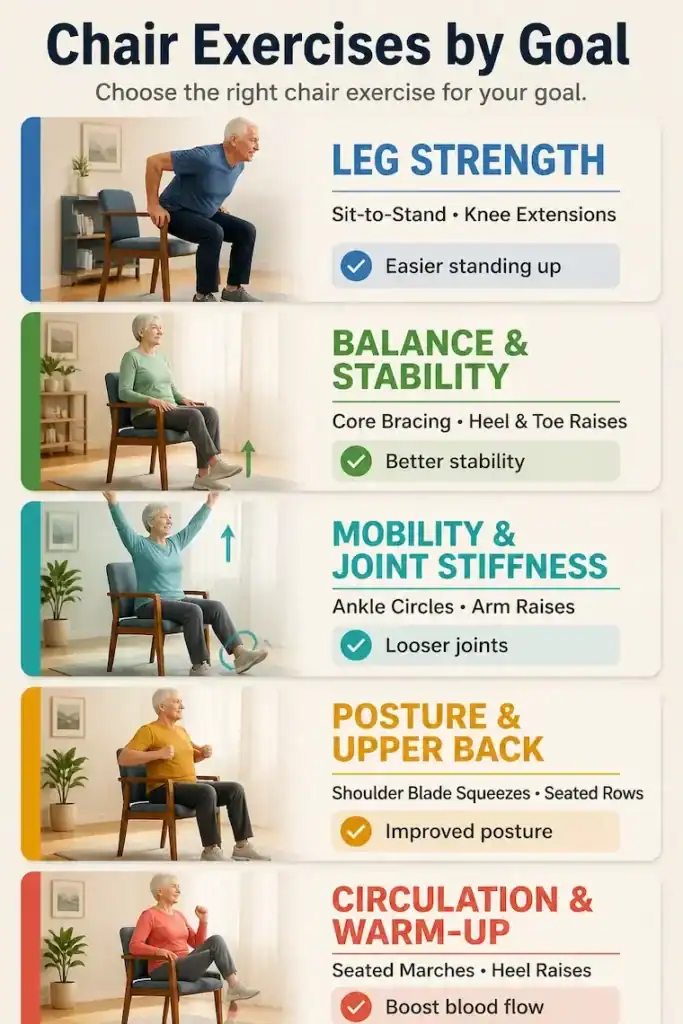
Chair Exercises by Goal: Balance, Strength, Flexibility, and Weight Loss
Not all chair exercises do the same thing. Doing random seated movements and hoping for the best is how people stay stuck. Matching your exercises to your actual goal is what creates results.
Here’s how to choose based on what you’re working toward.
Best Chair Exercises for Balance
Balance is not a single skill. It’s the product of four systems working together: leg strength, core control, ankle stability, and movement confidence.
Leg strength gives you the force to catch yourself when you stumble. Core control keeps your trunk stable when you twist, reach, or shift your weight. Ankle strength governs the micro-corrections your feet make on uneven surfaces.
And fear, physically, makes balance worse. It causes people to tense up, shorten their stride, and get a shuffling gait that accelerates muscle loss and fall risk.
Best exercises for balance:
- Seated Marches: Force your core to stabilize your trunk while your legs move independently. Build hip flexor and thigh strength that directly improves stepping height and reduces tripping risk.
- Heel and Toe Raises: Strengthen the calves and shins simultaneously. This combats a shuffling gait, improves push-off when walking, and trains the ankle to clear uneven surfaces.
- Seated Core Bracing: Tighten the deep abdominals and lower back without using the chair’s backrest. This builds the static trunk stability that prevents postural swaying.
- Sit-to-Stands: Shift your center of gravity forward and upward in a controlled way. Mastering this single movement is one of the strongest predictors of long-term fall prevention.
- Supported Standing Weight Shifts (if safe): Stand behind the chair and gently rock your weight from toes to heels, or left leg to right. This trains the exact weight-transfer mechanics your body uses to walk and recover from a stumble.
As your balance improves, a soft foam balance pad can help safely challenge ankle stability and coordination while still using the chair for support.
Best Chair Exercises for Strength
The CDC recommends muscle-strengthening activity at least 2 days per week for adults 65 and older. That guideline exists because sarcopenia, age-related muscle loss, is progressive and directly tied to loss of independence.
Strength work should feel challenging and controlled. You want muscle fatigue by the end of your set. You do not want jerky momentum, postural collapse, or sharp joint pain.
Best exercises for strength:
- Chair Stands (Sit-to-Stands): Move your full bodyweight against gravity using your quadriceps, glutes, and core together. This is the single exercise most correlated with independence from chairs, toilets, and beds.
- Seated Knee Extensions: Isolate the quadriceps without placing vertical load on the knee joint. Strong quads absorb shock and stabilize the knee for stairs, curbs, and uneven terrain.
- Seated Biceps Curls: Build the pulling strength needed to carry grocery bags, lift laundry, and pick up grandchildren. Use light dumbbells or water bottles and curl toward the shoulders.
- Seated Shoulder Raises: Front raises and lateral raises target the anterior and lateral deltoids. Stronger shoulders make overhead reaching easier and protect the rotator cuff from strain.
- Seated Rows and Band Pulls: Loop a resistance band around your feet or pull dumbbells toward your hips, squeezing your shoulder blades together at the end. This targets the rhomboids and latissimus dorsi, corrects the forward-slumping posture that develops with age, and builds the pulling strength needed for doors, yard work, and heavy tasks.
Best Chair Exercises for Flexibility & Stiffness
Connective tissue loses elasticity with age. A consistent stretching routine restores blood flow to those tissues and keeps joints supple and functional.
One rule before you start: stretching should feel like gentle tension, not pain. Bouncing through a stretch or pushing into sharp pain causes muscles to reflexively tighten. That’s the opposite of what you want.
Best exercises for flexibility:
- Seated Hamstring Stretch: Extend one leg forward with heel on the floor and toes up. Keep your spine straight, inhale, then hinge forward from the hips on the exhale. Lead with your chest, not your shoulders. Hold 10 to 30 seconds per side. Tight hamstrings pull directly on the lower back and impair standing posture.
- Neck Turns: Sit tall and slowly turn your head to look over one shoulder, holding 5 seconds before returning to center. Keeps the sternocleidomastoid supple and restores the range of motion needed to check blind spots while driving.
- Shoulder Stretch: Place one hand on the opposite shoulder, cup the elbow with your other hand, and gently pull the elbow across your chest. Hold 5 to 15 seconds. Prevents the rotator cuff tightness that makes overhead reaching painful.
- Ankle Circles: Lift one foot slightly and rotate the ankle slowly through full range, 10 to 15 circles each direction per foot. Keep the rest of the leg still so the ankle joint does all the work.
- Seated Trunk Rotation: Sit tall, inhale to lengthen the spine, then exhale and twist gently to one side. Place one hand on the outside of the opposite knee for support. Hold 15 to 30 seconds, hips square, and move smoothly without forcing the rotation.
Best Chair Exercises to Lose Weight
Fat loss comes down to three things: calorie balance, adequate protein intake, and consistency. Chair exercises contribute by raising your heart rate, increasing total calorie burn, and rebuilding the metabolically active muscle tissue that keeps your metabolism running.
One thing worth stating plainly: spot reduction doesn’t work. Seated crunches will not melt a ton of belly fat. Your body loses fat systemically, from all over at once, when you maintain a consistent caloric deficit.
So the best chair exercises for weight loss are full-body, aerobic movements that maximize total calorie burn.
Best Exercises for Calorie Burn:
- Seated Marches (brisk pace): Pump your arms while lifting your knees rhythmically. Engaging both large lower-body muscles and the arms simultaneously recruits significant muscle mass, which raises metabolic demand.
- Fast Heel Taps: Alternate tapping each heel quickly on the floor in front of you. Continuous lower-body movement at a fast clip elevates breathing rate without any joint impact.
- Arm Punches: Controlled forward punches build aerobic endurance from the upper body. Add very light weights or water bottles to increase muscular demand and calorie expenditure.
- Seated Jumping-Jack Arms: Raise both arms fully overhead and bring them back down rapidly while marching or tapping heels. Overhead arm movement forces the heart to work harder to pump blood upward against gravity.
- Longer 20-30 Minute Routines: Short bouts are a strong starting point. Sustained aerobic effort of 20 to 30 continuous minutes is where metabolic conditioning and meaningful calorie burn compound. Build toward this duration gradually using the 4-week progression plan outlined earlier.
5-Minute, 10-Minute, 20-Minute & 30-Minute Chair Exercise Routines
5-Minute Starter Routine for Very Beginners
Best for:
- Seniors over 80
- deconditioned beginners
- anyone restarting after a long break from movement
Five minutes is enough to start. That’s not a compromise. It’s the right starting point if you’re highly deconditioned, recovering from inactivity, or dealing with significant balance and mobility challenges.
Jumping into a 20-minute routine from a standing start is how people get sore enough to quit. This routine exists to prevent that.
Five focused minutes begins rebuilding the neuromuscular connections between your brain and your muscles. It increases circulation, lubricates stiff joints, and proves to your body that movement is safe again. All from a chair that removes the fear of falling entirely.
Do this three days in a row and you’ll notice something shift. Not dramatic. But real.
How to use this routine:
Start here for your first two weeks. When five minutes starts feeling easy and your energy after the session is good, add one more exercise or extend the marching interval.
If a movement causes sharp joint pain, skip it and move to the next one. If you feel dizzy or short of breath, stop and rest. Coming back tomorrow counts as progress.
10-Minute Daily Chair Routine
This beginner-friendly seated chair workout helps improve strength, circulation, balance, posture, and mobility safely at home in just 10 minutes.
How to Use This Routine:
- Stop immediately if you feel dizzy, chest pain, or sharp pain
- Perform 1 set of each exercise
- Move slowly and with control
- Rest briefly between exercises if needed
- Breathe continuously throughout the workout
20-Minute Full-Body Chair Workout
This 20-minute chair workout combines strength training, mobility work, posture exercises, light cardio, and core activation into one complete beginner-friendly routine for seniors.
How to Use This Routine:
- Aim to complete this routine 3–5 days per week
- Perform 1 round of the full workout
- Move slowly and with control
- Rest briefly whenever needed
- Focus on steady breathing throughout
- Stop immediately if you feel dizzy, chest pain, or sharp joint pain
How Often Should Seniors Do Chair Exercises?
Key Takeaways:
- Aim for at least 150 minutes of moderate chair cardio per week spread across 3–5 days
- Strength train 2–3 times weekly on non-consecutive days to allow muscle recovery
- Beginners should start with bodyweight only and focus on slow, controlled movement
- Consistency matters more than intensity during the first few weeks (even short 10-minute workouts count)
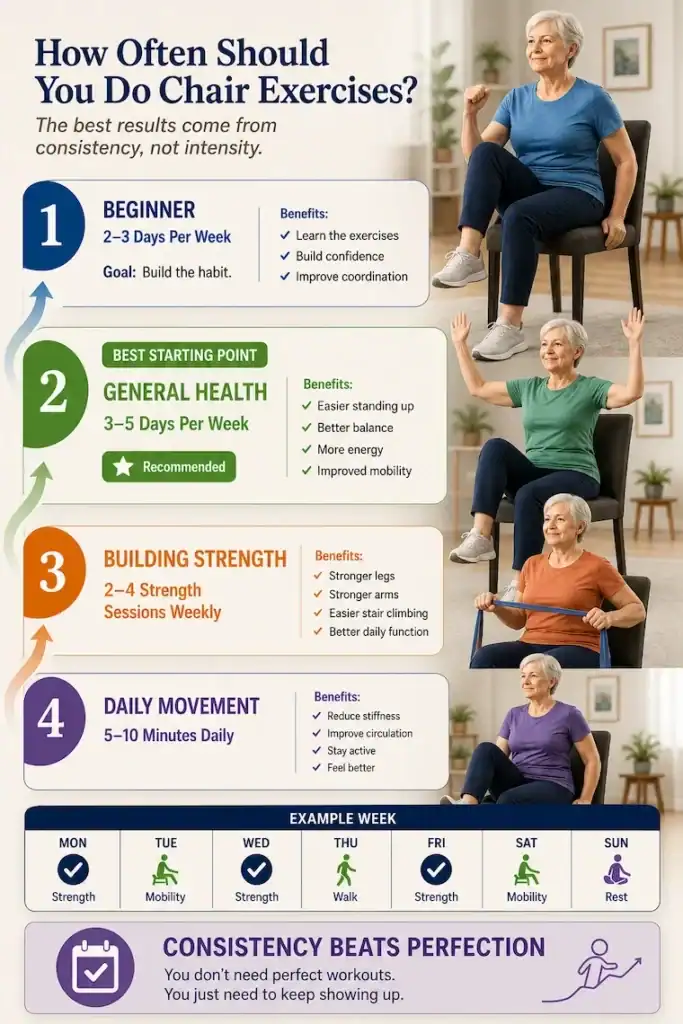
More is not always better. But doing nothing consistently is always worse.
The right frequency for chair exercises depends on what type of movement you’re doing. Each category has its own recovery needs, and mixing them up without a plan is where most beginners stall out.
Cardio and aerobic work target heart health and circulation. Aim for at least 150 minutes of moderate‑intensity aerobic activity per week, spread over 3 to 5 days, in line with WHO and ACSM physical activity guidelines for adults.36
If 30 minutes at a stretch feels like too much right now, you can break it up. Two 15‑minute sessions or three 10‑minute bouts of moderate‑intensity activity spread through the day provide similar cardiovascular benefits when the total weekly time adds up to your 150‑minute goal.
Strength and resistance training. For most older adults, strength training the same muscle groups is usually spaced about 48 hours (up to 72 hours after harder sessions) to allow recovery and adaptation between workouts.37
Resistance exercise provides the stimulus, but the actual repair and strengthening of muscle fibers happens during the recovery period. This is when muscle protein synthesis is elevated (and with adequate protein), exceeding breakdown.38
Recovery is part of the workout, especially when your muscles need more time between sessions. BioTRUST Ageless Multi Magnesium is one option I like because its multi-form blend supports muscle relaxation, cellular energy, and exercise recovery.
A 7-form magnesium complex designed for adults 40+ to support restful sleep, relaxation, muscle recovery, and whole-body health. Each serving provides 350mg of magnesium plus L-theanine and vitamin B6 for added nervous-system support.
- 7-Form Magnesium Blend: Combines glycinate, taurate, malate, citrate, Sucrosomial® magnesium & complementary forms
- Sleep & Relaxation Support: Magnesium glycinate plus L-theanine help support calm, relaxation & restful sleep
- Muscle Recovery & Comfort: Supports normal muscle relaxation, recovery & energy production
- Enhanced Absorption: Includes clinically studied Sucrosomial® Magnesium for high absorption & gentle digestion
- Heart, Bone & Nervous System Support: Provides 350mg of magnesium plus vitamin B6 for essential body functions

One thing I consistently see with older adults is that protein intake tends to drop right when the body needs it most.
As we age, maintaining muscle becomes harder, especially if appetite decreases or meals become smaller and lower in protein. That’s why I often recommend prioritizing high-quality protein intake alongside strength training and chair exercises to help support muscle maintenance, recovery, energy, and healthy aging.
2-3 times per week on non-consecutive days is the sweet spot.
Core stability work is gentler and shorter. Isometric exercises like seated lean-backs can be done 4 to 6 times per week without overtaxing your system.
Stretching and flexibility improve most reliably with steady practice. Two to three days per week is the minimum to see improvement in joint range of motion.
More frequent stretching (most days of the week) tends to produce greater improvements in flexibility.
One of my clients was stretching once a week and wondering why her hips still felt locked up every morning. We bumped her to daily five-minute sessions. Within three weeks, she was getting out of bed without the slow shuffle to the bathroom first.
For your first 2-4 weeks, keep it simple.
Start with bodyweight only. No bands, no dumbbells. Master the movement patterns first so your form is dialed before you add any external load.
If you’re just getting started, guidelines suggest starting with 1–2 sets of about 8–12 slow, controlled repetitions per exercise.
That controlled tempo (not speed) is what builds neuromuscular coordination early on.
Your body needs time to acclimate to new physical stress. Pushing volume too fast is a common reason people become overly sore and stop exercising.
Consistency over those first weeks matters far more than intensity.
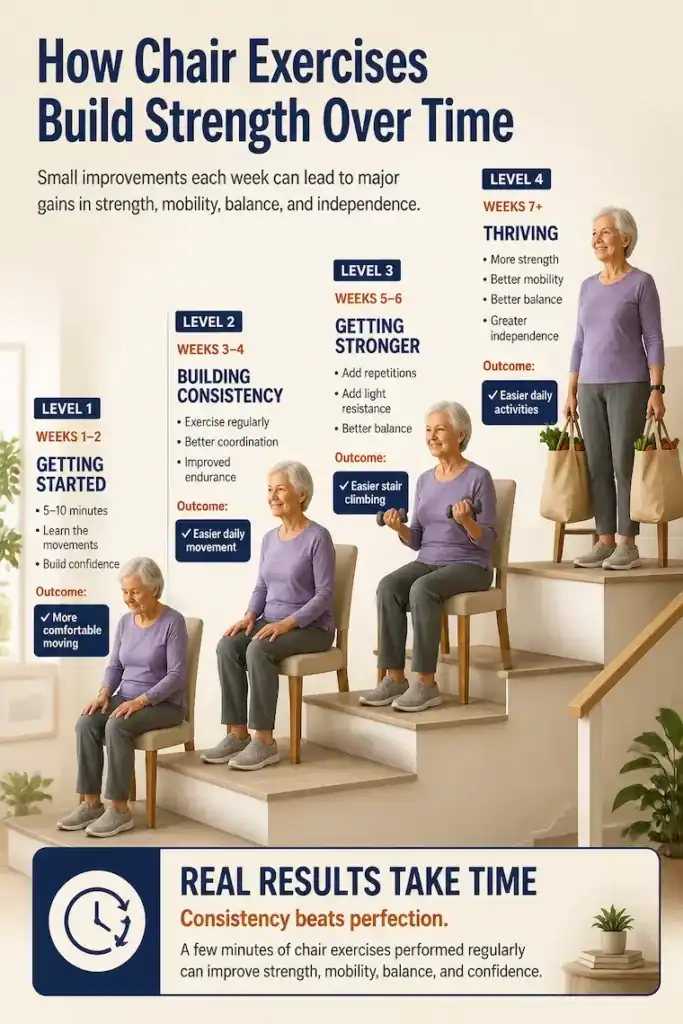
How Chair Exercises Check Every Box in the Weekly Fitness Guidelines for Seniors
Most people don’t realize that chair exercises can be adapted to meet all three categories recommended by major health organizations for adults 65 and older.
The guidelines call for at least 150 minutes of moderate-intensity aerobic activity per week, plus muscle-strengthening and balance work on two or more days. Chair exercises can be adapted to address each of these targets.
Here’s how the movements map directly to each…
Cardio: Seated Marches
Seated marching is the entry point for aerobic conditioning. Sit tall, alternate briskly lifting your knees toward your chest, and it can produce similar cardiovascular responses when performed at sufficient intensity.
Your heart rate climbs. Circulation improves. Oxygen moves through your body. And it greatly reduces the impact on your knees and hips.
Strength: Chair Stands & Knee Extensions
You don’t need external weights to build functional muscle. Progressive bodyweight resistance training (done with enough effort and progression) has the ability to significantly increase strength and muscle size.39
Chair stands, getting up from a seat, and sitting back down directly strengthen the glutes, hips, and thighs. Those are the muscles that get you off the toilet, out of a car, and up from the couch without grabbing something for help.
Seated knee extensions work the quadriceps specifically. Strong quadriceps act as key dynamic stabilizers for the knee. They help support the joint, control alignment during weight-bearing, and reduce excessive stress on passive structures.
One of my clients added these twice a week and told me after a month that going up her front steps “finally felt like nothing again.”
Balance: Heel Raises, Core Bracing & Sit-to-Stands
Balance training doesn’t require standing on one foot. It starts with the muscles that keep you stable in the first place.
Heel raises (performed standing behind the chair for support) strengthen the calves and ankles. Strong, stable ankles play a key role in your first line of defense against trips and slips. The muscles around the ankle control your balance, adapt to bumpy ground, and make rapid corrections before you lose your footing.
Seated core bracing, pulling your belly button in and creating tension through your midsection, trains the deep stabilizers that keep your torso upright when your footing shifts.
Sit-to-stands do double duty. They strengthen the hips and thighs and train you to shift your center of mass forward and up in a controlled way. This is the same coordination pattern you use every time you stand up, which is strongly tied to better balance and lower fall risk.38
The perspective shift most people miss: chair exercises are not the finish line. They’re like the on-ramp.
As your strength and confidence build from the chair, those same movement patterns transfer directly to standing work. The chair stops being your seat and becomes your balance support, something to hold while you do standing leg lifts or heel raises.
On days when arthritis flares or a particular joint is acting up, switching to gentler, chair‑based exercises lets you keep up your weekly activity while reducing the load on the inflamed joint. This is why arthritis programs often use seated routines as a lower‑impact option.40
Chair Exercises for Seniors Over 70 & Over 80
Key Takeaways:
- Seniors over 70 can still build meaningful muscle; focus on progressive resistance, pain-free range of motion, and sit-to-stand strength.
- Seniors over 80 benefit most from multiple short sessions of 5 to 10 minutes targeting circulation, mobility, posture, and movement confidence
- High fall risk at any age warrants supervision and a uncluttered environment with a sturdy, non-wheeled chair.
Age is not the obstacle most people think it is. Physical inactivity is one of the major contributors to muscle weakness with aging.
Studies comparing younger and older adults on the same strength programs find that older adults can increase their strength by similar percentages when the training is appropriately challenging.41
The starting point just looks different depending on where you are.
Chair Exercises for Seniors Over 70
The primary goals at this stage are consistency, pain-free range of motion, and protecting sit-to-stand ability. These factors are strongly linked to retaining independence as we age.42
Progressive resistance training is one of the most effective ways to slow (and in many cases partially reverse) age-related muscle loss. The same muscle tension that rebuilds strength also loads the bones, helping support bone density and decreasing the risk of osteoporotic fractures over time.43
Moving joints through their full, pain-free range also stimulates synovial fluid production. That’s the lubricant your joints run on. Stronger surrounding muscles can act like dynamic shock absorbers, helping control impact forces and improve joint stability, which may reduce stress on arthritic joints.44
Once a movement feels easy, add a light resistance band or a small dumbbell. Settling into a routine that no longer challenges your muscles means your rate of adaptation slows significantly.
Best exercises for seniors over 70:
- Chair Stands (Sit-to-Stands): Sit near the front of the chair, lean slightly forward with nose over toes, and push through your heels to stand fully upright. Lower back down with control. This builds the glutes, hips, and thighs needed for daily independence.
- Knee Extensions: Sit tall, slowly extend one leg until the knee is straight, hold briefly, and lower with control. Stronger quadriceps stabilize the knee and can make everyday tasks like climbing stairs feel easier.46
- Seated Marches: Alternate lifting knees toward the chest with an engaged core and straight back. This builds hip mobility and cardiovascular conditioning with minimal joint impact.
- Heel and Toe Raises: Push up onto the balls of your feet, lower, then lift your toes. This strengthens the calves and ankles, improves balance and walking mechanics, and lowers your risk of shuffling gait patterns linked to falls.47
- Shoulder Blade Squeezes: Pull your elbows back and squeeze the shoulder blades together. This targets the rhomboids and upper back, directly countering the forward-slumping posture that develops with age.
Chair Exercises for Seniors Over 80
The emphasis shifts here. The goal is not maximum output. It’s keeping the body moving, the blood circulating, and the self-confidence growing.
Tolerance for physical stress is typically lower at this stage. Shorter sessions are often better tolerated than one long session. Prioritize circulation, mobility, posture, and movement confidence above all else.
One of my clients, 83 years old, was doing two 8-minute sessions daily from her kitchen chair. Within a month, she told me her ankles weren’t swelling by evening as much as they used to. Small sessions, consistent results.
Best exercises for seniors over 80:
- Ankle Circles: Lift one foot slightly and rotate the ankle clockwise, then counterclockwise. This improves joint flexibility, increases circulation in the lower legs, and strengthens the small stabilizing muscles critical for balance.
- Seated Marches: A gentle marching rhythm from a supportive chair builds cardiovascular health and circulation without loading fragile joints.
- Heel and Toe Raises (Seated): Lifting your heels and toes while seated activates the calf muscle pump, helping push blood from the lower legs back toward the heart.48
- Arm Raises: Slowly raise arms out to the sides or straight in front. This preserves shoulder mobility for reaching, dressing, and overhead tasks.
- Modified Sit-to-Stand Practice: If a full stand isn’t safe yet, practice leaning forward and lifting your hips just an inch off the chair before sitting back down. That small movement trains the same fundamental sit‑to‑stand pattern and works the main muscles needed to build toward a full stand.49
If fall risk is high, supervision matters. A family member, caregiver, or trainer nearby removes both the physical risk and the psychological hesitation that keeps people from starting at all.
Two additional safety details specific to this age group:
Because aging blunts the body’s thirst signal, dehydration can develop before you feel thirsty and may show up as dizziness partway through a session. Drink water before, during, and after.50
Dropping the head well below the heart or tilting it sharply back can trigger sudden changes in blood pressure in some older adults, increasing the chance of dizziness or even fainting during exercise.51 Both movements can cause sudden blood pressure fluctuations that trigger dizziness in older adults.
Chair Exercise Modifications for Pain, Arthritis & Limited Mobility
Most fitness content assumes you’re starting from neutral. You’re not, and that’s fine. This section is for the real starting points: knee pain, arthritis flare-ups, balance fears, wheelchair use, and low energy.
Find your situation below and start there…
If You Have Knee Pain
Avoid forcing a full sit-to-stand range if it triggers pain. Use a higher chair or add a firm cushion to raise your seat height. Reducing depth generally decreases stress on the knee joint.
During seated knee extensions, never lock or hyperextend the knee at the top. Always keep a soft bend. Locking the joint shifts more stress to the passive joint structures rather than maintaining muscle tension.
If lifting the leg causes sharp pain, try heel slides instead. Place a towel under your foot on a smooth floor, slowly slide it forward until it’s extended, then drag it back. This strengthens the leg with minimal joint pressure.
Keep your feet planted flat during these exercises, with your knees tracking roughly over your toes. When the knees cave inward (dynamic knee valgus), forces shift toward the inside of the joint and can increase stress on the knee structures with every rep.52
If You Have Arthritis
Apply heat to stiff joints before you start. A warm pack on the knee or shoulder for 10 minutes before exercise loosens the surrounding tissue, making the first few reps far more tolerable.
Start with gentle range-of-motion drills rather than resistance work. Movement commonly feels easier after a longer warm‑up because repeated motion stimulates synovial fluid to better lubricate the joint surfaces, decreasing friction and stiffness.53
Never force a stretch into pain, especially if a joint is swollen, red, or hot to the touch. Those are signs of active inflammation that should be checked by a health professional before you load the joint.
During an active flare-up, stick to pain-free movements only, or rest that joint completely.
Use the ‘two‑hour rule’: if a joint is more painful than it was before exercise and still feels worse two hours later, you likely did too much. Next time, reduce the load by cutting back the intensity, range, or number of reps.
One of my clients with rheumatoid arthritis kept skipping her sessions on bad days entirely. We switched her to isometric holds on flare days, tightening the muscle without moving the joint. She stopped losing her training momentum, and her confidence stayed intact.
If You Have Poor Balance or Fear of Falling
Start with fully seated exercises only. No standing required. Place your chair near a wall so you have an immediate backup if you feel unsteady.
Clear your exercise space before every session. Throw rugs, loose cords, and pets underfoot are common tripping hazards that can raise both anxiety and real fall risk for older adults.54
Fixing your gaze on a stable object provides your brain with clearer, more precise visual input about your body’s position and can measurably reduce postural sway, thereby improving physical stability. A picture frame, a light switch, anything that doesn’t move. A visual anchor gives your brain reliable input and measurably improves physical stability.55
When you do progress toward standing exercises, use the finger-reduction method. Start holding the chair with both hands, then with one hand, then just with the fingertips. Let the support fade gradually as your confidence builds.
If You Use a Wheelchair
Lock the brakes before every session. That’s non-negotiable. A moving chair turns every exercise into a balance problem.
If your chair allows, swing the footrests out of the way to give your lower legs room to move. From there, the most effective exercises are seated marches (if lower-body mobility allows), arm raises, shoulder blade squeezes, core bracing, resistance-band rows, and ankle circles or foot movements.
Wheelchair push‑ups are worth adding if upper‑body strength is a goal. Placing your hands on the armrests and pressing your weight up off the seat strengthens the triceps and shoulder muscles that help with independent transfers.56
Don’t chase perfect form around the armrests. Modify the range to whatever angle feels right and unobstructed.
If You Get Tired Quickly
Fatigue is not failure. It tells you exactly where your starting point is.
Begin with two-minute sessions if that’s all you have. Progress to five minutes, then ten. An interval approach works well here: one minute of movement, one minute of rest. A 20-minute block might be 10 minutes of actual exercise, and that still counts.
Alternate upper-body and lower-body exercises back-to-back. While your arms work, your legs recover, and vice versa. This stretches your stamina without adding time.
Dehydration often shows up as unusual tiredness or fatigue, especially in older adults. Sip water before, during, and after each session, even short ones.
Schedule movement during your natural energy peak. If mid-morning is when you feel sharpest, that’s your training window.
Common Chair Exercise Mistakes to Avoid
Key Takeaways:
- Posture and breathing are techniques, not optional extras; slouching and breath-holding actively work against your results.
- Slow, controlled reps outperform fast, momentum-driven ones for both strength gain and joint safety.
- Progress is required: a routine that never gets harder eventually stops producing any adaptation.
Most people don’t get hurt doing chair exercises by working too hard. They get hurt or stop making progress by repeating small technique errors session after session.
Technique errors and poor exercise setup can contribute to pain, stagnant progress, or injury risk over time. These are the ones I see most often.
Using the Wrong Chair
Rolling chairs, soft recliners, and unstable seats turn every exercise into a balance problem before you’ve even started.
Use a sturdy, straight-backed chair with non-slip feet and no wheels. Your chair is your foundation. A shaky foundation makes everything harder and riskier.
Slouching or Poor Posture
Exercising with poor posture can increase joint stress and reduce the effectiveness of the workout. Slouching puts your lumbar spine into repeated flexion, which increases pressure on the front of the discs and shifts more load onto passive spinal structures with every rep.57
Sit tall, brace your midsection, and establish that posture before you move your limbs.
Holding Your Breath
Holding your breath while you strain triggers a Valsalva maneuver, causing big swings in blood pressure and reducing the amount of oxygen that reaches working muscles, so the effort can feel much more tiring than it needs to.
Exhale on the hardest part of the movement, inhale on the easier part, and keep breathing smoothly throughout.
One of my clients was turning red during seated leg lifts because she was bracing by holding her breath. Coaching her to exhale on the lift dropped her perceived effort within one session.
Locking Your Joints
Hyperextending the knee or elbow at the end of a movement feels like a full range rep. It isn’t.
Locking a joint into its end range (the ‘close‑packed’ position) lets the surrounding ligaments and joint surfaces take more of the load, so the muscles do less of the stabilizing work.58
Repeated hyperextension may, over time, place additional stress on passive joint structures. Always keep a soft, slight bend at the end of every extension.
Moving Too Fast or Using Momentum
Swinging a leg up or throwing an arm forward means the muscle isn’t doing the work. Momentum is.
Controlled repetitions can improve muscular tension and movement quality. Controlled movements may help reduce unnecessary stress on connective tissue by dodging sudden, high‑velocity forces.59
Skipping the Warm-Up or Cool-Down
Cold muscles tend to be stiffer and less flexible, so warming up before harder work can help decrease strain on muscles and connective tissue and may reduce injury risk.60
A few minutes of gentle movement helps synovial fluid lubricate your joints and gradually raises tissue temperature, so everything moves more easily.61
Skipping the cool-down leaves your heart rate elevated and your muscles tightening back up before they’ve had a chance to recover.
Ignoring Pain Signals
Muscle effort and fatigue are normal. Sharp, stabbing pain felt inside a joint is not a normal training feeling and should be treated as a warning sign to stop and get it checked.
Stop the specific movement immediately if pain is joint-based rather than muscular. Repeatedly pushing through joint pain can worsen irritation or injury.
Doing the Same Easy Routine Forever
A routine that no longer challenges you no longer changes you.
Once a session starts feeling comfortable, add reps, extend your range of motion, increase time under tension, or introduce a light resistance band.
Progress doesn’t have to be dramatic. It just has to keep moving forward.
Over-Gripping the Chair or Weights
Squeezing equipment with very high effort causes a short‑term spike in blood pressure and can place extra stress on arthritic hand joints. So it’s safer to use a strong but not maximal grip.
Use a firm but relaxed grip. You want control, not a white-knuckle clench.
Wearing Improper Footwear
Your feet press into the floor throughout every seated exercise to stabilize your body.
Loose slippers or socks on hard floors take away a stable, grippy base under your feet and can raise your risk of slipping, especially when you’re transferring in and out of a chair.62
Wear supportive athletic shoes with non-slip soles every session.
How to Progress Chair Exercises Safely (So You Keep Getting Stronger, Not Just Comfortable)
A routine that never changes eventually stops working. As your body adapts to a training stimulus, progress tends to slow unless the challenge gradually increases.
That’s not failure. That’s physiology. The fix is called progressive overload, and it doesn’t require heavy weights or more time than you have.
The 4-Week Chair Exercise Progression Plan
Start here if you’re new or returning after a long break. The goal in the first month is to build the habit and the movement patterns before adding any real load.
Week 1: Build consistency. Aim for 5 to 10 minutes, 3 days a week. Use bodyweight only. Focus entirely on posture and form. Your muscles and joints are acclimating to new stress, and that process needs time.
Week 2: Add volume. Bump to 10 to 15 minutes, 4 days a week. The movements should feel more recognizable now. Increasing duration and frequency builds the stamina base you need before adding resistance.
Week 3: Add strength. Add one extra set, or introduce light dumbbells, water bottles, or soup cans. If you’ve been doing one round of 10 reps, trying two rounds increases your total workload in a meaningful way, which can help drive further progress.63
Week 4: Add endurance. Work up to 20-30 minutes, or try longer sustained intervals. This is where cardiovascular adaptation starts to compound alongside strength gains.
If a week still feels too hard, repeat it. One of my clients spent three weeks on Week 1 before she felt ready to move forward. She’s now four months in and doing seated resistance band work three days a week.
Signs You’re Ready to Make It Harder
Watch for these four signals before adding any load or time:
- Exercises feel too easy at the end of your sets, with no muscle fatigue at 12-15 reps.
- You can complete every rep with good form, no slouching, no momentum, no compensation.
- You fully recover within 24 to 48 hours, with no lingering joint pain.
- Daily tasks like getting out of a chair, carrying groceries, or walking feel noticeably more stable
None of the four need to be true at the same time. But if the first two are consistent, your body is ready for more challenge.
Easy Ways to Progress Without Switching to Heavier Weights
You have more options than just adding weight.
Add 2 to 3 reps. If you’re doing 10, push to 12 or 13 before changing anything else. More reps at the same load increase total volume. With the weight held constant, doing more repetitions of a lift increases your total training volume (sets × reps × load).
Add another set. Rest 30 to 60 seconds, then repeat. A second set at the same weight and reps is a meaningful increase in total workload.
Slow down the lowering phase. Taking about 4 to 5 seconds to lower yourself into the chair (instead of dropping it quickly) substantially increases the time your muscles spend under tension during each set.64
Muscles develop strength and size from both lifting and lowering the weight, and emphasizing a controlled lowering phase can provide a particularly strong stimulus for adaptation.65
Add light hand weights. Once bodyweight movements feel easy, hold light dumbbells or household items to add load without changing the movement pattern.
Add a resistance band. Bands create variable resistance that can increase muscular tension throughout portions of the movement, especially toward the end of the range.66
Add short cardio intervals. Inserting 30 seconds of brisk seated marching or quick arm swings between strength exercises can raise your heart rate, contribute to cardiovascular conditioning, and modestly increase total calorie burn within the same overall workout time.
What Results Can Seniors Realistically Expect From Chair Exercises? (A Week-by-Week Breakdown)
Key Takeaways:
- Weeks 1 to 2 bring reduced stiffness, better circulation, and postural awareness; visible strength comes later.
- Weeks 3 to 4 produce functional gains: easier standing, more stamina, stronger legs and arms from neuromuscular adaptation.
- Stalled results almost always trace back to inconsistent frequency, insufficient challenge, or a lack of progressive overload.
“I tried chair exercises, but I don’t know if I’m doing enough.”
That’s one of the most common things I hear, and it’s a fair frustration. Because seated workouts look gentle, it’s easy to doubt whether anything is actually changing inside your body.
Your body is changing; it just adapts in stages, and knowing that progress unfolds over weeks and months rather than days can make it less hard to stick with your program rather than quit early.67
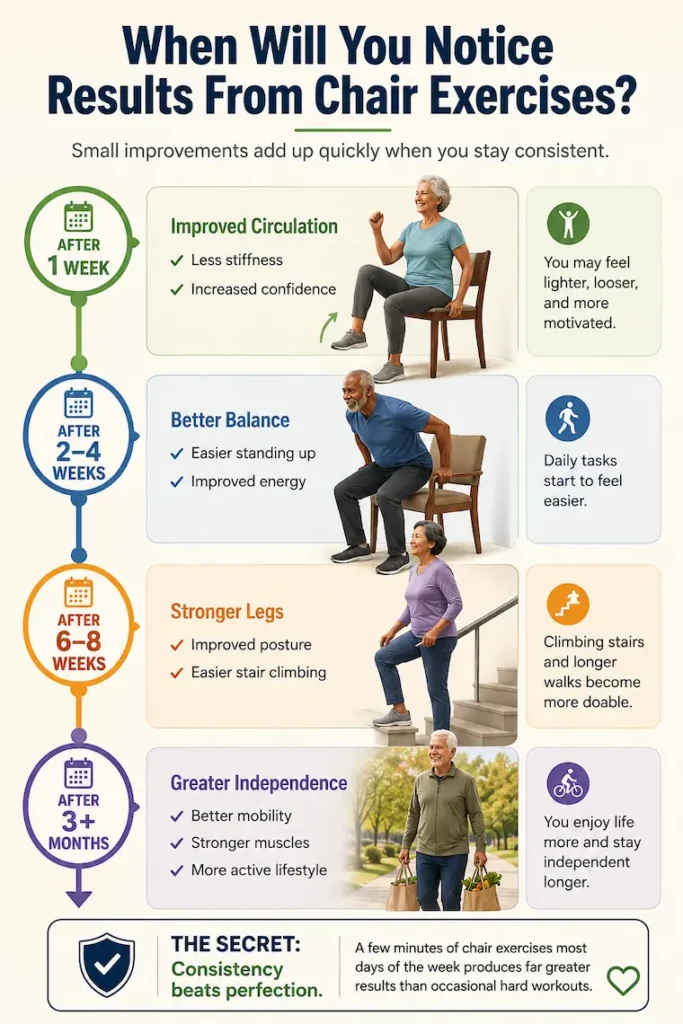
Weeks 1 to 2: The Awakening Phase
In the first few weeks of a new strength program, most of the progress is neurological and coordination-related, so joints move more smoothly, and you get stronger even before any visible muscle changes show up in the mirror.68
As you move a stiff joint through its comfortable range, the synovial membrane helps circulate and replenish the fluid that lubricates the cartilage surfaces. This is why stiffness and mild ‘rusty’ achiness from sitting often ease up quickly once you start moving.
Movement helps keep joints mobile, while connective tissues still need the right building blocks. BioTRUST Ageless Multi Collagen is one option I like because its five collagen types support cartilage, tendons, ligaments, and joint comfort as you stay active.
Powered by 5 Types of Bioactive Naturally Hydrolyzed Collagen Peptides for Full-Body Support (Odorless & Flavorless)
- Natural GLP-1 Support: Helps support healthy appetite signals, fullness & metabolic function
- Lean Muscle Support: Helps preserve muscle, strength & healthy body composition during weight loss
- High-Protein Collagen: Adds 20g of protein with 5 collagen types to help support daily protein intake
- Skin, Joint & Hair Support: Provides collagen peptides to support skin elasticity, joints, hair & nails
- 3-Part Weight-Loss Support: Combines muscle, protein/collagen & appetite support in one simple daily stack

Rhythmic seated movement raises your heart rate slightly and improves circulation, helping deliver more oxygen‑rich blood to your limbs and brain than when you’re sitting still. This shows up as slightly more daily energy and less swelling in the lower legs by the end of the day.
Posture awareness shifts too. Sitting tall near the front of the chair, without leaning on the backrest, encourages your deep core muscles to engage and help support your spine.
Most people notice within two weeks that they’re catching themselves slouching during the day and correcting it without being prompted.
Weeks 3 to 4: The Neuromuscular Phase
Your brain is getting better at communicating with your muscles. That’s not a metaphor.
In the early weeks of training, your nervous system learns to recruit and coordinate more of your existing muscle fibers with each movement. This is why exercises often feel easier in the first few weeks: your nervous system is adapting, even before your muscles visibly change in size.69
Getting out of a chair, off the toilet, or out of a car starts requiring noticeably less arm-pushing effort. Stamina climbs too. Sessions that left you winded in Week 1 feel manageable now.
One of my clients told me at the four-week mark that she’d walked to her mailbox and back without stopping to rest… for the first time in months.
Weeks 6 to 8: The Functional Transformation Phase
By about 6 to 8 weeks, many people begin to see and feel more concrete changes. Exercises feel more natural, and visible muscle changes often start to appear when training and nutrition have been consistent.70
Daily activities which seemed exhausting or risky, like lifting groceries, reaching overhead, or doing household chores, feel meaningfully lighter.
As your hips, thighs, and core get stronger, walking usually feels more stable and confident. This is because these muscles help control your stride mechanics and support your balance, especially on uneven ground.71
By this point, many people are ready to add standing balance work or a more vigorous walking routine. The chair has done its job as a foundation.
What If You Don’t See Results?
Four questions you should answer honestly…
Are you doing them often enough? Strength gains are best supported when you train each major muscle group at least two non‑consecutive days per week, with some people benefiting from up to three sessions depending on recovery and goals.
Sporadic movement doesn’t give muscles the consistent stimulus they need to change.
Are they too easy? If you finish every set without any muscle fatigue… Your progress may slow because your body has adapted to the current challenge.
Are you progressing? Add reps, slow down the lowering phase, or introduce light resistance. Any one of those three moves the needle.
Is weight loss the goal? For long‑term weight management, the most effective approach is to pair a nutrient‑rich, calorie‑appropriate diet with regular aerobic activity and strength training, rather than relying on any one of these alone.72
For older adults who spend long periods sitting, a seated pedal exerciser can be an easy way to increase daily movement, circulation, and calorie burn while watching TV or reading.
Chair Exercises vs. Chair Yoga: What’s the Difference (And Which One Do You Actually Need)?
Key Takeaways:
- Chair exercises target strength, muscle conditioning, and functional daily movement using structured sets and reps.
- Chair yoga focuses on gentle mobility, deep stretching, breath control, and stress reduction using fluid movement sequences.
- Both hold distinct roles; together, they create a more complete weekly routine than either alone.
They both use a chair. That’s where the similarity ends.
A lot of people search for one and end up doing the other, then wonder why they’re not getting the results they wanted. The distinction matters, and it’s simpler than most content makes it.
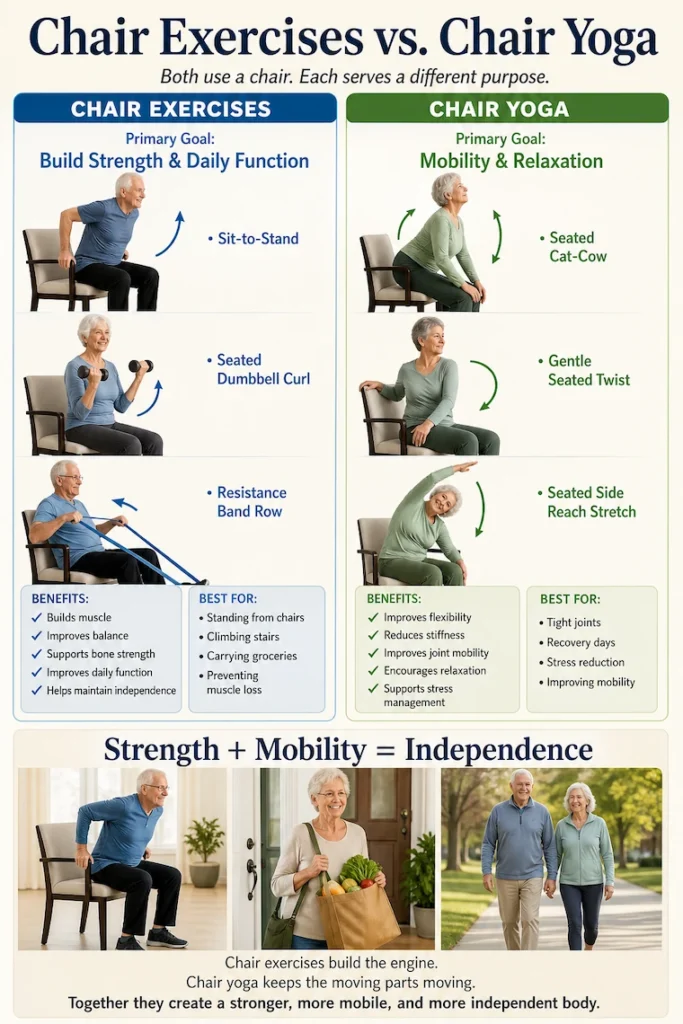
Chair Exercises: Built for Strength & Function
Chair exercises are structured around sets, reps, and targeted muscle groups. The goal is progressive overload: gradually increasing the challenge so your muscles and nervous system are stressed enough to adapt, rebuild, and get stronger over time.73
Movements like sit-to-stands, seated knee extensions, and resistance band rows are examples of resistance exercises that help counter age-related muscle loss (sarcopenia) by improving strength and physical function in older adults.74
These exercises build the lower‑body and upper‑body strength that supports everyday tasks like getting off the toilet or out of a chair, carrying groceries, climbing stairs, and staying independent in daily life.
Cardiovascular conditioning fits here, too. Seated marching, arm swings, and chair aerobics raise your heart rate and improve circulation in a low-impact format.
Chair Yoga: Built for Mobility & Calm
Chair yoga is adapted from traditional yoga practice, with poses performed seated or using the chair for support. The emphasis is not on muscle fatigue. It’s on fluid movement, breath control, and deep stretching.
Poses like seated cat-cow or seated forward bends lengthen tight muscles and increase joint range of motion without any jarring load.
Breathing is central: Coordinating your breaths with slow, controlled movement—and especially taking slow, deeper breaths with relaxed, longer exhales—can activate the parasympathetic ‘rest and digest’ system, which helps lower blood pressure and promote a sense of relaxation.75
Chair yoga may provide additional mindfulness and relaxation benefits beyond usual strength training. Chair yoga has been shown to reduce anxiety and depressive symptoms and to promote relaxation and a calmer, less ‘noisy’ mind in older adults.76
One of my clients described her chair yoga sessions as “the only 20 minutes of the day my brain actually shuts up.” She kept both in her weekly routine.
Which One Do You Need? Both, if you enjoy them.
Choose chair exercises if your primary goal is rebuilding muscle, regaining functional strength, or retaining the physical capacity for daily independence. Structured resistance work is the most direct path to those outcomes.
Choose chair yoga if stiffness, stress, or tight joints are your main issues. It’s also a strong option on recovery days, on arthritis flare-up days, or any time your body needs movement without load.
Used together, they complement each other directly. Strength training builds the engine. Chair yoga keeps the moving parts supple, the joints mobile, and the mind settled enough to show up consistently.
The Bottom Line: Pick the one that fits today’s goal, and use the other one as the counterbalance.
Best Equipment for Chair Exercises (Spoiler: You Probably Already Have Everything You Need)
You don’t need a home gym. You don’t need a membership, a machine, or a single piece of equipment to start building real strength from a chair.
No Equipment Needed
Your body weight is enough to begin. It builds functional strength, lubricates joints, and improves posture without spending a dollar. Most effective beginner routines require nothing beyond a sturdy chair and a few feet of clear floor space.
Start there. Add equipment only when bodyweight movements stop feeling challenging.
Optional Equipment (Add These As You Progress)
Light dumbbells. A set of 1 to 5-pound dumbbells works well for bicep curls, shoulder presses, and seated rows. Water bottles or soup cans do the same job if you’re not ready to buy anything yet.
Resistance bands. Bands can increase muscular tension throughout portions of the movement. They’re also joint-friendly, inexpensive, and easy to store.
Small Pilates ball or pillow. Squeeze a soft ball between your knees during core or inner-thigh exercises to add muscle activation without any external load. Place it behind your lower back to support spinal alignment if your chair lacks lumbar support.
Ankle weights. These straps are directly attached to your legs, so your hands stay free as you add resistance to knee lifts and leg extensions. One of my clients with arthritic hands couldn’t grip dumbbells comfortably, so we switched her lower-body work entirely to ankle weights. Problem solved.
Non-slip shoes. Your feet press into the floor throughout every seated exercise to stabilize your body. Supportive shoes with good grip can improve stability during seated exercise transitions.
Timer. A phone timer or basic stopwatch is useful for managing isometric holds, exercise intervals, and rest periods. Guessing at times leads to inconsistent sessions.
Printable tracker. Logging your sets, reps, and how the session felt keeps you honest about progression. It also shows you how far you’ve come, which matters more than most people expect as motivation dips.
What to Avoid
Heavy weights too soon. Using more resistance than you can control may increase joint stress and compromise movement quality. Start light, progress gradually, and earn the right to add load.
Unstable chairs. Wheeled chairs, soft recliners, and wobbly dining chairs shift under you mid-movement. A chair that moves when you don’t intend it to turns every exercise into a fall risk.
Slippery socks. Socks on hardwood or tile floors are a slip hazard during chair transitions. Wear athletic shoes or, if your surface is safe, exercise barefoot for better grip.
Aggressive trunk twisting. Quick, uncontrolled twisting may increase stress on the lower spine and spinal structures. Always rotate smoothly and within a comfortable, pain-free range.
Frequently Asked Questions About Chair Exercises for Seniors
Does the chair workout for seniors really work?
Chair workouts absolutely work for seniors, delivering real, measurable results. Studies show seniors can build muscle, improve balance, and reduce fall risk at any age. Even 10–30 minutes daily strengthens joints, boosts circulation, and builds functional fitness. This makes everyday tasks like climbing stairs or rising from a chair noticeably easier.
Can you lose belly fat doing chair exercises?
Chair exercises can help you lose belly fat, but spot-reduction is a myth… you can’t target belly fat directly. Seated strength training builds muscle, raising your metabolism, while cardio moves like seated marches burn calories. Pair consistent chair workouts with a protein-rich, low-sugar diet to see real belly fat results within 8–12 weeks.
Are there any free chair exercises for seniors?
Yes, most chair exercises are completely free and require zero equipment. Effective bodyweight moves include sit-to-stands, seated marches, knee extensions, and heel raises. For added resistance, use water bottles or soup cans.
What is the best chair exercise for seniors?
The sit-to-stand is the single best chair exercise for seniors. It builds strength in your quads, hamstrings, and glutes while directly mimicking real-life movements like rising from a toilet or car seat. Start with 2–3 sets of 10–15 reps, and it measurably improves balance, functional mobility, and fall prevention.
Is 30 minutes of chair exercise a day enough?
Yes, 30 minutes of chair exercise daily is enough to meet CDC guidelines of 150 minutes of moderate activity per week. It reduces heart disease risk, builds muscle, and boosts mood through endorphin release. Can’t do 30 minutes straight? Split it into three 10-minute sessions—research shows identical health benefits either way.
Can chair exercises help with balance?
Yes, chair exercises significantly improve balance by building the leg, hip, and core strength that keeps you steady on your feet. Use the chair as a safety prop for standing moves like single-leg holds and heel raises, applying progressive overload over 4–6 weeks. Stronger muscles and better core stability directly reduce fall risk.
Should seniors do chair exercises every day?
Seniors can do chair exercises daily, but the type matters. Stretching, light cardio, and balance work are safe every day. Strength training needs 48–72 hours of recovery between sessions, so limit resistance work to 2–3 non-consecutive days per week. Daily movement of any kind helps hit the CDC’s 150-minute weekly activity goal.
Are chair exercises good for arthritis?
Chair exercises are excellent for arthritis. Inactivity actually worsens joint pain by weakening surrounding muscles. Seated moves build the muscle “shock absorbers” that protect joints, while gentle movement circulates synovial fluid to reduce stiffness. Focus on isometric holds, resistance bands, and range-of-motion stretches. If pain lasts more than 2 hours post-workout, reduce intensity.
