
If your lower back has been flaring up lately… then you’re not the only one.
Lower back pain is one of the most common complaints I hear. It’s estimated that up to 80% of people experience lower back pain in their lifetime.1
And it’s also one of the most frustrating. Because it doesn’t just hurt… but it also makes you hesitant.
You question every movement: Is this going to make it worse? Now this is a valid fear. And it’s exactly why I put this list together.
These lower back exercises are specifically chosen for safety, low risk, and beginner-friendliness. No aggressive stretching. No positions that crank your spine into places it doesn’t want to go. Just movements that are actually going to help.
Here’s what most people do instead: they Google a few generic stretches, try them for a couple of days, and when the pain keeps coming back (or gets worse), they give up. Then they jump into “core strengthening” exercises that sound helpful but end up aggravating their lower back.
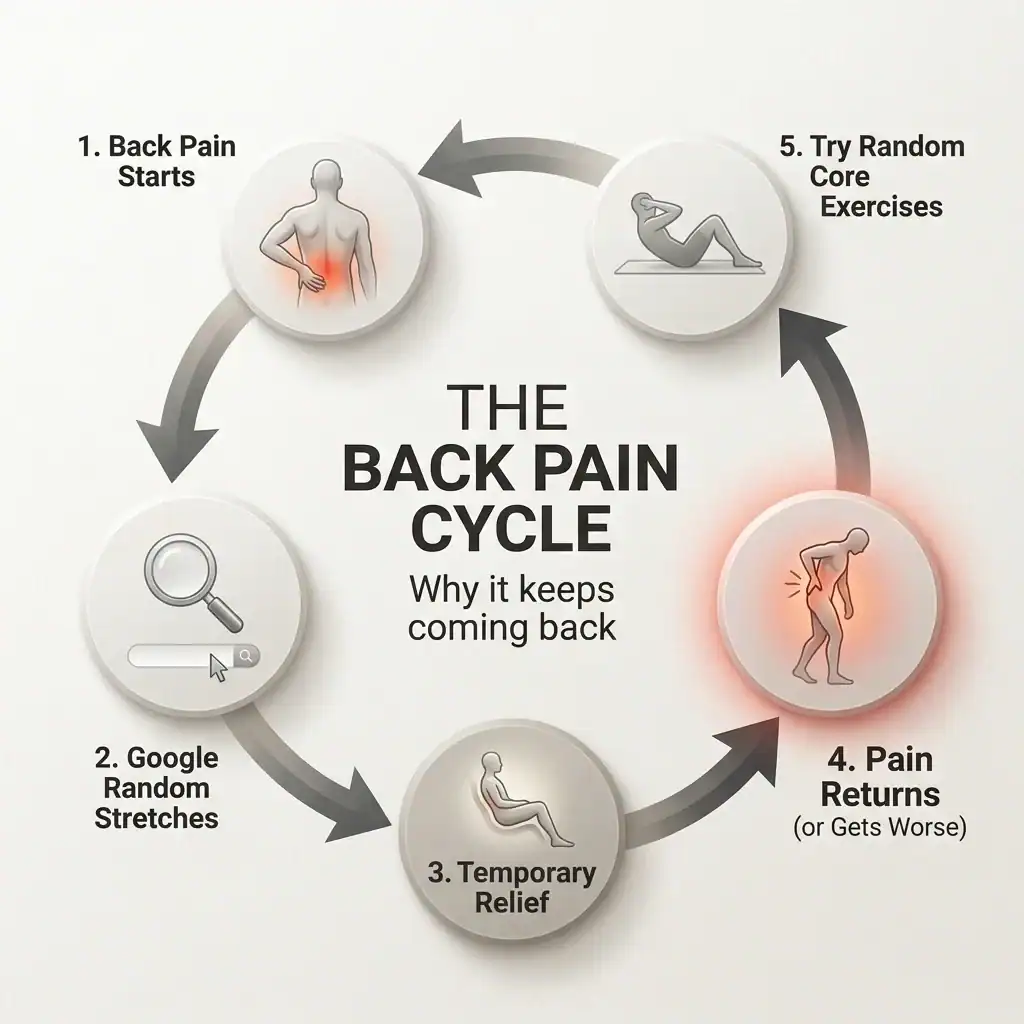
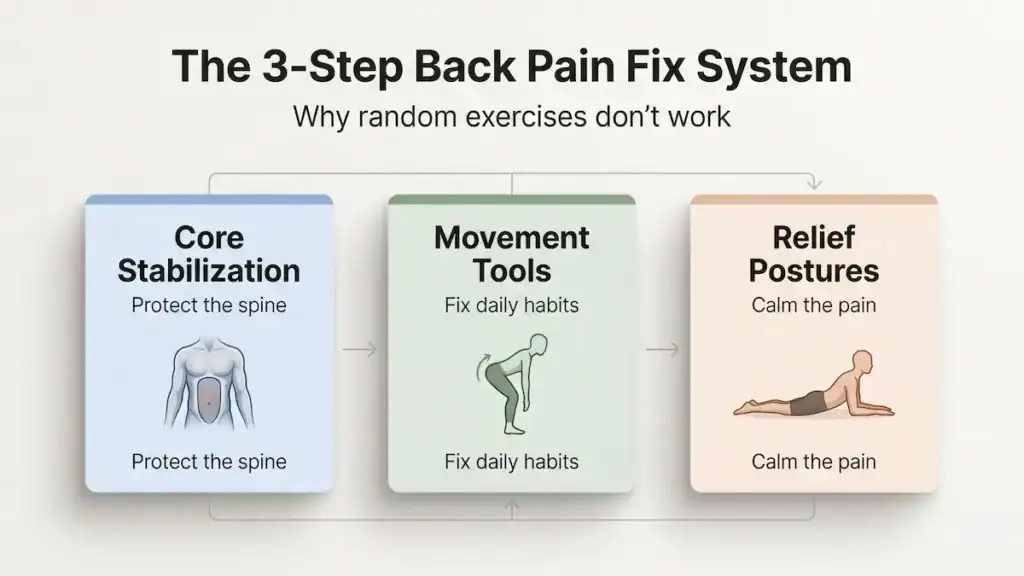
But these exercises are different. They’re a part of a system. Designed to calm the pain first, activate the muscles that support your spine, and gradually rebuild the strength that keeps your back protected long-term.2
When done consistently, you’ll feel looser, more stable, and you’ll start putting less strain on your lower back just going about your day. Some of these can bring noticeable relief almost immediately.3
And I’ll show you the one mistake most people make that keeps their back pain coming back. Now let’s start with the safest and most effective exercises…
Quick Start: 7 Exercises for Lower Back Pain Relief
Key Takeaways:
- The Big 3 (modified curl-up, side bridge, bird-dog) build the core stiffness needed to stop painful joint micro-movements without loading the spine through dangerous flexion.4
- Spine hygiene tools like the hip hinge, lunge, and stop-twist replace the flawed daily movement habits that keep re-triggering pain between exercise sessions.
- Motor control drills like clamshells and glute bridges reverse gluteal amnesia by retraining the brain to fire the glutes correctly, so the hips (not the lower back) absorb the workload during everyday movement.
I learned these ten movements from the clinical methodology of world-renowned back pain expert Dr. Stuart McGill. This is from the same framework used to rehabilitate elite athletes, military personnel, and chronic pain patients who had failed every other treatment first.
McGill’s book “Back Mechanic” is for the lay public and uses common, everyday language. It gives you the truths you need to construct an effective strategy without overwhelming you with medical jargon. Much of this info is synthesized into this article.
They fall into three categories: stabilization exercises, movement tools for daily life, and relief postures. You’ll need all three.
The Big 3: Core Stabilization Exercises
Modified Curl-Up
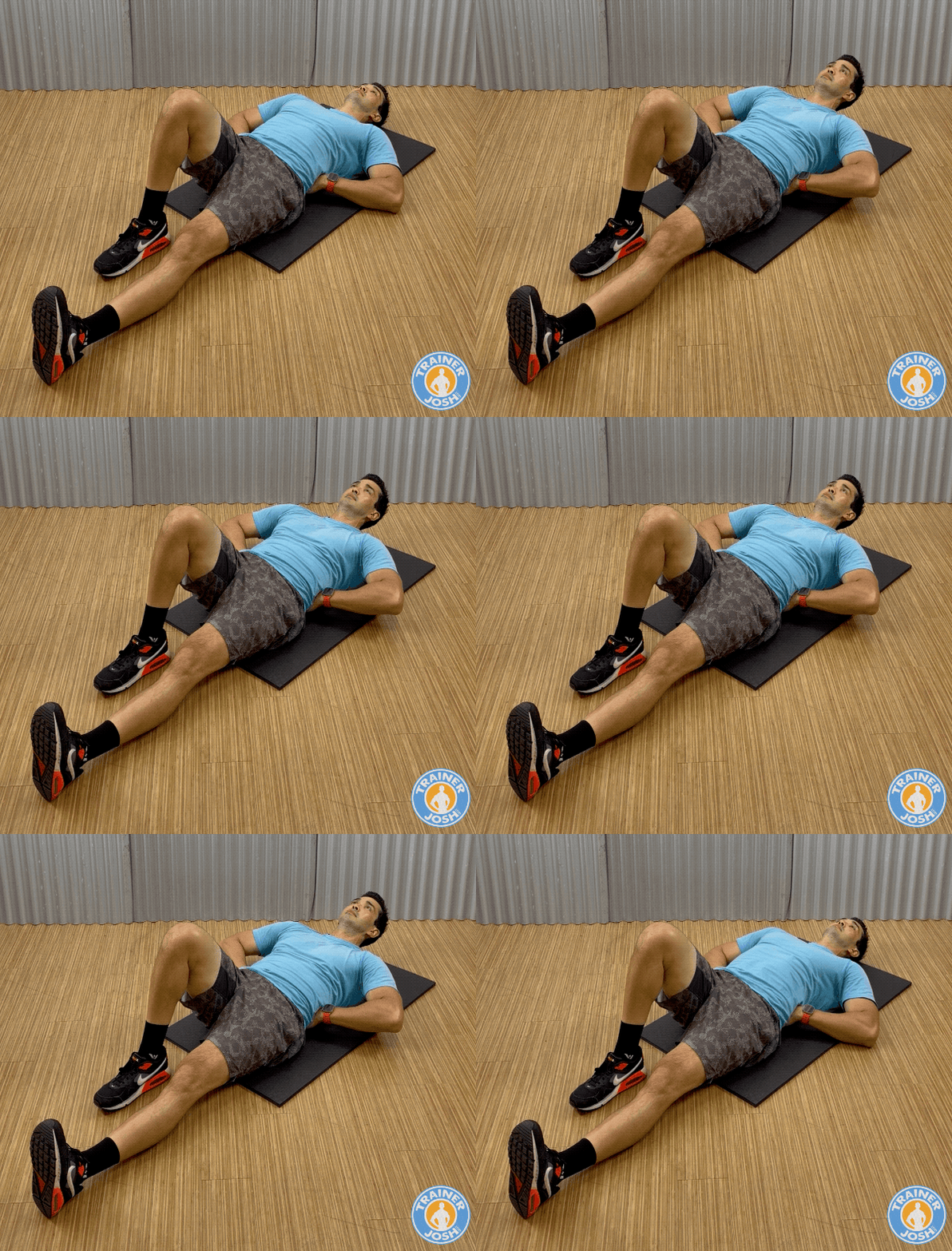
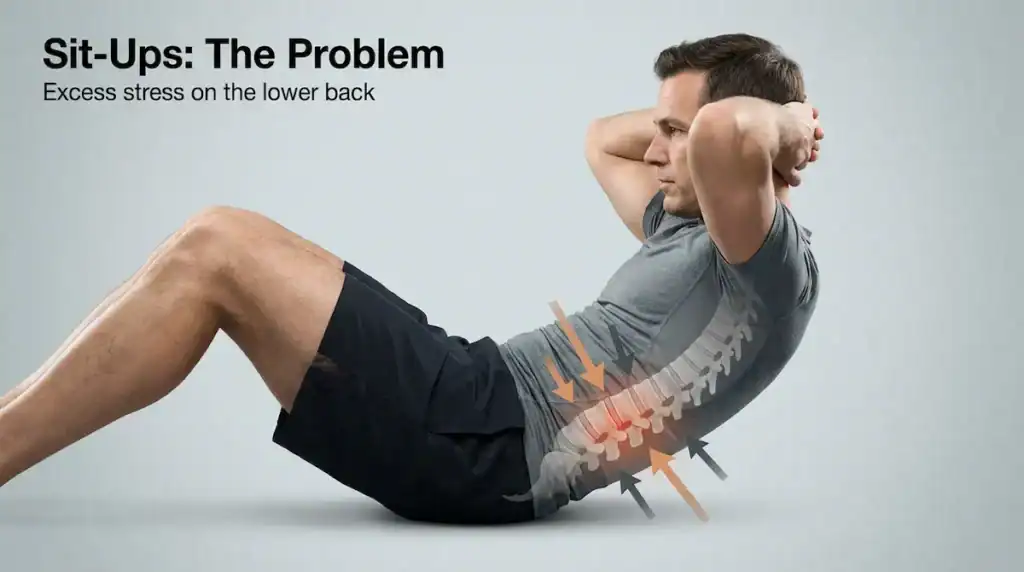
The modified curl-up is a foundational exercise that builds muscular endurance. It’s also going to challenge the rectus abdominis (the front of the abdominal wall) while keeping psoas and oblique activity low. This is what spares the lower back from high compressive loads compared to traditional sit-ups.5
Why this Works: This exercise safely builds the core stiffness and endurance needed to prevent painful joint micro-movements. It can help improve core stability so the back is better protected throughout the day by completely eliminating lumbar spine motion while locking the neck.
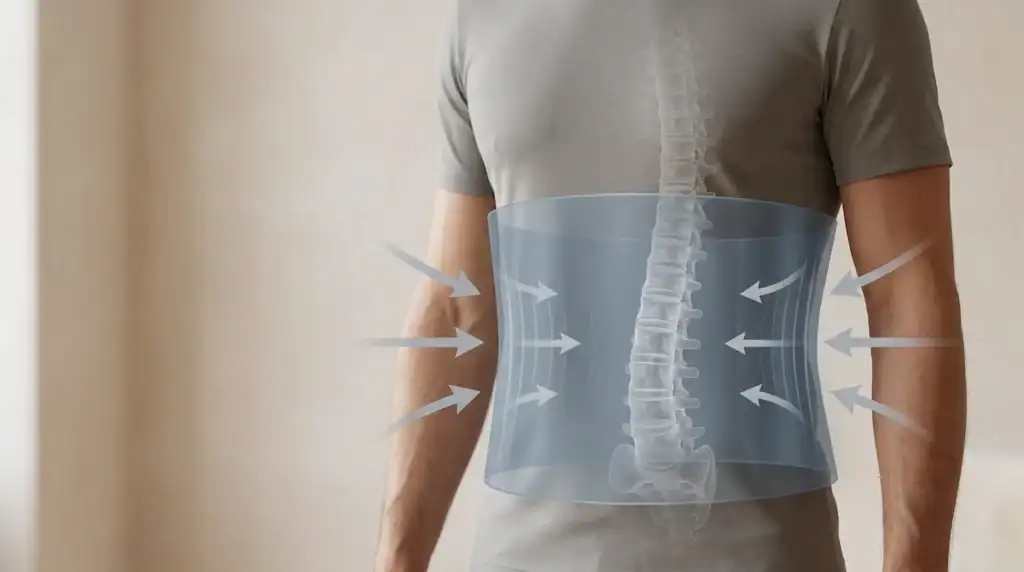
It also transforms your abdominal wall into a rigid shield, teaching you to maintain productive spinal stability while breathing deeply and efficiently through your diaphragm.
Consider the AIREX Corona Premium Exercise Mat when doing these exercises for lower back pain. It’s commonly used in physical therapy and rehabilitation clinics. It has thick cushioning (5/8″ thick), firm yet comfortable, and non-slip surface.
How to Properly Perform the Modified Curl-Up:
- Set your starting position: Lie face-up on the floor, bend one knee to about 90 degrees with the foot flat on the floor. Keep your other leg straight and relaxed (this prevents your lower back from flattening). Place your hands, palms down, underneath your lower back to support and preserve your natural, pain-free lumbar curve.
- Brace & float the elbows: Mildly stiffen your abdominal muscles (an abdominal brace) just enough to prevent motion, and elevate your elbows slightly off the floor so they “float” at your sides.
- The Curl-Up: Treat your head and neck as a rigid, immovable block. Slightly lift your head and shoulders just a short distance off the floor. All rotation should be focused entirely on your mid-thoracic region (near the sternum/bra line). You should NOT feel any motion in your lower back or your neck.
- Hold & breathe: Hold this slightly elevated position for 8 to 10 seconds while taking deep breaths. Make sure that your abdominal brace remains completely locked in place. During this hold, you should feel your abdominal wall working to maintain a constant stiff shield.
- Lower & repeat: Slowly lower your head and shoulders back to the starting position under control, relax the core, and repeat using the Russian descending pyramid scheme (e.g., 6 reps, then 4 reps, then 2 reps) to build endurance without fatiguing the muscles to failure.
Pro Trainer Tips to Maximize Results
- The “Bathroom Scale” Cue: To ensure you are not lifting too high, imagine your head and shoulders are resting on a bathroom scale. When you perform the curl-up, simply lift just enough to make the scale read zero.
- Eliminate Neck Pain: If you experience neck discomfort, lightly touch your teeth together, push your tongue hard against the roof of your mouth behind your front teeth, and slightly grimace downward with the corners of your mouth. This strongly activates the deep neck flexors (digastrics) to support the head and safely alleviate neck strain.
- Advanced “Fascial Raking”: For advanced athletes seeking maximum abdominal activation, a partner (or yourself) can dig their fingers laterally into your oblique muscles (not the rectus) and “rake” or squeeze the tissue. This intense physical cue prompts the brain to instantly and powerfully contract the entire abdominal wall right before you curl up.
Common Mistakes to Avoid
- Flattening the Lower Back: Never flatten your lumbar spine into the floor (like a pelvic tilt). Doing so takes the spine out of elastic equilibrium and massively increases stress on your passive tissues. Always use your hands and the straight leg to preserve the curve.
- Bending the Neck: Do not poke your chin forward or tuck it to your chest; your neck and head must remain completely rigid and move as a single block on top of your thoracic spine.
- Lifting Too High: This is not a traditional crunch or a sit-up. Raising your head and shoulders too far off the floor places unnecessary bending load on the spine and defeats the pain-sparing purpose of the exercise.
- Prying With the Elbows: Leaving your elbows on the ground lets you cheat by pushing off the floor to artificially lift your upper body.
- Placing Hands Behind the Head: Never interlace your fingers behind your neck, as this encourages harmful pulling on the cervical spine.
Here’s something most people overlook…
You can do all the “core exercises” you want but if your body doesn’t have enough protein to rebuild and strengthen those muscles then your progress stalls fast.
Rebuilding a stronger core takes more than exercise alone. The BioTRUST GLP-1 Companion Stack combines targeted protein and nutritional support to help preserve lean muscle while you improve strength, especially if appetite changes or weight loss make it harder to meet your daily protein needs.
A 3-part daily stack designed to support people using GLP-1 medications or losing weight naturally. It combines muscle, protein, collagen, and appetite support to help you maintain a healthier body composition as you lose weight.
- Natural GLP-1 Support: Helps support healthy appetite signals, fullness & metabolic function
- Lean Muscle Support: Helps preserve muscle, strength & healthy body composition during weight loss
- High-Protein Collagen: Adds 20 g of protein with 5 collagen types to help support daily protein intake
- Skin, Joint & Hair Support: Provides collagen peptides to support skin elasticity, joints, hair & nails
- 3-Part Weight-Loss Support: Combines muscle, protein/collagen & appetite support in one simple daily stack

Side Plank
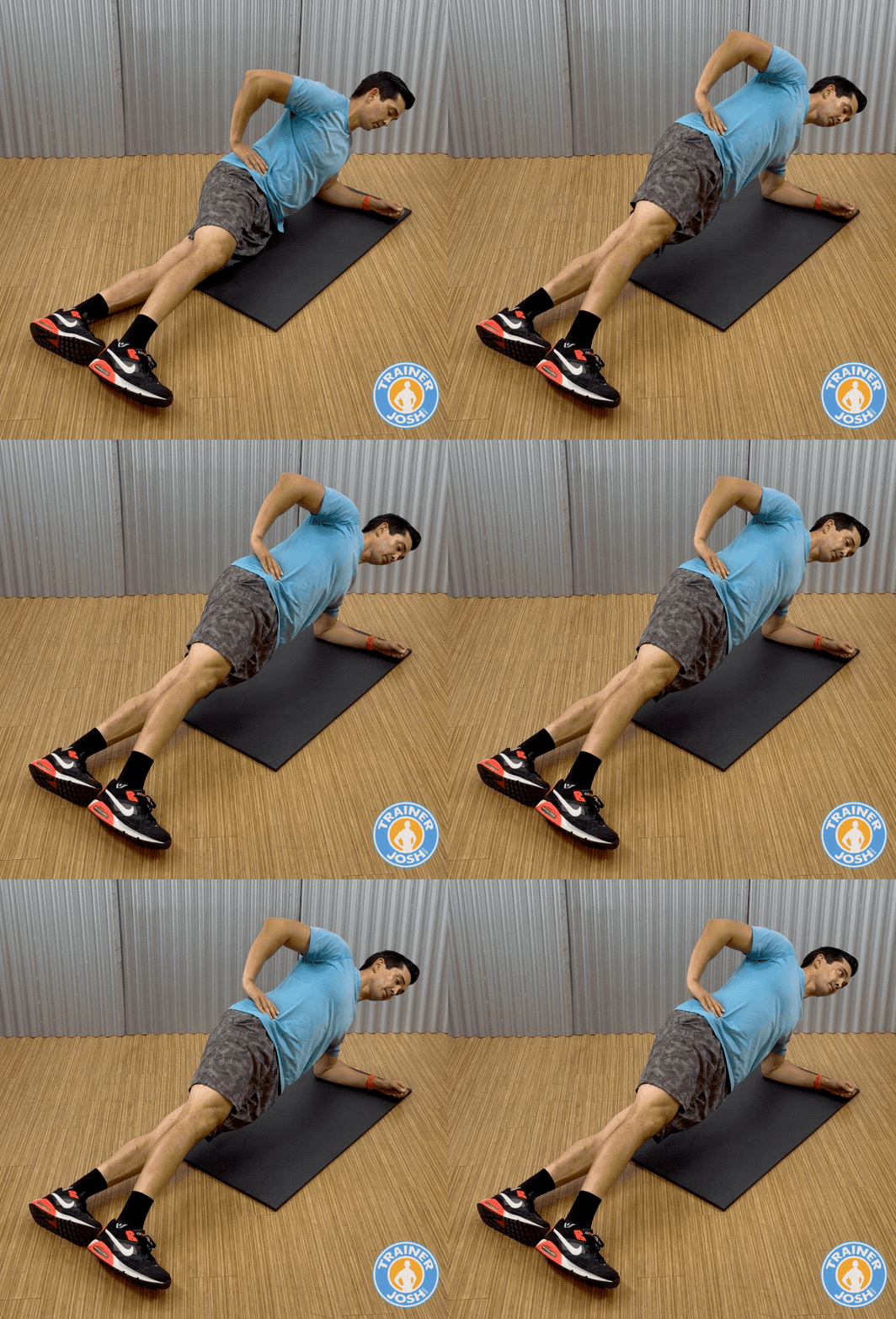
Why this Works: The side plank (or side bridge) is one of the essential spine-sparing exercises that really challenge the lateral core muscles.6 This includes the lateral spine stabilizers: quadratus lumborum, transverse abdominis, and the obliques. All while keeping the compressive loads on the lower back to an absolute minimum.
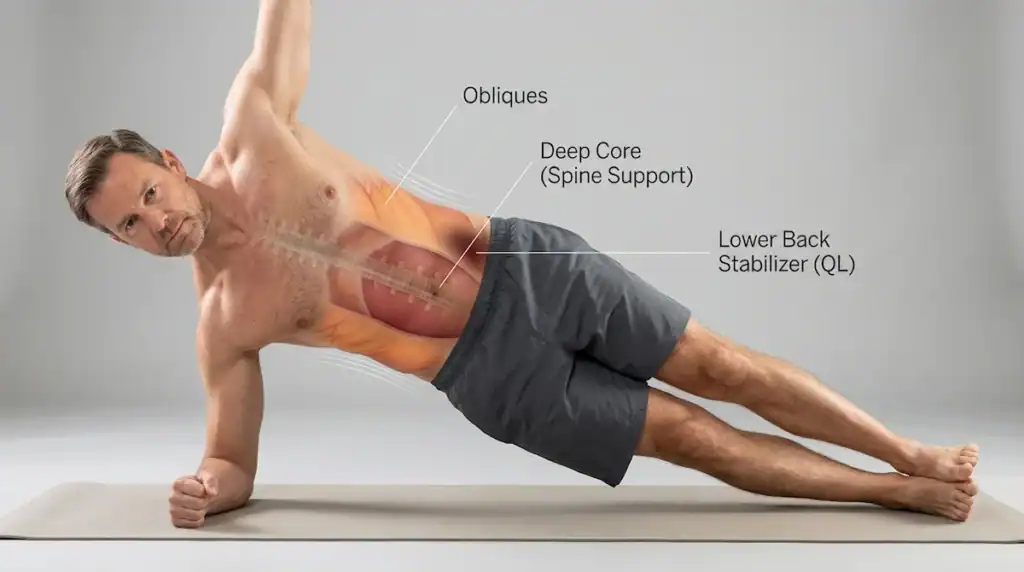
It imposes only half the compressive load on the spine compared to other traditional abdominal exercises since it forces one side of the torso musculature to work.7
This exercise also integrates the latissumus dorsi, which helps to build muscular endurance and protective “guy-wire” stiffness that’s needed to eliminate painful joint micro-movements, stabilize the pelvis, and enhance athletic performance.8
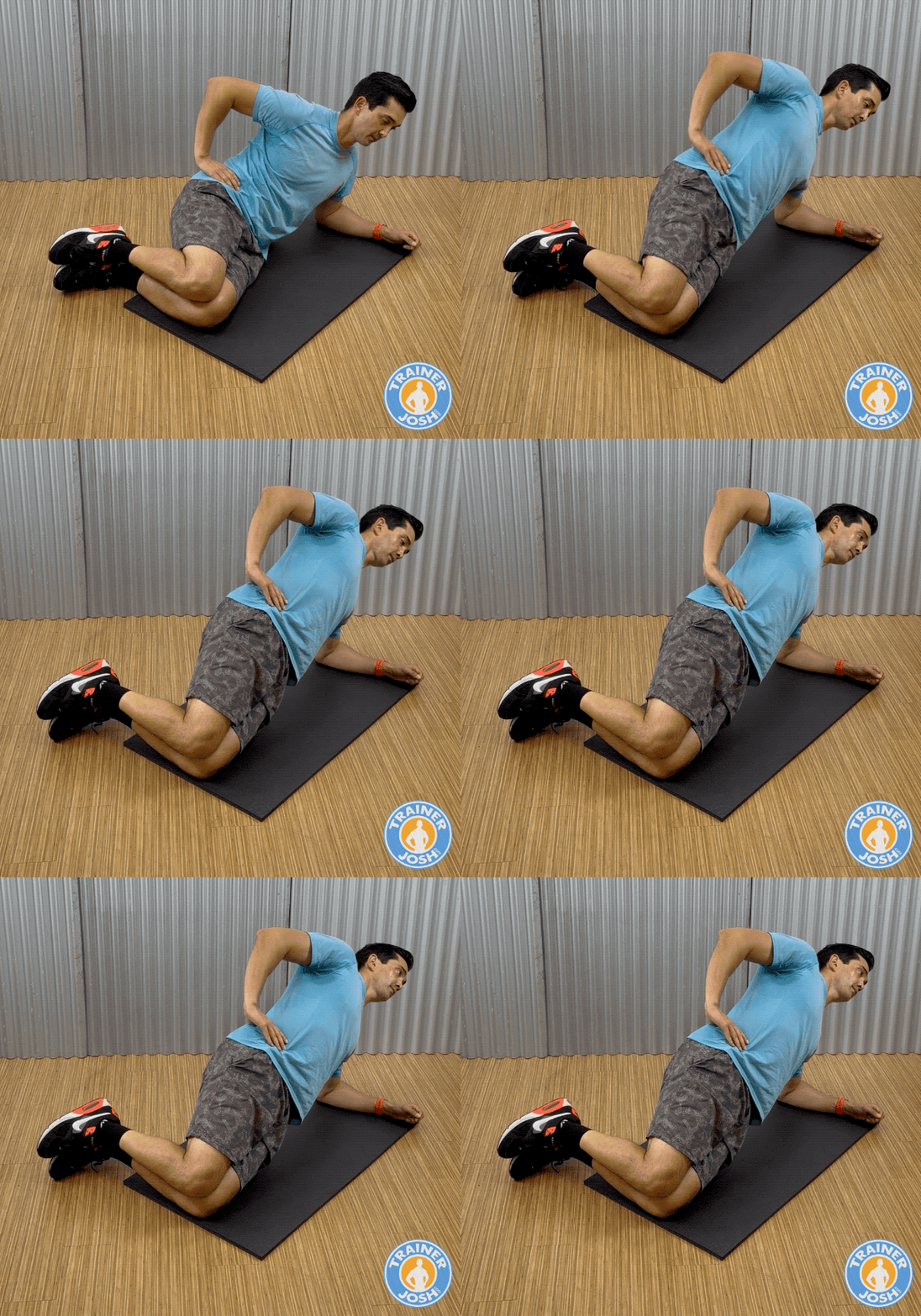
You may want to use an cushioned pad for your elbow when doing side planks. Elbow discomfort when doing this exercise is common and can be a real pain point. With my clients, I use the Airex Balance Pad for elbow cushioning for this exercise as well as many other exercises.
How to Properly Perform the Side Plank:
- Set your starting position: Lie on your side supported by your elbow and hip, with your knees either bent to 90 degrees (for beginners) or legs straight with the top foot placed flat on the floor in front of the bottom foot (intermediate).
- Brace your core: Mildly stiffen your abdominal wall and adjust your pelvis to ensure your spine is perfectly aligned in a neutral, pain-free posture.
- Secure your shoulder: Take your free hand, spread the fingers wide to cap the opposite shoulder (deltoid), and pull that elbow down firmly across your chest to stabilize the supporting shoulder.
- Hinge into the bridge: Do not simply lift your hips sideways. Instead, push your hips forward in a squatting or hip-hinge motion to extend the hips and straighten the torso.
- Hold and breathe: Support your body in a straight line on your elbow and knees (or feet), holding the position for 10 seconds while breathing normally. During this hold, you should feel the muscles on the side of your torso closest to the floor working intensely. You should NOT feel any lateral bending or twisting in your spine, nor should you feel pain in your supporting shoulder.
- Hinge back down: To lower yourself, simply hinge your hips backward to return to the starting position on the floor. Be sure your spine does not bend or slouch as you land.
Pro Trainer Tips to Maximize Results
- Use the “Russian Descending Pyramid”: To safely build endurance without fatiguing to the point of breaking form, limit your holds to exactly 10 seconds. Structure your sets by performing, for example, 5 repetitions per side, resting, then 4 reps, resting, then 3 reps.
- Breathe Behind the Shield: Master the ability to maintain a rigid abdominal brace while taking deep diaphragmatic breaths. This makes sure your spinal stability is never compromised by the rise and fall of your breathing cycle.
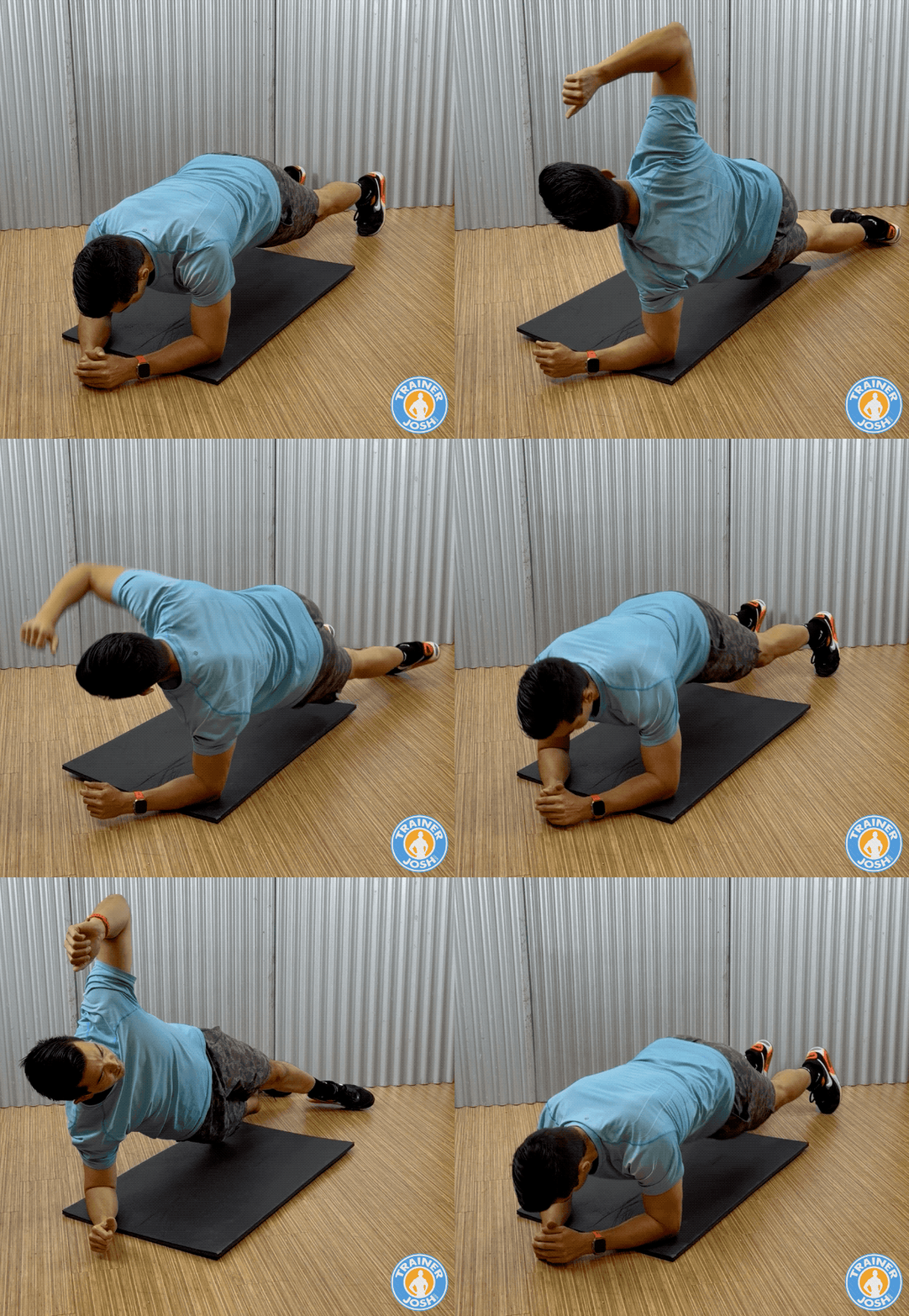
- Progress with the “Roll”: To increase the challenge, transition from a right-side plank, into a front plank supported on both elbows, and then into a left-side plank. Crucially, you must lock your ribcage to your pelvis so they move as a single block, avoiding any twisting in the spine as you pivot on your feet.
Common Mistakes to Avoid
- Stacking the Feet: A common error popularized in fitness media is stacking the feet on top of one another. Always place the top foot on the floor in front of the bottom foot. This improves balance, reduces back stress, and allows for safe rolling progressions.
- Lifting Laterally (Side-Bending): Do not initiate the bridge by bending your spine sideways to lift your hips off the floor since this actively triggers pain. Always use hip extension (a hip-hinge) to push forward into the bridged position.
- Slumping or Losing Neutral Spine: Never allow your body to slump into a laterally deviated, bent posture while resting on the floor or during the bridge. You must proactively align your spine in a neutral position before initiating the movement.
Bird Dog
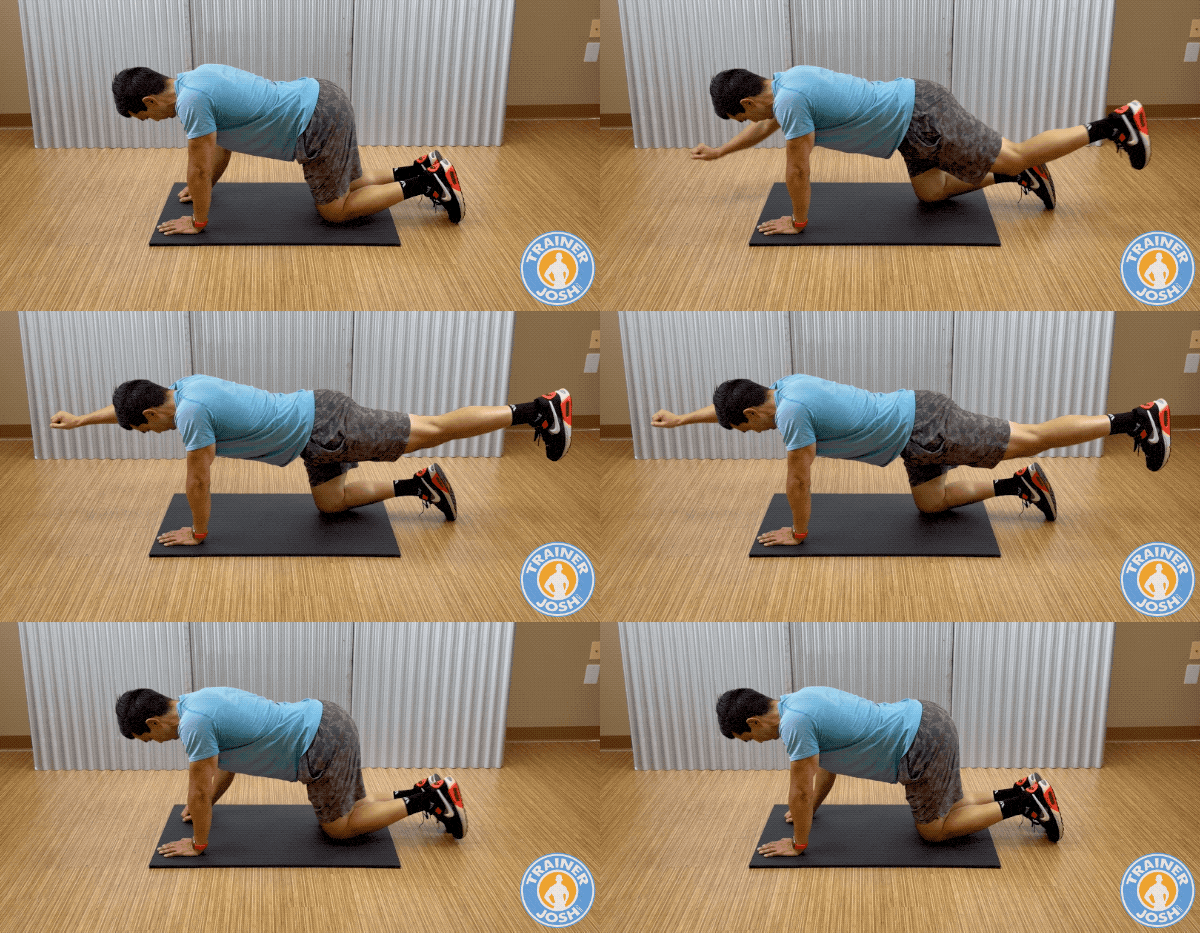
The bird dog is a foundational core stabilization exercise that trains your back and hip extensors. It also spares them from high, damaging compressive loads.9
Why it Works: It creates a protective stiffness in the core by requiring your opposite arm and leg to extend simultaneously. It teaches your brain to dissociate the movement of your ball and socket joints (hip and shoulders) from your spine.10
It does a great job of challenging your lumbar and thoracic portions of major back muscles (longissimus, iliocostalis, and multifidus), making it a major contributor to desensitizing and preventing back pain.11
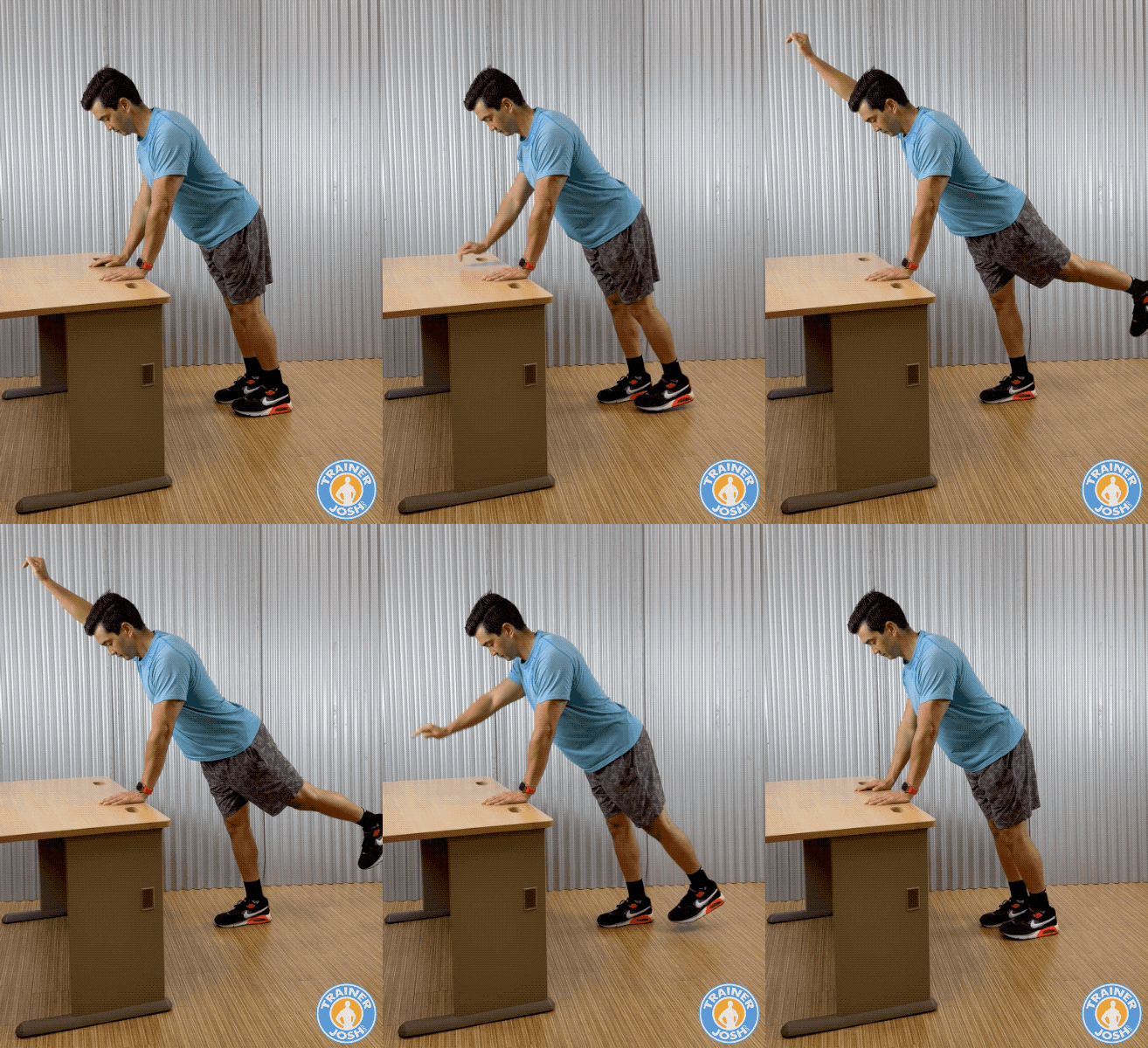
You may want to use the AIREX balance pad on your knees when doing this exercise. Having your knees on the floor can be a friction point.
How to Properly Perform the Bird Dog:
- Set your starting posture: Get down on all fours, ensuring your hands are placed directly beneath your shoulders and your knees are directly beneath your hips.
- Find the “sweet spot”: Subtly flex and extend your back to find a neutral, pain-free spine posture, and mildly stiffen your abdominal muscles to lock this torso position in place. You should NOT feel any bending, sagging, or twisting in your lower back.
- Extend your limbs: Simultaneously raise your opposite arm and leg straight out. Important!—Do not raise your arm higher than your shoulder or your leg past the height of your hips.
- Hold the position: Hold the extended limbs parallel to the floor for a brief isometric hold of about 6 to 10 seconds. During this hold, you should feel strong muscle activation in your glutes, hamstrings, and the opposite sides of your upper and lower back.
- Return and repeat: Lower your hand and knee back down under control, and repeat the reps using a descending pyramid scheme (e.g., 6 reps, then 4 reps, then 2 reps) to build endurance without breaking form.
Pro Trainer Tips to Maximize Results
- Push the Heel & Clench the Fist: Instead of simply lifting the leg, focus on actively pushing your heel away from you with a flexed foot, and clench your upraised hand into a tight fist. This dramatically enhances the muscle contraction in your glutes, hamstrings, and upper back while preventing you from lifting the leg too high.
- Sweep the Floor: Between your 10-second holds (rather than resting your hand and knee on the ground) “sweep” them just above the floor, taking no weight, then extend them right back out. This technique aids muscle reoxygenation while continuously challenging the core.
- Draw Squares: For advanced athletic training, trace small squares in the air with your extended fist and foot (drawing them out away from the midline, down, across, and back up). This powerfully challenges the various neuromuscular compartments of the back.
Common Mistakes to Avoid
- Hip Hiking & Twisting: Lifting the leg too high can cause the pelvis to hike up on one side, which actively twists the spine. This defeats the spine-sparing purpose of the exercise and can trigger pain.
- Spinal movement: Allowing the lower back to sag, arch, or flex during the limb extension. You must rigidly lock the core so that absolutely all motion occurs exclusively at the shoulder and hip joints.
Mobility & Therapeutic Movement
Cat-Camel
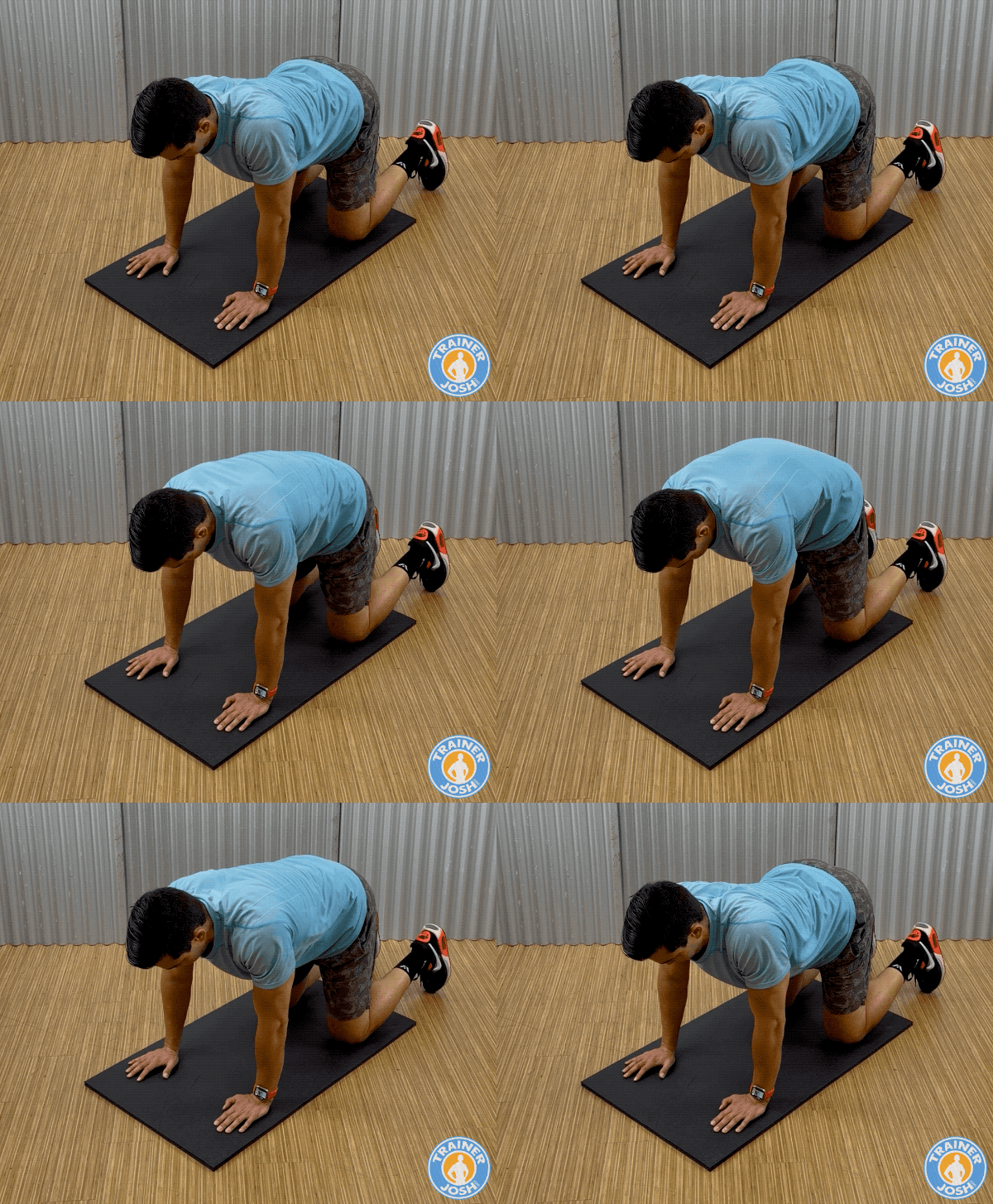
The cat-camel is a highly spine-sparing, gentle motion exercise designed to safely lubricate the spinal joints. Think of it as a “spine greaser” that reduces internal friction (viscosity) without imposing shear or compressive stresses on the discs.
Because it is performed on your hands and knees, it creates a horizontal “three-point bend” that places minimal compressive load on the spine. It maximizes mobility in the cervical, thoracic, and lumbar segments of the spine while removing gravity-induced stress on the spinal discs and facet joints.
This makes it an ideal way to gently establish pain-free movement or serve as a warm-up to prepare the back for other activities. All without trigger the pain sensitization caused by traditional end-range stretching.12
How to Properly Perform the Cat-Camel:
- Set Up on All Fours: Get into a hands-and-knees position. Make sure your hands are directly beneath your shoulders, and your knees are directly beneath your hips.
- The Camel: Gently and smoothly hump your entire spine upward toward the ceiling (like a camel) while letting your head look down. You should NOT feel any pain or intense pulling at the extremes of the movement.
- The Cat: Reverse the motion by smoothly curving your spine downward toward the floor (like a cat) while gently lifting your head to look upward.
- Cycle the motion: Continuously flow back and forth between the cat and camel positions, ensuring each complete cycle takes about three to four seconds.
- Stop early: Perform a total of only 5 to 8 cycles. You should feel a reduction in stiffness and resistance, but you should NOT feel like you are actively pushing into a deep stretch at either end of the movement.
Pro Trainer Tips to Maximize Results
- It Is a Motion Exercise, Not a Stretch: The therapeutic value is in the motion itself, not the endpoints. You must not aggressively push into the extreme end-ranges of flexion or extension. It is often helpful to slightly reduce your range of motion so you never feel you are hitting the absolute limit of your joints.
- Use It to Prime the Body: Perform this exercise first as part of a warm-up routine. Once the viscous friction of the spine has been reduced through these few cycles, your subsequent motions and exercises can be accomplished with far less stress on the tissues.
- Involve the Whole System: Do not just focus on wiggling the middle of the back. Make sure the motion is fully coordinated across the entire spine (cervical, thoracic, and lumbar) while allowing the hips to help drive the movement.
Common Mistakes to Avoid
- Treating It as a Stretch: This is the most common mistake. The cat-camel is a motion exercise, so you must never push into the deep end-ranges of motion or force a stretch at the top or bottom of the movement.
- Doing Too Many Repetitions: Performing 15 to 20 cycles provides no additional benefit, does not further reduce joint friction, and may actively irritate sensitized tissues.
- Moving Only the Spine: Failing to use your hips to assist the motion is a movement flaw. You must make sure your pelvis and hips are actively engaged to avoid putting all the stress on your lower back.
Lunge Psoas Stretch
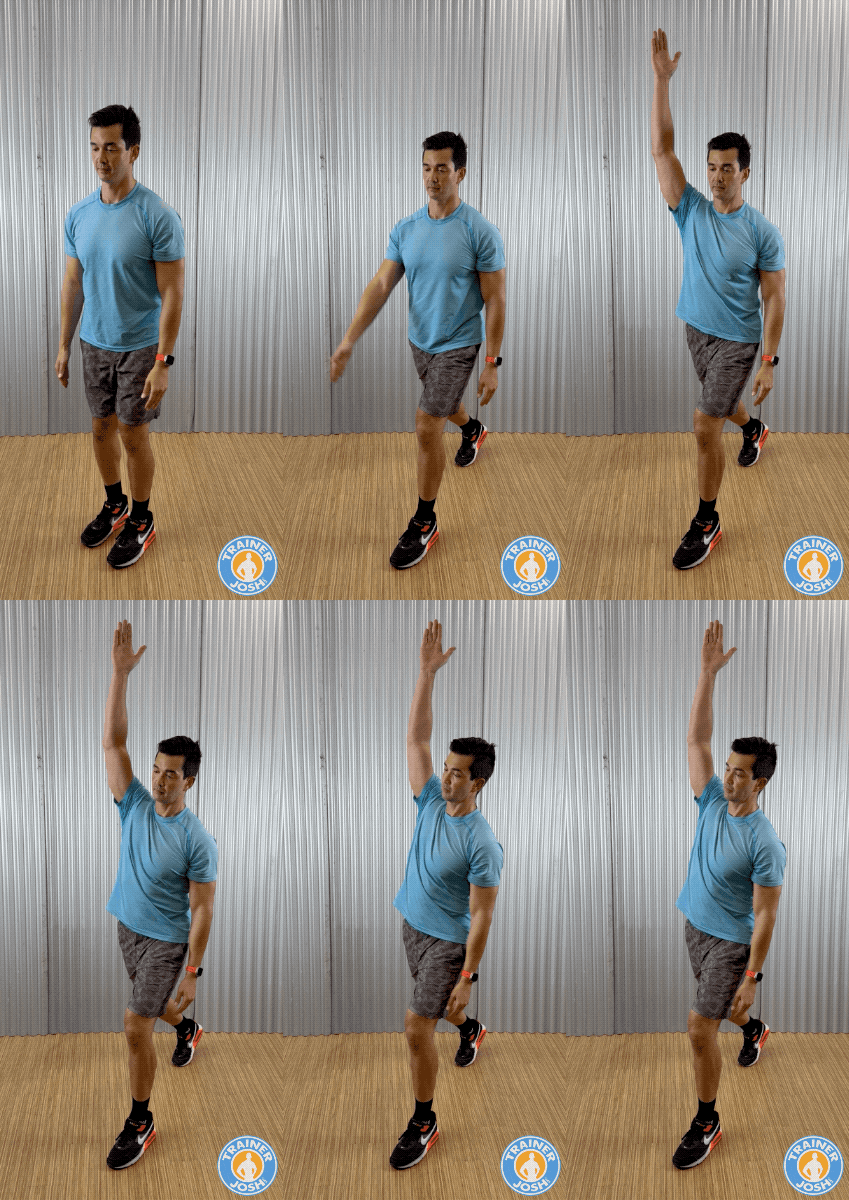
The psoas muscle can become neurologically facilitated or chronically tight, resulting in back and hip pain. The psoas is a multi-articular muscle that attaches to every lumbar vertebra and travels up to the bottom of the ribcage (psoas originates from T12-L5 and inserts on the lesser trochanter).
This specific active flexibility is essential because back and hip pain often causes the psoas to become neurologically facilitated and chronically tight. The lunge psoas stretch releases neurogenic tension and restores essential hip mobility by moving the spine to target these high-attachment points.13
Athletes (especially sprinters) can lengthen the hip flexors by releasing the psoas. This allows greater power production through the hip extensors’ range of motion.
How to Properly Perform the Lunge Psoas Stretch:
- Assume the lunge position: Get into a kneeling lunge posture with an upright torso, resting on one knee.
- Palpate the tendon: Place your fingers on the high quadricep (rectus femoris) just below the inguinal crease. Slide them inward (medially) into the iliopectineal notch to locate the psoas tendon. At this point, you should NOT feel tension in the tendon.
- Raise the arm: Reach the arm on the same side as your extended (kneeling) hip straight overhead. Actively push your hand toward the ceiling to glide your ribcage upward.
- Bend laterally: Bend your torso slightly away from the extended, kneeling hip.
- Twist and extend: Drop the raised shoulder slightly backward to introduce a twist and mild extension, which will isolate the tension directly into the psoas tendon under your fingers. As you complete the bend and twist, you should now physically feel the psoas tendon become tight and prominent directly under your fingers.
Pro Trainer Tips to Maximize Results
- Engage the Fascial Train: You can intensify the stretch by actively pushing the heel of your raised hand toward the ceiling and subtly rotating your arm internally and externally. This engages the “anatomy trains” or fascial web connecting your arm and shoulder directly to the psoas.
- The “Bark” Technique: To neurologically prime and explosively release a tight psoas, hold the targeted stretch and perform a sharp, guttural “bark” (a forceful exhalation) directly from your core.
- The Walking Lunge: This stretch can be progressed dynamically by taking a walking stride, switching the kneeling leg, and raising the opposite arm for the next repetition.
Common Mistakes to Avoid
- Performing a Standard Upright Lunge: A frequent misconception is that a basic lunge stretches the psoas. Because the iliacus only crosses the hip, a standard lunge exclusively stretches the iliacus. You must include the lateral bend, reach, and twist to successfully target the psoas.
- Keeping the Back Leg Straight: Straightening the back leg is poor form because it typically forces the torso to lean or flex forward. You must keep your torso upright to preserve a neutral, spine-sparing posture.
- Treating It as a Passive Stretch: Do not just passively hang at the end-range of motion, as static stretching can deaden muscle spindles, weaken proprioception, and trigger muscle spasms. Treat this as an active tool for flexibility and neural priming.
Spine Hygiene: Daily Movement Tools
Hip Hinge (Stop Short Squat)
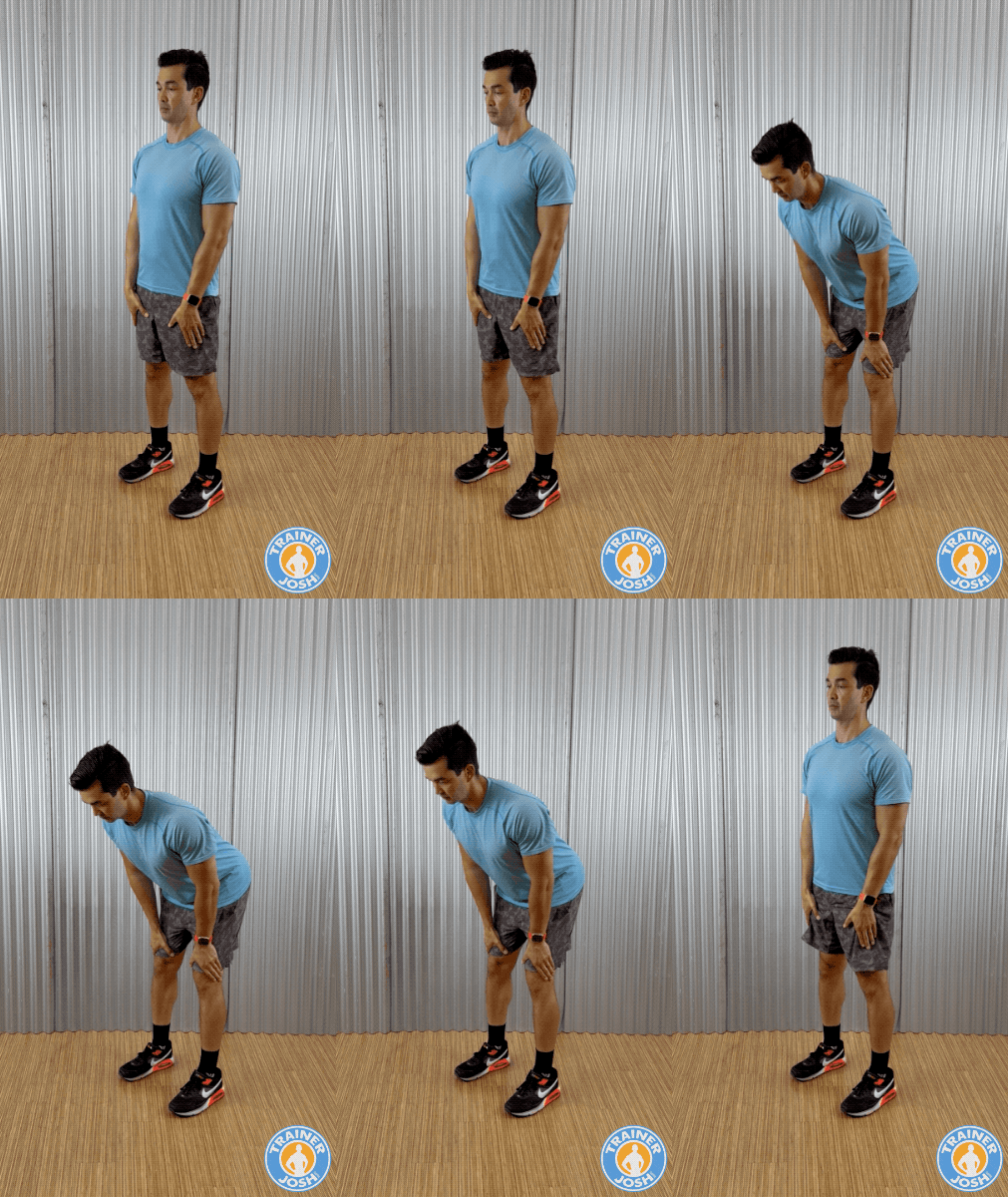
The Short-Stop Squat, or hip hinge, is a foundational spine-sparing movement tool that let’s you perform daily activities like sitting, standing, and lifting without triggering back pain.
You’ll shift the center of motion away from the vulnerable, flexible spine and into the powerful ball-and-socket joints of the hips. This movement prevents harmful spinal flexion and shear forces that cause disc damage.14
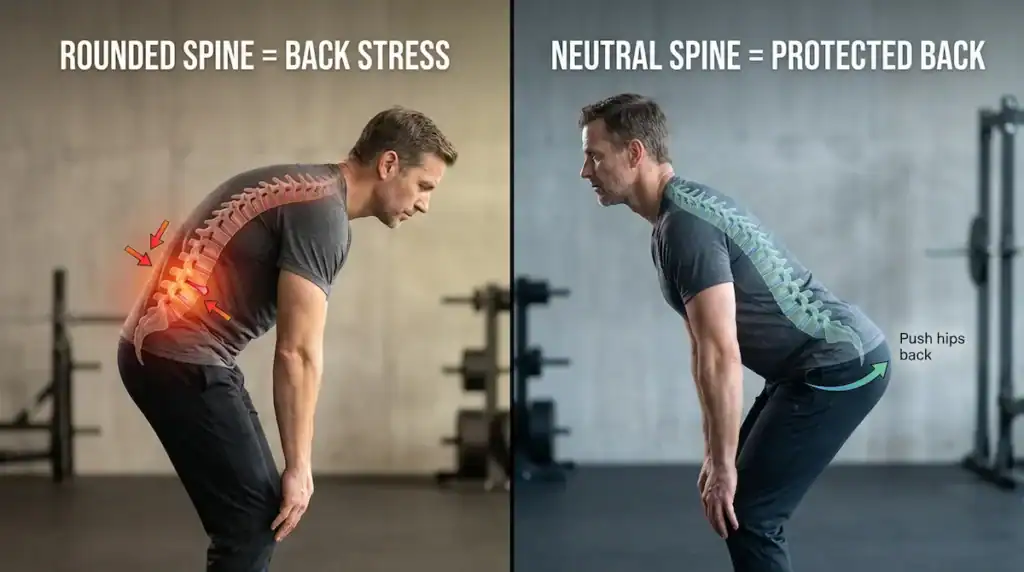
Mastering this pattern replaces flawed, pain-triggering habits with pristine mechanics. This allows sensitized tissues to heal while safely building strength and capacity in the hips and legs.15
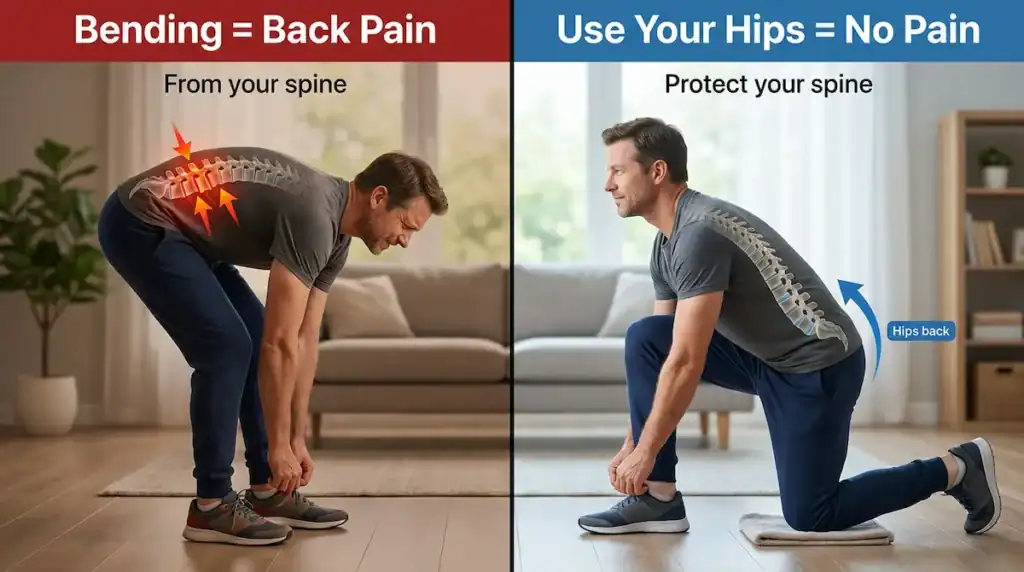
How to Properly Perform the Short-Stop Squat:
- Set your stance and hands: Stand upright with your feet spread about shoulder-width apart. Form a “crotch” with your maximally opened thumb and forefinger of each hand, and place them on your thighs.
- Hinge at the hips: Keeping your spine rigidly locked in a straight, neutral posture, push your hips backward (think of sitting back, not down) and slide your hands down your thighs until they cup just above your kneecaps. You should NOT feel your lower back bending, slouching, or rounding.
- Align your joints: Make sure your knees remain directly over the middle of your feet (mid-way between your heels and toes), instead of drifting forward.
- Brace and “Anti-shrug”: Find your pain-free spinal “sweet spot” and mildly brace your abdominal wall. Then, actively push your shoulders down and away from your ears (an “anti-shrug”) to carry the weight of your torso down your stiffened arms to your knees.
- Pull the hips through: To ascend, do NOT lift with your back. Keep your torso completely stiffened and simply pull your hips forward, dragging your hands back up your thighs until you are fully upright.
Pro Trainer Tips to Maximize Results:
- The “Sniff” Cue: Take a short, sharp nasal “sniff” of air just before you begin to descend. This acts as a powerful neurological trigger to run the proper movement pattern and instantly locks in your core stiffness.
- Root & Spread the Floor: Grip the floor firmly with your toes and heels, and consciously attempt to “spread the floor” apart with your feet. This instantly engages your gluteal muscles and optimizes hip power.
- Mastering the “Anti-Shrug”: Pulling your shoulders down into your back pockets is essential. This engages the latissimus dorsi and pectoral muscles, creating a stabilizing “guy-wire” system for the spine and allowing your arms to bear the weight of your torso.
Common Mistakes to Avoid:
- Bending the Spine: Allowing your back to slouch or letting its natural curve flatten into flexion during the descent is the most common flaw and completely defeats the spine-sparing purpose of the exercise.
- Knees Drifting Forward: Letting your knees travel forward ahead of your toes rather than effectively pushing your pelvis backward places unnecessary strain on the knees and indicates a failure to hinge purely at the hips.
- Lifting With the Back: Initiating the upward phase by extending your back or lifting your chest rather than pulling your hips through practically guarantees you will trigger back pain.
The “Lunge”
The lunge is a much-needed, spine-sparing “movement tool” that allows individuals to safely transition down to the floor or perform daily tasks, like tying their shoes, without bending the lower back.
McGill recommends this “lunge” pattern that keeps the spine from bending the discs. This helps to avoid the flexion pattern that can aggravate disc-related pain.16
By locking the spine in a pain-free, neutral posture and forcing the movement to occur exclusively at the hips and knees, the lunge prevents the harmful spinal flexion that typically triggers discogenic back pain.
When properly adapted, it can serve as an excellent active mobility exercise to stretch the psoas and enhance hip mobility. This further unloads the spine and prepares the body for athletic performance.
How to Properly Perform the Lunge (To Transition to the Floor):
- Set the Core: Find your pain-free “sweet spot” (a neutral spine curve) and stiffen your core with an abdominal brace so that no motion occurs in your spine.
- The Descent: Take a short “sniff” of air to lock in your core tension, take a step forward, and drop down onto one knee while keeping your torso perfectly upright.
- Tall Kneeling: Bring your other knee to the ground to assume a tall kneeling position, keeping your spine rigid.
- To the Floor: Slide your hands down your thighs, walk them forward on the floor until you are on all fours, and safely lower your hips and ribcage to the ground as a single unit without twisting.
- The Ascent: To get back up, reverse the process by pushing up to your hands and knees, walking your hands back to your thighs, stiffening your torso, placing one foot forward, tucking the rear toes, and driving straight up to a stand.
Pro Trainer Tips to Maximize Results
- Take Hips to the Target: Place your foot on a bench or chair when using the lunge in daily life, such as tying your shoes. Instead of reaching forward with your back, lock your spine and move your hips forward toward the elevated foot.
- Targeting the Psoas: If your goal is to use the lunge to stretch a tight psoas muscle then adopt the kneeling lunge position: raise the arm on the side of the kneeling leg straight up toward the ceiling, and bend your torso slightly away while dropping your shoulder back.
Common Mistakes to Avoid
- Bending the Spine: The most common error is flexing the spine forward rather than keeping the torso fully upright and moving strictly through the hips.
- Keeping the Back Leg Straight: Some individuals mistakenly keep their back leg completely straight during a lunge. This forces the torso to lean forward, defeating the spine-sparing purpose of the exercise and altering the stretch.
- Ignoring Pelvic Ring Instability (SI Joint Pain): If you suffer from sacroiliac (SI) joint pain or a lax pelvic ring, avoid heavy or frequent lunging. The split stance of a lunge forces one half of the pelvis to rotate forward and the other half to rotate backward. This can severely irritate and shear the SI joints. If you must lunge, use a relatively short stance to decrease the torsional load on the pelvis.
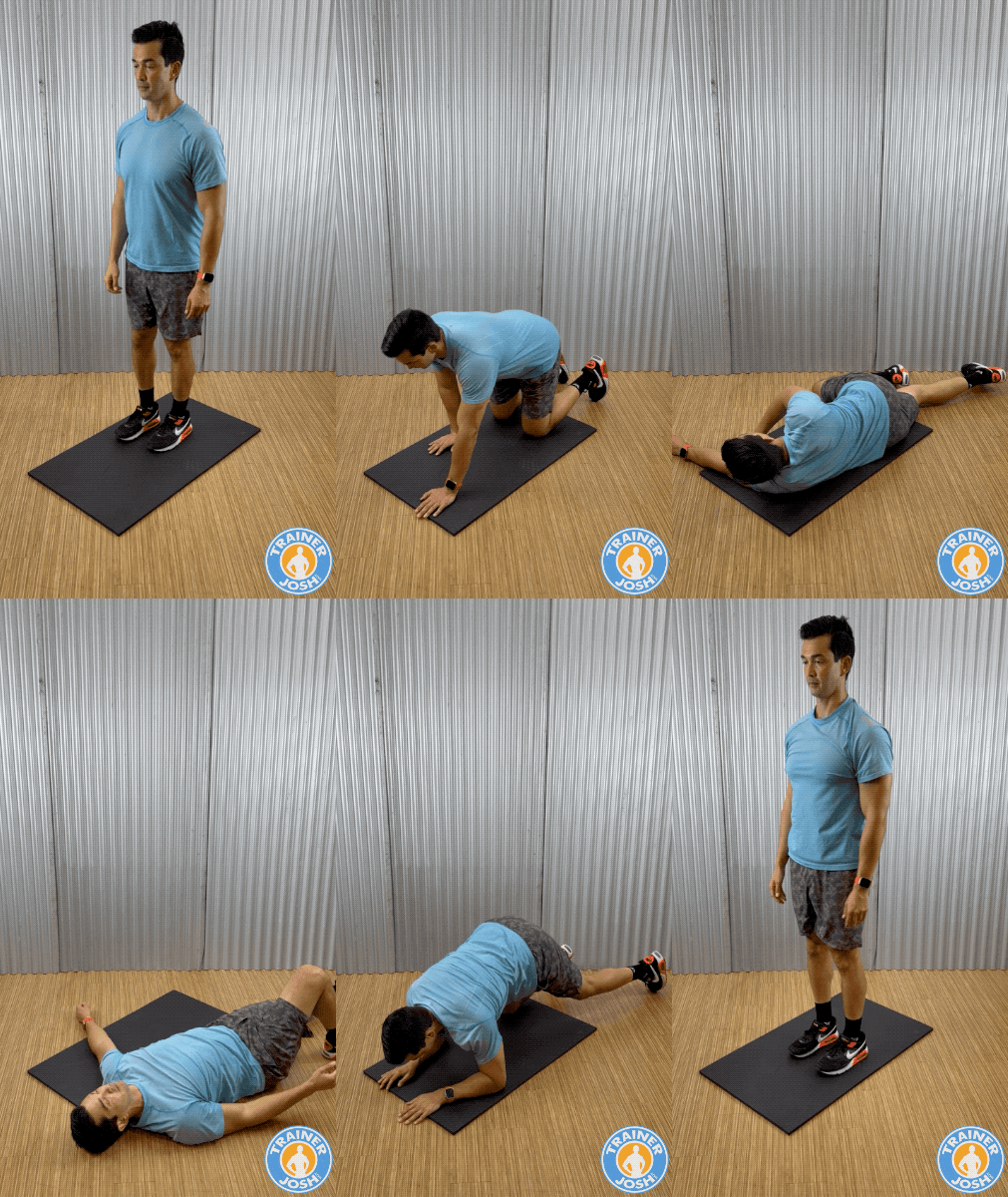
The Stop Twist
The “stop twist” completely locks the vulnerable spine to prevent harmful twisting. Instead it transfers the rotational burden to the powerful ball-and-socket joints of the hips and shoulders.
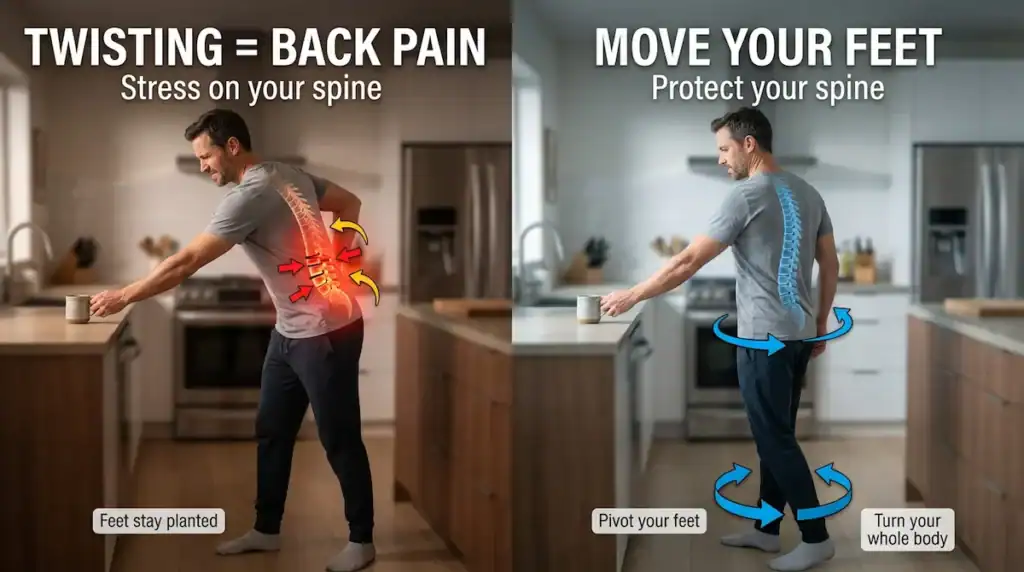
Mastering this anti-rotation technique is critical for sparing the lower back during daily activities like opening heavy doors, vacuuming, or rolling over in bed. Repetitive twisting under load otherwise causes the spinal discs’ concentric layers to separate and tear.
Repetitive twisting under load can increase interlaminar shear stresses in the discs. Scientific models identify this as a mechanism for delamination (separation of the disc’s protective layers) and an increased risk of annular tears.17
You’ll prevent harmful twisting and build a strong base to move without pain by keeping your core tight and your torso stable.
How to Properly Perform the Stop Twist:
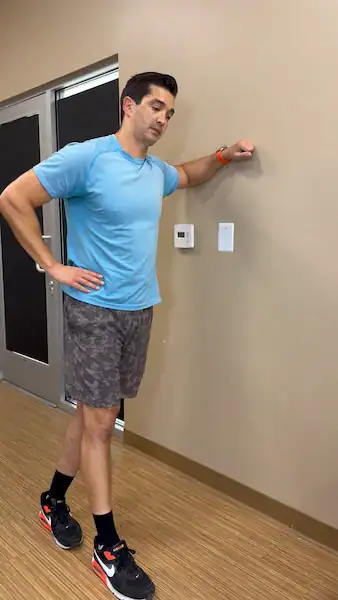
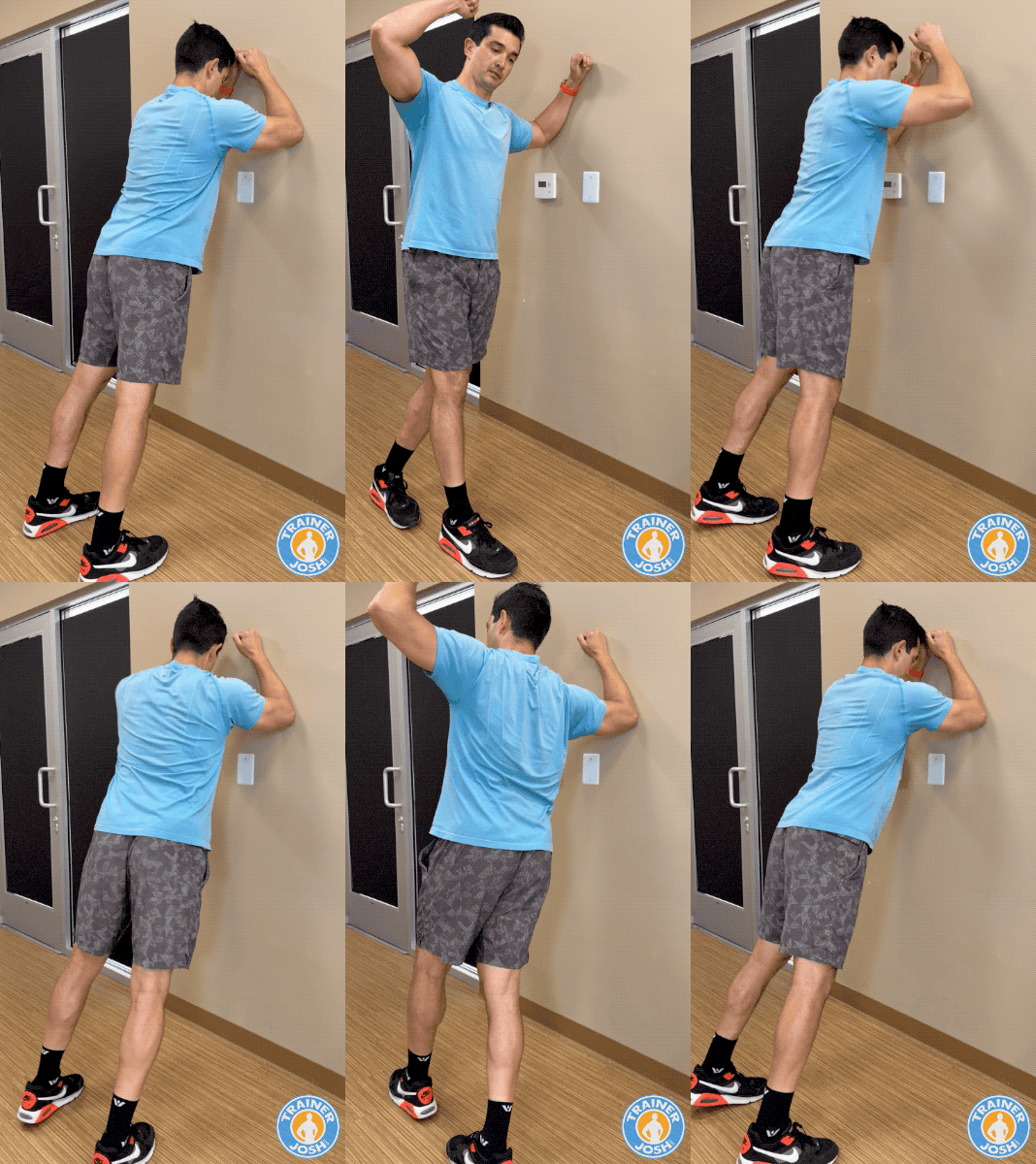
- Set your foundation: Stand and lean into a “plank” position against a wall with both elbows planted directly in front of you. Find your “sweet spot”—the neutral, pain-free curve of your spine.
- Lock the core: Mildly stiffen your abdominal muscles (an abdominal brace) to firmly lock your ribcage and your pelvis together so they act as a single, rigid unit.
- Pivot and pull: Using your toes as a pivot point, activate your latissimus dorsi (back muscles) to pull one elbow off the wall.
- Spin as a block: Spin your entire body around your toes into a side plank. You should NOT feel any twisting or motion in your lower back. You should feel your core maintaining a stiff shield and your shoulder/lat muscles initiating the turn.
- Return and cycle: Smoothly pivot back to the starting wall plank, strictly maintaining the rigid lock between your ribs and pelvis, and then repeat on the other side.
Pro Trainer Tips to Maximize Results
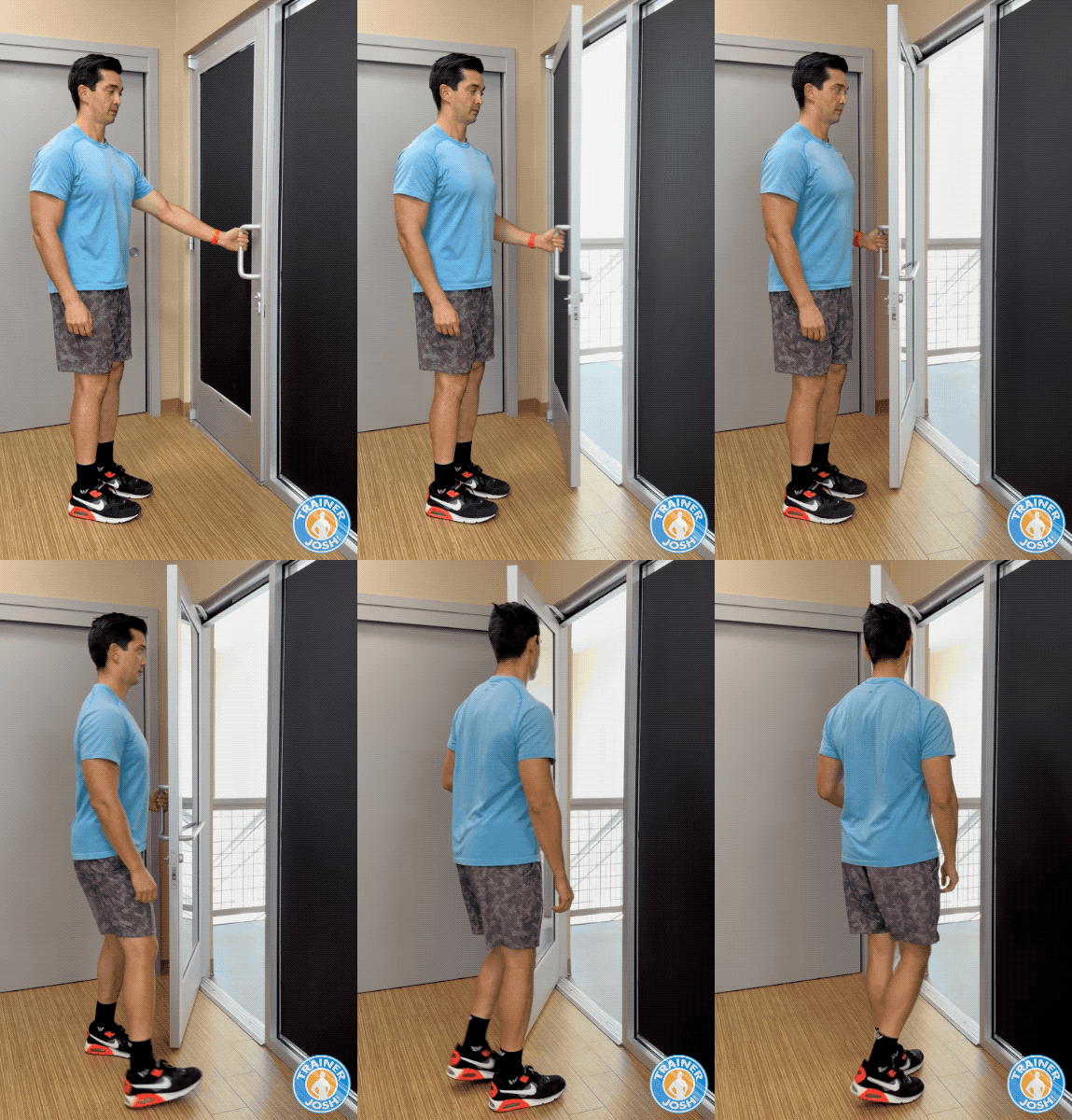
- Apply It to Daily Life (The “Waltz”): When opening a heavy commercial door, do not reach and pull with your back. Instead, direct the pulling force straight toward your navel, lock your core, and do a “two-step waltz” to step around the door, treating your body as a locked unit.
- Fascial Cueing: A clinician or partner can lightly tap your shoulder and “rake” their fingers across your obliques to physically cue your brain to lock the core and initiate the turn from the latissimus dorsi rather than the spine.
- Progress to the Floor: Once mastered on the wall, progress to doing the stop twist from a front plank to a side plank on the floor to significantly increase the challenge.
Common Mistakes to Avoid
- G With the Pelvis: The most frequent error is allowing the pelvis to move or rotate before the ribcage. This actively twists the spine, instantly defeating the pain-sparing purpose of the exercise. Your torso must move perfectly synchronously.
- Losing Straight Alignment: Allowing the body to sag, slouch, or bend out of a perfectly straight line as you roll.
- Enter: When translating this to the real world (like opening doors or vacuuming), pulling the object off to the side rather than keeping the force directed through the center of your body will create unwanted rotational torque on the spine.
Motor Control & Muscle Re-education Exercises
Clamshells
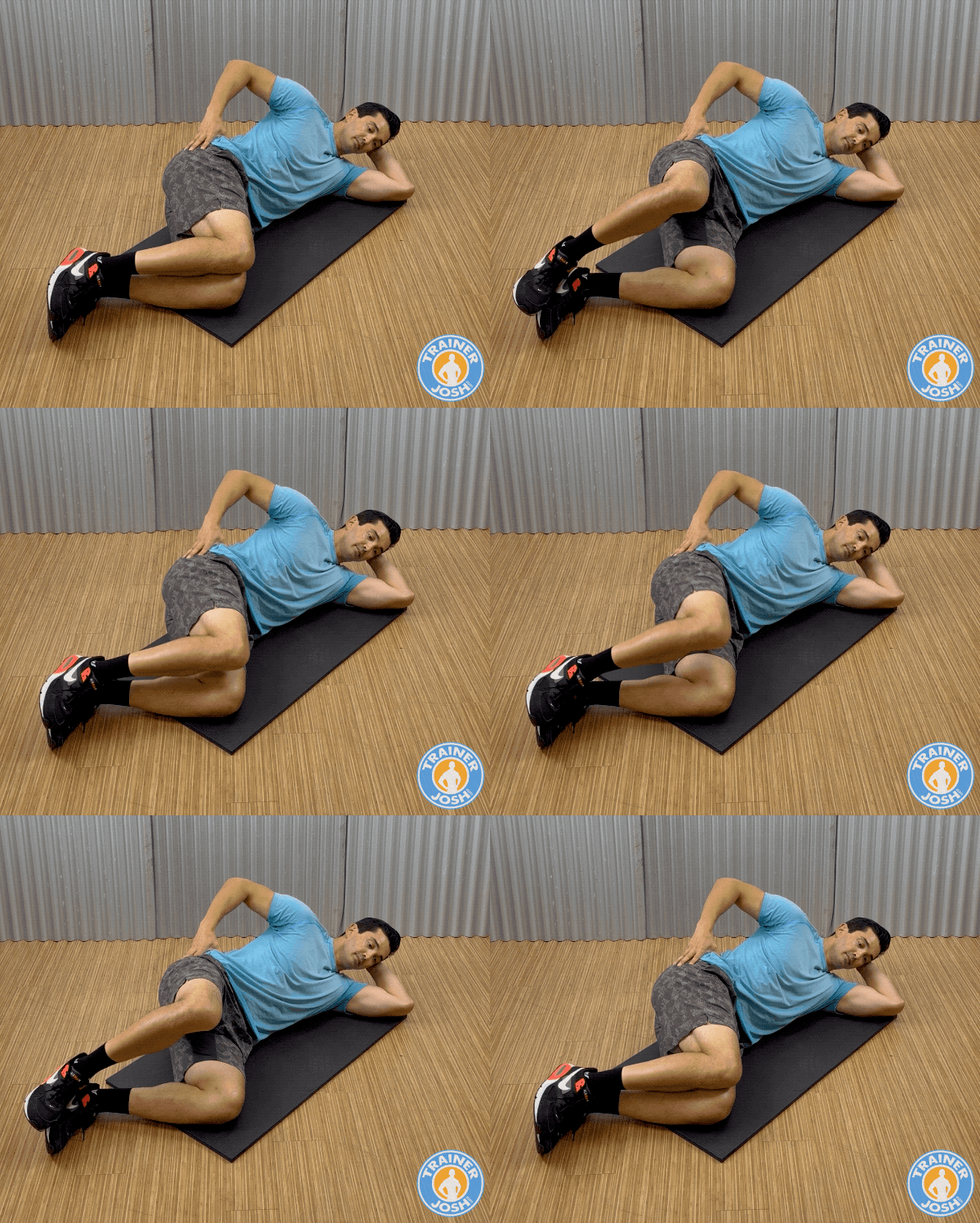
Clamshells are an essential exercise designed to address “gluteal amnesia.” This is a condition where the brain neurologically inhibits the gluteal muscles and forgets how to fire them correctly.
This exercise helps stabilize the pelvis by focusing on isolating, re-educating, and reawakening the gluteus medius (the high, lateral gluteal muscle). This ultimately restores hip dominance that prevents the lower back from inappropriately taking over the workload, which spares the spine from damaging forces.
You’ll rebuild the essential movement patterns needed to stabilize the pelvis during gait and single-leg tasks by mindfully training this specific muscle to fire without allowing the pelvis to roll or twist the spine.
How to Properly Perform the Clamshell:
- Set your position: Lie on your side with your hips and knees bent.
- Target the muscle: Place your thumb on the Anterior-Superior-Iliac-Spine (the bony lump on the front of your pelvis) and rest your fingertips directly on the upper glute (gluteus medius) behind it.
- Anchor the feet: Keep your feet and ankles pinned together so they act as a stable hinge.
- Open the knee: Mildly stiffen your core to lock your ribcage to your pelvis, and slowly open your top knee upward, separating it from the bottom knee like a clamshell.
- Hold and feel: As you open the knee, you should feel the gluteus medius muscle actively contracting and swelling directly under your fingertips. You should NOT feel your lower back engage, your pelvis roll backward, or your spine twist to artificially create the movement.
Pro Trainer Tips to Maximize Results
- Establish a “Home Base”: Before moving the knee, create core stiffness using a mild abdominal brace (pushing the obliques slightly outward). This locks the spine and provides a rigid foundation, allowing the hip to move in isolation.
- Apply Immediate Resistance: Do not use elastic bands around the knees, as they fail to provide resistance at the very beginning of the movement. Instead, place a sandbag or have a partner press their hand against your top knee. This immediate resistance forces your brain to recruit the glutes immediately to initiate the motion rather than relying on your back.
- Focus on Control, Not Strength: Treat this as a motor control and muscle re-education drill. The objective is mindful activation and “feeling” the muscle work, not traditional heavy strength training.
Common Mistakes to Avoid
- Rolling the Pelvis Backward: The most common error is allowing the pelvis to rock backward to lift the knee. This is a substitution pattern in which you use your back to artificially create the motion rather than properly using the gluteus medius.
- Twisting the Spine: Failing to lock the core and allowing the spine to twist undermines the isolation of the hip and is likely to trigger back pain. The spine must remain completely still.
- Lifting the Knee Too High: Opening the knee so far that you run out of natural hip mobility forces you to “jack” or hike your lower back to gain extra height, resulting in a flawed substitution pattern. Only open the knee as far as pure gluteus medius activation allows.
“Coin Squeeze” Glute Bridge
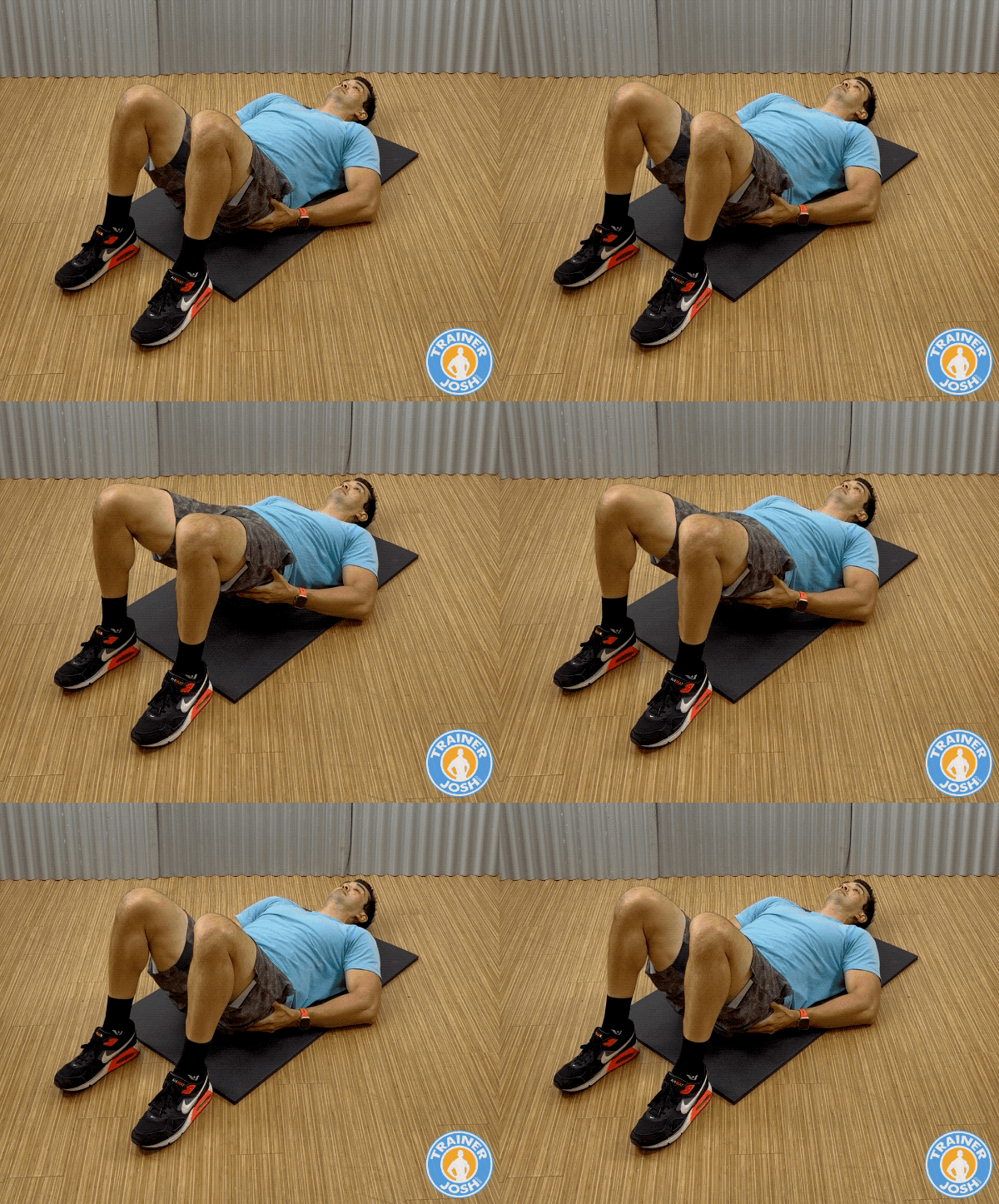
The “coin squeeze” glute bridge is a foundational motor-control and muscle re-education exercise designed to address “gluteal amnesia.” Once again, this is the condition in which chronic back or hip pain neurologically inhibits the gluteal muscles, causing the hamstrings and lower back to improperly take over hip extension.
This mindful exercise trains your brain to activate the gluteus maximus without moving the spine. So it spares the vulnerable lumbar region from absorbing crushing compressive forces.
You’ll also correct this specific pattern to prevent hamstring dominance. This can otherwise detrimentally push the femoral head forward into the hip socket, causing anterior impingement and pain.
You’ll need to master targeted gluteal activation to re-establish proper hip mechanics before safely progressing to heavier, functional movements like squats or deadlifts.
How to Properly Perform the Coin Squeeze Glute Bridge:
- Set your position: Lie on your back with your knees bent and feet resting flat on the floor.
- Target the muscle: Place your fingers directly on your gluteus maximus (the bulk of your buttocks) so you can physically feel the muscle fibers activate. You should NOT feel your lower back flatten against the floor or your pelvis tilt to artificially create this contraction.
- The “Coin Squeeze”: Imagine you have a valuable coin placed in your gluteal fold that you absolutely cannot drop, and actively squeeze your buttocks together to secure it while keeping your lumbar spine completely neutral and avoiding any pelvic tilt.
- Check the hamstrings: Check that your hamstring muscles remain completely soft and silent. You should NOT feel any tension in your hamstrings… 100% of the muscular tension should be isolated in your glutes.
- Bridge up: Maintaining that intense gluteal squeeze, push through your hips to raise your pelvis off the floor into a bridge. You should feel your glutes driving the entire upward motion.
- Lower and repeat: Return to the floor under control, keeping the “coin” tightly squeezed throughout the entire range of motion.
Pro Trainer Tips to Maximize Results
- The “Toe-Push” Trick: If you struggle to keep your hamstrings from firing, try lightly pushing your toes away from you into a wall or a partner’s foot to slightly activate the quadriceps. This mild quad engagement helps neurologically inhibit the hamstrings, making it much easier for your brain to isolate and fire the glutes.
- Adjust Your Knee Angle: If you find yourself pushing your heels hard into the ground (which automatically activates the hamstrings), bring your feet slightly closer to your buttocks to close the knee angle.
- Progress to One Leg: Once you master the two-legged bridge with complete gluteal control and soft hamstrings, progress to a single-leg back bridge to further groove the pattern and build essential strength.
Common Mistakes to Avoid
- Hamstring Dominance: Allowing the hamstrings to initiate the lift robs the glutes of the workload, reinforces flawed movement patterns, and actively drives the femoral head forward to impinge the anterior hip joint.
- Pelvic Tilting: Flattening your lower back to the floor or using spinal motion (like tucking your tailbone) to artificially create the contraction completely defeats the purpose. Your lumbar spine must remain rigidly in a neutral posture.
- Treating It Like Strength Training: This is a motor control and re-education drill, not a heavy strength exercise. Trying to squeeze with maximum effort right away often causes the body to substitute with the hamstrings or lower back. Focus purely on the mind-muscle connection first.
Why Your Lower Back Pain Keeps Coming Back
Key Takeaways:
- Lower back pain is usually a compensation problem… the back is overworking because the glutes, hips, or core are underperforming.
- Moving into flexion triggers temporary pain relief (15 to 20 minutes) but replicates the disc-damaging mechanism behind most injuries.
- Gluteal amnesia, poor core stiffness, and restricted hip mobility are the three root causes driving most chronic lower back pain cases.
Dr. Stuart McGill recommends using a lumbar support to maintain your spine’s natural, pain-free curve while sitting. His go-to is the adjustable “Lumbair” cushion that lets you fine-tune support throughout the day as your spine needs change. Unlike a rolled towel, it adapts in seconds—helping reduce the buildup of disc stress that leads to back pain.
It’s Not Just Your Back… Your Back Is the Victim
Your lower back is not the problem. It’s paying the price for problems happening somewhere else.
The lumbar spine is a flexible structure built to transfer force, not absorb it. When other parts of the chain stop doing their job, the lower back steps in to pick up the slack. Do that long enough, and something breaks down.
Your hips and shoulders are designed to create movement. Your core muscles (abdominals, obliques, lats, and quadratus lumborum) are designed to stop movement by bracing the spine in a locked, neutral position.
When the core does its job, 100% of the power your hips generate transfers safely through your body. When it doesn’t, the spine bends and shears under loads it was never built to handle.
You’re Accidentally Re-Injuring Your Back Every Day
Lower back pain comes back all the time because sufferer are continually “picking the scab” of their injury through flawed daily movement patterns. Instead of suffering from just a single injury that won’t heal… most people experience chronic or recurring pain because they’re unwittingly repeating the exact postures, motions, and loads that caused the original tissue damage.
It’s like repeatedly hitting your thumb with a hammer. The spinal tissues are continuously re-traumatized and never given the necessary rest to heal. This cycle of constant re-injury leads to several physiological changes that cause pain to linger and return.
Your spine also needs support when you sleep. A pillow like the PropAir Sleeper Back Support helps keep your spine in a neutral position overnight. This reduces the low back stress that builds up from poor sleeping posture. It’s an easy way to wake up with less stiffness instead of starting the day already irritated.
Quality recovery also depends on giving tense, overworked muscles the nutrients they need. BioTRUST Ageless Multi-Magnesium combines multiple forms of magnesium to support normal muscle function, relaxation, and better sleep quality while you work on rebuilding pain-free movement habits.
A 7-form magnesium complex designed for adults 40+ to support restful sleep, relaxation, muscle recovery, and whole-body health. Each serving provides 350mg of magnesium plus L-theanine and vitamin B6 for added nervous-system support.
- 7-Form Magnesium Blend: Combines glycinate, taurate, malate, citrate, Sucrosomial® magnesium & complementary forms
- Sleep & Relaxation Support: Magnesium glycinate plus L-theanine help support calm, relaxation & restful sleep
- Muscle Recovery & Comfort: Supports normal muscle relaxation, recovery & energy production
- Enhanced Absorption: Includes clinically studied Sucrosomial® Magnesium for high absorption & gentle digestion
- Heart, Bone & Nervous System Support: Provides 350mg of magnesium plus vitamin B6 for essential body functions

Neurological Sensitization
Repeat the same stimulus enough times, and your nervous system stops waiting for a “big” signal to fire. It gets hypersensitive… lowering its threshold until even minor movements trigger a full alarm response.
This is called central sensitization. It explains why, after months of recurring back pain, something as basic as reaching for a coffee cup can drop you to your knees. The movement isn’t dangerous… your nervous system has just been conditioned to treat everything like a threat.
Spinal Micromovement & Joint Shearing
When a disc or end-plate gets damaged, the spine loses segmental stiffness. This is the natural resistance that keeps vertebrae from sliding against each other. Without it, you get micromovement or “shearing” at the joint.
These aren’t dramatic movements. You can’t feel them happening. But over weeks and months, that constant low-grade grinding wears on the surrounding nerves and soft tissue.
This produces those sharp, unpredictable catches of pain you get during normal activities like standing up from a chair or rolling over in bed.
The Degenerative Cascade
This one is the slow burn… and most people don’t connect the dots until years later.
When a disc loses height from a compression or flexion injury, it shifts extra mechanical load onto the facet joints at the rear of the spine. Those joints weren’t designed to carry that load.
Over 3–5 years, they can wear down, become arthritic, and create a new pain source… even after the original disc injury has quieted. The pain moves. The cause evolves. And most people keep chasing symptoms instead of fixing the underlying mechanics.
Your spine isn’t just muscles but it’s also discs, ligaments, and connective tissue that takes a beating over time. If those tissues aren’t getting the raw materials they need to repair, then it’s a lot harder to stay pain free (even if you’re doing all the right exercises.
That’s where this comes in:
Powered by 5 Types of Bioactive Naturally Hydrolyzed Collagen Peptides for Full-Body Support (Odorless & Flavorless)
- Natural GLP-1 Support: Helps support healthy appetite signals, fullness & metabolic function
- Lean Muscle Support: Helps preserve muscle, strength & healthy body composition during weight loss
- High-Protein Collagen: Adds 20g of protein with 5 collagen types to help support daily protein intake
- Skin, Joint & Hair Support: Provides collagen peptides to support skin elasticity, joints, hair & nails
- 3-Part Weight-Loss Support: Combines muscle, protein/collagen & appetite support in one simple daily stack
The “Feel-Good” Stretches That Are Making It Worse
Back pain often recurs because rehabilitation efforts focus on treating the symptom (the pain) rather than removing the underlying mechanical cause. A lot of back pain sufferers are doing stretches that are making it worse.
Pulling your knees to your chest. Child’s pose. Seated forward folds. These feel amazing in the moment… but that’s exactly the problem.
They trigger a stretch reflex and temporary neurological analgesia, which blocks pain for 15–20 minutes. But they also drive the lumbar spine into deep flexion… the exact position that re-stresses a herniated or bulging disc once the temporary neurological relief wears off.
You feel better. You do it again. The disc gets irritated again. The cycle continues.
THE BOTTOM LINE:
To stop the back pain from coming back… you need to identify the specific mechanical triggers causing your pain and change your movement mechanics to completely avoid them. This will finally allow your hypersensitive tissues to rest, desensitize, and heal.
The 10 Hidden Causes of Most Lower Back Pain
1. Weak Glutes (Gluteal Amnesia)
Back pain and hip pain alter your nervous system. One effect is that your glutes partially shut off. This is called gluteal amnesia, and it means your body stops using your largest and most powerful hip extensor. Instead, it starts relying on the hamstrings and lower back muscles instead.
Those muscles were not designed for that workload. They overfire, fatigue, and cram unnecessary compressive load into the spine. That’s where the cramping and chronic aching come from during squats, climbing stairs, or rising from a chair.
2. Poor Core Stability
Core stability is not about strength. It’s about stiffness… the ability to brace the spine and prevent it from micro-shifting under load.
After an injury, spinal joints lose their natural rigidity. Small, unstable shifts occur at the joint level. Those shifts irritate the highly sensitized nerves surrounding the spine.
They produce sharp, stabbing pain from movements as minor as reaching for a glass or turning to look over your shoulder.
3. Tight Hips
Restricted hip mobility doesn’t make movement disappear. It redirects it instead.
Every degree of motion your hips can’t provide is transferred directly to the lumbar spine. Bending to tie your shoes, sitting down, or picking something up off the floor forces the spine to flex instead of the hip.
Repeated spinal bending like that delaminates the collagen fibers in your discs over time. This is the mechanical precursor to disc bulges, herniations, and sciatic nerve pain.
4. Your Genetic Spine Anatomy
Not all spines are built the same. This is one of the most overlooked reasons why exercises that work for one person can wreck another.
A person with a thicker, heavier-boned spine develops significantly higher disc stress when bending compared to someone with a slender build. A slender-spined individual might do hundreds of sit-ups with no issue. A thicker-spined individual doing the same movement can herniate a disc fast.
Disc shape can do this further. Thicker-boned people often have lima-bean-shaped discs (a limacon shape) that concentrate bending stress into the back corners of the disc, creating focal herniations. Slender people tend to have oval-shaped discs that distribute stress more evenly.
Facet joint orientation matters too. People with “open” facets (common in gymnasts and dancers) have impressive rotational range. But that identical structure can cause severe bone stress when arching backward. This often leads to a hidden stress fracture called spondylolisthesis.
5. The Morning Danger Zone
Your spinal discs are hydrophilic. They suck up fluid overnight and arrive at maximum hydration and pressure by the time your alarm goes off. That pressurization has a cost.
A 1996 study in Annals of the Rheumatic Diseases found that sustained loading caused human intervertebral discs to lose an average of 18% of their fluid over 6 hours. This supports the idea that spinal discs dehydrate under compression and rehydrate when unloaded.18
Bending over to put on socks, pulling your knees to your chest, or cranking through sit-ups right after getting out of bed are all high-risk moves. Give your spine 30 to 60 minutes to decompress before loading it.
6. Spinal Memory & Ligament Creep
Your spine has a biomechanical memory, and prolonged sitting exploits it. When you sit at a desk or hunch over work for extended periods then your spinal ligaments slowly stretch and lose their protective stiffness. This process is called “creep.”
Stand up and immediately try to lift something, and your spine is temporarily unprotected because those ligaments haven’t yet regained their normal elastic tension.
Full recovery can take up to 30 minutes of standing. That’s why so many people throw their back out doing something completely ordinary right after getting up from their desk.
7. The “Plop” Problem
Most people assume they hurt their back picking something up. A surprising number of acute injuries happen on the way down, when setting an object on the floor or lowering a weight.
The mechanism is called loss of eccentric control. The nervous system unconsciously relaxes the muscles at the bottom instead of maintaining a braced, stiff core throughout the movement. The load stays. The stability disappears. The spine buckles.
One of my friends at a local gym, a 42-year-old contractor, told me he’d lifted the same toolbox hundreds of times without issue. But then one time, he hurt his back pretty bad putting it down.
8. Stress & Spinal Load
Mental stress creates measurable mechanical load on the spine. This is not abstract.
A 2002 workplace study found that mental processing stress during lifting significantly increased spine loading, and that among ‘intuitors.’ Sideways spinal forces rose by about 25% while compressive load rose by about 11% under mentally demanding work conditions.19
“Sensors,” who focused on one task at a time, showed no such increase. Beyond muscle tension… chronic emotional stress causes a collapsed, forward-flexed posture. This chronically overloads the back extensors and elevates the shoulders.
9. Misguided Rehab Exercises
Some of the most common back pain prescriptions make things worse.
Pulling your knees to your chest triggers a stretch reflex that mutes pain for about 15 minutes. Mechanically, it compresses the discs and prevents the pain cycle from recurring.
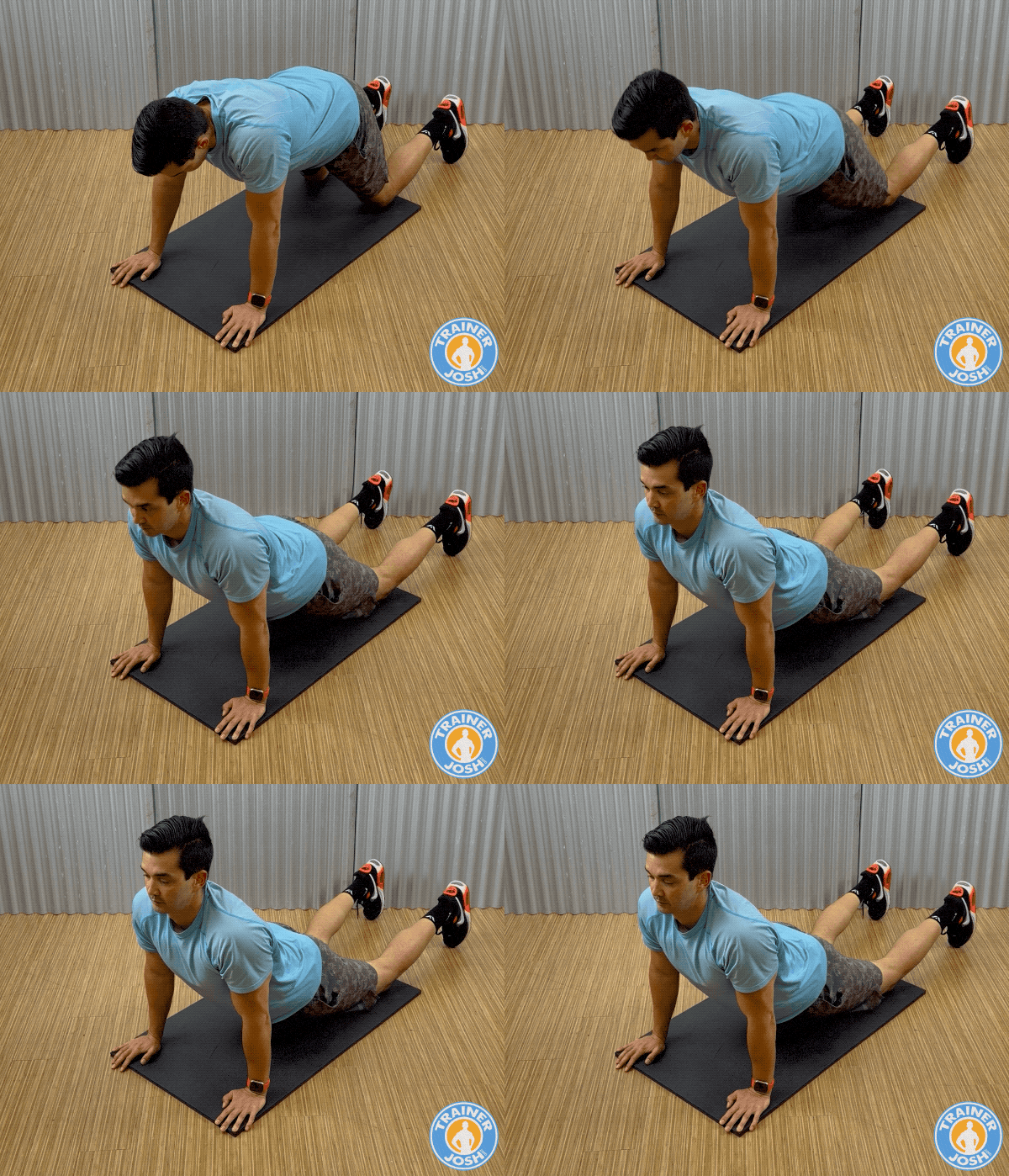
But McKenzie extension work (the “floppy push-up”) can be a very effective and almost “magical” treatment for acute disc bulges. But doing them dynamically and repetitively causes the facet joints to collide and grind together.
The “static prone extension” is a much safer alternative to the McKenzie floppy push-up. You’ll get the same healing “vacuum” effect but will avoid the mechanical friction and trauma to the facet joints.
The exercise isn’t always wrong. But the diagnosis behind it is.
10. Wallet Sciatica
This one surprises a lot of people…
Men who sit with a wallet in their back pocket are placing a wedge directly under one side of the pelvis. That wedge tilts the pelvis, creates a focal pressure point on the hip capsule, and can compress the sciatic nerve hard enough to mimic a serious spinal problem.
I received an email from a man who spent months chasing a disc diagnosis. But his MRI was clean. Turns out he’d been sitting on a thick wallet for years.
The 3-Phase Plan to Fix Lower Back Pain (Without Making It Worse First)
Key Takeaways:
- Phase 1 is always identification and elimination first. Jumping to exercises before removing pain triggers is the most common reason back pain programs fail.
- A standard sit-up places over 3,300 Newtons of compressive load on the spine. Core training should build stiffness to stop motion, not create it
- Isometric holds are capped at 7 to 10 seconds, and the Russian descending pyramid builds spinal endurance without the fatigue that can lead to reinjury.
Most back pain programs skip straight to exercises. That’s the mistake.
Spine researcher Dr. Stuart McGill spent decades studying why people stay in pain despite doing “all the right things.” His answer: They never stopped doing the wrong things first.
The system below follows his clinical framework… adapted for real life.
Phase 1: Acute Lower Back Pain… What to Do Right Now (Before You Touch a Single Exercise)
If you’re in severe lower back pain right now, then more exercise will not help you at the moment. That’s the counterintuitive reality of acute back pain… and it’s the first thing Dr. Stuart McGill tells his most severe patients.
The goal in this phase isn’t fitness. It’s stopping the damage.
If the Pain Is Severe: “Virtual Surgery“
If your back is in unrelenting, severe pain and you’ve started wondering whether surgery is your only option… try this first.
Treat the day exactly as if you just had a spinal operation. Rest in bed. Get up only every few hours for short, shuffling walks to the bathroom. Nothing more.
This enforced stillness gives highly sensitized tissues the break they need to begin calming down.
I had a client in his 50s who’d been white-knuckling through daily walks and light stretching despite barely being able to get off the floor. Two days of virtual surgery dropped his pain from a 9 to a 4. Movement came after.
Find Your Position of Respite
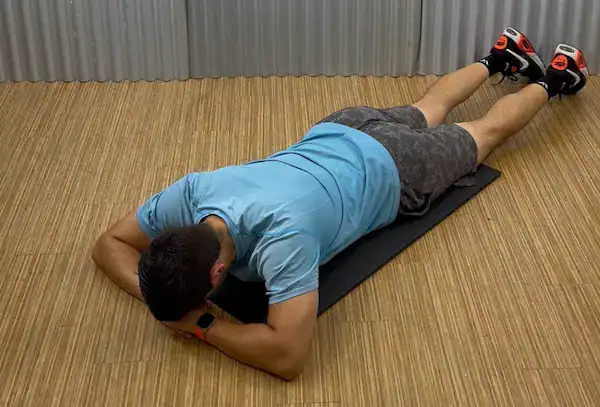
Your first “exercise” is to find a posture that turns off your back muscles. For most disc-related pain, this is prone lying: face down on the floor, breathing deeply, letting your lower back melt into the floor with each breath out.
Place a flat hand or vertical fist under your chin to gently restore the spine’s natural curve. This position shuts off chronic muscle guarding and can act as mild traction that reduces posterior disc bulge pressure.
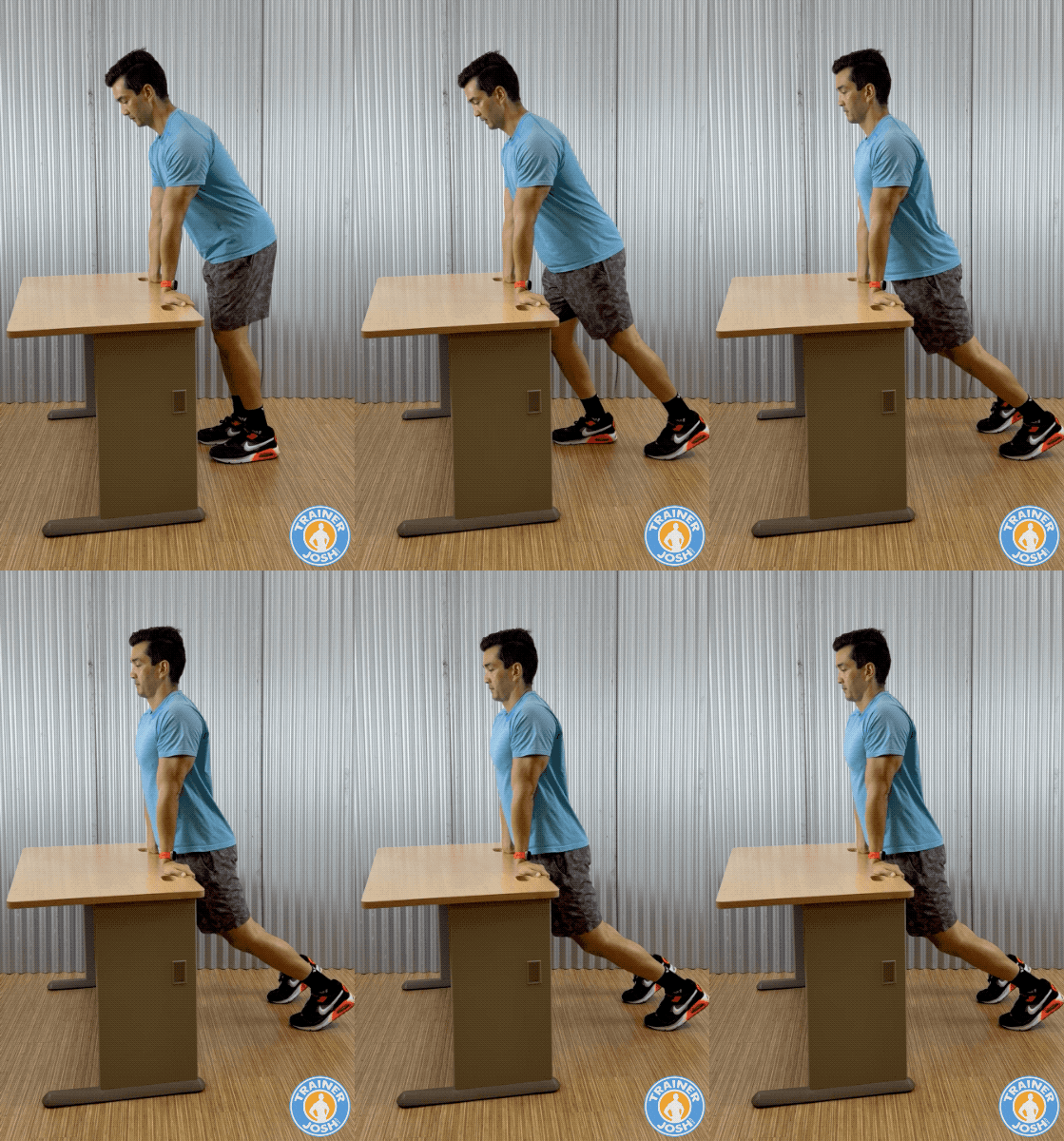
For stenosis or compression pain, use park bench decompression before symptoms set in. Place your hands on something sturdy at hip height and let your hips sag downward. This takes compressive load off the spine and relieves the nerves.
Your First Movement: Interval Walking
Walking is the first real activity, but it must be done and kept below your pain threshold. If 10 steps trigger pain, then your prescription is 6 to 8 steps per hour. Not more.
Capacity builds from there into multiple short intervals: three 20-minute walks rather than one long walk that sends you back to the floor.
Brisk interval walking is like “Nature’s Back Balm” since it acts like an elastic energy storage and recovery system that actively unloads the spine. When done correctly, each step produces gentle, reciprocal muscle contractions that challenge the lateral core, trim the hips, and provide therapeutic motion to the spinal discs.
Breaking the exercise into short, tolerable intervals (like three 20-min walks instead of one 60-min walk) makes sure that the activity builds pain-free endurance and capacity without crossing your biological “tripping point” into pain.
How to Properly Perform Interval Walking:
- Set an Upright Posture: Stand tall with your ears over your shoulders and your chest slightly lifted, which immediately helps to shut off cramping and tension in your lower back muscles.
- Engage the Core: Lightly stiffen your abdominal muscles (a mild brace) to provide protective stability to the spine.
- Swing from the Shoulders: As you walk, allow your arms to swing freely from the shoulder joints, rather than just bending your arms at the elbows.
- Walk Briskly: Take purposeful, larger, and faster steps. You should walk briskly, as if you “mean business” or are walking to a destination.
- Dose with Intervals: Walk only until completely pain-free, stopping before any symptoms or aches begin.
Pro Trainer Tips to Maximize Results
- The “Park Bench Decompression”: If you suffer from conditions like stenosis and can only walk for a few minutes before pain sets in, use “micro-breaks.” Stop walking, place the heels of your hands on a park bench or sturdy railing, keep your arms straight, and let your hips sag forward to gently traction and decompress the spine. Once the pain subsides, walk for another short interval.
- Walk Like You “Own the World”: Adopt a proud attitude with your chest puffed out (like Russian walkers) rather than looking down at the ground (like typical American walkers). This naturally promotes the arm swing required to store and recover elastic energy in the torso,.
Common Mistakes to Avoid
- “Mall Strolling” (Walking too slowly): Slow, leisurely walking is highly detrimental. It statically loads the spine, eliminates the spring action of your legs, and causes back muscles to cramp, which often exacerbates pain.
- Pushing Through a Single Long Dose: Walking for a full hour in one continuous session heavily increases your risk of triggering pain. It is far safer and more effective to break that hour into three 20-minute doses throughout the day to guarantee success.
- Swinging Arms from the Elbows: Pained individuals often lock their shoulders and only swing their forearms from the elbow. You must swing from the shoulders to utilize the torso’s elastic slings, which can reduce compressive spine loads by up to 10%.
Phase 2: How to Calm Lower Back Pain (Find the Cause, Then Stop Doing It)
There is no such thing as “non-specific” back pain. Every case has a specific mechanical cause. Finding yours is the first job.
Most people skip this step and jump straight to exercises. That’s how you end up doing the wrong things for months and wondering why nothing works.
Step 1: Figure Out What’s Triggering You
Start by making two lists. Write down every activity that flares your pain, and every activity that relieves it. The pattern tells you more than most MRI reports.
If sitting, driving, or tying your shoes makes it worse but walking relieves it: you’re likely flexion-intolerant. This is the classic presentation of a bulging disc.
If walking or standing causes pain but sitting helps: you’re likely dealing with an extension-intolerant, stenotic, or arthritic condition.
If rolling over in bed sends a sharp catch through your back: you probably have spinal instability, where micro-movements at the joint level are pinching sensitized tissue.
Three quick tests additionally sharpen the picture.
- Sit tall on a stool, pull up on the seat to compress your spine, then slouch and pull up again. If the slouched position reproduces your familiar pain, spinal flexion is your primary trigger.
- Stand relaxed, rise onto your toes, and drop hard onto your heels. A deep, boring ache after the heel drop is commonly a sign of end-plate compression intolerance.
- Lie face down and let your lower back relax into the floor. Pain that steadily fades in this position points to a posterior disc bulge.
Step 2: Stop Picking the Scab
“Picking the scab” is a way of saying how people continue to re-injure their backs by repeatedly doing the same flawed movement patterns, postures, and loads that irritate the sensitive tissues. Continuing to provoke the pain while your body is constantly trying to heal the damage makes sure the tissues stay highly sensitized and prevents recovery.
Here’s how to stop picking the scab so you can allow the pain to wind down:
Identify Your Specific Pain Triggers: Act like a detective to pinpoint the exact activities, motions, or postures that trigger your pain. You can’t eliminate the cause if you don’t know what it is.
Practice 24/7 “Spine Hygiene”: You have to consciously eliminate your pain triggers from your routine. Replace them with pain-free movement alternatives.
This means applying perfect, joint-sparing mechanics to everyday tasks like how you sit, stand, walk, tie your shoes, and get out of a chair.
Master New Movement Tools: You have to correct aberrant motor patterns to avoid bending the flexible spine under load by learning to move instead through the ball-and-socket joints of the hips and shoulders.
Master movement tools like the hip hinge and the lunge. They allow you to get through daily life without putting destructive stress on your vulnerable back.
Once you stop doing the exact movements that trigger your lower back pain, you can finally give your inflamed tissues time to rest and heal. This actively turns down your neurological pain sensitivity and gradually expands your repertoire of pain-free activities.
Step 3: Calm the Tissues Down
Find your position of respite and use it all the time. Prone lying (face down on the floor) is common for most disc-related pain.
Breathe deeply and let your lower back melt into the floor on each breath out. This shuts off chronic muscle guarding and can act as mild traction that reduces posterior disc bulge pressure.
Use park bench decompression for stenosis or compression-type pain. Before symptoms set in… lean forward and place your hands on something sturdy at hip height. Let your hips sag. This takes compressive load off the spine and relieves nerve pressure.
For general stiffness, use the Cat-Camel: 5 to 8 slow, gentle cycles on your hands and knees. Not more. Performing 20 repetitions offers no benefit and risks further irritating the tissues.
If your pain is severe and unrelenting, treat the day like virtual surgery. Rest in bed. Get up only every few hours for short, shuffling walks. Forced rest is sometimes the only thing that breaks the inflammation cycle enough to move forward.
Phase 3: Build Strength Without Triggering a Flare-Up
Endurance comes before strength. This is a non-negotiable rule of spinal rehabilitation.
Stabilization exercises use short isometric holds of 7 to 10 seconds maximum. Longer holds starve the torso muscles of oxygen and accelerate fatigue. Fatigue corrupts form. Corrupted form under load is how re-injuries happen.
Loading follows the Russian descending pyramid: 6 reps, rest, 4 reps, rest, 2 reps. This builds endurance without ever reaching your breakdown point.
Preventing recurrence in the long term means permanently replacing old movement habits. The hip hinge (a short-stop squat position) keeps the spine locked neutral while the hips take the load during bending and lifting. The “lunge” handles transitions to the floor.
Back injuries rarely result from a single dramatic event. They come from thousands of small, sub-failure movements stacked up over months and years.
Why Most Core Exercises Make Back Pain Worse
Sit-ups, crunches, leg raises, and Pilates roll-ups. These are the exercises most people try when their back hurts. But they’re also some of the fastest ways to make it worse.
The core’s primary job is to stop motion, not create it. When you train it by repeatedly flexing and rotating the spine, you bypass its natural function entirely and drive compressive load straight into already-irritated tissue.
The Sit-Up Problem Nobody Talks About
A biomechanics study on abdominal exercises reported that a standard sit-up can generate roughly 3,300 to 3,500 newtons of compressive force on the lumbar spine. Straight-leg sit-ups produce about 3,506 N, a level close to or above commonly cited spinal safety thresholds.3
That force replicates the exact stress that causes spinal disc fibers to delaminate and eventually herniate. Training this pattern repeatedly, on an already sensitized spine, is what keeps people stuck in a pain cycle they can’t break out of.
I talked to one guy, a 40-year-old who’d been doing 50 crunches a night because “his physio said to strengthen his core,” and he came to me confused about why he kept flaring. We pulled the crunches. The flares stopped within two weeks.
The “Hollow Your Stomach” Myth
Fitness and rehab circles have long promoted abdominal hollowing (sucking the navel toward the spine) as the gold standard cue for core activation. It isn’t.
Hollowing physically shrinks the base of support for the muscular system that protects your spine. It creates a weak point. Under load, that weak point encourages the spinal column to buckle.
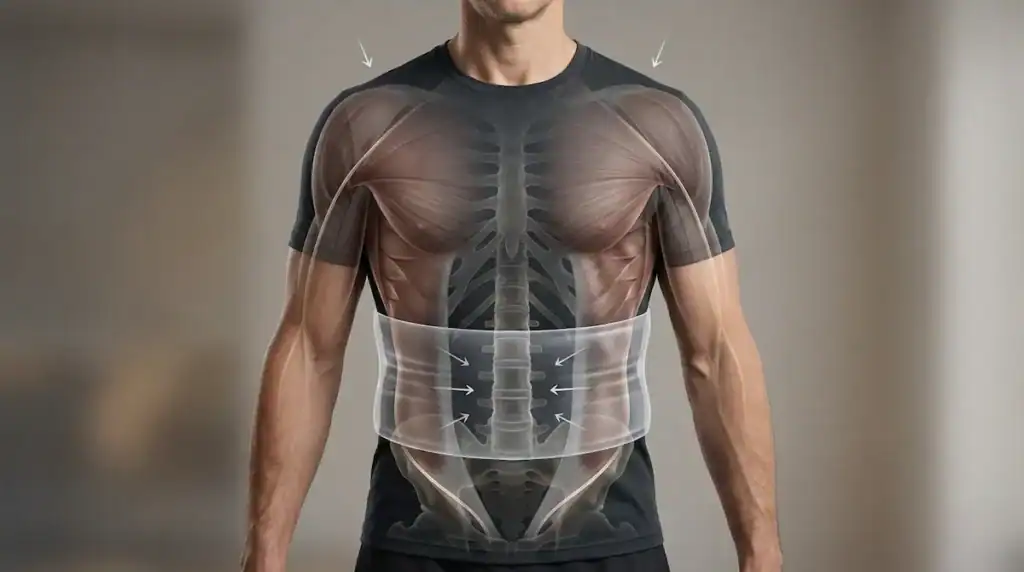
What works is an abdominal brace: a mild, simultaneous co-contraction of the entire abdominal wall (rectus abdominis, obliques, and transverse abdominis together) without drawing the belly in or pushing it out.
This 360-degree contraction binds the abdominal layers into a stiff composite that eliminates the micro-movements responsible for nerve irritation and sharp pain.
The Psoas Trap in Bent-Knee Exercises
Bending the knees during sit-ups is widely taught as a way to protect the lower back. It doesn’t.
When the hips are flexed, the psoas (a hip flexor that attaches directly to each lumbar vertebra) is already shortened. It contracts with even greater force to complete the movement.
That force compresses directly down onto the lumbar spine, and loads up the very joints you were trying to protect.
What Happens When the Core Goes Soft
A stiff, braced core acts as a rigid barrel connecting your pelvis and ribcage. When that barrel is locked, 100% of the power your hips generate transfers efficiently through your body.
When it collapses under load, the spine absorbs that force instead. Every rep becomes cumulative trauma. Every session adds to the total.
The McGill Big 3 (modified curl-up, side bridge, bird-dog) trains the core to resist movement under load. And this is the exact mechanical function your core was built for.
The Glute Exercises That Take Pressure Off Your Lower Back
Key Takeaways:
- Gluteal amnesia is a neurological inhibition caused by back and hip pain; the glutes don’t weaken because of disuse alone, the nervous system actively suppresses them
- The clamshell targets gluteus medius motor control; the coin squeeze and bridge target gluteus maximus activation; both must be mastered before loading the hips with resistance
- The “spread the floor” cue during squats and hinges integrates glute activation into functional movement patterns and repositions the femoral head away from the impingement zone
Your glutes might be the most important muscle group for back pain relief that nobody talks about. The nervous system partially shuts the glutes off when chronic back or hip pain sets in.
Vladimir Janda described lower crossed syndrome as a pattern of overactive hip flexors and lumbar extensors with inhibited abdominal and gluteal muscles. The later term for this is ‘gluteal amnesia’, which is a simplified modern shorthand for this concept.
Your brain doesn’t forget how to use your legs. It forgets how to use the right muscles to move them.
The body compensates by overloading the hamstrings and lower back extensors to do the work the glutes should be handling. That compensation drives crushing compressive load into the lumbar spine and pushes the femoral head forward. This causes an anterior hip impingement on top of the back pain.
A guy at my local gym, a 42-year-old who’d been doing bridges and deadlifts for months with no relief, couldn’t feel his glutes fire at all during a basic bridge. His hamstrings were doing everything. We went back to square one with the progression below, and his back pain dropped significantly within three weeks.
Step 1: Wake Up the Gluteus Medius (Clamshell)
The gluteus medius is the high, outer glute muscle that stabilizes your pelvis during walking and any single-leg movement. Most people with back pain have almost no control over it.
Lie on your side, hips and knees bent. Place your thumb on the front of your hip bone and fingers on the upper outer glute so you can feel it contract. Brace your core to lock your ribcage to your pelvis, then open your top knee like a clamshell while keeping your feet together.
The goal here is not to burn. It’s neural connection: feeling that specific muscle actually works.
Step 2: Isolate the Gluteus Maximus (Coin Squeeze and Bridge)
The gluteus maximus drives hip extension, but hamstring-dominant movers can’t access it without cheating.
Lie on your back, knees bent, feet flat. Imagine a highly valuable coin held between your glutes that you cannot drop. Squeeze without tilting your pelvis, flattening your lower back into the floor, or pushing through your heels. Once you feel the glutes engage cleanly, hold that contraction and lift your hips into a bridge.
If your hamstrings cramp instead of your glutes firing, gently push your toes away from you. This activates the quadriceps, which neurologically inhibits the hamstrings and forces the glutes to take over.
Step 3: Carry It Into Standing Movement (Spreading the Floor)
Floor-based activation means nothing if it doesn’t transfer to how you move upright.
During any squat or hip hinge, grip the ground through your toes and heels to create a stable base. As you move, consciously spread your feet apart and rotate your knees outward.
This cue fires the glutes, aligns the knees, and pulls the femoral head back into a pain-free position in the hip socket.
The Neurological Hack: Backward Hill Walk
If you’re walking but still can’t find your glutes, try this…
Walk backward up a hill, pushing through your knees until your quads are noticeably fatigued. Then turn around and walk forward up the same hill.
Your brain perceives the quads as spent and automatically recruits the next muscle in the hierarchy: the glutes. It’s one of the fastest ways to reawaken a neurologically inhibited muscle without any equipment.
THE BOTTOM LINE:
Your back is overworking because your glutes stopped doing their job. Retrain the neural connection first, then build the strength on top of it.
Low-Impact Cardio & Lower Back Pain (Some “Safe” Options Aren’t Safe for You)
No cardio exercise is universally safe for back pain. Every option on this list can help one person and hurt another, depending on their specific injury mechanism and pain triggers.
This isn’t a menu to pick from freely. It’s a guide to choosing the right tool for your situation.
Elliptical: Only Safe If Your Hips Can Handle It
The elliptical is excellent cardio for lower back pain… if your hips are mobile enough to run it properly.
For people with good hip mobility, the elliptical heavily activates the glutes while keeping spinal load low. For people with tight or stiff hips, it becomes a back pain machine.
The elliptical requires significantly more hip range of motion than normal walking. When the hips run out of room mid-stride, the pelvis and lumbar spine compensate by gyrating and twisting with every single step. That motion transfers mechanical stress directly into the lower back.
A woman I started training with told me she had been using the elliptical daily for six weeks, trying to stay active during her recovery. Her back kept getting worse, and she couldn’t figure out why.
Her hips were the problem. We stopped the elliptical, added hip mobility work for 3 weeks, retested, and she was fine on it afterward.
Screen your hip mobility before committing to the elliptical.
Cycling: A Problem for Flexion-Intolerant Backs
Road cycling requires the spine to remain in prolonged deep flexion throughout the session. If sitting, bending forward, or driving triggers your back pain, cycling will likely aggravate it for the same mechanical reason.
Prolonged flexion likewise reinforces hamstring dominance, where the hamstrings take over the work the glutes should be doing. That compensation pattern is a direct contributor to lower back overload.
If you want to keep cycling, get off the bike during rest breaks and stand tall in an extended, upright posture. This gives spinal tissues a recovery window from the continuous bending position.
Swimming: Spine-Sparing Only With a Neutral Spine
Swimming works well for people who are highly compression-intolerant (including those with osteoporosis) because the water relieves spinal compression.
The catch: it only spares the spine if you can keep a neutral position in the water without contorting your back into awkward postures.
People with a heavily rounded upper back (thoracic hyperkyphosis) often have compromised shoulder mobility on top of that. The overhead reaching required in swimming can become mechanically difficult and painful for this group specifically.
Cross-Country Skiing: The Underrated Option
Cross-country skiing is one of the best low-impact cardio options for those suffering from back pain who live in the right climate. It creates a strong aerobic effect without the spinal compression of running.
THE BOTTOM LINE:
Know your pain trigger first, then test your cardio option against it. The label “low-impact” doesn’t necessarily mean low risk for your specific back.
Exercises to Avoid With Lower Back Pain (And the Daily Mistakes Keeping You Stuck)
Exercises to Cut Immediately
Sit-ups & Crunches: A standard sit-up puts over 3,300 Newtons of compressive force on the lumbar spine. Bending the knees doesn’t fix this.
The psoas, shortened in that position, contracts even harder to complete the movement and drives that compression directly into the lumbar vertebrae.
The Pilates roll-up is worse: it places extreme emphasis on moving through the spine across the full range, making it one of the most damaging options for back pain patients.
The Superman Exercise: Lying face down and simultaneously extending both arms and legs places over 4,000 Newtons of compression on a hyperextended spine. That load crushes the interspinous ligaments and hammers the facet joints. This exercise is poorly designed for anyone, back pain or not.4
Leg Raises: Hanging leg raises and lying straight-leg raises heavily recruit the psoas, which attaches directly to the lumbar vertebrae. The compressive penalty is significant. These are not a safe substitute for sit-ups.
Twisting Machines & Russian Twists: Forcing the spine to rotate under torque causes the concentric collagen layers of the spinal discs to separate and tear. Seated torso-twisting machines and Russian twists both do this. Neither belongs in a back pain recovery program.
Gym Balls in Early Recovery: Doing curl-ups or stabilization work on a gym ball forces the torso muscles into heavy co-contraction to manage the unstable surface.
This can nearly double the compressive spinal load compared to exercising on the floor. Save the ball for later stages when stability is already established.
The Daily Mistakes That Undo Your Progress
Exercising First Thing in the Morning: Spinal discs absorb fluid overnight and reach peak swelling and pressure by the time you wake up.
A pressurized disc requires far less force to fracture an end-plate or herniate. Wait at least one to two hours after waking before any spine-loading or bending exercises.
Ignoring Spine Hygiene the Other 23 Hours: One of my clients did his McGill Big 3 every single morning without fail. His back wasn’t improving. The problem was everything else: slouching at his desk, tying his shoes with a rounded spine, bending at the back instead of hinging at the hips all day.
Every poor movement re-sensitized the nerves and canceled the work he had been doing in the morning. Therapeutic exercise done well but surrounded by bad movement habits is like patching a leak while leaving the tap running.
Losing Control on the Way Down: Most people assume they hurt their back lifting something. A significant number of acute injuries happen when setting the load down.
The nervous system unconsciously relaxes the stabilizing muscles during the lowering phase, and the person “plops” out of the movement. The spine absorbs the full uncontrolled load. Maintain your brace all the way to the bottom, every rep.
Pushing Strength Before Endurance: Injuries happen when form breaks down under fatigue. Pushing the load before the stabilizing muscles can maintain a braced spine throughout an entire set guarantees breakdown. Endurance comes first. Strength is built on top of it.
Hollowing Instead of Bracing: Sucking the navel toward the spine shrinks the base of support for the structures protecting the spine, making it prone to buckling under load. Brace instead: mildly stiffen the entire abdominal wall outward in all directions without drawing it in.
How to Exercise With Lower Back Pain Without Making It Worse
The first rule is to cancel the gym motto: “no pain, no gain”… does not apply here.
Training through muscular fatigue is one thing. Training through joint or tissue pain actively rewires your movement patterns in the wrong direction will keep you injured.
If an exercise causes back pain, then something about how you’re doing it is wrong.
The Rules for Exercising Safely
Build Endurance Before You Build Strength: Most gym injuries happen when form breaks down under fatigue. More strength won’t protect you if your core can’t hold a safe position through an entire set.
Endurance comes first. Strength is built on top of a foundation that doesn’t collapse when you’re tired.
Use Short Holds & the Descending Pyramid: Core holds longer than 7 to 10 seconds deplete the oxygen supply in the torso muscles and accelerate the fatigue that corrupts form.
Keep holds short. Build capacity using the Russian descending pyramid: 6 reps, rest, 4 reps, rest, 2 reps. This accumulates serious endurance volume without ever reaching the point of breakdown.
Train When You’re Fresh: Your nervous system encodes movement patterns established from how you perform them. Fatigued, end-of-day workouts teach your brain sloppy mechanics.
Train when you’re alert enough to move well. Do not train as an afterthought before bed.
How to Know If an Exercise Is Helping or Hurting
Use the Three-Day Rule: Adding a new exercise or stepping up intensity requires a three-day test.
Day one: do a small amount of the new activity.
Day two: rest and evaluate. A tweak or increased pain means you need more time. No reaction means you’re ready to repeat the small exposure on day three. Only then do you begin building volume.
I talked to a guy, a 39-year-old who’d been stuck in a flare cycle for months, kept jumping straight into new exercises every few days. Every time he felt slightly better, he added something. Every time, he flared again. The three-day rule broke the cycle by forcing an evaluation window between attempts.
Keep a Daily Logbook: Don’t track pain on a 1-to-10 scale. Instead, write down what your back felt like and match it to the exact tasks and exercises you did that day.
When a flare happens, the log shows exactly which movements preceded it. That precision is what lets you remove the actual trigger instead of guessing.
Think in Terms of a Biological Bank Account: Every pain-free movement puts credit into your physical recovery account. Every movement that triggers pain withdraws from it.
As strength coach Pavel Tsatsouline puts it: “A good workout leaves you with more than it takes away.” If a session causes a flare-up, then you went past your biological tipping point. Regress, and don’t push through it.
The Best Exercises for Lower Back Pain by Condition ( Sciatica, Hip Pain & Stenosis)
Generic back pain lists suck because they treat every back the same. The exercises that help a disc bulge can worsen stenosis. What works for a 35-year-old with sciatica is different from what a 65-year-old with arthritis needs.
Match the exercise to the condition…
Lower Back Pain With Sciatica: Nerve-Friendly Movements
Stretching is the worst thing you can do for an irritated nerve. Pulling your knees to your chest or reaching for your hamstrings does not release a compressed nerve. It increases neural sensitivity and keeps the pain cycle running.
Reduce the compression first. If a disc bulge is pressing on the nerve, lie face down for a few minutes and let your lower back relax into the floor. This can reduce the bulge enough to take pressure off the nerve root before any other movement.
Then floss, don’t stretch. Nerve flossing helps the sciatic nerve slide smoothly through its canal, clearing inflammatory buildup and reducing sensitivity over time.
Sit on a high surface with legs hanging freely. Look up while simultaneously straightening the painful leg and pulling toes toward the ceiling. Then look down as you bend the knee back.
That’s one cycle. Perform about 10 per leg, staying completely within a pain-free range. The moment it hurts, you’ve gone too far.
For Seniors With Lower Back Pain
Older adults rarely deal with acute disc bulges. Their pain is more commonly driven by spinal stenosis, arthritis, or osteoporotic bone fragility. Each needs a different approach.
For stenosis: Walk only until just before pain or leg numbness sets in. Then find a sturdy surface at hip height, place the heels of your hands on it, keep your arms straight, and let your hips sag forward.
This park bench decompression takes compressive load off the narrowed nerve canals. Once the symptoms ease, walk for another short interval and repeat.
For kyphosis (hunched upper back): Interlace your fingers behind your head and place your elbows on a table. Gently press your elbows down into the surface for 10 seconds, then relax and draw your hips back to extend the upper back and create a taller posture.
The chronic upper back cramping that many older adults feel is driven by sustained forward collapse. This drill will directly address it.
For osteoporosis: Heavy loading and forward bending are off the table. The priority is fall prevention. Practice standing on one foot, stepping over obstacles, or any activity that requires directional changes and balance. A fall on a fragile spine is the real danger, and agility training is the protection.
Lower Back & Hip Pain: Restoring the Chain
Back pain and hip pain share the same root dysfunction: the glutes shut down, the psoas tightens, and the lower back absorbs the workload of both. Fixing the hip and fixing the back are the same job.
Clamshell: Lie on your side, knees bent. Place your thumb on your front hip bone and fingers on the upper outer glute so you can feel it fire. Lock your core to prevent the spine from rolling, then open your top knee like a clamshell. The goal is neural connection, not burn.
Glute Bridge: Lie on your back, knees bent. Squeeze the glutes without flattening your lower back to the floor. Lift the hips. If the hamstrings cramp instead, push your toes away from you to activate the quads and force the glutes to take over.
Psoas Lunge Stretch: Once pain has settled, get into a kneeling lunge. Raise the arm on the side of the kneeling leg straight overhead and bend the torso slightly away from it. This position specifically targets the psoas where it attaches to the lumbar spine, not just the front of the hip.
Hip Airplane: Stand on one leg and hinge the hips back. Place a thumb on the ribcage and fingers on the pelvis to monitor for spinal movement. Rotate the torso and pelvis down toward the floor, then up toward the ceiling. All rotation must come from the hip socket. The spine stays still throughout.
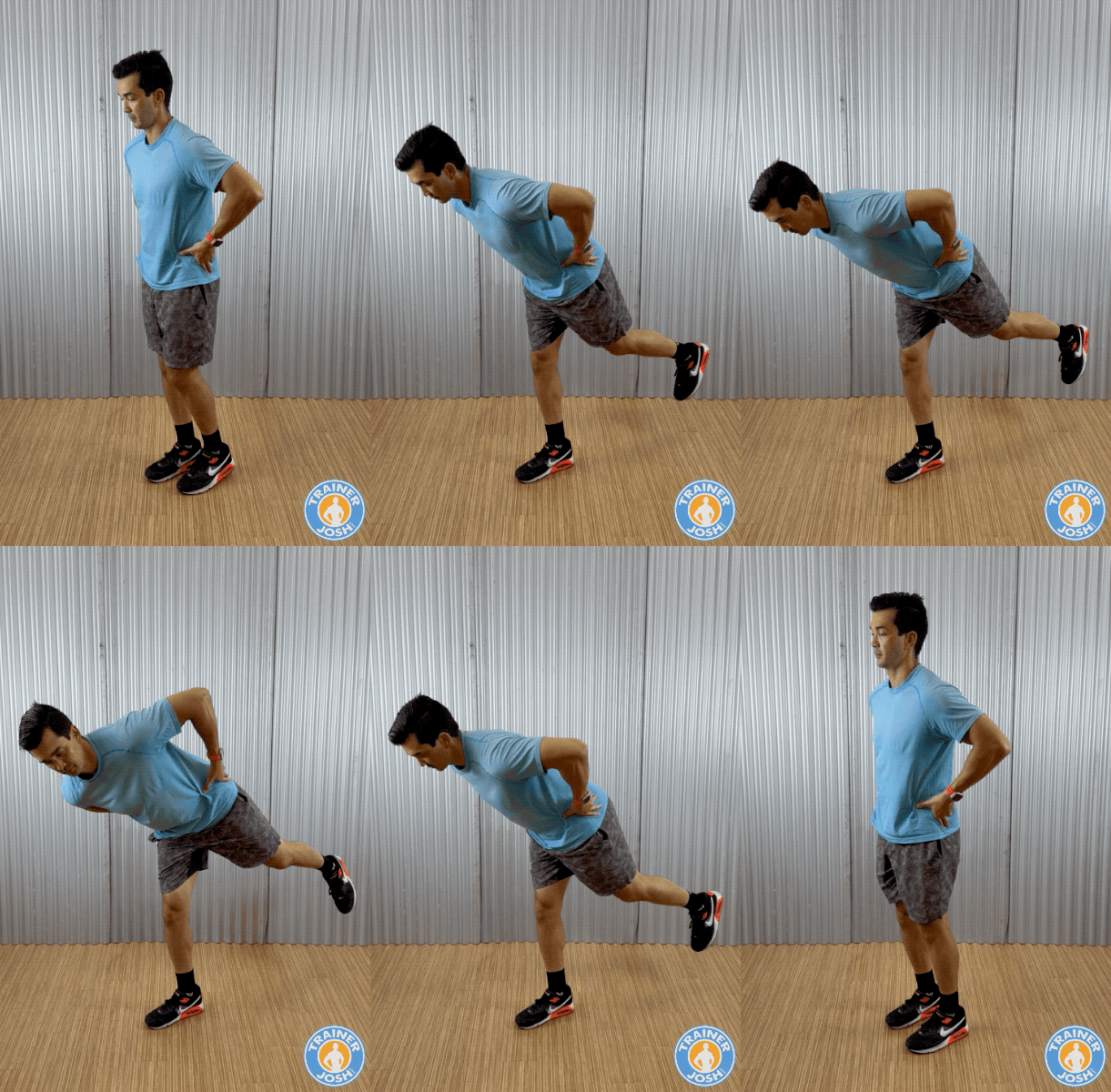
Hip airplanes are a foundational and advanced hip mobilization drill (known as a “hip greaser”) for restoring hip mobility and glute strengthener simultaneously. It should be treated as an active movement and not a passive stretch.
The hip airplane builds essential active flexibility without stressing the back. It takes the gluteus maximus and gluteus medius through their full range of motion under load. McGill thinks of it as such an important movement that he incorporates it into serious squat training and calls it a compulsory warm-up for lifters, runners, and golfers.
This exercise focuses on the fundamental athletic movement pattern of internal and external hip rotation. At the same time it demands intense balance and the ability to steer strength through a single supporting leg.
10-Minute Daily Routine for Lower Back Pain (Plus a Progression Plan)
Ten minutes. No equipment. No gym. This is the routine that spine researcher Dr. Stuart McGill’s methodology is built on, and it’s the same foundation I give every client who walks in with a back that’s been beaten up.
The goal isn’t flexibility. It’s protective stiffness around the spine, built by controlled stability work and minimal compressive load.
Minutes 1-2: Cat-Camel. On your hands and knees, slowly cycle between a gently rounded back and a gently arched back. Stay out of the deep end-ranges.
This is joint lubrication, not stretching. Perform exactly 7 to 8 cycles. More repetitions add no benefit and risk irritating the tissue.
Minutes 2-10: The Big 3 (Descending Pyramid). All three exercises use holds of 8 to 10 seconds maximum.
Longer holds deplete oxygen in the torso muscles, accelerate fatigue, and break down form. Keep holds short and reps crisp.
Arrange each exercise in a descending pyramid:
Modified Curl-Up: Lie on your back, one knee bent, hands under your lower back. Lift your head and shoulders one inch. Hold 10 seconds.
- Set 1: 4 reps, brief rest
- Set 2: 3 reps, brief rest
- Set 3: 2 reps
Side Bridge: Plank from your knees (beginners) or feet, on your side. Hold 10 seconds per side.
- Set 1: 4 reps each side
- Set 2: 3 reps each side
- Set 3: 2 reps each side
Bird-Dog: On hands and knees, extend opposite arm and leg. Spine stays completely still. Hold 10 seconds per side.
- Set 1: 4 reps each side
- Set 2: 3 reps each side
- Set 3: 2 reps each side
Pair this daily routine with interval walking: three 20-minute walks with upright posture and arm swing from the shoulders. Walking unloads the spine and builds the aerobic base that supports recovery.
The Progression Plan
Phase 1: Add Reps, Never Time
Never extend your holds beyond 10 seconds. Instead, add one rep to each set. Move from a 4-3-2 pyramid to 5-4-3, then to 6-4-2.
One of my clients, a 53-year-old with chronic lower back pain, went from barely managing 4-3-2 to completing 6-4-2 pain-free across six weeks. That progression alone changed his baseline pain significantly.
Phase 2: Increase Motor Control Complexity
Once the basic Big 3 feel controlled and pain-free, add complexity minus adding load. For the bird-dog, sweep the extended hand and foot along the floor without resting between holds, then progress to drawing small squares in the air.
For the side bridge, progress from knees to feet, then learn to roll from a right-side plank into a front plank into a left-side plank while keeping the ribcage locked to the pelvis throughout.
Phase 3: Train Movement Patterns
Once pain is fully managed and core endurance is solid, shift from rehabilitation to functional strength. Stop training isolated muscles.
Train movement patterns instead: push, pull, lift, and carry. Push-ups, TRX rows, cable pulls, and suitcase carries (one heavy weight in one hand, spine locked and upright) all build athletic strength while keeping the spine safely out of the load-bearing position.
All power is generated from the hips and shoulders. The spine stays stiff and neutral throughout.
When to Stop Exercising & See a Doctor (Red Flags)
The vast majority of back pain is mechanical. It responds to movement corrections, load management, and the kind of rehabilitation covered throughout this article.
Some back pain is not mechanical. And pushing through the wrong kind can cost you.
Red Flags: Stop Everything and See a Doctor
These symptoms require a physician, not a new exercise program. If you experience any of the following, stop all exercise and seek immediate assessment.
Bowel or bladder incontinence (loss of control over either). This points to possible cauda equina syndrome, a medical emergency involving severe spinal nerve compression.
Saddle anesthesia: numbness around the inner thighs and pelvic floor.
Progressive night pain that is constant and gets worse over time, not positional.
Unexplained weight loss with no change in diet or activity.
Back pain with fever or pain accompanied by a history of systemic illness.
Abdominal pain located between the navel and pubis, or extreme constipation alongside back pain.
A history of cancer or intravenous drug use.
Recent significant trauma, such as a car accident or serious fall.
Pain that doesn’t change with any position or movement. This is one of the most important flags on this list. Mechanical back pain almost always fluctuates in intensity with posture, load, and movement.
Pain that remains completely constant regardless of whether you’re sitting, lying, standing, or moving points toward serious internal causes. This includes an aortic aneurysm, pulmonary embolism, or tumor. It is not a movement problem.
When to Stop a Specific Exercise Mid-Routine
Short of a medical emergency, you also need clear rules for when to halt an individual’s exercise during recovery.
Stop when it causes pain. Pain during exercise indicates you have crossed your biological tipping point and are actively causing microtrauma in the tissue. Regress to a completely pain-free level. There is no version of this where pushing through pain speeds recovery.
Stop when your form breaks. Fatigue shifts mechanical stress from the muscles onto the spinal joints. The moment your technique degrades, that stress lands exactly where it can’t be tolerated. End the set before form goes, not after.
Stop when you fail the Three-Day Rule. Present any new exercise with a small exposure on day one. Evaluate on day two.
A tweak or increased pain means you have done too much too soon. Stop the new exercise and return to your established foundation before trying again.
Final Thoughts: How to Fix Lower Back Pain for Good (Instead of Just Managing It Forever)
Most people don’t fail at back pain recovery because they’re lazy. They fail because they’re chasing the wrong target.
Relief is not recovery. Feeling better for an hour after a massage, a stretch, or a manipulation is not the same as fixing the mechanical problem that caused the pain.
The moment the passive treatment ends… the flawed movement patterns that caused the damage are still there, just waiting.
Why Most People Stay Stuck
Passive treatments (massage, ultrasound, laser therapy, repeated joint manipulation) have one thing in common: something is done to you rather than by you.
They can open a window of reduced pain. They do nothing to re-educate the movement habits that caused the tissue damage in the first place.
Stretching compounds this. Pulling your knees to your chest gives 15 to 20 minutes of neurological pain relief while mechanically aggravating the discs underneath. The pain comes back because the cause was never touched.
The deeper trap is this: people do their therapeutic exercises correctly for 10 minutes, then spend the other 23 hours slouching at a desk, bending at the spine instead of the hips, and loading their back in the exact patterns that caused the problem.
That’s picking the scab. The tissues never get the uninterrupted window they need to heal.
What to Do Next
Recovery from lower back pain is not a 7-day fix. It requires a sequential, systematic approach and the patience to follow it in order.
Step 1: Assess. Identify your exact pain triggers. Find the specific motions, postures, and loads that reproduce your symptoms. Without this, every intervention is guesswork.
Step 2: Eliminate the cause. Replace the flawed daily movement habits with spine-sparing tools: the hip hinge for bending and lifting, the lunge for reaching the floor, the stop-twist for rotation. Stop picking the scab.
Step 3: Build the foundation. Once pain begins to settle, introduce the Big 3 (modified curl-up, side bridge, bird-dog) paired with daily interval walking. Build core endurance first. Strength and complexity come after.
Think of your recovery as a biological bank account. Every pain-free movement puts credit in. Every movement that triggers pain withdraws from it.
Consistent, joint-sparing mechanics gradually overwrite the corrupted pain circuits in the nervous system and dial down baseline sensitivity over time. That’s the actual neurological mechanism behind long-term recovery.
The people who get their lives back are the ones who stop chasing relief and start fixing the cause.