

You switched from cereal to granola because it was supposed to be the “healthy” choice. You’ve been spooning it over Greek yogurt every morning. But the scale hasn’t budged in weeks.
Here’s the truth… granola isn’t the enemy. But the way most people eat it is when fat loss goes sideways.
I’ve spent 20 years as a personal trainer watching clients do everything right on paper. Hit their macros, choose “clean” foods, stay consistent… but it still feels like the math isn’t mathing.
Granola is one of the most misunderstood foods in the weight loss world. The beta-glucan fiber in oats can suppress the hunger hormone ghrelin, slow gastric emptying, and blunt post-meal blood sugar spikes.
But those benefits get buried when granola is toasted in oil and loaded with brown sugar and maple syrup. This flips it from a functional food into a blood sugar spike that sends you raiding the kitchen by 10 a.m.
Most people don’t realise a “healthy” serving is just 25 grams. Many adults will pour 2-3x that without blinking. Quietly adding 400-600 calories before the day even starts.
Here we’ll break down exactly why granola can work for weight loss under the right conditions, why it backfires for most people, and the specific strategies to actually move the scale.
Quick Answer: Is Granola Good or Bad for Weight Loss?
Key Takeaways:
- You can eat granola and still lose weight—if you stay in a calorie deficit. Fat loss ultimately comes down to calories in vs calories out, and you can lose weight if you budget it in.
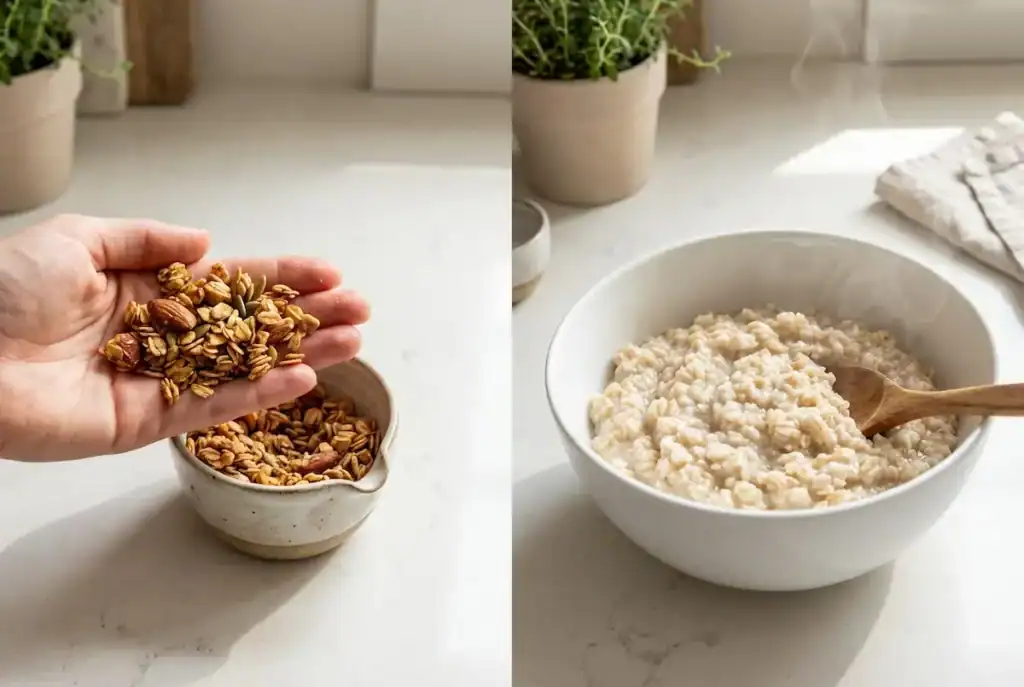
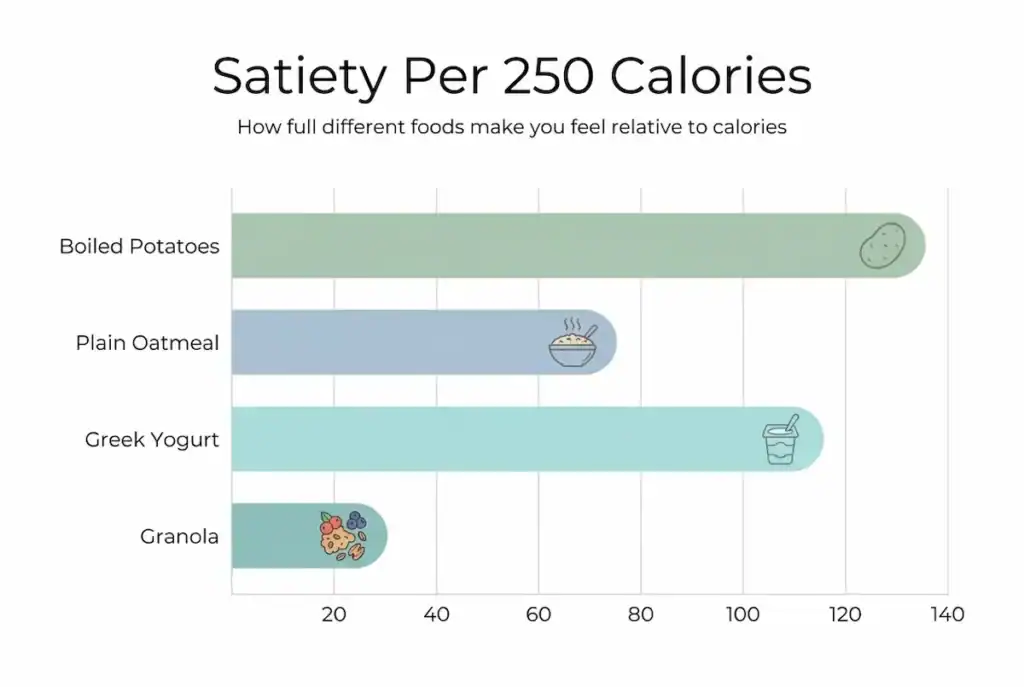
- Granola is calorie-dense but not very filling. Compared to oatmeal, granola has more calories with less volume and weaker satiety. This makes it easy to overeat.
- Portion size is the biggest danger. Just 1/2 cup was ~250 calories. But most people pour 2-3 servings. This turns a “healthy” breakfast into a 600-900 calorie bomb.
Let’s cut straight to it… granola isn’t a forbidden bad food. But it’s not your friend either.
Here’s the honest answer: you can eat granola and lose weight. Fat loss comes down to energy balance. Calories in vs calories out. So if you’re in a calorie deficit then you’ll body fat.
The problem isn’t necessarily the granola. It’s the portion size.
A half-cup of honey-sweetened granola runs around 250 calories. Sounds manageable until you realize people pour 2-3x that without thinking. One “healthy” bowl can quietly deliver 600-900 calories before you’ve eaten anything else. That’s half a day’s food budget gone wrong before 9 a.m.
And here’s what makes it sneaky: granola scores poorly on the satiety index. This is the measure of how full a food actually makes you feel relative to its calories.
Compare that to plain oatmeal, which expands with liquid, activates beta-glucan fiber, and gives you significantly more volume for less calories. Same macronutrient category. But a completely different hungry response.
Most store bought granola compounds this problem with bad vegetable seed oils (soy, canola, sunflower) and added sugar. This combination spikes insulin, blunts fat burning, and has you hunting for a snack by mid-morning. Sugar sweetened granola has close to zero satiating effect.
A 2018 randomized controlled trial in the British Journal of Nutrition found that replacing two daily snacks with granola providing 16 grams of oligofructose per day for 12 weeks did not significantly change body weight, fat mass, or total daily energy intake in overweight and obese adults.1
THE BOTTOM LINE:
The verdict? Granola can fit into a fat-loss diet… but ONLY if you weigh it, track it, and treat it like the calorie dense food it is.
Why Granola Can Help with Weight Loss
Granola does have a legitimate case for helping you lose weight. Here’s when and why it can work.
High Fiber Helps You Feel Fuller Longer
The oats and nuts in granola contain dietary fiber that slows gastric emptying. This means food physically stays in your stomach longer. That delays the hunger signal.
Since granola is typically made from nuts and seeds, the undigested lipids in the stomach delay gastric emptying. This can help enhance long-term satiety.
But the fiber in granola isn’t the same as that in other oat foods like oatmeal. Grains in granola are often rolled, puffed, or extruded. This processing breaks down the fiber structure and causes the starch to be digested rapidly into sugar.
Healthy Fats Reduce Cravings
The nuts and seeds in granola (almonds, walnut, pumpkin seeds) slow digestion even further by delaying gastric absorption. Fat triggers the release of satiety hormones like leptin. This keeps blood sugar from spiking and crashing.
That crash is what can send you raiding the pantry at 3 p.m..
Research suggests that some calories from nuts may actually go unabsorbed. This means the caloric impact is lower than what’s printed on the label.
A controlled feeding study in The American Journal of Clinical Nutrition found that whole almonds provide about 4.6 kilocalories per gram—roughly 20–30% fewer usable calories than standard Atwater-based labels—because a significant portion of almond fat remains trapped within intact plant cell walls and is excreted rather than absorbed.2
Convenience Keeps You Off Junk Food
This one’s underrated. Granola is shelf-stable, requires zero prep, and pairs with protein in under two minutes.
For the person who skips breakfast and ends up eating drive through by 10 a.m.… then a pre-portioned 40g serving with Greek yogurt is a legit win. Not because granola is magic, but because it beats the alternative.
The best diet is the one you can actually stick to.
When you’re traveling, hiking, or busy at work, it’s common to be surrounded by “toxic” options like vending machine snacks or fast food. Nut-based granola can hold up well in warm temperatures and doesn’t spoil easily. Keeping a baggie of it ensures you have a high-fat, hunger-killing meal replacement on hand. This will prevent you from resorting to fast food.
Granola is also crunchy and requires chewing. This harder texture needs more “oral processing.” This stimulates satiety signals better than soft or liquid foods.
One of the hardest parts of transitioning into a low-carb diet is missing the “crunch” and comfort of cereal. Granola satisfies the craving for crunchy texture and can be a vehicle for healthy fats when adding it with Greek yogurt or cottage cheese.
If allowing a small amount of granola to satisfy the crunchy craving allows you to stick to a low-carb or healthy-fat diet without feeling deprived… then it’ll prevent binges on worse junk food.
Why Granola Can Cause Weight Gain
This is where most people get blindsided. Because granola looks healthy… so they stop paying attention.
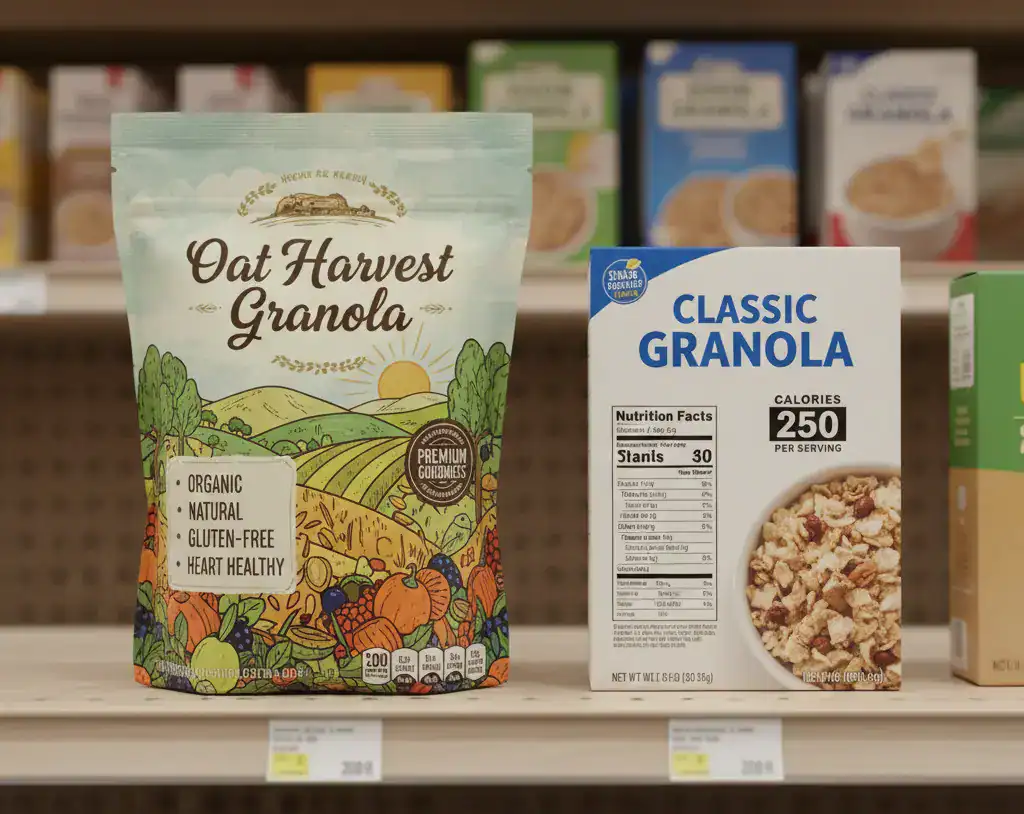
The “Health Halo” effect is the psychological bias that often causes people to overeat foods they perceive as healthy. Deceptive marketing can lead people to let down their guard with portion control.
A 2026 study in the European Review of Agricultural Economics found that both restrained and unrestrained eaters rated otherwise identical foods as healthier and lower in calories when they carried an organic label, and this organic health halo persisted across different mood states even though the organic and regular versions had exactly the same calorie content.com
It’s Extremely Calorie-Dense
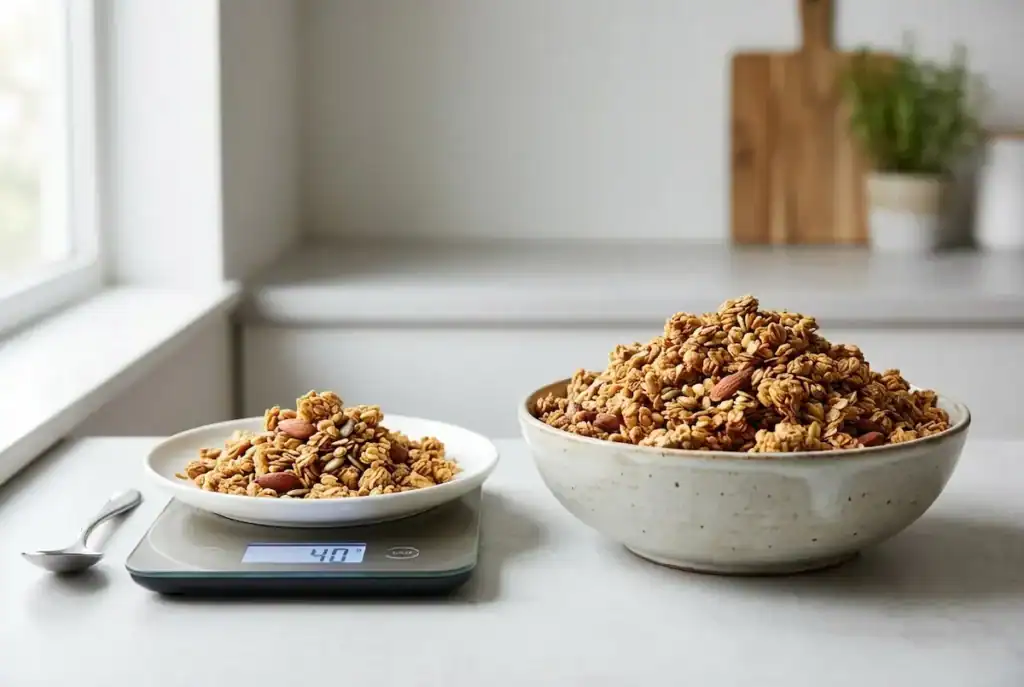
A half-cup of honey-sweetened granola contains 250 calories. Even the low-fat versions contain about 186 calories per small scoop.
Here’s the visual: that half-cup fits in the palm of your hand. It doesn’t look like much. And it doesn’t feel like much. Because granola is dry, low in water, and doesn’t trigger the stomach-stretch receptors that signal fullness.
Pour a normal looking bowl? You’re likely looking at 600-900 calories before you add milk.
There’s another layer most don’t know: because granola is processed (baked, dried, sweetened), your body burns fewer calories digesting it than it would whole oats and raw nuts.
Research shows processed meals have roughly half the thermic effect of whole-food meals with identical macros. You’re getting more net calories than the label even suggests.
A 2010 crossover study in Food & Nutrition Research reported that an 800‑kilocalorie processed cheese sandwich made with white bread and processed cheese produced about 50% less diet‑induced thermogenesis over 6 hours than an 800‑kilocalorie “whole‑food” sandwich made with multigrain bread and cheddar, despite having nearly identical macronutrient profiles.4
So your net energy balance might be higher even if you’re tracking the calories of granola perfectly. This is because your body expends less energy digesting the granola.
So eating the same calorie amount from less processed foods, like plain oats or raw nuts, can push your net energy balance lower.
Portion Sizes Are Much Smaller Than You Think
The recommended serving is 40-50 grams. That’s about a quarter to a half cup.
Most people pour 2-3x that much without a thought.
One client of mine who loves granola told me… “I realized a serving was only 25g… and I was eating closer to three times that.” That single realization changed it all.
For weight loss: stick to 30-40g (40g max), weighed on a scale. No eyeballing. People underestimate portions by up to 50%. And with granola, that error can cost you hundreds of calories.
Added Sugars Sabotage Fat Loss
Granola is a high-carbohydrate “carb bomb” that spikes insulin. The primary drivers of excess body fat are calories and insulin.
Sugar spikes blood glucose. Insulin floods in to clear it. Fat burning is then shut off while insulin is elevated. Your body can’t physically access stored fat for fuel.
And even worse is how insulin overcompensates. Blood sugar crashes, and now you’re hungry again two hours later. You’ll crave more carbs to stabilize. It’s a loop.
Many “natural” granolas use honey, maple syrup, agave, or evaporated cane juice instead of refined sugar. Healthier? Slightly. They can skyrocket the calories and make it possible to get fat by eating high-calorie natural carbs.
The fat and carb content is highly palatable. Granola combines high carbs (oats/sugar) with high fat (nuts/oils). Foods rich in both carbs and fats are rare in nature. But they hyper-stimulate the brain’s reward pathways, overriding your body’s natural “stop eating” signal.
Many store-bought granolas are toasted using refined polyunsaturated vegetable (seed) oils. Think of these as free radicals in a bottle. They’re highly unstable and prone to oxidation.
Consuming these seed oils can disrupt healthy cellular function and can interfere with healthy fat metabolism. Over time, this can make it harder for you to burn the fat you already have.
It Won’t Keep You Full Alone
Granola is mostly carbs and fat. Protein is minimal.
Protein is the macronutrient that most aggressively controls hunger hormones and keeps you satisfied between meals.
You’ll burn through the granola fast without protein to anchor your breakfast. Then you’ll be searching for food again before lunch.
You can use my free protein calculator to instantly determine your daily protein needs.
Granola is usually dehydrated and dry. Satiety is strongly influenced by food volume and viscosity (thickness/water content).
It’s better to eat high-volume foods rich in water, like fruits and vegetables. They trigger gastric stretching receptors that signal fullness. But granola doesn’t trigger these receptors since it lacks water volume… unless you have eaten a lot of it.
Best Way to Eat Granola for Weight Loss
Granola is one of those “danger zone” foods that you need to use a strategic approach when eating. It’s high in energy density, low in water content, and highly palatable (combines sugar + fat) making it easy to overeat.
Weigh Your Portions (Do Not Eyeball)
Granola is so energy dense it can become dangerously easy to overeat. With a standard bowl holding two to three cups, this could add up to 1,000+ calories in one sitting.
Never pour granola freely from the container. Don’t use measuring cups for granola since it’s calorically dense. It can settle and can be overpacked. Always use a digital food scale.
Stick to a max of 40 grams of granola per serving size. This will be a lot smaller than what you visualize as a “bowl”. I advise my clients to ideally limit each serving to 20-30g.
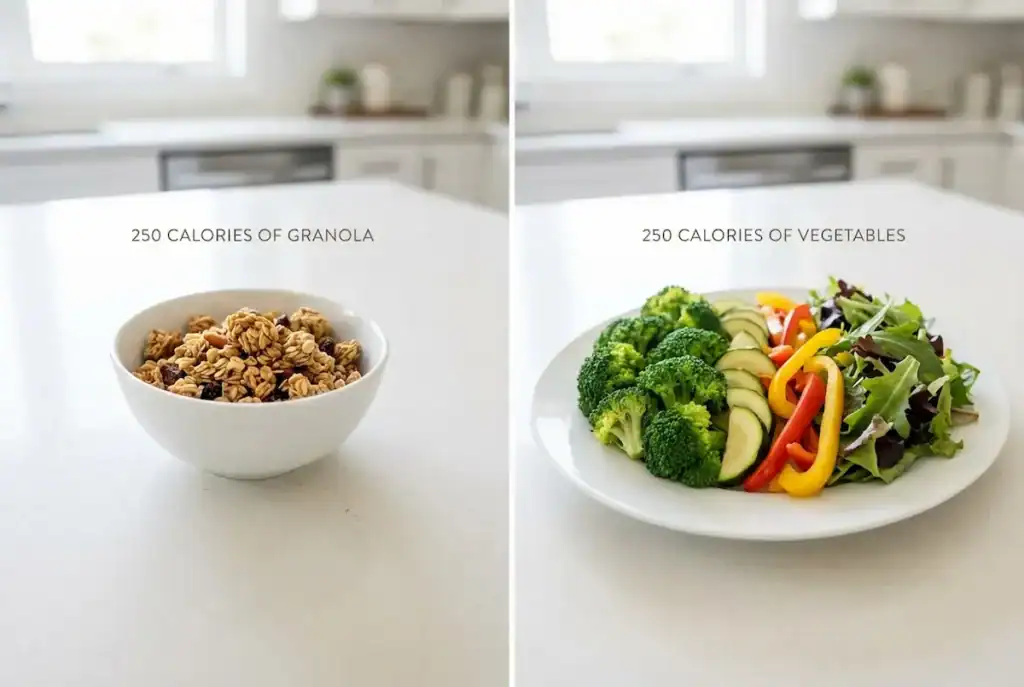
Research shows that people tend to underestimate the calorie content of foods they perceive as healthy. A small handful can easily contain as many calories as a large plate of vegetables.
Treat it as a Garnish, Not a Meal
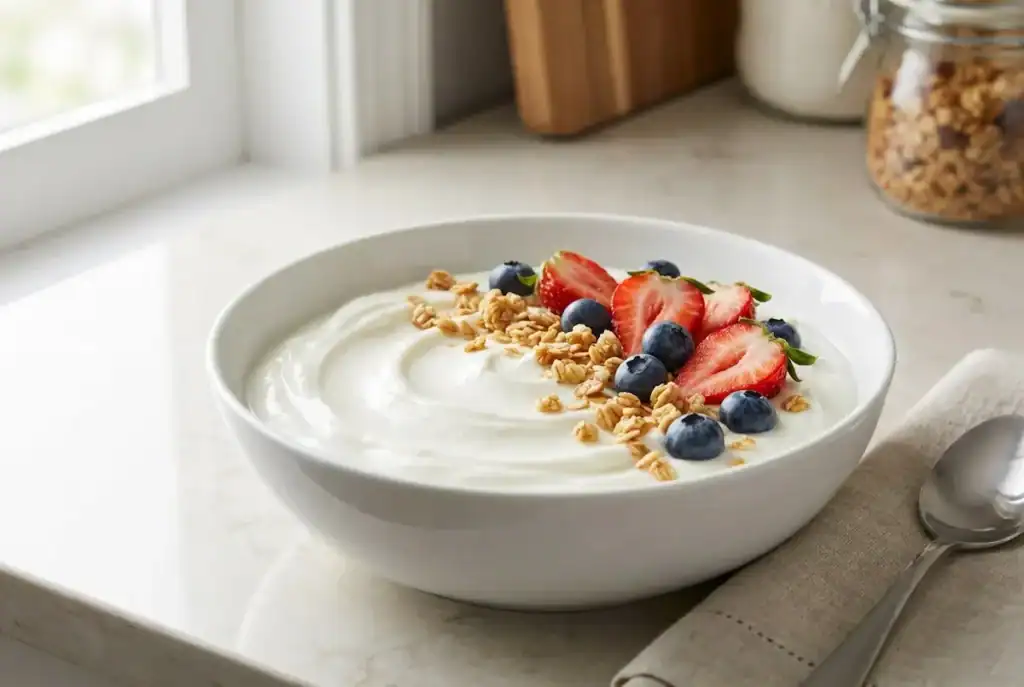
Do not eat granola like cereal in a bowl with milk. Adding calories from milk to dry, energy-dense foods (such as granola) will lead to poor satiety.
Instead, use granola as a crunchy topping on high-viscosity, high-protein foods.
These foods include Greek yogurt, cottage cheese, quark, egg whites, or casein. These are top-tier satiety foods because of their thickness (“viscosity”) and protein content.
Mixing a small amount of granola into thick yogurt will create a high-volume, satiating meal. But eating a bowl of granola with milk will only provide a small amount of food and be high in calories.
“Volumize” with Fruit
Granola is dehydrated, so to lower the caloric density of your meal, mix it with foods that are high in water content.
The Strategy: Mix a small portion of granola with a large portion of strawberries, blueberries, blackberries, or melon.
This is because fruits have high water content and volume. Adding them will reduce the meal’s average energy density.
This will allow you to eat more food while consuming fewer calories. This will trigger the gastric stress receptors that signal fullness.
But a warning on dried fruit. Dried fruit can be a challenge for dieters because removing water reduces bulk and volume. This makes it very easy to overconsume hundreds of calories of sugar without feeling full.
How to Choose the Best Granola for Weight Loss
Granola can be an exercise in damage control. Granola is low on the satiety index, so it doesn’t make you feel full, but also extremely high in energy density, containing high calories for such a small volume.
When choosing the best granola for weight loss, look for specific characteristics that mitigate these issues.
The first and most important step is to flip the package over and read the ingredients first.
1) Look for “Low Fat” & “No Sugar Added”
The least satiating foods are those that are high in both carbohydrates and fat. This combination hyperstimulates your brain’s reward pathways, which will override satiety signals.
Choose a granola that’s low-fat and/or low-sugar. Avoiding the combination of the two is key to preventing passive overeating.
Avoid granolas that come with dried fruit. Dried fruit is essentially candy in terms of sugar concentration. It will lack the water content of fresh fruit, which helps you feel full.
Sugar-free means no honey, agave, maple syrup or cane sugar.
2) Check the Fiber Content
The fiber is crucial for weight loss because it slows gastric emptying and adds bulk without adding significant calories.
Every 14 grams of fiber can reduce ad libitum energy intake by 10%. Soluble viscous fibers are particularly effective because they swell with water.
But do not rely only on the fiber count. On a calorie-for-calorie basis, the fiber in grains is far less effective for weight loss than the fiber in vegetables. This is because grains have a much higher energy density.
Look for oats/grains that are as unrefined as possible. The more processed the grain, the less fiber it typically holds. And then the faster it’ll spike blood sugar.
3) Check the Fat Source
Granola contains fat from two sources: nuts/seeds and added oils.
Nuts/seeds can be terrible for weight loss because of how calorie-dense they are. Nuts contain roughly 600 calories per 100g.
Research shows nuts are no more satiating than chocolate or rice cakes when matched for calories. So a granola loaded with nuts will skyrocket the calorie density without providing a proportional increase in fullness.
A 2014 randomized crossover study in the American Journal of Clinical Nutrition found that when adults consumed isoenergetic 300‑kilocalorie snacks, peanuts did not produce greater subjective satiety than potato crisps, even though all snacks were matched for calories.5
And many granolas are toasted with oils to make them crunchy. This adds passive calories that don’t improve satiety. It’s best to choose a granola where the fat comes primarily from nuts/seeds instead of added oils.
Avoid “vegetable” oils such as canola, soybean, sunflower, safflower, corn, or cottonseed. These oils promote systemic inflammation and can directly interfere with your body’s ability to burn stored fat.
It’s best to choose a granola that’s baked with coconut oil, butter, ghee, or avocado oil. These are stable, healthy saturated and monounsaturated fats that support cell function and satiety.
4) Best Option: Make Your Own
Finding a store-bought granola with minimal added sugars or seed oils is difficult. This is because they’re cheap and common.
This is why the best option is usually just to make your own healthy granola. You can use high-satiety ingredients and low-calorie sweeteners without the seed oils.
If you’re shopping or baking granola, then look for this profile:
- Base: Raw almonds, cashews, flax, chia, pumpkin seeds & sunflower seeds
- Texture/Flavor: Unsweetened coconut flakes, cacao nibs, cinnamon, and/or nutmeg
- Binder: Coconut oil and a tiny amount of honey (or keto sweetener)
This profile provides you with high healthy fats (~38g), moderate protein (11g), and low carbs (20g total, much of which is fiber).
You can also use egg whites as a binder for your granola instead of oil or excessive honey. This will increase protein (which is satiating) and lower fat density.
Use low-calorie sweeteners like stevia, allulose, or monk fruit instead of sugar/honey. This significantly reduces empty calories without spiking insulin or appetite.
You can also use the “trail mix” strategy to dilute the sugar impact with healthy fats.
Mix ⅓ to ½ cup of healthy granola with 1-2 ounces of raw/toasted nuts (like almonds, pecans, or macadamias) and shredded coconut.
This increases the healthy fat and protein content. Also slows digestion and prevents the insulin spike that locks in fat storage.
Best Time to Eat Granola for Weight Loss
The best time to eat granola for weight loss depends heavily on your carbohydrate tolerance, body fat percentage, and sleep quality.
This is because granola is a calorie-dense carbohydrate source with a low satiety index. So timing can strategically help mitigate its downside (easy overeating) and leverage its upsides (sleep support).
The Best Time: Around Your Workout
From a physiological perspective, the best time to eat a calorie-dense, high-carbohydrate food like granola is before or after exercise.
Fueling Training: Granola provides a concentrated source of carbohydrates. Consuming carbohydrates 1-4 hours before a workout will top off muscle and liver glycogen. This helps delay fatigue and maintain training intensity.
Post-Workout Recovery: After a workout, your muscles are primed to take up nutrients. Eating carbohydrates like the oats and grains in granola, combined with protein, immediately after training refills muscle glycogen and stimulates protein synthesis. In this window, the calories are used for recovery rather than fat storage.
Insulin Sensitivity: Exercise increases insulin sensitivity. This means your body is better at shuttling the sugar and starch from granola into muscle cells rather than fat cells.
“Is granola good in the morning?”
I’m usually against having granola in the morning since it can be a “healthy start” trap. A breakfast with granola, yogurt, and fruit combination will deliver a massive carbohydrate load often exceeding 100 grams.
This will spike blood sugar and trigger a flood of insulin that’ll shut off fat burning immediately. This is especially true if you had an overnight fast, which will set you up for a sugar crash and hunger pangs by mid-morning.
Your body naturally burns fat and produces ketones in the morning after an overnight fast. Eating a high-carb breakfast stops this process instantly, so a high-carb morning meal sends a signal to your genes that carbohydrates are going to be your go-to fuel source for the rest of the day.
In the morning, your body releases a natural pulse of cortisol to help you wake up and mobilize energy. But cortisol and insulin have opposite effects. Eating carbs like granola at this time forces your body to release more insulin to manage the blood sugar than it would later in the day.
If you’re trying to maximize weight loss, then consider skipping breakfast entirely and using intermittent fasting.
Wait until your hunger ensues naturally. This extends your fat-burning window. If you must eat early, a high-fat, high-protein meal like an omelet is preferred over granola to keep insulin low.
“Is granola good at night?”
Contrary to the myth that carbs at night make you fat, if you’re a lean, healthy individual, then saving your carbohydrates like granola for the evening can be good for weight loss. It’s known as carb backloading and offers several physiological advantages for weight loss and recovery.
Epidemiological studies show that night eating is linked to weight gain only because it usually involves mindless snacking on high calorie foods. But controlled studies show that when calories are matched, eating late at night does not reduce fat loss.
A 2004 longitudinal study in Obesity Research found that adults who routinely consumed large snacks between 11 p.m. and 5 a.m. ate about 500 extra kilocalories per day compared with non–night eaters. This indicates that the excess weight gain was primarily attributable to additional nighttime snack calories rather than to meal timing alone.6
Sleep Quality: Eating high-carb foods 2-4 hours before bed can significantly improve sleep quality. Carbohydrates facilitate the transport of tryptophan into your brain, which converts to serotonin and then to melatonin (the sleep hormone).
Sleep deprivation forces your body to lose muscle and retain fat during a diet, so eating granola at night to improve sleep can indirectly support weight loss.
However, I wouldn’t recommend eating it late at night, as even healthy food can disrupt your circadian rhythm and hormones. Try to finish eating dinner by 7 pm or 8 pm at the latest.
Hunger Management: Eating carbohydrates at dinner has been shown to alter leptin (a satiety hormone) and adiponectin secretion patterns. This leads to lower hunger levels the following day.
Optimal Hormones: Cortisol levels naturally decline throughout the day. This means your body responds less to insulin in the evening.
Low Glycogen Stores: By the end of the day, especially if you’ve been active, your muscles and liver have been partly emptied. This allows your body to store the sugar from the granola in these stores rather than converting it immediately into body fat.
How Much Granola Should You Eat Per Day to Lose Weight?
There isn’t a single universal daily gram amount of granola you should eat. This is because granola has a high energy density and a low satiety index. This makes the recommended serving size for weight loss much smaller than a standard bowl.
If you’re trying to lose weight while eating granola, follow the garnish rule. Stick with 15-30 grams of granola per serving, and I definitely wouldn’t exceed 40 grams at the maximum.
Use it as a crunchy garnish on high-volume, high-protein foods such as Greek yogurt.
This lets you enjoy the flavor and texture of granola without consuming the 300-600 calories in a typical bowl. That would require massive dietary compensation elsewhere.
You have to treat calories as your daily budget. Weight loss is determined by energy balance. If you want to eat granola and lose weight, then you have to budget it in.
Granola is “expensive”. If you’re eating a large portion of granola, then you’re spending a large portion of your daily budget on a food that will not keep you full. To stay in a deficit, you would then have to drastically reduce calories from other meals, which would make you hungrier later in the day.
Ask yourself if granola is worth it. If a small 30-gram portion satisfies your craving and fits in your budget, then it’ll work if you’re trying to lose weight. But if you need a huge bowl to feel satisfied, then the “cost” of hunger later is likely too high.
Treat granola as a “sweet treat.” Granola is sugary, so it’s better to treat it as a dessert rather than a meal. Since granola is calorically dense, you’ll probably only need 2-3 tablespoons sprinkled over yogurt.
Who Should Eat Granola for Weight Loss (and Who Should Avoid It)
Who Should Avoid Granola
Volume Eaters and Those Struggling With Hunger
If you rely on feeling physically full to stop eating, then granola is a poor choice.
Granola is energy-dense and low in water content. You can cut the carbohydrate-derived energy intake of a meal in half by switching from grains like granola to potatoes or vegetables.
This will provide significantly more volume and satiety for the same calories.
The “Sugar burner” / Carb Dependent
Individuals with carbohydrate intolerance (often overweight/PCOS) are those who can get “hangry” and need to eat every few hours to maintain energy.
A sugar burner is someone whose metabolism has been damaged to the point that their cells cannot efficiently burn body fat for fuel. They rely on regular intake of sugar and starch to maintain energy.
For these people, eating granola can reinforce the very metabolic dysfunction they’re trying to heal. It’ll reinforce sugar dependency. It’s best for them to steer clear of granola.
People with poor carbohydrate tolerance are often characterized by being overweight, having PCOS, or insulin resistance. These typically lose more fat on lower-carbohydrate diets.
Carbohydrate foods like granola can increase inflammation and reduce energy expenditure due to a lower thermic effect of food in insulin-resistant individuals. For women with PCOS, reducing carb intake is specifically recommended to improve hormonal profiles and fat loss.
Impulsive Eaters
Granola is highly palatable since it’s usually sweet and fatty, and it’s also very snackable. So, for people who struggle with impulsive eating or binge eating, having highly palatable, energy-dense foods like granola visible in the kitchen can increase the likelihood of overeating.
Who Can Eat Granola (Strategically)
The “Sleep Hacker” (Lean & Strength Trained)
A small portion of granola 2-4 hours before bed can be a useful strategy for these people. Lean, insulin-sensitive individuals can consume carbohydrates in the evening by a process called carb backloading to improve sleep quality.
The “Big Breakfast” Responder
If you’re overweight and insist on eating granola, then maybe try eating it at breakfast and not at night.
This shows that for overweight individuals, consuming the majority of their calories and carbohydrates at breakfast leads to greater weight loss and better glucose control than eating them at dinner. This front-loading helps prevent impulsive snacking later in the day.
The “Flexible Dieter” (with High Calorie Awareness)
Track your macros and treat calories as a budget, then you can fit granola in. To mitigate its poor satiety, try mixing a small amount into high viscosity foods like Greek yogurt. The thickness of the yogurt compensates for the low volume of the granola, and this creates a satisfying meal that fits in a weight loss plan.
Is it ok to eat granola every day?
Yes, it’s ok to eat granola every day if you really want to. But it’s generally considered a suboptimal food choice for fat loss and health compared to other carbohydrate sources. Unless you’re being strict on managing it.
Granola is very calorie-dense and has low water content. Grains like granola have a lower satiety index than fruits or vegetables. You have to eat a tiny portion to keep calories low. And that can usually leave you hungry.
Commercial granola bars and cereals are often categorized as processed foods. These foods generally have a lower thermic effect of food (TEF). So you’ll burn fewer calories digesting them, and they’re less satiating.
Granola also contains anti-nutrients that can be harmful if you’re eating it every day. Grains (oats, wheat) contain phytic acid, which is an anti-nutrient that binds to minerals like magnesium, iron, and zinc in your gut and prevents their absorption.
Phytic acid can reduce magnesium absorption by 60%. A randomized crossover trial in the American Journal of Clinical Nutrition found that adding phytic acid to white‑wheat bread at a level similar to whole‑meal bread (1.49 mmol per 200 g) reduced fractional magnesium absorption from 32.5% to 13.0%, a decrease of roughly 60%.7
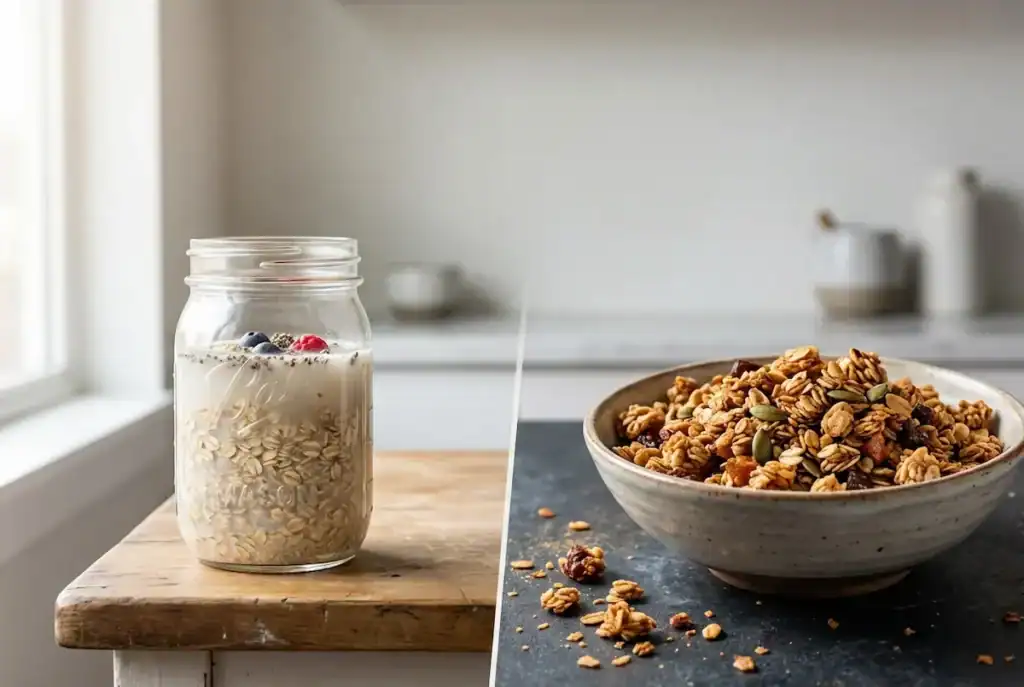
Soaking and fermentation (e.g., sourdough and overnight oats) are traditional preparation methods to reduce anti-nutrients. But most commercial crunchy granolas aren’t prepared this way. They remain high in anti-nutrients and can lead to mineral deficiencies.