
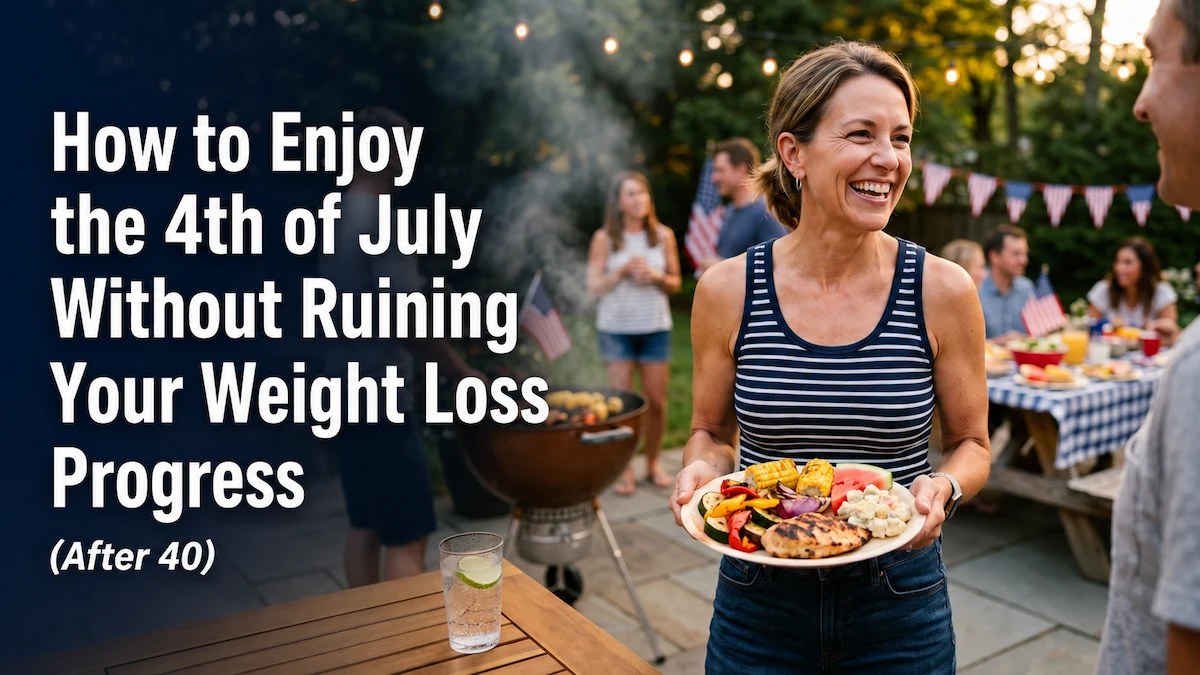

Trying to lose weight after 40? Then the 4th of July can feel less like a holiday and more like a trap.
Burgers. Chips. Beer. Someone’s homemade potato salad you didn’t plan for. Then leftovers on the fifth. And on the sixth.
Then you step on the scale one morning, and it’s up four pounds overnight. Suddenly it feels like you erased two weeks of progress in a single weekend.
Here’s the thing… After coaching busy professionals and parents over 40 through this exact moment for years, I can tell you the burger almost never ruins anything. What actually does the damage is the spiral after the burger.
You know the one. The scale jumps, the guilt kicks in, you decide you already blew it, so you keep picking at leftovers all day. Then you swear you’ll “start over Monday” and punish yourself with a brutal workout that makes you miserable and changes nothing.
That’s the real progress-killer. Not the holiday. The all-or-nothing crash that follows it.
The good news? You can enjoy the 4th, eat real BBQ, have a drink if you want one, and keep your fat loss momentum rolling. You just need a plan, not willpower.
In this guide, I’ll show you exactly how: what to do before you go, how to build a plate that still looks like a cookout, how to handle drinks, why the scale jumps (and why it’s not fat), and how to reset the next morning without starving yourself.
Read this before the first BBQ starts.
QUICK ANSWER:
One 4th of July BBQ will not ruin your weight loss progress. The real problem is showing up starving, grazing all day, drinking more than planned, panicking over water weight, and letting one meal turn into a whole weekend.
Eat protein before you go, build one smart plate, set your drink limit, and get back to normal the next morning.
Why the Fourth of July Feels So Dangerous When You’re Trying to Lose Weight After 40
Key Takeaways:
- The danger isn’t the burger. It’s the trigger stack (food variety, alcohol, poor sleep) plus the all-or-nothing spiral that follows it.
- Your metabolism after 40 isn’t broken. RMR remains stable with age when you account for muscle mass; the real issue is lifestyle and muscle loss.
- Alcohol suppresses fat burning and fuels next-day cravings by wrecking sleep and hunger hormones.
It’s not one hot dog. It’s not the burger, either.
The real threat is the pile-up: grazing all day, alcohol, dessert tables, salty food, late nights, and leftovers waiting for you the next morning.
That combination hijacks your fullness signals. Researchers call it sensory-specific satiety. The more food variety in front of you, the more your brain resets “full” and asks for another plate. A BBQ spread with five different dishes is designed to make you eat past your fill.
Is your metabolism really the problem after 40?
Your metabolism isn’t broken. That surprises most of my clients over 40.
Research shows resting metabolic rate stays remarkably stable from your 20s through your 60s once you account for fat-free mass (muscle). Fat loss feels harder now because of accumulated stress, less daily activity, and muscle you’ve lost from sitting more than you used to, not a slowing engine.
STUDY SAYS:
A 2021 study in Science looked at more than 6,400 people and found that, after adjusting for body size and fat-free mass, daily energy expenditure stays mostly stable from early adulthood through about age 60.1
That’s good news. You’re not fighting your biology. You’re fighting habits, and habits you can change.
Why does one holiday turn into a lost weekend?
Holiday weight gain rarely comes from one dramatic meal. Research on weekend eating patterns shows that it builds slowly and that the pattern that sticks is the one that matters, not a single plate.
Most people torch their progress in a different spot: the all-or-nothing mindset that follows. One off-plan plate turns into “well, I already blew it,” and Saturday becomes a write-off too.
From the Coaching Floor:
I had a client in her 40s tell me she lost two weeks of progress in one weekend, not because of the burger she ate Thursday, but because she gave up completely for the three days after.
One deviation from a fixed plan often triggers its total abandonment. Flexible control (enjoy the holiday, then get right back to normal) beats rigid control every time.
Why do alcohol and poor sleep hit harder now?
Alcohol doesn’t just add calories. Your liver treats it as a toxin, so it stops burning fat to clear it from your system first. It also doesn’t fill you up. It does the opposite: appetite goes up while your self-control goes down.
Stack a late night on top of that, and cortisol spikes. That throws off the hormones controlling hunger and fullness, which is why you wake up starving for carbs the next day.
Guilt doesn’t fix any of this. Shame after one meal often triggers people to eat the whole dessert table, “since I already blew it.” One holiday is a momentum risk, not a moral failure.
THE BOTTOM LINE:
One holiday plate isn’t the crisis. The guilt-driven spiral after it is. Skip the shame and get back to your normal plan at the very next meal.
Why “Saving Calories” All Day Before the BBQ Backfires (And What to Eat Instead)
Key Takeaways:
- Skipping meals before the BBQ backfires: it crashes your blood sugar and shuts down the self-control you need most.
- Eat a small protein-and-fat snack before you go so you arrive calm instead of starving.
- Real control comes from food quality and the 90/10 rule, not white-knuckling your way past the buffet.
Skipping meals to “save up” for the BBQ feels smart. It’s one of the fastest ways to lose control once you get there.
The Sumo Wrestler Mistake
Sumo wrestlers skip breakfast and train hard on an empty stomach on purpose. By the time they eat, they’re so ravenous they pack away massive quantities of food, and their bodies store it as fat.
That’s what happens when you starve yourself all day before a party. Your blood sugar crashes. Your brain sounds an ancient alarm built for actual starvation, and it doesn’t care about your goals.
Your Willpower Runs on Fuel, Not Motivation
Here’s what most people miss: willpower isn’t a mindset. It’s a biological resource that takes energy to run.
When your blood sugar drops, your brain goes into what researchers call “ego depletion.” Your self-control center starts shutting down because it’s out of fuel to operate on.
That’s the state one patient called “zombie eating.” You’re not choosing to grab three buns and a plate of sweet BBQ sauce. Your brain is doing it for you.
I had a client who professed she could “handle” skipping lunch before a party. She texted me that night: three plates in, and she couldn’t tell me why.
What to Eat Before You Go
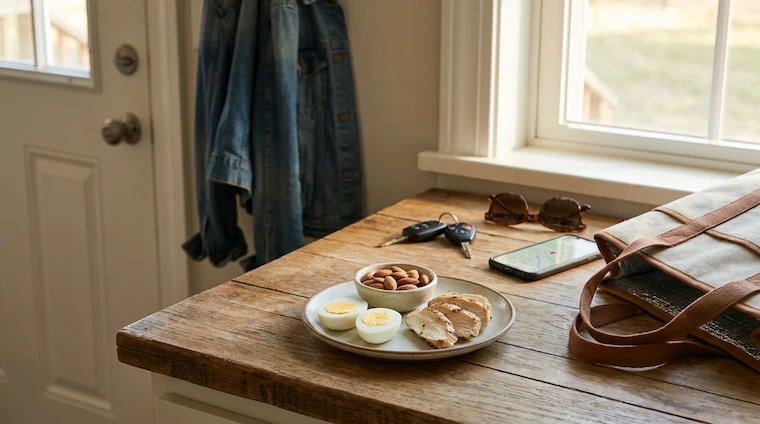
Don’t arrive empty. Eat a small meal or snack with protein and healthy fat before you leave the house.
COACHING TIP:
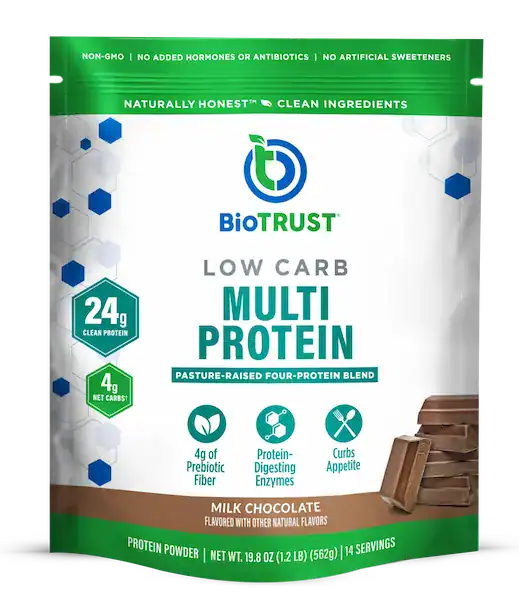
Real food is always the goal, but showing up to a BBQ starving is the worst move. If you’re short on time, a quick protein shake is better than walking into a party hungry, impatient, and surrounded by chips, buns, and dessert.
A low-carb, high-protein shake can help take the edge off hunger without feeling like a full meal, so you show up calm instead of circling the food table.
Finally, a Protein Powder Designed for those over 45... Only 150 calories, 4g net carbs, hormone & antibiotic-free. Supports lean muscle, weight loss & promotes healthy aging.
- 24g of clean protein for muscle health
- Fast digesting Whey for muscle support & slow digesting Casein for appetite control
- Four-Protein Time-Released Blend to keep you full and support weight management
- Natural ProHydrolase® enzymes to boost absorption
Good options: a handful of macadamia nuts, a hard-boiled egg, beef jerky, or a couple squares of 85% dark chocolate. These steady your blood sugar without spoiling your appetite for the main event.
Pack backup too… Raw almonds, walnuts, or hummus and veggies in the car mean you’re never stuck with junk food as your only option.
Drink a glass of water before you eat. It’s a simple habit that cuts appetite before you’ve taken a single bite.
Control Without Obsessing
Real control doesn’t come from tracking every calorie or gritting your teeth past the dessert table. Willpower like that runs out fast.
It comes from showing up with stable blood sugar and shifting your focus from quantity to quality. Fill your plate with real food first, and your appetite will naturally settle.
Try the 90/10 rule: Make solid choices 90 percent of the time, and give yourself room to enjoy the other 10 percent without guilt. That margin is what keeps one plate from turning into a spiral.
THE BOTTOM LINE:
Never arrive at the BBQ hungry; eat something small and protein-rich beforehand so your brain, not your blood sugar, makes the decisions.
Eat This High-Protein Meal Earlier in the Day (So You’re Not Thinking About Food at the BBQ)
Key Takeaways:
- A protein-forward meal earlier in the day releases hormones that keep you full for hours, not minutes.
- Digesting protein burns more calories than digesting fat or carbs, since your body works harder to break it down.
- Showing up fed means you’re present at the party instead of circling the food table.
There’s a difference between grabbing a handful of nuts on your way out the door and eating an actual meal earlier in the day. This is about the meal.
Protein Turns Down Your Hunger Hormones
Protein does something most food groups can’t. It triggers your body to release hormones that tell your brain you’re satisfied.
That’s not a mood thing. It’s a chemical signal, and it’s why a protein-forward lunch keeps you full for hours instead of one.
Protein also raises your metabolic rate while you digest it. Your body works harder to break it down, which means you burn more just processing the meal itself.
Why This Changes How You Show Up at the Party
Eating a real meal before you go does something bigger than curb hunger. It frees up your attention.
When your blood sugar is steady and you’re not thinking about food, you can actually be at the party. You talk to people. You watch the fireworks. You’re not circling the dessert table with one eye while pretending to listen to your cousin’s story.
From the Coaching Floor:
I had a client in his 50s who used to show up to every cookout starving because he thought skipping lunch would “even things out.” He’d spend the whole party hovering near the food table instead of talking to anyone.
Once he started eating a real protein-based lunch beforehand, he told me it was the first 4th of July in years he actually remembered the conversations.
What This Looks Like
Build your earlier meal around a solid protein source, whether that’s grilled chicken, eggs, or a lean cut of meat. Pair it with real food, not a shake and not a granola bar.
This isn’t the small pre-party snack from earlier. This is lunch or an early dinner, eaten like a normal meal, hours before the BBQ starts.
Skip this step, and you’re back to arriving hungry no matter how many almonds you packed in the car.
Pick Your “Worth It” Foods Before You Walk In (This Kills Buffet Overeating)
Key Takeaways:
- Food variety resets your appetite, dish by dish; even seeing more options can increase your intake by 43%.
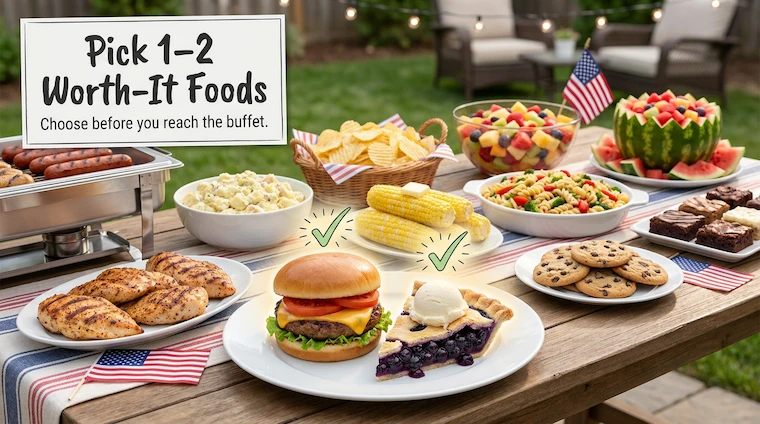
- Pick 1-2 “worth it” foods before you arrive, not while you’re standing at the table.
- Deciding in the moment burns willpower fast; deciding ahead of time protects it.
Decide what you’re eating before you’re standing over the food table. Not after.
Your Brain Resets “Full” With Every New Flavor
Your appetite doesn’t work like a single fuel gauge. It works flavor by flavor.
Researchers call this sensory-specific satiety. Your brain gets tired of one taste, but a new one shows up (sweet after salty, creamy after crunchy) and your appetite wakes back up.
STUDY SAYS:
A 1984 study published in Appetite found that offering a varied four‑course meal increased energy intake by about 60% compared with repeating the same food across all courses, and that the pleasantness of the eaten foods dropped rapidly while uneaten foods stayed appealing.2
Here’s the part that should stop you: even the illusion of more food variety can push your intake up by 43%. You don’t even need the extra dishes. Just seeing them is enough to make you eat more.
That’s exactly what a 4th of July spread is built on. Burgers, chips, three kinds of salad, a dessert table. Every new dish resets your “I’m satisfied” signal before you ever get there.
Pick 1-2 Items. Skip the Rest.
Scan the spread before you fill your plate. Pick one or two foods you actually want, the ones worth the calories to you.
Everything else gets a pass, not because you’re being “good,” but because you already decided it’s not worth it to you.
This isn’t about restriction. It’s about cutting the variety that resets your appetite in the first place.
COACHING TIP:
The hard part at a BBQ isn’t always hunger. It’s appetite. That “I’m full, but I still want something salty, sweet, creamy, and crunchy” feeling is exactly why holiday buffets are so easy to overdo.
This is where supporting your natural fullness signals can help. When your appetite is calmer going in, it’s easier to pick the one or two foods you actually want instead of grabbing a little bit of everything.
Why Deciding at the Table Never Works
Waiting until you’re standing at the buffet to decide is where most people lose the plan entirely.
Willpower runs on brain energy. Standing over a table full of food, negotiating with yourself dish by dish, burns through that energy fast.
I had a client tell me she “wasn’t going to eat the pie” right up until she was holding a plate at the dessert table. She caved, not because she lacked discipline, but because she made the decision at the worst moment possible, hungry and surrounded by options.
Decide before you’re hungry. Decide before you’re standing there. That’s what makes the choice stick.
Make It Count
If you’re going to spend calories on something, make it something worth it. A homemade pie beats a store-bought cookie you didn’t even want.
Choosing deliberately means you actually enjoy what you eat instead of grazing on whatever’s closest.
Choose your one or two “worth it” foods before you walk in, so you’re not negotiating with yourself over a full plate.
Know Your Drink Limit Before the First Sip (Or the Buffet Line Won’t Stand a Chance)
Key Takeaways:
- Binge drinking starts at 4+ drinks (women) or 5+ drinks (men) in one sitting, per the CDC.
- Set your drink number before you leave the house, not once you’re already holding one.
- Choose dry wine or clear spirits with a calorie-free mixer to avoid the fastest calorie traps.
Decide your drink limit before you pick up a drink. That’s the whole rule.
The CDC Draws a Hard Line Here
Four or more drinks in one sitting counts as binge drinking for women. Five or more counts for men.
Cross into eight or more drinks a week as a woman, or 15 or more as a man, and you’ve moved into heavy drinking territory. These aren’t arbitrary numbers. They mark the point where your brain’s decision-making takes a real hit.
Alcohol Doesn’t Just Add Calories, It Steals Your Filter
Protein and fiber shut down your appetite the more you eat them. Alcohol does the opposite.
It cranks up your appetite while it shuts down your judgment. That’s the exact combination that turns “I’ll just have one burger” into a second trip to the buffet you don’t remember deciding to make.
Wait until you’re already drinking to set a limit, and you’re asking a compromised brain to make the call. That never works.
Set the Number While You’re Still Sober
Pick your limit before you leave the house. Not “I’ll see how I feel.” An actual number.
Something like “two drinks tonight” works because you set it with a clear head, before the room, the music, and the peer pressure get involved.
The Calories Add Up Faster Than You’d Guess
Alcohol packs 7.1 calories per gram. A single cocktail can run past 500 calories on its own.
A night of casual beer drinking, the kind in which you lose count, can tack on 3,000 extra calories without a single trip to the food table.
What to Actually Order
Stick to dry wine, clear spirits with a calorie-free mixer, or straight liquor. Skip the sugary cocktails and the mixers loaded with syrup.
Space your drinks out, too. Giving your liver time between each one keeps your judgment sharper for longer.
From the Coaching Floor:
One of my clients used to show up to the 4th with no plan and always regretted the night after. Now she picks her number on the drive over. She told me just having the number in her head made her stop after two drinks without thinking twice.
Pick your drink limit sober, before the first sip, so alcohol never gets the chance to talk you out of it.
How to Build a BBQ Plate That Looks Like a Cookout, Not a “Diet”
Key Takeaways:
- Build your plate around a protein anchor (meat, skip the bun) plus a big pile of vegetables.
- Serve your 1-2 “worth it” extras in small portions, and eat them last, after protein and veggies.
- An acidic marinade before grilling reduces the formation of heat-induced aging compounds.
You don’t need diet food on the 4th. You need a plate built right.
Skip the “Don’t Eat the Fun Stuff” Rule
Telling yourself you can’t have any of it backfires. It’s called the forbidden fruit effect: ban a food, and you want it more, until you cave and eat way past what you actually wanted.
Nobody wins that game. Not you, not your plate.
Anchor Your Plate With Protein
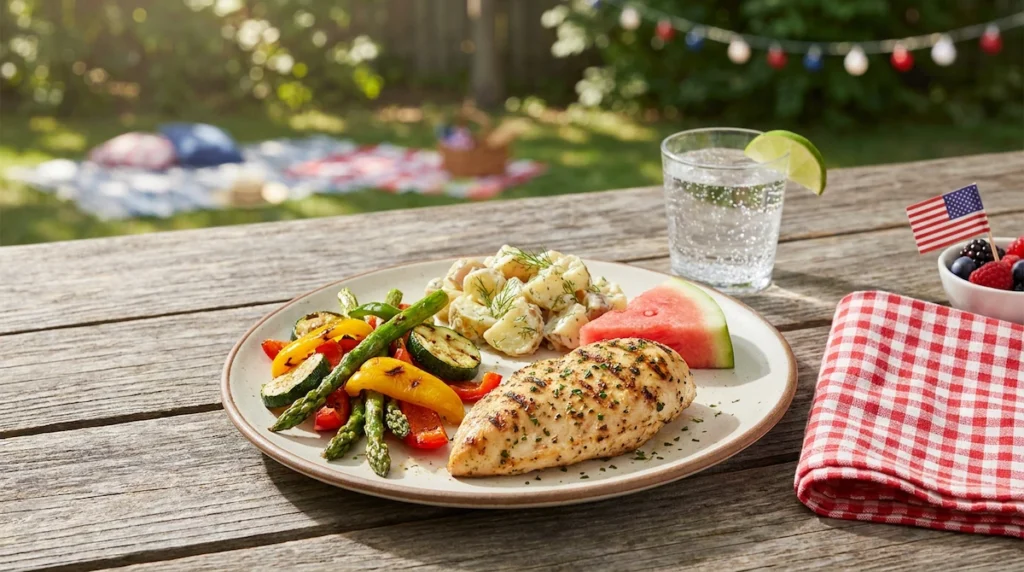
Fill most of your plate with grilled chicken, steak, burgers, or hot dogs. Skip the bun, or use half, and pile on real toppings: cheese, bacon, guacamole, pickles, onions.
This isn’t a downgrade. Fat carries flavor and keeps you full, so the plate feels as a feast, not a punishment.
Load up on vegetables too. A big salad, grilled zucchini, peppers. These barely cost you anything calorie-wise, and they take up serious space on the plate.
Pick 1-2 Extras, Then Serve Them Small
You already know to choose your “worth it” foods ahead of time. Here’s the part most people miss: portion them small on purpose.
Humans have something called the clean plate effect. Whatever you put on your plate, you’ll eat, whether you’re hungry for it or not.
So load up on protein and veggies, then serve yourself a modest scoop of that potato salad, not a mountain of it.
Eat in This Order
Protein and veggies first. Extras last.
By the time you get to the potato salad or the slice of pie, your stomach’s already working with real food. You’re eating the treat because you want the taste, not because you’re starving. That makes it a lot easier to stop after one plate instead of going back for round two.
From the Coaching Floor:
I had a client who used to load his plate corner to corner: chips, mac salad, a burger, dessert, all in one go. Once he started with protein and veggies first, he told me the mac salad just didn’t matter to him anymore by the time he got to it.
A Grilling Tip Most People Never Hear
High-heat grilling creates compounds called AGEs and HCAs, which are linked to faster aging.
STUDY SAYS:
A 2007 paper in the Journal of the American Dietetic Association found that grilling, broiling, and frying animal foods at high, dry heat increased dietary advanced glycation end products (AGEs) by up to 10–100 times compared with lower‑temperature moist methods, and these AGEs were linked to oxidative stress, inflammation, and age‑related diseases.3
An easy fix: Marinate your meat in an acidic liquid like lemon juice or vinegar and season it with herbs such as rosemary or thyme before grilling.
Studies show this combo can reduce harmful HCAs by up to 70–90% and cut AGE formation roughly in half, while improving flavor and tenderness.4
Anchor your plate with protein and veggies first, save your extras for last in small portions, and you get a plate that looks and tastes like a real cookout.
Why Protein First Isn’t Just a Rule, It’s a Trick on Your Own Brain
Key Takeaways:
- Protein and fiber trigger stomach stretch receptors that send the “stop eating” signal to your brain faster than sugar or starch does.
- Eating sweet or starchy foods first dulls your taste buds, making the savory protein you actually need taste bland by comparison.
- Digesting protein burns up to 20% more calories than digesting fat or carbs, simply from the effort of breaking it down.
You already know to build your plate around protein. Here’s the part nobody explains: why eating it first matters as much as choosing it.
Your Stomach Sends a “Stop Eating” Signal, But Only If You Trigger It Early
Your gut has stretch receptors. Once your stomach physically fills up, those receptors fire a signal to your brain that says “stop eating.”
Protein and fiber trigger that signal fast. Load up on grilled chicken, a lean burger, or shrimp first, and you hit that stretch point before you’ve touched a single dessert.
That means by the time you get to the fun stuff, your body has already sent the brake signal. You’re not fighting hunger anymore. You’re just choosing.
Eating Dessert First Ruins the Rest of Your Plate
Here’s the part almost nobody talks about: what you eat first changes how everything else tastes.
Hit the sweet stuff or the creamy potato salad before your protein, and your taste buds adjust. Suddenly that plain grilled chicken tastes bland by comparison, and you don’t want it anymore.
I had a client who grabbed a brownie the second he walked up to the buffet “just to get it out of the way.” Twenty minutes later, he told me his kabob “tasted like nothing.” He wasn’t wrong. His taste buds had already been recalibrated by the sugar.
Eat your protein while you’re still hungry for it, and it actually tastes good. Save the treats for last, and you’ll enjoy them more, since your palate hasn’t been blunted by sugar first.
Protein Burns Calories Just to Be Digested
Your body works harder to break down protein than it does fat or carbs. That effort alone can burn up to 20% more calories from a protein-rich meal compared to one loaded with starch or sugar.
That’s calories spent before you’ve taken a single step toward the fireworks.
So eat your protein while you’re still hungry for it, both for the caloric burn and because it’s the only way it’ll actually taste good.
The One Plate-Building Rule That Stops You From Going “Way Over” Without Noticing
Key Takeaways:
- Stacking multiple carbs (bun, chips, salad, dessert) happens gradually, one scoop at a time, without you noticing the total.
- Distracted eating at social events can push your calorie intake up by 75% or more compared to eating with full attention.
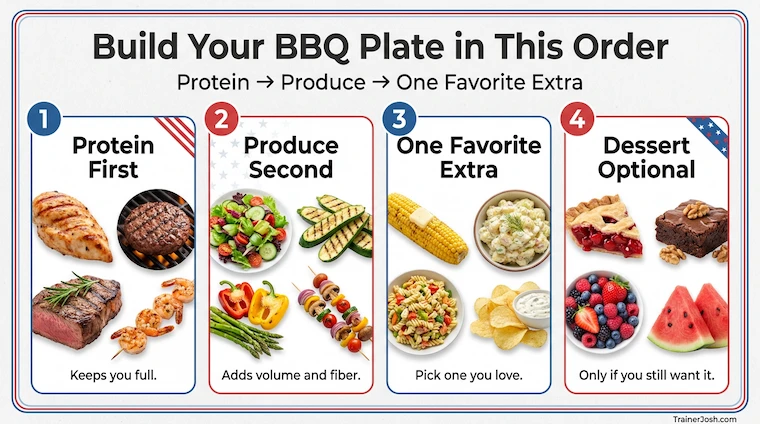
- Build your plate protein first, produce second, one favorite carb third, so you enjoy the extra without stacking five more on top of it.
You don’t need to skip carbs on the 4th. You need to stop stacking them.
How You Accidentally Eat Six Carbs on One Plate
Bun. Chips. Pasta salad. Potato salad. Dessert. A drink in your other hand.
Nobody sits down and plans that plate. It happens one scoop at a time, and by the time you’re done, you’ve stacked six different carb sources without ever noticing.
Distraction Doubles Your Damage
Here’s the part that makes BBQs uniquely dangerous: you’re not eating alone at a table. You’re eating while talking, laughing, half-watching the kids.
Research shows that eating while distracted (by screens, multitasking, or conversation) can significantly increase how much people eat and makes them more likely to overeat later, partly because the brain doesn’t encode the meal as clearly when attention is elsewhere.5
That’s not a willpower problem. That’s a math problem your brain can’t solve while it’s doing three other things at once.
The Fix: Protein, Produce, Then Your One Favorite Extra
Build your plate in this order every time. Protein first. Vegetables or salad second. Then one carb you actually want.
Not “cut carbs.” Just cut the stacking.
I had a client tell me she used to grab “a little bit of everything” because she didn’t want to miss out. Once she started building her plate in this order, she said she still had her mom’s potato salad every year, just one scoop instead of three, and never felt like she was missing anything.
Why This Works Instead of Feeling Like Restriction
Skip carbs completely, and you set yourself up for the exact binge you’re trying to avoid. Ban a food, and you want it more.
Pick one carb you actually want, eat it after your plate is already full of protein and veggies, and you get to enjoy it without the guilt spiral that turns one plate into three.
Skip the stack, not the carb. Pick one favorite extra, build your plate in order, and you’ll never have to ask, “How did I eat that much?” again.
This Is Where Your BBQ Calories Actually Disappear (Hint: It’s Not the Burger)
Key Takeaways:
- Chips combine fat, carbs, and salt in a way that hijacks your brain’s reward system and barely registers as “food” in your stomach.
- Distracted eating (talking while you eat) can push your calorie intake up by 75% or more.
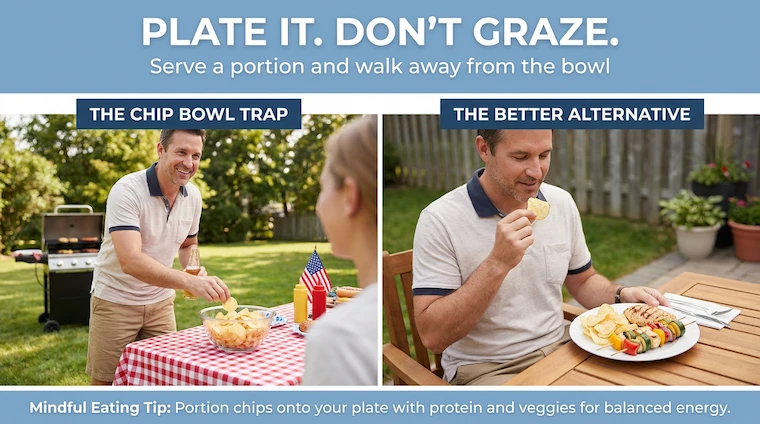
- Swap sugary sauces for mustard, hot sauce, salsa, or guacamole, and always plate your chips instead of grazing from the bowl.
Chips are what brings the real damage. Not the burger. Not even the bun.
Why Chips Beat Your Willpower Every Time
Chips hit a combo your brain can’t resist: fat, carbs, and salt, all in one bite. That combination lights up your brain’s reward system harder than almost anything else on the table.
Here’s what makes it worse. A 150-calorie handful of chips takes up almost no space in your stomach. Compare that to popcorn at the same calorie count, and the popcorn actually fills you up. The chips just disappear.
That’s why you can polish off half a bag standing at the food table and barely register it happened.
The Real Reason You Can’t Stop at “Just a Few”
You’re not weak. You’re distracted.
Your brain is busy listening to your brother-in-law’s fireworks story. It’s not tracking how many times your hand went back into the bowl.
From the Coaching Floor:
I had a client who insisted she “barely touched” the chips at her family’s BBQ. When I asked her to actually plate a portion next time instead of grazing from the bowl, she told me she was shocked how much less she ate just from sitting down with a plate instead of standing near the bowl all night.
Sauces Aren’t the Enemy, Sugar Bombs Are
You don’t need to skip condiments. You need better ones.
Standard BBQ sauce and ketchup are loaded with sugar. Some bottles pack over 30 teaspoons per container. Creamy dips lean hard on cheap oils that add calories without adding fullness.
Swap in mustard, hot sauce, salsa, or guacamole instead. Same big flavor, no sugar crash.
The Fix Nobody Tells You
Skip the communal bowl. Serve yourself a real portion on a plate, then walk away from the table.
And stop eating while you talk. Take a bite, set your food down, then talk. Sounds small. It’s the difference between noticing what you eat and not noticing it.
THE BOTTOM LINE:
Plate your chips, walk away from the bowl, and save your sauce for flavor, not a sugar bomb, so the calories that disappear fast don’t disappear from your memory too.
The Alcohol Section You’ve Been Waiting For (Why Drinking Hits Harder After 40)
Key Takeaways:
- Your liver treats alcohol as a toxin and stops burning fat until it’s cleared, which means the food you eat alongside your drinks is more likely to get stored.
- Dark drinks (beer, rum, red wine) carry more hangover-causing congeners than clear spirits or dry white wine.
- Alcohol disturbs deep sleep, which spikes your hunger hormones and makes the next day’s cravings brutal.
Alcohol isn’t just extra calories. That’s the small problem.
The real problem is what it does to your liver, your sleep, and your next 24 hours.
Your Liver Stops Burning Fat the Second You Take a Sip
Your body treats alcohol as a toxin, not a food. So your liver prioritizes clearing it out over everything else.
That means the burger, the chips, the cheese on your plate? While your liver’s busy processing your drink, that food has a much better shot at being stored as fat rather than burned for energy.
Alcohol Turns Off Your Filter, Then Turns On Your Appetite
Protein fills you up. Alcohol does the opposite. It cranks your hunger up while shutting down the part of your brain that says “maybe not.”
That’s the exact combination behind the 11pm plate of leftovers you don’t remember deciding to eat.
Why the Next Day Feels So Much Worse Now
Miss even a few hours of sleep, and your hunger hormones spike the next day. Add alcohol on top, and your sleep barely counts as sleep at all.
One of my clients in her 40s told me she used to bounce back from a night out in her 20s no problem. Now? “One glass of wine and I’m wide awake at 3am with my heart beating fast,” she said.
That’s not frailty. That’s alcohol disrupting your deep sleep cycles, and it gets harder to shake off as the years of accumulated stress and poor recovery stack up.
Wake up running on no sleep, and your appetite hormones are working against you all day. That’s why the day after feels like a fight you can’t win.
Not All Drinks Hangover the Same
Dark drinks like beer, rum, and red wine carry more congeners, the toxic byproducts resulting from fermentation that make hangovers worse. Clear spirits and dry white wine carry far fewer.
Same buzz, less punishment the next morning.
The Bloat Isn’t Fat, But It Feels Like It
Beer and sugary mixers pump gas and fluid straight into your gut. Your waistline can look several inches bigger by the next morning, and it has nothing to do with fat gain.
So stick to clear spirits or dry wine, keep your number set before you drink, and protect your sleep. Because that’s what actually decides how rough tomorrow feels.
Why Alcohol Hits You Twice Before You’ve Even Grabbed a Mixer
Key Takeaways:
- A regular beer runs about 153 calories, craft beer runs 170-350, and a shot of liquor runs about 97, all before mixers.
- Your liver treats alcohol as a priority toxin to clear, which pauses fat burning and makes the food you eat alongside it more likely to get stored.
- Bloating, junk-food cravings, and a rough next day aren’t separate problems; they all stem from the same appetite-and-judgment hit alcohol delivers.
Here’s the number nobody tells you at the cooler: a regular 12-ounce beer runs about 153 calories. Before the bun. Before the chips. Before anything else touches your plate.
Reach for a craft beer instead, and that number jumps to 170 to 350 calories, depending on the brew. Some of those “just one beer” moments are closer to a slice of pizza.
Even a shot of 80-proof liquor, poured neat with nothing added, costs you roughly 97 calories. That’s the calorie hit before a single drop of soda or juice touches the glass.
That’s Hit One. Here’s Hit Two.
The calories are the easy part to spot. The second hit is the one that actually wrecks your week.
Once alcohol enters your system, your liver stops everything else to clear it out first. That means the food on your plate- the burger, the chips, the cheese- gets pushed to the back of the line and stored instead of burned.
Stack three or four drinks on top of a full plate, and you’re not just adding calories. You’re actively blocking your body from using the ones already there.
Why It Keeps Showing Up in the Same Complaints
Bloating, junk-food cravings, a wrecked next day. If that sounds like a recognizable cycle, it’s because all three trace back to the same root cause.
Alcohol ramps up your appetite while it shuts down your judgment. That combo is exactly what turns “I’ll have one drink” into standing over the chip bowl at midnight.
I had a client tell me she could always predict her worst eating days: they were never the day after a big meal. They were always the day after drinks.
So count your drink calories the same way you’d count food, because the number adds up fast, and it’s only half the story.
What to Order If You Want a Drink (Without Paying for It All Week)
Key Takeaways:
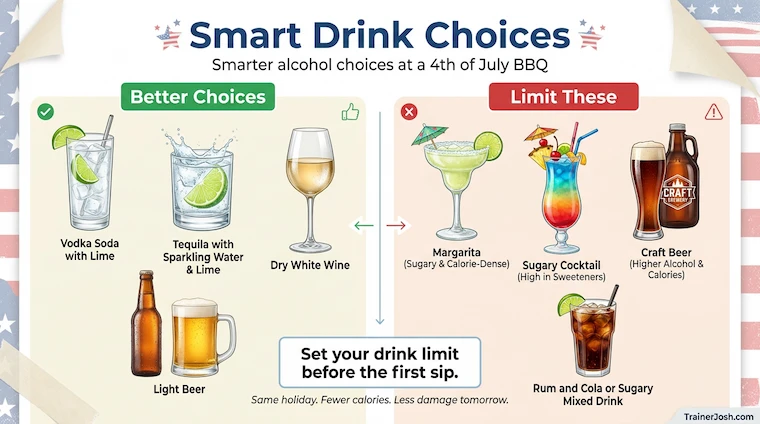
- Mixed cocktails can run past 500 calories; clear spirits or light beer sit around 100, and dry wine around 125.
- Your liver processes roughly one drink per hour, so spacing drinks out matters as much as your total count.
- Dark drinks (beer, rum, red wine) carry more congeners than clear spirits or white wine, which means a rougher hangover.
Yes, keep it simple. Lighter beer, spirits with zero-sugar mixers, or just fewer total drinks. All three work.
Skip the Sugary Cocktail, Even If It’s “Just One”
A mixed cocktail can run past 500 calories in a single glass. That’s not a drink, that’s a meal you didn’t plan for.
Clear spirits and light beer sit closer to 100 calories a pour. Dry white wine lands around 125. Same buzz, a fraction of the cost.
Order vodka soda or tequila with sparkling water instead of a margarita, and you’re not skipping the fun. You’re just skipping the sugar that turns one drink into a 500-calorie decision.
Fewer Drinks Isn’t About Willpower, It’s About Timing
Your liver can only process about one drink per hour. That’s not opinion… that’s just how fast the enzyme works.
Space your drinks out over the course of the party instead of stacking them back-to-back, and you give your liver room to actually keep up. Slam three drinks in an hour, and you’re not drunker because you willed it. You’re drunker because your liver never had a chance.
I had a client who used to order her second drink the second she finished her first, just out of habit. Once she started spacing them an hour apart, she told me she drank the same total but felt mentally sharper the whole night.
Watch What Color Is in Your Glass
Dark drinks carry more congeners, the toxic leftovers from fermentation that make hangovers worse. Beer, rum, brandy, and red wine are all higher in congeners.
Clear spirits and white wine carry far fewer. Less congeners, less punishment tomorrow.
So order clear spirits with a zero-sugar mixer or a light beer, space your drinks out, and you get to enjoy the holiday without spending the next three days paying for it.
This Is the Real Reason to Watch What You Drink (It’s Not the Calories)
Key Takeaways:
- Poor sleep from a night of drinking can spike your appetite by 20% the next day, on top of already weakened willpower.
- Heavy drinking can crash testosterone by 45% that night and leave it down 23% the next day.
- Sleep loss after drinking can shift weight loss toward muscle rather than fat, reducing fat loss by up to 55%.
Counting drink calories misses the point entirely.
The real cost of a heavy night isn’t what you drank. It’s what happens to you tomorrow.
Your Willpower Runs Out Before Your Hangover Does
Your brain runs on two systems: the rational one that wants your goals, and the emotional one that wants instant relief. A night of drinking and bad sleep weakens the rational one fast.
That’s why the day after a party, your brain’s reward centers go into overdrive when it comes to food. You’re not choosing the pizza. Your exhausted brain is demanding it.
Your Hunger Hormones Turn Against You
Sleep 4 to 7 hours instead of a full 8, and your baseline appetite can jump by 20% the next day. Pair that spike with a brain too tired to say no, and you’ve got a fight you’re set up to lose before you even wake up.
A heavy night of drinking (9 or more drinks) can crash a man’s testosterone by 45%. The next day, it can still be down 23%.
That’s not a small dip. That’s the same hormonal crash a bodybuilder gets from weeks of brutal contest prep, and it happens from one night out.
You Might Lose Muscle Instead of Fat
If you’re sleep-deprived after a night of drinking, even a “good” day of eating the next day works against you.
STUDY SAYS:
In a controlled weight‑loss trial, restricting sleep from 8.5 to 5.5 hours per night reduced fat lost by about 55% and increased loss of fat‑free mass (including muscle) by roughly 60%, even though total weight loss was the same.6
That means the weight might still come off. It’s just coming from the wrong place.
I had a client in his 40s who used to think one wild night “wasn’t a big deal” because he ate clean the next day. Once I explained what sleep loss does to muscle versus fat, he told me it finally clicked why his “good days” after drinking never showed up on the scale the way he expected.
After 40, the goal isn’t just losing weight. It’s losing the right kind of weight.
A rough holiday weekend can leave you tired, inflamed, under-recovered, and tempted to “make up for it” with a brutal workout. But the smarter move is to protect your muscle, recover well, and get back to normal training.
The Real Win…
Pacing your drinks, choosing clear spirits, eating your protein first. None of that is really about the party.
It’s about waking up tomorrow with your hormones intact, your appetite manageable, and your brain sharp enough to make good choices without a fight.
You’re not managing drink calories… you’re protecting tomorrow’s hormones and hunger. So treat your drink limit as insurance for the next 24 hours, not just tonight.
Why the Scale Jumped 4 Pounds Overnight (And Why It’s Not the Fat You Think It Is)
Key Takeaways:
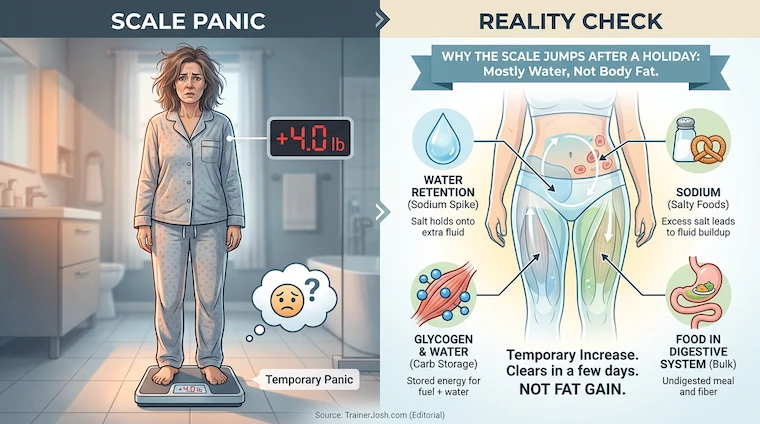
- Every gram of glycogen your body stores pulls in 3 to 4 grams of water, which alone can add several pounds overnight.
- Sodium and insulin team up to make your kidneys hold onto water, adding to the spike on the scale.
- Gaining real fat requires a 3,500-calorie surplus per pound; an 8-pound jump would mean 28,000 extra calories, which isn’t physically realistic in one weekend.
You step on the scale the morning after the 4th. It says four pounds heavier. Maybe six. Maybe ten.
Your stomach drops. Two weeks of progress, gone overnight. That’s what it feels like.
Here’s what actually happened. None of that weight is fat.
Your Muscles Are Holding Water, Not Storing Fat
Eat a carb-heavy meal (burger bun, potato salad, dessert), and your body stores that sugar as glycogen in your muscles and liver.
Every gram of glycogen drags in 3 to 4 grams of water. Store half a kilogram of glycogen after a big meal, and you’ve pulled in over 3 extra pounds of water along with it.
That’s four pounds on the scale before you’ve gained a single ounce of fat.
Salt & Sugar Team Up Against You
BBQ food is loaded with sodium: marinades, sauces, chips, processed meats. Salt makes your kidneys hold onto water to keep your blood chemistry balanced.
Now add insulin to the mix. A big meal spikes insulin, and insulin tells your kidneys to hang onto sodium instead of flushing it out.
Salt and sugar working together is the exact combo behind that puffy, bloated feeling the morning after.
The Math Doesn’t Lie
Here’s the number that should calm you down instantly: gaining one pound of actual body fat takes a surplus of about 3,500 calories.
If the scale jumped by 8 pounds, that would mean you ate 28,000 extra calories over the weekend. Nobody’s doing that. Not even close.
What you’re seeing is water, glycogen, and the actual weight of food still sitting in your gut, waiting to move through.
From the Coaching Floor:
I had a client panic over a 6-pound jump after a holiday trip. I asked her what she ate that day. Burgers, chips, two margaritas, the works.
I told her: that’s not six pounds of fat… that’s a math problem your kidneys will solve in 48 hours. She texted me three days after. The scale was back to normal.
That scale jump is water, salt, and undigested food, not fat, so skip the panic and get back to your normal eating. Your body will flush it out on its own within a few days.
Why One BBQ Can Hit You With Four Water-Weight Triggers at Once
Key Takeaways:
- Digesting a heavy meal pulls water from your bloodstream into your gut, adding real actual weight while food is still being processed.
- Alcohol adds bloat directly (gas and fluid) and indirectly (munchies that restock sodium and glycogen).
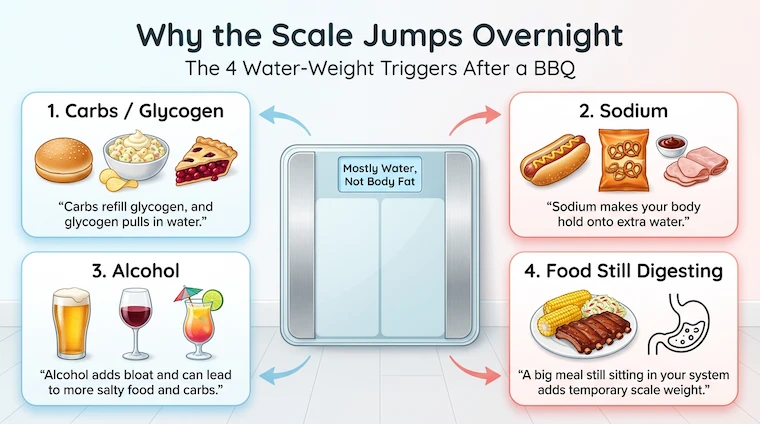
- A BBQ stacks all four water-retention triggers (carbs, sodium, alcohol, digestive bulk) into a single day, which is why the scale spike feels so extreme.
You already know carbs and salt pull in water. Here’s what makes the 4th different: it stacks all four triggers on the same day.
Your Gut Physically Weighs More While It’s Working
Digesting food takes water. A lot of it.
Your small intestine pulls several liters of fluid from your bloodstream just to break down what you ate. Eat a heavy plate of BBQ food, and that food, plus the fluid your gut pulled in to process it, sits inside you for hours.
That’s real, actual weight on the scale. Not fat. Just food and water still moving through 30 feet of digestive tract.
Alcohol Piles On Two Ways, Not One
You already know alcohol pauses fat burning. Here’s the part that hits the scale directly: beer and carbonated mixers pump gas and fluid straight into your gut, causing physical bloating you can feel.
Then alcohol wrecks your judgment, and that’s when the munchies hit. You reach for the salty chips and the bun you skipped earlier, which restocks the exact sodium and glycogen stores that pull in water.
One drink doesn’t just add its own bloat. It sets you up to add more from the food that follows.
Four Triggers, One Day, One Scary Number
Carbs pull water into your muscles. Salt pulls water into your bloodstream. Alcohol pulls gas into your gut and pushes you toward more of both. And the meal itself sits as actual weight while it digests.
None of these show up alone at a normal Tuesday dinner. At a BBQ, all four land on your plate in the same afternoon.
I had a client tell me she felt “personally attacked” by her scale after a holiday cookout. I walked her through what was actually on her plate that day (buns, chips, two beers, potato salad).
She realized she’d hit all four triggers in one sitting. Made a lot more sense once she saw it laid out.
One BBQ plate rarely hits just one water-weight trigger. It hits all four at once, so a dramatic scale jump the next morning is expected… not a sign anything went wrong.
The 3 Reactions That Turn a Water-Weight Blip Into an Actual Setback
Key Takeaways:
- Slashing calories after a big weekend spikes hunger and tanks self-control, setting up the next binge instead of preventing it.
- “Sweating it off” with extra cardio rarely offsets a big meal, and your body often compensates by moving less the rest of the day.
- Treating one weekend as a failure (not the food itself) is what predicts long-term yo-yo dieting.
You already know the scale jump isn’t fat. Good. Now here’s what happens if you react to it like it was.
Don’t Slash Your Calories to “Make Up For It”
Your first instinct might be to eat almost nothing on Monday. Punish the number back down.
That backfires fast. Starve yourself after a big weekend, and your hunger spikes while your self-control tanks, which sets you up for round two of the exact binge you’re trying to avoid.
I had a client who tried to “fix” a holiday weekend by eating 900 calories on Monday. By Wednesday she’d binged twice. The restriction didn’t erase the weekend. It extended it.
Don’t Try to “Sweat It Off”
The other instinct is to punish it with cardio. Grind out an extra hour on the treadmill to burn off the BBQ.
Here’s the problem.. It takes a massive amount of exercise to offset one big meal, way more than most people realize. And your body often compensates by making you move less the rest of the day, which quietly cancels out a chunk of what you just burned.
You end up exhausted, not lighter.
Don’t Turn Monday Into a Punishment
This is the one that actually does the damage. Treating one weekend as a moral failure, something you have to “pay for.”
That black-and-white thinking (perfect or ruined, nothing in between) is exactly what predicts long-term yo-yo dieting. Not the burger. The mindset.
Just go back to normal. Not a detox. Not a “clean eating reset.” Your regular meals, your regular training, starting at your very next meal.
Your body already has this handled. Skip the punishment, and your kidneys flush the extra sodium, your glycogen levels settle, and the scale drops back down on its own within a few days.
THE BOTTOM LINE:
Don’t slash, don’t sweat it off, don’t punish; just eat your normal meal next, and let your body do what it already knows how to do.
The 5-Step Reset That Actually Works (No Detox, No Punishment)
Key Takeaways:
- Hydrate with a pinch of salt added back in, since your body releases sodium along with the water weight it’s flushing.
- A short 15-minute walk after meals can cut your blood sugar spike in half and ease bloating.
- Skip the scale for a few days and judge progress by your weekly average, not a single post-holiday morning.
You already know what not to do. Here’s exactly what to do instead.
Hydrate First
Drink water. Not because it’s magic, but because your body needs it to flush the sodium and process everything sitting in your gut.
Add a pinch of salt to it if you’re feeling foggy or crampy. Sounds backward after a salty weekend, but as your body sheds water weight, it also releases sodium. Replacing a little keeps you from feeling wiped out.
Resume Normal Meals
Not a detox. Not “clean eating” for a week straight. Just your regular meals, starting right now.
Build them the way you always do: protein, produce, real food. That’s it. No special rules for “making up” for the weekend.
Hit Your Protein, But Don’t Overdo It
Protein at your normal meals helps. It stretches your stomach, slows digestion, and shuts down lingering cravings fast.
Skip the temptation to double up on protein shakes to “compensate,” though. Your body can only use so much at once. The extra just turns into more calories your body has to deal with, not a shortcut back to baseline.
Take a Walk After Meals
This one’s backed by real data. A short walk after eating (even a slow 15-minute stroll) can cut your blood sugar spike in half.
Keep it light and easy. This isn’t the day for a brutal workout. A relaxed walk clears glucose from your blood, helps your gut move things along, and takes the edge off any bloating.
Wait Before You Trust the Scale
Your weight the day after a big weekend means almost nothing. It’s inflated by food still in your gut, glycogen, and water.
Give it a few days. Once your body flushes the extra fluid and settles back down, weigh yourself again and look at the trend, not the single number.
I had a client who used to weigh in every morning during a holiday week and spiral each time the number moved. Once she started only checking her weekly average, she told me the panic disappeared completely, even though nothing about her actual results changed.
Hydrate, eat normally, walk after meals, and give the scale a few days before you trust it, because your body already knows how to reset itself.
Your Morning-After Script (Read This Before You Panic About the Scale)
Key Takeaways:
- Run the mental script first: this morning’s weight is water, not fat, and doesn’t need punishment.
- Morning sunlight and a normal breakfast do more to reset you than any extreme measure.
- Protecting tonight’s sleep matters as much as anything you do today, since it resets the hunger hormones alcohol and late nights threw off.
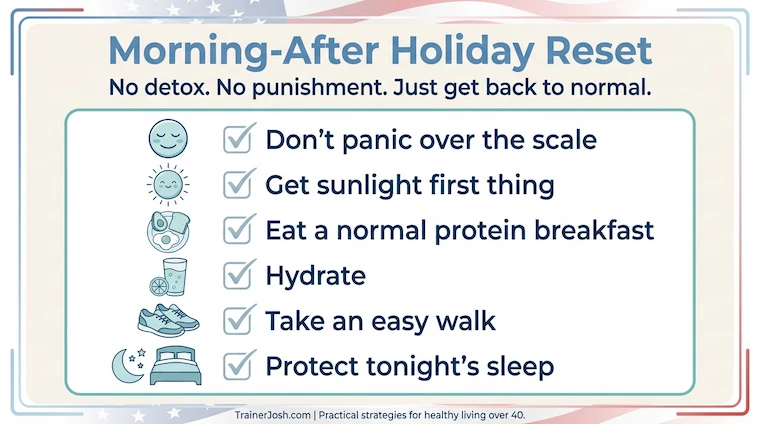
Here’s the exact script to run through your head the morning after:
“I enjoyed the holiday and made a conscious choice. This morning’s number is water and food weight, not fat. I’m not punishing myself. I’m not starving myself. Today is just a normal day.”
Read that again if you need to. Then run through this checklist.
The Holiday Reset Checklist
☐ Don’t check the scale (or check it and ignore it). You already know why. Give your body a few days before that number means anything.
☐ Get sunlight first thing. Step outside within the first hour of waking, before coffee if you can. Sunlight at dawn hits your eyes and resets your internal clock, making you more alert now and helping you sleep better tonight. Small habit, real payoff, especially after a late night of fireworks and social media scrolling.
☐ Eat breakfast like normal. Not a punishment breakfast. Not a shake to “make up for it.” Your regular protein-forward meal, same as any typical Tuesday.
☐ Move, don’t punish: A walk, not a grueling workout. Save the intense training for when you’re not running on four hours of sleep and a hangover.
☐ Reflect, don’t dwell. Ask yourself one question: what actually happened yesterday? Did you skip a meal and arrive starving? Drink more than you planned? Use it to tweak your next event. Don’t use it to beat yourself up.
☐ Protect tonight’s sleep. This is the step almost nobody thinks about. One rough night doesn’t have to become two. Get to bed at your normal time tonight, and your hunger hormones reset by tomorrow morning.
I had a client who used to treat the day after a holiday like a crisis: extra cardio, barely any food, checking the scale three times. She’d end up more exhausted and more likely to binge by Wednesday.
Once she started following this exact script instead, she told me the “day after” stopped feeling like damage control and started feeling like… just another Tuesday.
That’s the whole goal. Not a dramatic reset. A boring one.
Follow the checklist, skip the drama, and let the day after the 4th feel as boring and normal as any typical Tuesday.
What Adults Over 40 Really Need to Hear Before This Holiday (It’s Not What You Think)
Key Takeaways:
- Your metabolism stays stable with age; the real shift is a thinner margin for error, not a broken engine.
- Protein and structure matter more now because your body needs a stronger signal to hold onto muscle.
- Higher stakes after 40 call for a plan made in advance, not punishment after the fact.
You’re not broken. Your body just doesn’t forgive the way it used to.
That’s the real message, and it changes everything about how you should approach this weekend.
Your Metabolism Didn’t Quit on You
Here’s what surprises almost every client I coach past 40: your resting metabolic rate stays remarkably stable from your 20s all the way into your 60s, once you account for muscle mass.
STUDY SAYS:
Researchers in a large Science study found that when adjusted for fat-free mass and body size, resting metabolic rate stays remarkably stable from about age 20 to 60, with no meaningful slowdown across those adult decades.7
Your body isn’t slowing down on its own. What’s actually happening is years of sitting more, moving less, and losing muscle you never noticed slipping away.
That’s not a life sentence. That’s a fixable problem.
So Why Does One Bad Weekend Feel So Much Bigger Now?
Because your margin for error got thinner. Not your metabolism.
Your body needs a stronger signal to hold onto the muscle you’ve got. That means protein isn’t optional anymore; it’s structural. Skip it, wing it, or “figure it out later,” and your body has less to work with.
Stack that on top of the stress you’re already carrying (career, kids, everything else pulling at you), and one rough night of drinking and bad sleep hits differently than it did at 25.
Your body just doesn’t have the same slack to absorb it.
Structure Beats Perfection, Every Time
Here’s the mindset shift that changes everything: you don’t need a perfect holiday. You need a plan.
Not “I’ll try to eat well.” An actual decision made in advance. “I’ll build my plate protein first.” “I’ll stop at two drinks.” “I’ll pick two treats and skip the rest.”
Decide it now, while you’re clear-headed, not later while you’re standing at the buffet.
I had a client tell me this was the first year the 4th of July didn’t feel like a test she had been destined to fail. She’d made her plan on the drive over. That was the big difference.
Why the Stakes Feel Higher (And Why That’s Not a Bad Thing)
One rough holiday after 40 can genuinely feel bigger than it did in your 20s. That’s not in your head.
But here’s the reframe: that’s exactly why you need a plan, not why you need to punish yourself. Higher stakes call for more structure, not more guilt.
THE BOTTOM LINE:
After 40, your body needs structure more than perfection, so build your plan before the holiday starts, not damage control after it ends.