


So you’re crushing it with strength training. 10 push-ups are easy. Your bench press is solid. But the second you lace up for a run or try to power through a high-rep bodyweight circuit… cardio is your downfall.
Many guys looking for military workout programs have the same problem… decent strength but terrible endurance. You want to be able to knock out 60+ push-ups in 2 minutes, run a sub-20-minute 5K, and see that lean, disciplined physique in the mirror.
But most military workout advice online is either dangerous (“just do push-ups, sit-ups, and run!”) or insanely complicated (12-week SOF prep programs that assume you can already run 30+ miles a week). You don’t need all that.
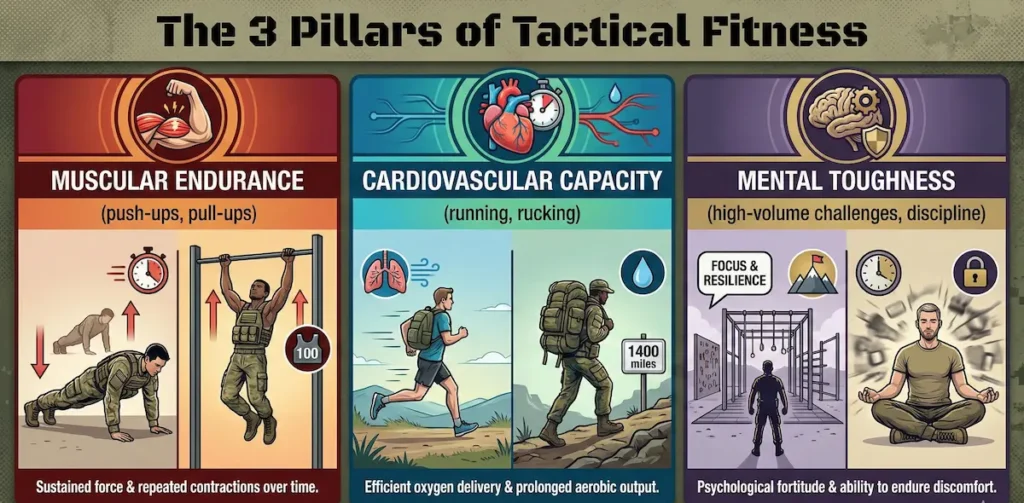
What you need is a functional, no BS bodyweight circuit that builds the three pillars actual soldiers train for: Muscular endurance, cardiovascular capacity, and mental toughness. Just proven structured conditioning that gets you strong, lean, and disciplined without needing a gym or getting injured in your first week.
This 30-day military workout plan gives you a zero-equipment, battle-tested bodyweight circuit designed to train like a soldier. This is a progressive four-week program that builds your aerobic base, burns fat, and develops functional strength that you can feel from week one.
Why Military-Style Training Delivers Results Fast
Key Takeaways:
A military style workout focuses on Tactical Fitness. The ability to run, ruck, swim, and carry equipment for extended periods. Core elements include:
- High-rep calisthenics (pyramid sets, max-rep burnouts)
- Cardio diversity (distance running, interval sprints, rucking with 40-60 lbs)
- Functional lifts (deadlifts, kettlebell swings, sandbag carries)
These workouts use periodization. Strategically cycling strength, endurance, and recovery phases. Building work capacity without overtraining.
Military workouts incorporate bodyweight circuits, cardiovascular endurance, and functional strength training. All combined into one complete system designed for operational readiness.
Military workouts are also beneficial for weight loss and fat loss. They’re effective due to their high metabolic demands, daily frequency, and endurance-based energy expenditure. This sustains a calorie deficit while preserving lean muscle mass.
When fat loss is the goal, keeping your muscle matters just as much as lowering the number on the scale. The BioTRUST GLP-1 Companion Stack is one option I like because it supports appetite control, strength, and lean muscle during a calorie deficit.
A 3-part daily stack designed to support people using GLP-1 medications or losing weight naturally. It combines muscle, protein, collagen, and appetite support to help you maintain a healthier body composition as you lose weight.
- Natural GLP-1 Support: Helps support healthy appetite signals, fullness & metabolic function
- Lean Muscle Support: Helps preserve muscle, strength & healthy body composition during weight loss
- High-Protein Collagen: Adds 20 g of protein with 5 collagen types to help support daily protein intake
- Skin, Joint & Hair Support: Provides collagen peptides to support skin elasticity, joints, hair & nails
- 3-Part Weight-Loss Support: Combines muscle, protein/collagen & appetite support in one simple daily stack

A 2023 study published in BMJ Military Health found that nine weeks of U.S. Army Basic Combat Training (BCT) significantly reduced body fat and altered the BMI–body fat relationship. Among 1,469 trainees, average body fat at a BMI of 25 kg/m² dropped from 33% to 29% in women and from 23% to 20% in men. At a BMI of 27.5 kg/m², body fat decreased from 35% to 31% in women and from 26% to 22% in men.1
Beginner tactical fitness plans are specifically designed to help recruits lose 20-30 pounds before boot camp. The formula is high-rep calisthenics (glycogen depletion) followed by steady-state cardio (fat oxidation).
The U.S. Army Physical Readiness Training Manual explains that combining aerobic endurance (such as running or rucking) with muscular endurance (through calisthenics) improves energy utilization efficiency and body composition. Military physical training involves sustained moderate-intensity effort (45-60 min) daily. This makes it highly effective for fat oxidation.
Now, here’s what makes it different from what most are doing:
Military Fitness vs. The Gym (What You Need to Know)
Most gym programs build muscle mass. Military workouts build durability.
Bodybuilding isolates muscles using exercises like bicep curls and leg extensions. Bodybuilders also train muscle groups on different days, such as chest day. It’s designed to make you look bigger (hypertrophy).
Military fitness is designed to keep you alive. Tactical athletes are training for functional movements. Pushing, pulling, lifting people or equipment, running under load, and swimming with fins.
The goal isn’t just a six-pack. It’s the ability to carry a 60-lb rucksack for 12 miles, drag a teammate to safety, or complete a 500-meter ocean swim in full gear without gassing out.
SEALs avoid exercises like dumbbell curls entirely. Why? Because they don’t translate to real-world tasks. Instead, they prioritize high-volume calisthenics such as push-ups, pull-ups, burpees, rucking, and swimming. These movements build muscle stamina and cardiovascular capacity simultaneously.
A 2022 systematic review and meta-analysis published in Military Medicine found that nontraditional military training programs (those emphasizing structured resistance and power exercises) produced significantly greater gains in muscular endurance, power, strength, and occupationally specific performance compared to traditional aerobic-based military training.2
The Three Principles That Make It Work
Military fitness is built on simplicity and consistency. Mastering movement, sustaining effort, and developing the mental endurance to persevere when others give up. No gym required. Just you, the ground, and the will to show up every day.
Simplicity – Few Movements, Maximum Output
Military training keeps it brutally simple. Push-ups, sit-ups, pull-ups, squats, and running. That’s 80% of the program.
This is because soldiers need to maintain readiness anywhere, from a forward operating base with no equipment to a ship deck or a dirt field. Calisthenics require zero gear and deliver maximum return.
The PT Pyramid (a classic Army workout) is a comprehensive session that combines warm-up, maximum-effort, and cool-down exercises all in one. High volume, zero complexity.
Consistency – Daily Activity & Mental Discipline
In the military, physical training isn’t optional… It’s mandatory every single day.
Consistency builds two key aspects: physical work capacity (your ability to sustain effort despite exhaustion) and mental toughness. Navy SEAL training pushes recruits to failure repeatedly… not to break them, but to force them to dig deep and persevere.
It’s not about fancy periodization. It’s about showing up every day and doing the work.
Functional Strength – Usable Power, Not Aesthetics
Tactical strength means one thing: can you grab, carry, push, or lift something heavy when it matters?
Military training trains your body as a holistic system. Squat, deadlift, kettlebell swing, sandbag, carry, buddy drag.
These movements build durability, reduce injury risk, and develop the core stability necessary for real-world tasks. Strength isn’t for show… It’s for survival.
The Core Components of Military Fitness
Military fitness isn’t built in a gym. It’s built with four core components that soldiers use to stay mission-ready anywhere. A dirt field, a ship deck, or a forward operating base with zero equipment.
Here’s what actually matters…
Bodyweight Strength (The Foundation)
Calisthenics are the backbone of military conditioning. Push-ups, pull-ups, sit-ups, squats, lunges, and planks develop muscle stamina (the ability to produce force repeatedly without breaking down).
Key movements soldiers live by:
- Push-ups: Wide, triceps, and regular variations. Army PT tests require 60+ reps in 2 minutes. High-volume pyramid workouts (1-2-3-4-5 and back down) build endurance fast.
- Pull-ups: Essential for climbing obstacles and pulling yourself over walls. SEALs use ladder sets (1, 2, 3, 4, 5 reps with minimal rest to build grip and back strength).
- Core work: Sit-ups, flutter kicks, leg raises, planks. A strong core stabilizes every movement from lifting heavy loads to sprinting under fatigue.
- Squats & Lunges: Air squats and walking lunges develop explosive leg power and functional strength for rucking and carrying equipment.
The plank is a favorite “rest position.” When soldiers fail at push-ups during grinder PT, they hold a plank (leaning rest) to recover while maintaining tension. One minute feels like 10.
Endurance Training – Aerobic & Anaerobic Capacity
Military endurance training blends sustained effort (long runs, rucking) with high-intensity bursts (sprints, intervals). Missions demand both.
Core endurance methods:
- Running: distance runs (3-5 miles), timed 1.5-mile tests, and intervals like 30:60s (30-second sprint, 60-second jog). Builds cardiovascular base and mental toughness.
- Rucking: Foot marches carrying 40-50 lb packs. This is non-negotiable for Army soldiers. Rucking builds leg strength, core stability, and the ability to move under load without gassing out.
- Swimming: Navy SEALs swim 500 meters with fins for their PST. If you don’t have pool access? Rowing, biking, or using an elliptical machine can serve as substitutes.
- Burpees + Running combos: The 8-count bodybuilder (burpee with a push-up) mixed with runs crushes your heart rate and stimulates the stop-start intensity of combat.
One former military client of mine said, “Doing long treks across rough terrain is the bread and butter of military fitness.”
Endurance isn’t just running fast. It’s a sustaining effort when exhausted.
Agility + Mobility (Functional Movement)
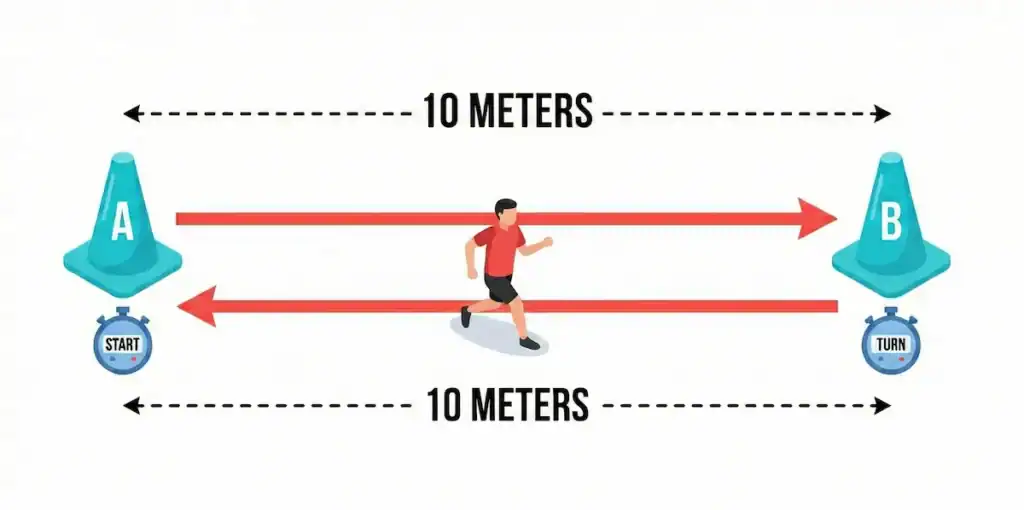
Strength without mobility is useless. Military training emphasizes movement proficiency. This is the ability to stop, start, change direction, and execute tactical maneuvers efficiently.
Key agility drills:
- Shuttle runs: Sprint 10 meters, touch the ground, sprint back. Repeat. Builds explosive direction changes.
- Crawls: Bear crawls, low crawls, and stair crawls simulate moving under obstacles or through confined spaces. They’re brutal mobile core exercises.
- Guerrilla drills: Including lunge walks, soldier carries, and sandbag drags, develop functional leg power & balance.
- Flexibility work: Including hip stability drills and recovery stretches, helps prevent injury and improves range of motion. Army PRT includes dedicated mobility sessions for durability.
Mental Conditioning – Discipline & Resilience
Physical training is mental training. Military workouts are designed to push you beyond your comfort zone and force you to dig deep when your body wants to quit.
How mental toughness is built:
- High-volume challenges: Completing 1,000 push-ups or 100 burpees in a single session isn’t about the reps. It’s about proving to yourself you can push through self-imposed limitations.
- Consistency over intensity: Showing up every day, even when you’re sore, tired, or unmotivated, builds discipline. Motivation fades. Habits endure.
- Precision under fatigue: Army PRT emphasizes quality movement even when exhausted. Sloppy reps breed injury. Controlled reps build skill.
The goal is to develop a warrior mindset… preparing the body, mind, and spirit simultaneously.
The Complete Military Workout Routine
You don’t need a gym to train like a soldier. You need a plan, consistency, and the discipline to execute. Here’s your roadmap from beginner to operator-level fitness. Choose your starting point and progress from there.
Beginner “Recruit” Plan (No Equipment)
Goal: Build a foundation of muscle stamina, endurance, and movement quality.
Schedule: 3-4 days per week with 1-2 full rest days.
This is the “Everyday Hero” phase – a combination of bodyweight basics and low-impact cardio to build your aerobic base without injury.
The beginner plan focuses on building a basic foundation of fitness, strength, muscle stamina, endurance, and flexibility. This stage is critical for beginners or those returning to fitness who need to lose a significant amount of weight to meet the standards.
A beginner can start with 3 days of training per week. Working up to 4 days. Focus on total-body movements to build a base before attempting more challenging, higher-volume routines.
Example Calisthenics Pyramid:
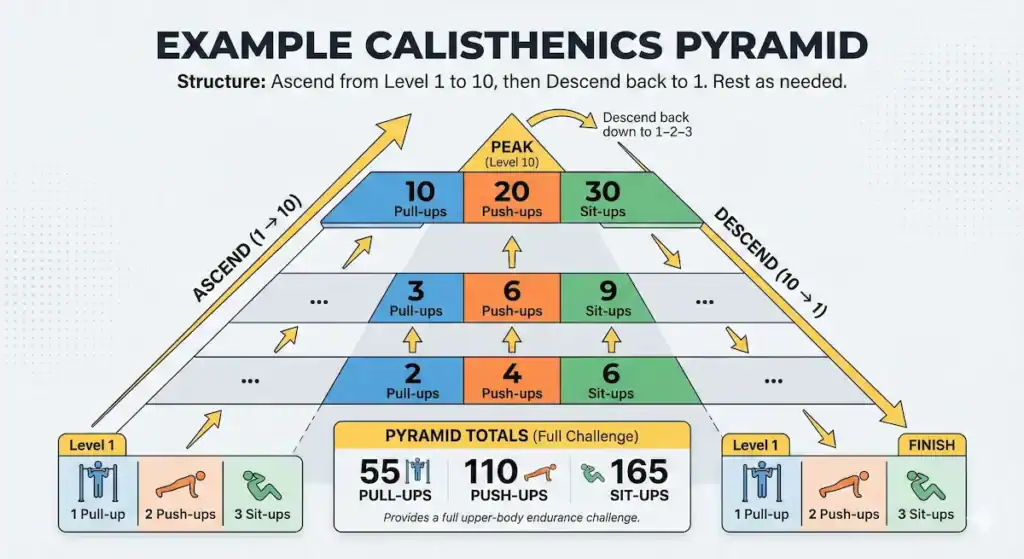
Each round adds one rep per exercise until you reach 10 reps. Then descends back down to 1. Rest only as needed between sets.
Exercises:
- Pull-ups
- Push-ups
- Sit-ups (or crunches)
Structure:
- 1 rep pull-up → 2 push-ups → 3 sit-ups
- 2 pull-ups → 4 push-ups → 6 sit-ups
- 3 pull-ups → 6 push-ups → 9 sit-ups
- …
- 10 pull-ups → 20 push-ups → 30 sit-ups
Then descend back down to 1–2–3. This pyramid totals 55 pull-ups, 110 push-ups, and 165 sit-ups, providing a full upper-body endurance challenge.
Rest Days and Tips for Recovery (Durability):
- Rest Frequency: Allow at least 1 to 2 days of complete rest during the week. Make sure you’re getting 12 to 24 hours between each workout session. So, if doing resistance training every other day, schedule rest or cardio days in between resistance days to allow maximum recovery and growth.
- Active Recovery: On rest days, activities such as walking, swimming, or biking can be performed. Endurance training (such as running, biking, swimming, or rucking) should progress logically. Limit rucking to 2-3 times a week max.
- Stretching/Mobility: Dedicate time to stretching before and after each workout. Stretching for 15 minutes after every workout helps decrease pain and soreness the next day.
Intermediate “Field Ready” Plan
Goal: Add resistance, volume, and weighted conditioning.
Schedule: 4-5 days per week with one recovery day.
The Intermediate Plan is for those with an average fitness foundation. The goal is to build on existing athletic skills by incorporating higher-volume, higher-rep calisthenics and functional strength elements, such as weighted exercises.
Example Intermediate Circuit: Add Resistance or Ruck
This level integrates movement and resistance, often utilizing Spartan Runs (mixing running with PT exercises).
Bodyweight Circuit CrossFit’s “Cindy”: AMRAP in 20 minutes of 5x pull-ups, 10x push-ups, 15x air squats.
Weighted/Ruck Circuit Example Circuit (Modified from sources): Repeat 4 times: 400m run at goal mile pace, followed by a set of weighted exercises (e.g., 10x burpees with ruck, 10x lunges per leg with ruck).
Running Intervals Track/Field Workout: Run 100m, 200m, 300m, 400m, then back down, with 20 burpees and 10 lunges per leg after each run segment.
Advanced “Special Forces” Routine
Goal: Peak strength, speed, and durability under load.
Schedule: 5-6 days per week with strategic recovery.
The Advanced Routine is designed to produce optimal results, achieve maximum test scores, and train for specialized selection programs, such as BUD/S. These routines demand high volume, mix heavy lifting, speed, and comprehensive endurance
This is operator-level training, combining heavy lifts, high-volume calisthenics, rucking, and speed work. This phase utilizes periodization to cycle through strength, endurance, and agility without overexertion.
Advanced programs incorporate periodization (cycling training phases) to ensure that all components—strength, endurance, agility, and speed—are addressed while minimizing the risk of overuse injuries.
Sample advanced exercises…
Weighted Carries:
- Farmer Walk: Carrying heavy dumbbells/weights for 100 meters.
- Overhead Weighted Lunge: Walking lunges carrying a weighted vest or plate overhead.
Plyo Push-Ups:
- Explosive push-ups. Can be performed as TRX Atomic Push-Ups (mixed push-up and knees-up).
Sprints:
- 30:60s or 60:120s (anaerobic intervals)
- Shuttle Run: 300-yard shuttle run
Weighted Pull-ups:
- Performing pull-ups while wearing a weight vest or a 25-pound weight.
Deadlifts:
- Heavy lift (targeting 1.5 to 2 times bodyweight)
30-Day Military Workout Challenge
Key Takeaways:
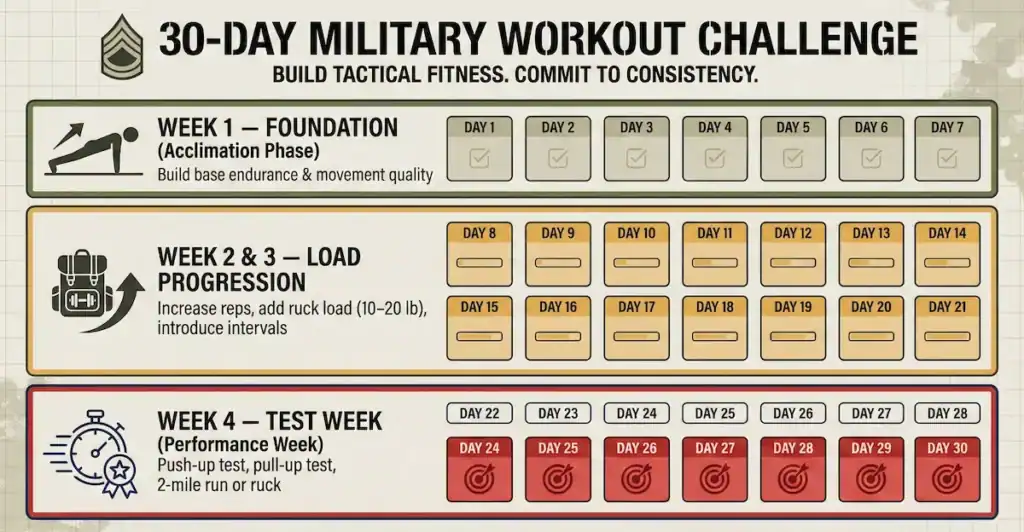
This 30-day challenge uses the same training logic found in SEAL and Army readiness plans: build capacity, test discipline, recover intelligently. It’s not about perfection… It’s about showing up, pushing limits, and proving what your body and mind can do when consistency meets purpose.
Purpose: Test your limits with structured progressive overload… blending calisthenics, endurance, and recovery.
Challenge Format:
- Track results: push-ups, pull-ups, and 2-mile run time (Day 1 vs. Day 30).
- Aim for +15–25% improvement in endurance and calisthenic volume.
Weekly Structure
Each week builds slightly on the last using a push/pull/cardio rotation. This follows the military training model of alternating muscle groups and recovery cycles to prevent burnout.
Week 1: Foundation (Acclimation Phase)
- Day 1: Push focus (push-ups, dips, plank)
- Day 2: Cardio (run, ruck, or swim)
- Day 3: Pull focus (pull-ups, rows, core)
- Day 4: Rest or active recovery
- Day 5: Full-body circuit (mix push, pull, legs)
- Day 6: Endurance (long jog or interval run)
- Day 7: Rest or light mobility drills
Week 2–3: Load and Intensity Progression
- Add a ruck or weighted backpack on cardio days (10–20 lb)
- Gradually increase repetitions (1–2 more per round)
- Introduce interval runs (400m sprints x 4 rounds)
- Maintain one active recovery day (walking, stretching, swimming)
Week 4: Performance & Test Week (Use the format from Army & Navy SEAL fitness testing)
- Day 1: Max push-ups in 2 minutes
- Day 2: 2-mile run or timed ruck (20–30 lb)
- Day 3: Max pull-ups
- Day 4: Recovery and mobility
- Day 5: Full-body “Combat Fitness” circuit (push-ups, squats, burpees, 400m run × 3 rounds)
Train Anywhere: Home, Gym, or Outdoors

Military fitness is built on adaptability. Soldiers train in deserts, on ship decks, in gyms, and in dirt fields with zero equipment. The location doesn’t matter, but the principles do. Here’s how to execute tactical training anywhere.
Home Version: Bodyweight, Backpack, and Stairs
No gym, no problem. Calisthenics require minimal equipment but deliver maximum results.
To perform a military-style workout at home, focus on high-volume calisthenics combined with cardio.
Use the PT Pyramid format: 1 pull-up (or row), 2 push-ups, 3 sit-ups per set. Climb to 10 and back down to 1. That’s 100 pull-ups, 200 push-ups, and 300 sit-ups in one session.
What you need:
- Your bodyweight
- A backpack or rucksack (load with 20-50 lbs of books, water bottles, or sand)
- Stairs or a sturdy step
Home “Mission Ready” Circuit (3-4 rounds):
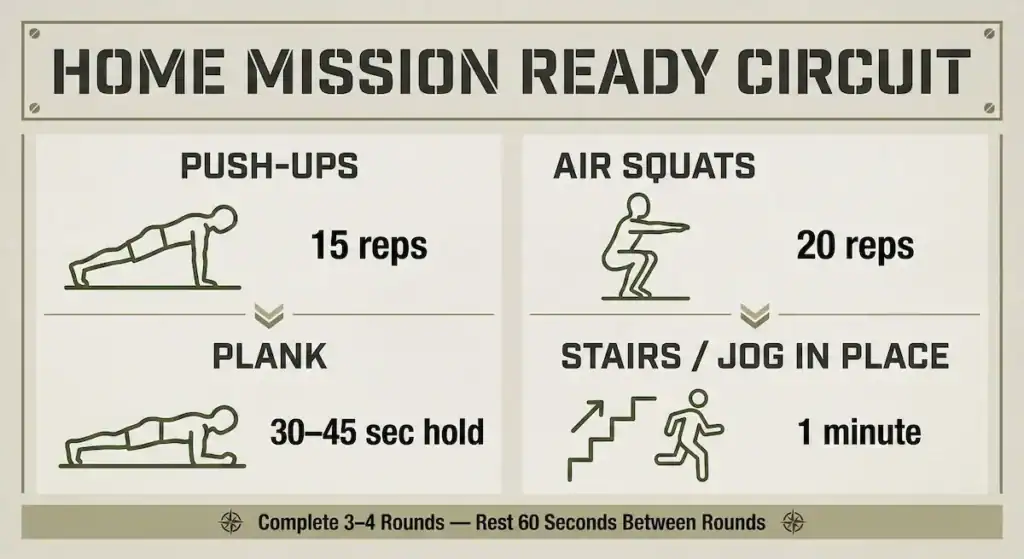
- Push-ups x15 reps
- Air squats x20 reps
- Plank hold x 30-45 seconds
- Stair climb or jog in place (1 minute)
- Rest 60 seconds between rounds
Progression: Add a loaded backpack or weighted vest (start with 10-20 lbs) to squats, lunges, or stair climbs. Work up to 40-50 lbs for rucking simulations.
Improvised Equipment:
- Pull-up bar substitute: Tree branch, sturdy door frame, or playground monkey bars
- Sandbag substitute: Duffel bag filled with sand or dirt
- Weight substitute: Textbooks, water jugs, or a basketball for core rotations
Gym Version: Free weights and Machines
The gym unlocks tactical strength. Heavy compound lifts that build maximal power and durability.
The best military workout for the gym is one that combines heavy compound lifts with high-intensity cardio.
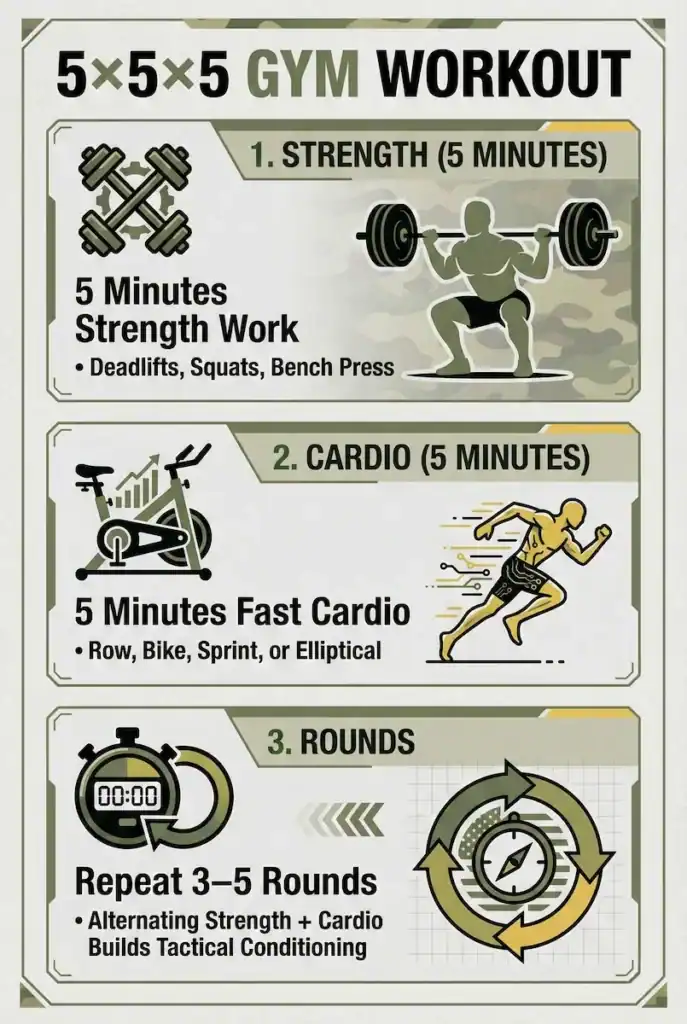
The 5x5x5 workout alternates 5 minutes of heavy lifting (deadlifts, squats, bench press) with 5 minutes of fast cardio (such as rowing, biking, or sprinting). Repeat 3-5 rounds.
Best Military Gym Workout (3-5 Rounds):
- Weighted pull-ups x5-10 reps (add 25 lbs if advanced)
- Bench press or dumbbell press x5 reps at 75-80% 1RM
- Front squats or leg press x8 reps
- Farmer Walks x100 meters (40 lbs in hand)
- Row or bike x400 meters at sprint pace
Why this works: Alternating heavy lifts (strength) with high-intensity cardio (work capacity) mimics the demands of tactical operations… bursts of power followed by sustained effort.
Key Gym Equipment:
- TRX Suspension Trainer: Replaces standard push-ups and TRX atomic push-ups (push-up + knee tuck)
- Kettlebell Swings: Build explosive hip power for sprints and carries
- Non-impact cardio: If your knees can’t handle running… use rowing, biking, or elliptical at increasing resistance
Aim for the 1,000 lb. This is a combined 1 rep max of 1,000 lbs across bench press, squat, and deadlift. It’s a standard tactical athlete challenge.
Outdoor Version: Sprints, Rucking, and Carries

Outdoor training adds terrain variation and functional movement. This is the bread and butter of military conditioning.
Outdoor Field Circuit (3-5 rounds):
- 100m sprint
- 50m bear crawl
- 100m sandbag carry (40-50 lbs)
- 20 squats + 20 push-ups
- 400m ruck with loaded backpack
Essential outdoor drills:
- Rucking: 4-mile ruck with 40-50 lbs pack in under 60 minutes. Builds cardiovascular fitness and functional leg strength.
- Speed work: 300-yard shuttle runs, 5-10-5 agility drills, or 100m sprints with walk-back recovery
- Carries: Farmer walks (heavy dumbbells), fireman carries (buddy rescue drills), or sandbag thrusters
These movements simulate real-world tactical tasks. Carrying equipment, dragging teammates, sprinting under load, or navigating obstacles.
Military Diet & Recovery Principles
You can’t out-train a bad diet. Soldiers understand this. Discipline extends to the kitchen. Feeling right is the difference between building durability and breaking down.
Here’s how tactical athletes eat and recover to stay mission ready…
Why Fueling Right Matters
Your body is a high-performance machine. Feed it cheap fuel (processed junk, sugar, or alcohol) and it’ll run, but it won’t perform optimally. Proper nutrition is non-negotiable for three reasons.
- Performance: What you eat today affects your workout tomorrow. Carbs fuel high-intensity work. Protein builds muscle. Fats support hormone production and joint health.
- Recovery: Refueling within 20 to 30 minutes after a workout accelerates glycogen restoration and muscle repair. Skip this window and you’re undercutting your progress.
- Injury Prevention: Dehydration and undernourishment can tank performance, kill motivation, and increase injury risk. Recovery isn’t rest, but it’s an active pursuit of durability.
Sample “Field Rations” Meal Plan
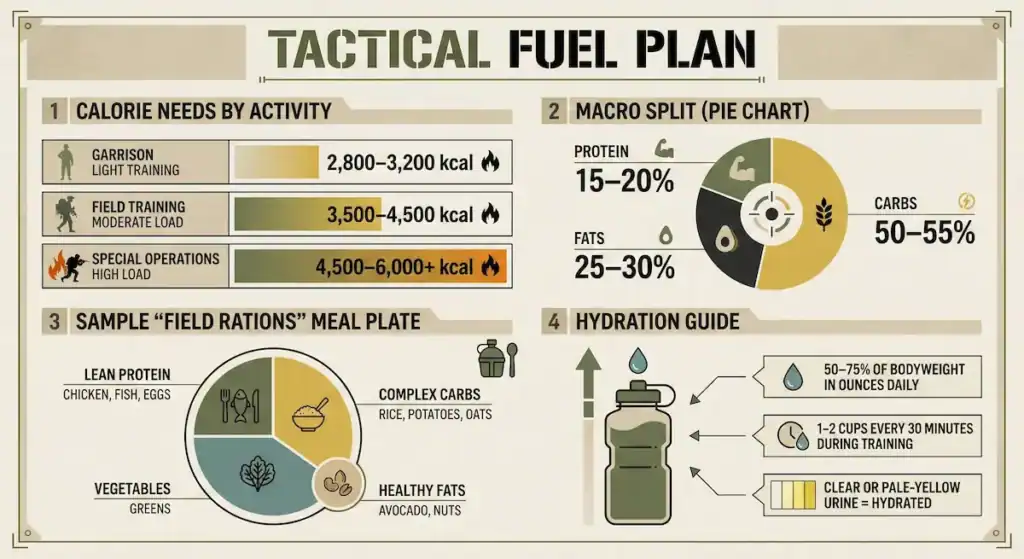
Calorie needs can vary significantly depending on activity level, climate, and mission load. Here are the following general ranges
- Garrison/Light Training: 2,800-3,200 kcal/day
- Field Training/Moderate Load: 3,500-4,500 kcal/day
- Special Operations/High Load (BUD/S, ruck, combat): 4,500-6,000+ kcal/day
The standard military macronutrient split aligns with U.S. Army Research Institute of Environmental Medicine (USARIEM) findings:
- Carbohydrates: 50-55%
- Protein: 15-20%
- Fat: 25-30%
Soldiers eat whole foods to stay fit. Focus on lean protein, complex carbs, and good fats. Avoid processed junk, excess dairy, and inflammatory seed oils 80% of the time.
Tactical Fuel Plan (Daily Example):
- Breakfast: Oatmeal + 2 eggs, fruit, black coffee
- Lunch: Grilled chicken, rice, mixed vegetables, olive oil
- Snack: Trail mix, protein bar, or beef jerky
- Dinner: Lean meat or fish, sweet potato, leafy greens
- Post-workout: Whey protein shake or chicken soup (higher potassium than a banana, more sodium than sports drinks)
Core principles (SEAL Fuel):
- High protein: Lean meats, fish, poultry, eggs
- Complex carbs: Rice, oatmeal, potatoes, whole grains (carbs are your preferred energy source for high-output training)
- Good fats: Nuts, seeds, olive oil, avocado
- Limit processed foods: 80/20 rule – eat clean 80% of the time, allow flexibility 20% for sustainability
Why carbs matter: During heavy training, 55-70% of calories should come from carbs to fuel endurance and strength sessions. After a workout, you want to consume high-glycemic carbs (e.g., white rice, fruit juice) to accelerate glycogen restoration.
Protein Requirements
How much protein do you need for military style workouts? Protein rebuilds muscle torn down during high-volume calisthenics, rucking, and strength training.
Recommended intake: 0.6-0.8 grams per pound of bodyweight daily.
- 175 lb trainee: 105-140 grams of protein per day
- 200 lb trainee: 120-160 grams of protein per day
You can use my protein calculator to instantly determine your daily protein requirements.
Timing Matters:
- Morning + post-workout: Fast-digesting whey protein (egg whites, fish, protein powder) for immediate repair
- Mid-day + evening: Slow-digesting casein protein (red meat, poultry, whole eggs) for sustained amino acid release
Max limit: over 0.8g per pound doesn’t increase muscle growth. You’re just oxidizing the extra protein and wasting your money.
Hydration Protocol
Active individuals need 50-75% of their body weight in fluid ounces of water daily.
- 175 lb trainee: 88-130 oz per day (11-16 cups)
- During training: 1-2 cups every 30 minutes during sustained activity or rucking
Hydration check: Your urine should be pale yellow or clear in color. Dark yellow or looks like apple juice? Then you’re dehydrated.
Electrolytes: Add ¼ tsp salt per quart of fluid in hot conditions. Potassium-rich foods (bananas, yogurt, tomato juice) replace what sweat depletes.
Sleep & Recovery Protocols
The military’s sleep and recovery protocols emphasize structured rest, controlled stress exposure, and active recovery. All is built into both training cycles and operational readiness schedules.
Recovery from stress is key and should be actively pursued even when sleep schedules are disrupted. Sleep is your body’s natural recovery cycle. Missing even a few nights of quality rest can mimic the symptoms of overtraining.
A target of 6-8 hours of sleep is optimal for tactical athletes to recharge and maintain their performance.
Long, uninterrupted sleep isn’t always possible so shorter, strategically timed naps and structured rest periods are built into training. Even short 10-15 minute naps can quickly restore alertness and combat fatigue.
Active recovery cycles help balance training and operations when sleep is inconsistent. Use deep breathing, stretching, mobility exercises, and a brief “cat nap” session between tasks.
Try the “coffee nap” rapid recovery technique used in the military. Drinking a small cup of coffee (100-200 mg caffeine). It takes 15-20 minutes to enter your bloodstream and begin blocking adenosine (a compound that makes you sleepy). Immediately take a short nap (10-20 minutes), and when you wake up, the caffeine kicks in, giving you a double alertness effect.
Military sleep and recovery protocols are about adaptability. You learn to perform despite fatigue, but always return to deliberate recovery cycles when possible. Actively pursuing recovery through smart scheduling, short restorative rest, and disciplined sleep hygiene to sustain long-term performance.
When hard training makes it tough to switch off at night, a better wind-down routine can support more consistent recovery. BioTRUST Ageless Multi Magnesium combines several forms of magnesium with L-theanine to support relaxation, restful sleep, and normal muscle function.
A 7-form magnesium complex designed for adults 40+ to support restful sleep, relaxation, muscle recovery, and whole-body health. Each serving provides 350mg of magnesium plus L-theanine and vitamin B6 for added nervous-system support.
- 7-Form Magnesium Blend: Combines glycinate, taurate, malate, citrate, Sucrosomial® magnesium & complementary forms
- Sleep & Relaxation Support: Magnesium glycinate plus L-theanine help support calm, relaxation & restful sleep
- Muscle Recovery & Comfort: Supports normal muscle relaxation, recovery & energy production
- Enhanced Absorption: Includes clinically studied Sucrosomial® Magnesium for high absorption & gentle digestion
- Heart, Bone & Nervous System Support: Provides 350mg of magnesium plus vitamin B6 for essential body functions

Mindset of a Soldier: Discipline, Grit & Motivation
Physical fitness gets you through the starting line. Mental toughness gets you through selection.
Navy SEALs say it plainly. Most failures and BUD/S aren’t physical… they’re mental. The body quits because the mind gives permission.
Here’s how soldiers build a warrior mindset that refuses to quit:
Consistency > Intensity
Military training doesn’t rely on motivation or crushing yourself once a week. It’s built on daily persistence.
The guiding principle: “Slow is smooth, smooth is fast.”
You don’t need to destroy yourself every session. You need to show up every day, even when tired, unmotivated, or sore. Discipline is doing what needs to be done, whether you feel like it or not.
Avoid the zero-to-hero trap. Transitioning from a couch potato to maximum effort can lead to burnout and injury. Build momentum slowly, week by week, focusing on one day, one rep, one breath at a time.
Techniques: How Soldiers Build Mental Toughness
1. Early-Morning Discipline (The Warrior SOP)
Success starts before the workout. Soldiers use a pre-training Standard Operating Procedure (SOP) to prepare their minds and bodies.
- Box Breathing (5 minutes): Inhale 4 counts, hold 4, exhale 4, hold 4. Clears mental baggage, eliminates distractions, and develops deep focus.
- Visualization: See yourself completing the workout with perfect form. This “dirt diving” technique activates positive energy and primes your nervous system for execution.
- Positive dialogue: Override negative thoughts with mantras. SEALs use phrases like “Feeling good, looking good, oughta be in Hollywood” to silence the “fear dog” barking in their head.
2. Accountability and Teamwork
Training solo builds discipline. Training with the team builds mental toughness through accountability.
During Hell Week (120 hours of continuous training with minimal sleep), many SEALs who broke bones didn’t quit because they refused to let down their boat crew. Their mentality was, “I won’t be the reason my team fails.”
Find accountability even if you train alone. You can find a workout partner, join an online group, or hire a personal trainer or coach. Quitting stops being an option when others count on you.
3. The “One More Rep” Mindset (20x Principle)
Trainees discover the 20x principle early. You’re capable of 20 times more than you think.
When your mind screams “stop,” your body is often 10 times stronger than your mind lets it be. The key is disassociation. This is disengaging from discomfort and focusing on something else (breath, form, a mantra).
Grit develops like a callus. The more you lean into hard things, the grittier you’ll become. Successful operators know the difference between injury (stop immediately) and pain (play through it).
Scaling, Safety & Injury Prevention
Key Takeaways:
Military training is built on durability, not destruction. Scale smartly, warm up fully, gradually, and recover deliberately. Injury prevention isn’t weakness… It’s the strategy that keeps you training for decades, not just a couple of weeks.
Train hard. Recover harder. Stay in the fight.
Military training builds durability. This is the ability to train hard, recover quickly, and stay mission-ready for years. However, the reality is that more soldiers get injured from overtraining for combat.
Time is your friend… don’t rush into an injury. Here’s how to scale smartly, progress safely, and avoid the injuries that often derail beginners.
How to Modify Workouts for Age, Gender, or Fitness Level
The S-A-V programs are hardcore but completely scalable. The key is to start where you are and not where you think you should be.
Beginner modifications:
- Can’t do pull-ups? Use resistance bands for assistance or substitute TRX rows.
- Push-ups too hard? Start on your knees or against an elevated surface (bench, wall).
- Knees hurt from running? Replace running with non-impact cardio, such as biking, rowing, swimming, or using an elliptical.
Age considerations (45+):
- Recovery takes longer. Allow 48 hours between heavy sessions, rather than 24.
- Start with Basic Training loads instead of Advanced Operator Training. Your joints will thank you.
- Prioritize mobility work – flexibility declines with age, making stretching a non-negotiable necessity.
Gender and bodyweight:
Women and smaller-framed athletes should prioritize core and shoulder stability from an early stage of their training. Pull-ups and rucking loads disproportionately stress smaller joints.
When high-rep training and loaded carries put extra stress on your joints, connective-tissue support can help you stay consistent. BioTRUST Ageless Multi Collagen provides five collagen types designed to support cartilage, tendons, ligaments, and joint comfort.
Powered by 5 Types of Bioactive Naturally Hydrolyzed Collagen Peptides for Full-Body Support (Odorless & Flavorless)
- Natural GLP-1 Support: Helps support healthy appetite signals, fullness & metabolic function
- Lean Muscle Support: Helps preserve muscle, strength & healthy body composition during weight loss
- High-Protein Collagen: Adds 20g of protein with 5 collagen types to help support daily protein intake
- Skin, Joint & Hair Support: Provides collagen peptides to support skin elasticity, joints, hair & nails
- 3-Part Weight-Loss Support: Combines muscle, protein/collagen & appetite support in one simple daily stack

Use less weight if needed: the integrity of the workout isn’t compromised by scaling load. It’s about putting in your maximum effort within your capacity.
Progression System: Increase gradually. Never sacrifice technique for speed or volume. Technique supersedes weight for all movements.
The crawl-walk-run approach:
- Week 1: Master form with bodyweight or light loads
- Week 2-4: Increase reps by 10-20% gradually
- Week 5+: Add weight or intensity gradually
Progression Guidelines:
- Calisthenics: Start pyramid workouts small (1-5 reps). When you can do 12+ reps easily, increase resistance (add a weighted vest or backpack).
- Running: Increase mileage by no more than 10-20% per week. Jumping from 10 miles to 20 miles weekly? That’s how you blow out your knees.
- Strength training: Build from 5RM (5-rep max) before testing 1RM. For strength, use 65-90% of 1RM with 1-12 reps. For endurance, use 30-50% of 1RM with 20-60 reps.
Critical rule: Increase one variable at a time… reps, weight, or distance. Not all three.
Proper Warm-Up & Cool-Down Routines
Skipping warm-ups and cool-downs is how beginners get hurt.
Warm-up (10-20 minutes):
- Cardio to break a sweat: light jog, jumping jacks, or bike for 5-10 minutes to increase blood flow
- Dynamic stretching: leg swings, butt kickers, Frankenstein walks, arm circles (5-10 minutes)
- Mental prep: box breathing (5 minutes) to clear your mind and visualize success
- Never stretch cold muscles. Warm up first, then stretch.
Cool-down (10-15 minutes):
- Gradual slowdown: walk for 5 minutes after running to normalize heart rate and prevent blood pooling
- Static stretching: hold each stretch 15-30 seconds while muscles are warm. This is when you achieve the most significant flexibility gains.
- Active recovery: light cycling or walking at 30-50% max heart rate accelerates lactate removal.
Preventing Knee, Shoulder & Back Injuries
These are the Big 3 injury zones for tactical athletes.
Knee protection:
- Keep your shins vertical during squats and lunges. Don’t let your knees drift forward past your toes.
- Use mid-foot or forefoot strike when running (not heel strike)
- Avoid high-impact cardio if overweight (40+ lbs to lose) – use biking, rowing, or swimming instead
Shoulder protection:
- Strengthen rotator cuffs with light-weight lateral raises (thumbs-up position)
- Avoid overhead pressing if experiencing shoulder pain
- Pull-ups stress shoulders – use bands or TRX rows if you have rotator cuff issues
Back protection:
- Core strength is critical: overdeveloped hip flexors from excessive sit-ups cause lower back pain. Add sandbag get-ups and planks for rotational core strength.
- Proper lifting technique: deadlifts and squats require lower lumbar stability. Tall athletes are at a higher risk… go slow and master your form first.
- Never round your back under load: lift with your legs, not your spine.
Injury protocol (RICE): If sharp pain occurs (not soreness), stop immediately. Rest, Ice, Compression, Elevation. Follow with Ice, Stretching, and Exercise (ISE) to restore range of motion.
Don’t Overtrain – Recovery is Mandatory
The most common mistake? Overtraining… excessive frequency, intensity, or duration without adequate recovery.
Symptoms of overtraining:
- Decreased performance and strength
- Persistent fatigue and muscle soreness
- Elevated resting heart rate
- Increased injury risk
- Loss of motivation
The solution:
- 1-2 complete rest days per week minimum
- 12-24 hours between workouts for muscle recovery
- Use periodization: cycle strength phases with cardio/calisthenics phases to prevent burnout.
- Sleep 8 hours: strength and endurance improvements occur during rest, not during training
FAQ
Is a military workout the same as bootcamp training?
Not quite. Bootcamp-style workouts are inspired by military physical training but are designed for general fitness and motivation. True military workouts are mission-specific conditioning programs that focus on strength, endurance, and job performance —not just calorie burn or group intensity.
How do soldiers train without equipment?
Soldiers train without equipment by using bodyweight exercises and their environment. They rely on calisthenics (push-ups, pull-ups, squats, lunges, planks) and use improvised resistance (rucksacks, sandbags, partner carries) to simulate load bearing. Field workouts even use helmets as medicine balls and ropes or logs for strength drills.
Can you get fit with only bodyweight training?
Yes, you can absolutely get fit with only bodyweight training. Military programs have long relied on calisthenics because they require no equipment, can be performed anywhere, and build both strength and endurance when executed progressively. Calisthenics build military-level endurance, functional strength, and lean muscle.
How to build mental toughness for workouts?
Mental toughness is trained like a muscle… through progressive exposure to discomfort.
1. Win the mental battle first: Use the pre-training SOP (box breathing, visualization, positive dialogue) before every workout.
2. Embrace the suck: Discomfort is the price of growth. When workouts hurt, remind yourself: “This is where I get stronger.”
3. Micro-goals: Facing 1,000 push-ups or a 5-mile run? Focus on one rep, one step, one breath at a time. Shatter self-imposed limits by shrinking the challenge.