

Yes, oatmeal can be a powerful weight loss tool… but for 30% of people, it backfires completely and leaves them ravenously hungry an hour later.
If you’re one of those people who eats a “healthy” bowl of oats for breakfast and finds yourself shaky, starving, and ready to raid the pantry by 10 AM then you’re not broken. You’re not doing it wrong. And you’re definitely not crazy. It’s the “oatmeal crash.”
You know you’ve heard you’re supposed to eat oatmeal. Your doctor mentioned it for cholesterol. Fitness influencers swear by it. But every time you try it? You feel like you need a nap. Or worse… you’re hungrier than if you’d eaten nothing at all.
Meanwhile, your friend posts about how oatmeal is her “secret weapon” for weight loss, how she’s never hungry, and how it’s a “game changer.” What gives?
Here’s the truth: The problem isn’t you. It’s the type of oatmeal you’re eating, how you’re preparing it, and whether it matches your body’s specific insulin response.
Here you will understand YOUR body’s reaction to oats, get the exact fixes that work, and learn how to make oatmeal actually support your weight loss—not sabotage it.
The Short Answer: Is Oatmeal Good for Weight Loss?
Yes — but only if you prepare it correctly.
Here’s what you need to know right now…
A half-cup of dry oats delivers roughly 150 calories, 4 grams of fiber, and 5 grams of protein. Not terrible. Not magic either.
The real question isn’t “Is oatmeal good for weight loss?”
It’s “Why does this supposedly healthy breakfast leave me starving an hour later?”
You’re not crazy. You’re not doing it wrong. But your body is telling you something.
A 2025 review in Critical Reviews in Food Science and Nutrition found that higher oat intake was consistently associated with lower body weight, reduced obesity-related measures, and healthier adiposity profiles. Randomized controlled trials showed oat-based interventions significantly reduced body weight, body fat, and waist circumference in overweight individuals when eaten regularly as part of a calorie-appropriate diet.1
Why Oatmeal Works for Some People
Oatmeal can be a “cheat code” for certain metabolisms. The beta-glucan fiber—a specific type of soluble fiber found in oats—creates a gel in your stomach that slows digestion.
Blood sugar stays stable. Hunger stays quiet. You cruise to lunch without thinking about food.
One of my clients dropped 15 pounds in two months and said: “I wasn’t expecting it, but I’ve lost 15 pounds in two months just by swapping my typical sugary breakfast for a bowl of oats.”
A 2019 review in Pomeranian Journal of Life Sciences found that oat products, rich in β-glucans, improve glycemic control, reduce blood cholesterol, and support weight loss in overweight and obesity through enhanced satiety and metabolic effects. Regular oat intake is linked to better management of type 2 diabetes, hypercholesterolemia, and excess body weight.2
But there’s a catch…
Most of those getting results aren’t eating plain oatmeal with water. They’re adding protein like egg whites, Greek yogurt, and cottage cheese. They’re adding healthy fats like chia seeds, flaxseed, and nuts.
They’re transforming “naked carbs” into a balanced meal.
Why Oatmeal Fails for Others
For you? Maybe oatmeal triggers what I call the “30-minute betrayal.”
You eat a bowl. You feel full. Then 30 minutes later you’re shaky, foggy, and ravenous. Hungrier than if you’d eaten nothing at all.
Sound familiar?
You’re experiencing an insulin spike followed by a crash. Plain oats (especially instant or rolled varieties) hit your bloodstream fast. Your body panics. Insulin floods in. Blood sugar plummets. And you’re left standing at the pantry, white-knuckling it until lunch.
Oatmeal only supports weight loss when it fits into an overall caloric deficit. No food (not even oatmeal) burns fat on its own.
A 2010 randomized controlled trial in the British Journal of Nutrition found that overweight women on a 2 MJ energy-deficit diet lost ~4.1 kg and reduced waist circumference significantly over 3 months, regardless of adding moderate (56 g) or high (89 g) oat β-glucan doses to cereals/snacks like oats versus high-fiber controls. No group differences emerged in weight loss, waist reduction, or appetite hormones. This confirms caloric energy restriction (not oats alone) drove the outcomes.3
And here’s what nobody tells you: individual insulin response varies wildly. What keeps your neighbor full for six hours might send you into a metabolic tailspin.
The Bottom Line:
Oatmeal isn’t universally “good” or “bad” for weight loss. It’s a tool. And like any tool, it only works if you’re using it right.
Let’s figure out which camp you fall into… and how to make oatmeal work for YOUR metabolism, not someone else’s.
Why Oatmeal Makes Some People HUNGRIER (The Hunger Paradox)
You’re not imagining it. And you’re definitely not alone.
If oatmeal leaves you ravenous within an hour, shaky by mid-morning or staring into the pantry like a zombie at 10 AM… then your body is screaming something important.
Listen to it.
The “Crash” Is Real—Here’s What’s Happening
“It fills me for maybe 30 minutes, and then I’m STARVING, and my blood sugar has dropped.”
That’s how one of my beginner clients described the betrayal.
Here’s the mechanism: When you eat oatmeal (especially instant or rolled varieties), it breaks down into glucose fast. Your pancreas sees that sugar flood and panics. It releases insulin to clear it out.
But here’s the trap…
Insulin does its job too well. It shoves that glucose into storage so aggressively that your blood sugar plummets. Now you’re in what experts call reactive hypoglycemia. This is low blood sugar triggered by the spike you just ate.
Your brain, which runs on glucose when you’re not fat-adapted, suddenly thinks you’re starving. Even though you just ate 300 calories.
The energy is locked away. You can’t access it. And your brain is demanding fuel right now.
Oatmeal triggers the least amount of Peptide YY. This is the hormone that tells your brain you’re full. Compared to protein or fat, carbs like oatmeal barely whisper “I’m satisfied” to your brain.
The processing makes it worse.
Instant oats? They’re essentially pre-digested. The manufacturing process pulverizes the grain structure, turning what should be a slow-burning fuel into something that hits your bloodstream like a sugar packet.
Nutrition experts call processed oats “instant sugar” for good reason. Grind up that oat, and wham, it converts to glucose as fast as candy.
Meanwhile, steel-cut oats (which retain their structure) digest more slowly. But even those can trigger crashes if you’re insulin-resistant or eating them “naked” (without protein or fat).
This is exactly the kind of hunger that has nothing to do with willpower. When your blood sugar crashes and your satiety hormones barely register the meal, your brain genuinely thinks it’s starving. If appetite control is part of your bigger weight-loss picture, the BioTrust GLP-1 Companion Stack is worth a look. It’s built around ingredients that support your body’s natural GLP-1 activity and healthy hunger signaling, so mornings like this are less likely to end with you raiding the pantry.
A 3-part daily stack designed to support people using GLP-1 medications or losing weight naturally. It combines muscle, protein, collagen, and appetite support to help you maintain a healthier body composition as you lose weight.
- Natural GLP-1 Support: Helps support healthy appetite signals, fullness & metabolic function
- Lean Muscle Support: Helps preserve muscle, strength & healthy body composition during weight loss
- High-Protein Collagen: Adds 20 g of protein with 5 collagen types to help support daily protein intake
- Skin, Joint & Hair Support: Provides collagen peptides to support skin elasticity, joints, hair & nails
- 3-Part Weight-Loss Support: Combines muscle, protein/collagen & appetite support in one simple daily stack

Signs Oatmeal Isn’t Working for YOUR Body
Watch for these red flags:
Hungry within 1-2 hours. You should coast to lunch, not count the minutes.
Brain fog or needing a nap. This is “metabolic damage.” Your body can’t access the energy it just stored.
Shaky, lightheaded, or irritable. Classic hypoglycemia. Your blood sugar crashed harder than it should have.
Feeling hungrier than if you’d skipped breakfast entirely. This one’s the kicker. People report this constantly. Eating the oatmeal created hunger that wasn’t there before.
If you’re nodding along to three or more of these? Oatmeal is working against you, not for you.
Imagine swapping that bowl for eggs and avocado tomorrow morning. Steady energy. No crash. No trying to survive until lunch.
That’s what your body is asking for.
The 3 Oatmeal Archetypes: Which One Are You?
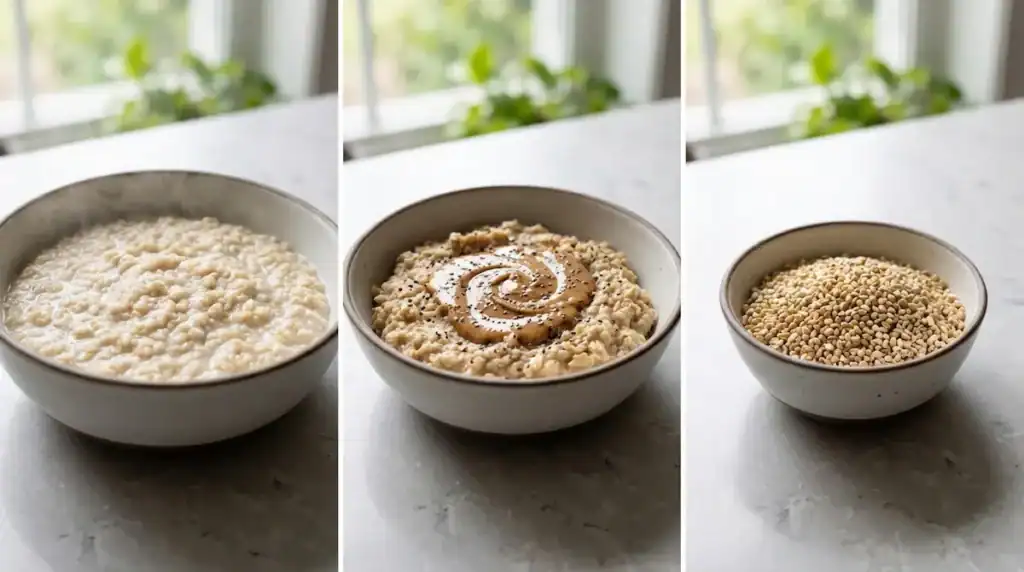
Not all bodies handle oatmeal the same way.
The solution isn’t to abandon oatmeal entirely… It’s about figuring out your biology and working with it, not against it.
Read these three profiles. One will feel like it’s describing you.
Archetype 1: The Volume Eater
Your profile: You need to see a full bowl. A tiny portion (even if it’s calorie-appropriate) leaves you mentally unsatisfied. You do best when your plate looks abundant.
Why oatmeal works for you: Oats are a sponge. They absorb massive amounts of liquid without adding calories.
Your fix: Hydration hacking.
Push your liquid-to-oat ratio to 3:1 or even 4:1. Standard recipes call for 2:1. You’re not standard.
Cook longer. Let the oats absorb every drop. The result? A bowl so huge you literally can’t finish it—for the same 150 calories.
Your secret weapon: Zoats.
Grate raw zucchini into your oats while they cook. The zucchini disappears into the texture, takes on the oat flavor, and doubles your bowl size for almost zero calories. I call this my oats “cheat code”—full for 4-6 hours on a 290-calorie bowl.
This is how volume eaters win.
Archetype 2: The Insulin-Sensitive / Crash-Prone
Your profile: Plain oatmeal leaves you shaky within an hour. You crash hard. You might be prediabetic or just carb-intolerant.
Why plain oatmeal fails you: Naked carbs spike insulin fast, then drop you into hypoglycemia. Your body can’t handle the glucose load on its own.
Your fix: The Protein Anchor protocol.
Never… and I mean never… eat oatmeal plain again.
Your secret weapon: Liquid egg whites whisked in while cooking.
Add 1/3 cup. It adds 9 grams of protein, creates a fluffy texture, and you won’t even taste them. I know people swear this trick transforms oatmeal from “starvation trigger” to “game changer.”
Also add fat. Nut butter. Chia seeds. Walnuts.
You’re not just eating oatmeal anymore. You’re “clothing your carbs.” Protein and fat blunt the insulin spike, slow digestion, and keep blood sugar stable.
Imagine cruising to lunch without once thinking about food.
That’s what happens when you anchor your carbs.
Archetype 3: The Texture-Averse
Your profile: Standard oatmeal makes you gag. It’s not about taste… It’s mechanical. The mushiness triggers something primal.
I’ve heard these people describe it as “warm wallpaper paste,” “mushy boiled cardboard,” even “slime.” If that’s you, you’re not picky—you’re texture-sensitive.
Why standard oatmeal fails you: Rolled oats turn gelatinous. Your brain reads it as wrong.
Your fix: Steel-cut oats or baked oats.
Steel-cut keeps its structure. It has chew. It has bite. It has a more satisfying “pop” that rolled oats never deliver. It eats more like rice than porridge.
Alternative: Baked oats.
Blend oats into flour, mix with egg and banana, and bake like a muffin. You get a cake-like breakfast with all the fiber benefits. Zero slime factor.
Overnight oats work too. The grains stay distinct, not mushy.
One of my texture-averse clients said steel-cut oats were “the only oats I can stomach.” Find your version and stick with it.
Quick Archetype Guide:
- Volume Eater: Hydration hack (3:1 or 4:1 ratio) + Zoats = massive, filling bowl
- Insulin-Sensitive: Protein anchor (egg whites, Greek yogurt) + healthy fats = no crash
- Texture-Averse: Steel-cut for chew, baked oats for cake texture, overnight for distinct grains
The downside to oatmeal? Eating it the wrong way for your body. Match your archetype, and oatmeal stops being a problem and starts being a tool.
How to Prepare Oatmeal for Weight Loss (The Right Way)
Here’s the truth: preparation matters more than the type of oat.
A perfectly prepped bowl of rolled oats beats a poorly prepared bowl of steel-cut every time.
Let’s fix your bowl…
The “Protein Anchor” Protocol (Non-Negotiable)
Rule #1: Never eat a naked oat
Carbs alone spike insulin, crash your blood sugar, and leave you ravenous. You need protein to anchor that carb.
The egg white hack: Whisk 1/3 cup liquid egg whites into your oats while they’re cooking. This adds 9 grams of protein, creates a fluffy texture, and you won’t even taste them.
The protein powder option: Stir in a scoop after cooking to create “proats.” Skip the cheap stuff—quality matters here.
Greek yogurt or cottage cheese: Add at the end for creaminess plus slow-digesting casein protein.
Your target: 15-25 grams of protein total in your bowl. This is what separates the people who stay full for 6 hours from those starving by 10 AM.
Hitting that protein target consistently is where most people fall short, especially once a smaller appetite makes eating enough food feel like a chore. The BioTrust GLP-1 Companion Stack pairs an easy-to-mix protein and collagen boost with ingredients that support lean muscle during a calorie deficit, which matters more the longer you stay in one. It’s one option I like for people who want their oatmeal protein add-in to also work toward preserving the muscle they’ve built.
A 3-part daily stack designed to support people using GLP-1 medications or losing weight naturally. It combines muscle, protein, collagen, and appetite support to help you maintain a healthier body composition as you lose weight.
- Natural GLP-1 Support: Helps support healthy appetite signals, fullness & metabolic function
- Lean Muscle Support: Helps preserve muscle, strength & healthy body composition during weight loss
- High-Protein Collagen: Adds 20 g of protein with 5 collagen types to help support daily protein intake
- Skin, Joint & Hair Support: Provides collagen peptides to support skin elasticity, joints, hair & nails
- 3-Part Weight-Loss Support: Combines muscle, protein/collagen & appetite support in one simple daily stack
The Volume Maximizer Technique
Want a bigger bowl without more calories?
Use a 3:1 or even 4:1 liquid-to-oat ratio. Standard recipes call for 2:1. You’re not interested in standard results.
Cook longer. Let those oats absorb every drop.
The vegetable volumizer: Grate raw zucchini or add riced cauliflower while cooking. They disappear into the texture, but double your bowl size for roughly 50 extra calories.
Why it works: Physical stomach distension triggers satiety receptors in your gut. Your brain gets the “I’m full” signal from volume, not just calories.
Imagine a bowl so massive you can’t finish it… for under 300 calories total.
The Glycemic Blunting Method
You’re “clothing your carbs” to slow digestion and stabilize blood sugar.
Add healthy fats: Chia seeds, ground flaxseed, walnuts, or a tablespoon of almond butter. Fat slows the insulin response dramatically.
Add fiber: Berries (especially blueberries and raspberries) are a good source of fiber without spiking sugar levels.
This combination transforms a “fast” carb into a “slow” meal. You’re blunting the spike before it happens.
What to Add (and What to Avoid)
AVOID these calorie bombs:
- Maple syrup
- Brown sugar
- Honey in large amounts
- Dried fruit
- Flavored instant packets
One of my online clients was eating a 700-calorie bowl of “healthy” oatmeal and wondered why she wasn’t losing weight. The toppings sabotaged her.
I told her, “Many people need to add honey, sugar, or some sweetener to make it palatable, but that doesn’t help the nutritional profile one bit.”
SMART ADDS instead:
Cinnamon (supports blood sugar stability)
Fresh berries (fiber + antioxidants)
Nuts and seeds (protein + fat)
Unsweetened cocoa powder (flavor without sugar)
The difference between a weight-loss breakfast and a dessert masquerading as health food? The toppings you choose.
The Preparation Checklist:
- Watch portions: Even “healthy” toppings can turn a 150-calorie bowl into a 700-calorie trap
- Protein anchor: Egg whites, protein powder, or Greek yogurt = 15-20g protein minimum
- Volume hack: 3:1 or 4:1 liquid ratio + grated zucchini = massive, filling bowl
- Glycemic blunting: Healthy fats (chia, nuts, nut butter) + berries = stable blood sugar
- Skip sugar bombs: No maple syrup, brown sugar, honey, or sweetener—use cinnamon and berries instead
Best Type of Oatmeal for Weight Loss (Steel Cut vs. Rolled vs. Instant)
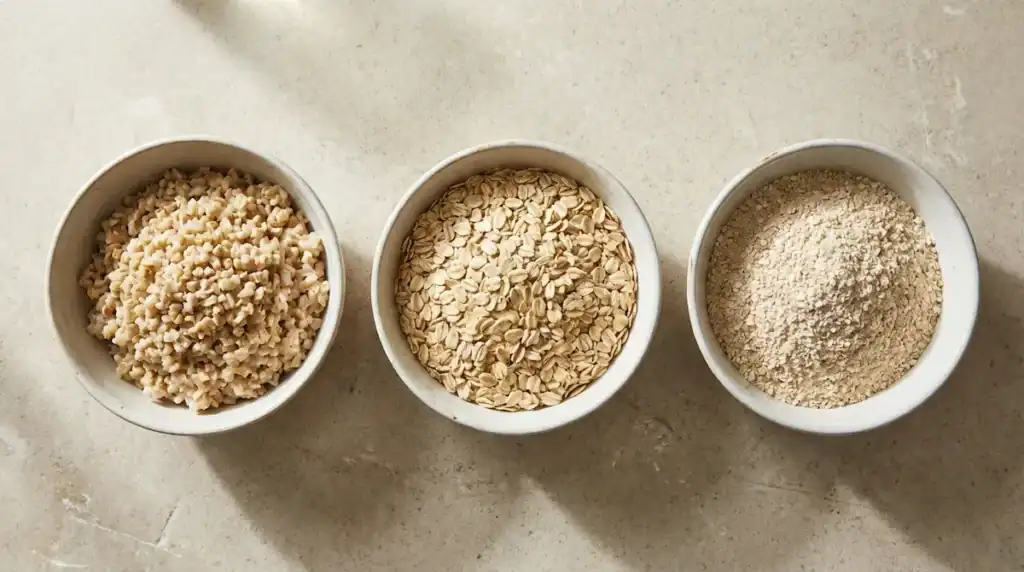
Let’s end the confusion…
You’ve stood in the oatmeal aisle, wondering whether the expensive steel-cut version is worth it or if Quaker instant will sabotage your results.
Here’s what actually matters.
The Quick Breakdown
Steel-cut oats: Least processed. Lowest glycemic index. Chewiest texture. Takes 20-30 minutes to cook.
Rolled oats (old-fashioned): The middle ground. Five-minute cook time. Versatile. Absorbs liquid beautifully.
Instant oats: Most processed. Highest glycemic index. Fastest cook. Most likely to trigger the crash.
Here’s the plot twist…
The differences in nutritional value between rolled oats and steel-cut oats are really, really insignificant.
The calories? Nearly identical. The fiber? Almost the same.
But the satiety difference? BIG difference.
Steel-cut oats have structure. They require chewing. Your jaw works, your brain registers “I’m eating substantial food,” and digestion happens slowly.
Rolled oats are softer but still decent. Instant oats turn to mush instantly. Your body barely registers that you ate solid food.
Which Type for YOUR Archetype
Volume Eaters: Rolled oats are your friend. They fluff up beautifully, absorb massive amounts of liquid (remember that 4:1 ratio?), and create the biggest bowl for the fewest calories.
Crash-Prone: Steel-cut, no question. The slower digestion and lower glycemic index keep your blood sugar stable. No mid-morning crash.
Texture-Averse: Steel-cut saves you here. I know people rave about the “pop” and “bite.” It eats like rice, not slime. Alternative: baked oats for that cake-like texture.
Time-Crunched: Overnight oats using rolled oats. Prep the night before, grab and go. Zero cook time.
The Verdict on Instant Oatmeal
Plain instant oats? Fine if you add protein and fat.
Flavored instant packets? Toss in the trash.
I tell my clients, “Stay away from the packets. They have added stuff to them. Get old-fashioned oats.”
The problem with those maple brown sugar packets isn’t just convenience. It’s the 9-12 grams of added sugar per serving. That’s nearly as much sugar as a candy bar.
Instant oats are processed so heavily that they act like “sugar packets” in your bloodstream. Processing destroys the grain structure that slows digestion. You spike fast. You crash hard.
A better move is to buy plain oats. Flavor them yourself with cinnamon, berries, and nuts.
Brand matters less than you think—though most people prefer Bob’s Red Mill for taste and texture over Quaker. But don’t let perfect be the enemy of good. Plain old-fashioned Quaker beats flavored instant packets every time.
Imagine knowing exactly which oat works for your body. No more guessing. No more wasted money on types that leave you starving.
That’s the power of matching oat to archetype.
Oat Type Cheat Sheet:
- Steel-Cut: Best for crash-prone and texture-averse; 20-30 min cook; chewiest; lowest GI
- Rolled (Old-Fashioned): Best for volume eaters; 5 min cook; most versatile; middle GI
- Instant Plain: Acceptable if you add protein/fat; 1 min cook; highest GI
- Flavored Packets: AVOID. 9-12g added sugar, sodium, processing = “sugar bombs”
- Bottom line: Nutritional differences are minimal, but satiety differences are REAL—texture, chewing, and digestion speed matter more than the nutrition label
Oatmeal Brand Guide: Quaker vs. Bob’s Red Mill vs. Store Brand
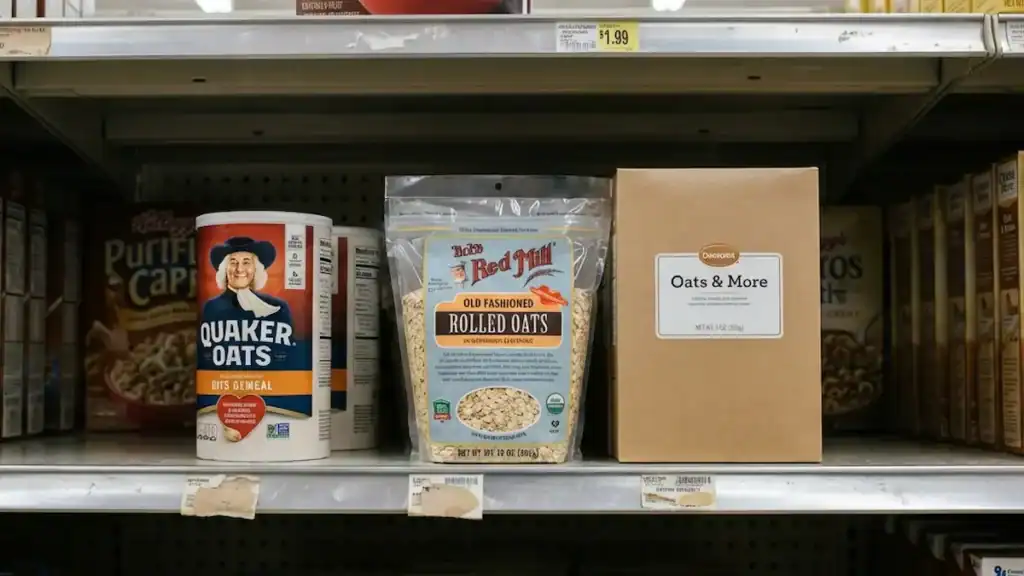
Does brand actually matter?
Short answer: It depends on what you’re doing with them.
Here’s the hierarchy…
The Brand Hierarchy
Bob’s Red Mill: The Premium Choice
I’ve heard people describe the taste as “nuttier” and “legitimately tasty.” There’s a noticeable difference in texture and flavor integrity compared to mass-market brands.
The real advantage? Trust for gluten-sensitive folks.
“I think Bob’s Red Mill are safer… dedicated gluten free factory.”
If you have Celiac disease or gluten sensitivity, Bob’s Red Mill operates dedicated gluten-free facilities—no risk of cross-contamination. Quaker can’t promise that.
Quaker: The Baseline
Widely available. Affordable. Gets the job done.
But I’ve heard of quality issues—”pieces of husks,” more “dust,” and broken flakes. The gluten-free community treats it with suspicion because of cross-contamination risks in processing facilities.
For weight loss purposes? Quaker works fine if you’re adding protein and fat and preparing it properly. The brand won’t make or break your results.
McCann’s: The Steel-Cut Gold Standard
If you’re serious about steel-cut oats, McCann’s is the brand users swear by. Traditional. Consistently good texture. The downside? Longer cook time—but that’s true of all steel-cut varieties.
Store Brands: “Oats Are Oats”
Here’s the truth from the budget-conscious crowd: for basic uses, generic works.
The catch? Texture can be inconsistent. One batch might be perfect, the next full of broken pieces.
The Budget Reality
Bob’s Red Mill costs 2-3 times as much as Quaker or store brands.
Is it worth it?
It depends on usage.
For baking: Generic is fine. You’re mixing oats into muffins or cookies—texture differences disappear.
For eating straight as porridge: Premium brands offer a noticeably better experience. The texture is cleaner. The taste is richer. And here’s the thing… better taste means better dietary compliance.
If your oatmeal tastes like cardboard, you won’t stick with it. If it’s actually tasty and enjoyable? You eat it consistently. Consistency wins weight loss battles.
The Budget Hack:
Buy steel-cut oats from bulk bins at WinCo, Whole Foods, or Sprouts. You get premium texture at generic prices—often 50-70% cheaper than packaged Bob’s Red Mill.
Same oats. Better price. No packaging waste.
Imagine paying $3 per pound instead of $8 for the exact same quality oats. That’s the bulk bin advantage.
Savory Oatmeal: The Weight Loss “Game Changer” Nobody Talks About
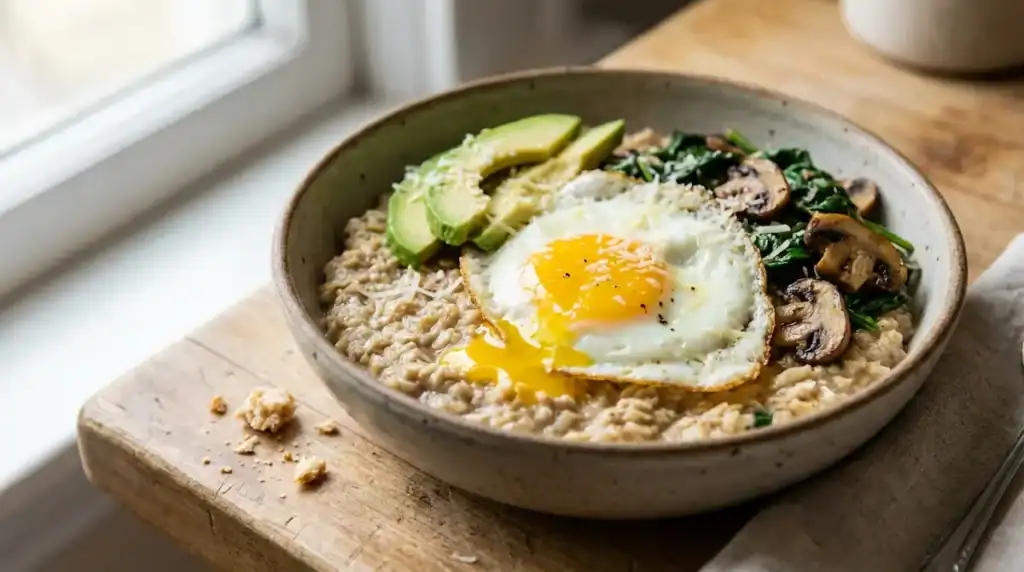
Here’s why savory oatmeal works better if you’re trying to lose weight…
You eliminate the topping trap completely.
No temptation to drizzle honey. No “just a little” maple syrup that turns into three tablespoons. No dried fruit calorie bombs.
Sweet oatmeal begs for sugar. Savory oatmeal demands protein and fat.
You can add the exact foods that keep you full:
- Fried eggs
- Avocado
- Cheese
- Sautéed vegetables
- Lean meats
Try putting a fried egg on your maple-cinnamon oatmeal. Doesn’t work, does it?
But on savory oats? The runny yolk creates a rich sauce that binds everything together.
You break the sweet-craving cycle.
Sweet breakfast triggers sweet cravings all day. You know this already… you’ve lived it.
Savory breakfast? Your brain registers “substantial meal.” The sugar rollercoaster never starts.
One of my clients who lost 30 pounds wrote: “I was instantly hooked… sweet oatmeal is kinda gross now.”
That’s palate fatigue working in your favor. After months of artificial sweeteners and “diet-sweet” foods, your taste buds crave something deep, meaty, and satisfying.
Savory oats deliver.
The “Gateway” Recipes (Start Here)
The Grits Style: Cook oats in water. Add crumbled bacon, sharp cheddar, hot sauce, and a fried egg. Treat it like grits because that’s essentially what it is.
The Asian Fusion (Congee): Cook oats in chicken or vegetable broth instead of water. Add soy sauce, grated ginger, sesame oil, and scallions. Top with a soft-boiled egg. Comfort food that feels restorative, not restrictive.
The Breakfast Risotto: Cook oats in mushroom broth. Stir in parmesan. Top with a fried egg (the runny yolk is key).
The Umami Bomb: Here’s the secret weapon: Better Than Bouillon paste. Mix beef, chicken, or even lobster base into your oats. Instant depth of flavor. Add an egg. You’ve just created a 300-calorie bowl that tastes like a cheat meal.
The Indian Masala: Turmeric, cumin, curry powder, sautéed vegetables. This one has anti-inflammatory properties as a bonus.
Overcoming the “Gross” Factor
I get it.
Your brain screams, “Oatmeal = maple syrup + cinnamon.” That association is deep.
Here’s the bridge: Think grits. Think polenta. Think rice porridge.
Don’t call it oatmeal in your head. It’s a grain base for real food.
Start with familiar flavors… bacon, cheese, eggs. Foods you already trust for breakfast.
Once you cross that psychological threshold, you’ll wonder why you ever ate dessert for breakfast.
The shift happens fast. One guy I know described it as a “road to Damascus” moment—from finding it “weird” to becoming an evangelical convert within days.
Wouldn’t it be great to eat breakfast that actually satisfies you? That stops the 10 AM snack attack. That feels like real food, not diet food.
That’s savory oats.
Can I Lose Weight Eating Oatmeal Every Day?
Yes.
Tons of people have done exactly that. Eating oatmeal daily for months, even years, while losing 10, 20, 30+ pounds.
But there’s a catch…
The Oatmeal “Every Day” Reality
“I eat oatmeal almost every day now, and it’s been the easiest way for me to stay on track.”
That’s what one of my clients said, describing sustainable weight loss. Daily oatmeal works because it creates structure.
Same breakfast = fewer decisions = easier calorie tracking = better adherence.
Here’s the problem nobody warns you about. Boredom will ambush you around day three.
“I was sick of it on day three.”
“I love oatmeal, and I get tired just from having it a few days in a row.”
This is where most people give up. Not because oatmeal stopped working… because they couldn’t stomach one more bowl of the same thing.
The Boredom Problem (And How to Solve It)
You don’t need to eat the exact same bowl every single day.
Solution 1: Rotate sweet and savory days.
Monday/Wednesday/Friday: Savory (bacon, eggs, cheese).
Tuesday/Thursday: Sweet (berries, nuts, cinnamon).
Your brain registers them as completely different meals.
Solution 2: Have 3-4 distinct “recipes” in rotation.
The Asian Congee. The Breakfast Risotto. The Berry Protein Bowl. The Grits Style.
Rotate them. You’ll never hit the boredom wall.
Solution 3: Overnight oats twice a week for variety in texture.
Cold, distinct grains. Completely different mouthfeel from hot porridge.
Solution 4: Baked oats once a week for the “treat” feeling.
Cake-like texture. Feels indulgent. Still hits your macro targets.
Imagine eating oatmeal every day for three months and never once feeling deprived. That’s what variety does.
What Happens If You Eat Oats Every Day for 30 Days?
The benefits:
Lower cholesterol. More consistent blood sugar. Steady weight loss.
One person emailed me and shared: “I started Quaker Oats 60 second oatmeal 9 months ago to help lower my LDL’s. After 8 months, my LDL’s dropped from 134 to 101.”
That’s a 33-point drop. From a diet breakfast.
Daily fiber improves digestion. Daily structure improves adherence. Daily oatmeal can absolutely work.
The downsides:
- Boredom (we covered this)
- Bloating for some (especially if you increase fiber too fast)
- Nutrient monotony (eating the same thing daily means you’re missing variety in micronutrients)
The fix: Pair your daily oatmeal breakfast with variety in your other meals. Rotate proteins at lunch. Mix up your dinner vegetables. Your breakfast can stay consistent while the rest of your day provides nutritional diversity.
The bottom line? Daily oatmeal is a tool, not a prison sentence.
Use variety to stay engaged. Use structure to stay consistent. Consistency beats perfection every time.
Is Oatmeal Good for Belly Fat Specifically?
Let’s cut through the noise…
The Truth About “Spot Reduction”
No food targets belly fat specifically. Not oatmeal. Not green tea. Not anything.
Fat loss doesn’t work that way.
What actually reduces belly fat? An overall caloric deficit + time.
You lose fat from your entire body. Your genetics decide which areas go first. Some people lose it from their face. Others from their thighs. Most people lose belly fat last because that’s where the body stores it most aggressively.
So why does oatmeal help?
It keeps you in that deficit by preventing the mid-morning snack attack. No grazing = calorie control = eventual belly fat loss.
Simple. Unsexy. True.
The Menopausal “Menobelly” Factor
For women over 45, this conversation gets more complicated.
Hormonal changes during menopause shift fat storage toward the midsection. The “menobelly” is real—and frustrating.
One lady wrote to me and captured it perfectly: “I just have to really watch my diet so I won’t gain weight… I feel bloated even from a bowl of oatmeal.”
Here’s why that happens…
Estrogen drop affects both digestion and fat distribution. Your body becomes more sensitive to fiber. Foods you tolerated for decades suddenly trigger bloating severe enough to make you look “6 months pregnant.”
Oatmeal’s beta-glucan fiber can be a double-edged sword here.
On one hand, it helps regulate blood sugar (critical for hormonal belly fat). Stable blood sugar = lower insulin spikes = better fat burning.
On the other hand, large portions overwhelm your changing digestive system.
The fix is to start with smaller portions (no more than ½ cup dry oats). Add protein. Skip instant varieties.
If bloating persists, try overnight oats. Soaking breaks down starches that trigger distension.
The Cholesterol Connection
Many middle-aged people aren’t just chasing weight loss. They have dual goals: lose weight AND lower cholesterol.
Their doctor showed them scary LDL numbers. Now they need to make a change.
One person told me, “I lowered my LDL cholesterol by 150 points in three months.”
That’s a 150-point drop. From oatmeal and chia seeds.
The mechanism? Beta-glucan fiber binds to cholesterol in your digestive tract like a sponge, preventing absorption. Your liver pulls cholesterol from your blood to make more bile. LDL drops.
Think of oatmeal as a “cholesterol sponge” that also supports weight loss. For the 35-60 demographic worried about heart disease while fighting belly fat, that dual benefit is powerful.
It’s possible to lower your cholesterol by 33 points while losing 15 pounds. Same breakfast. Two problems solved.
That’s the oatmeal advantage for this demographic. But remember, portion control still matters. “Heart healthy” doesn’t mean unlimited.
When to Eat Oatmeal for Weight Loss (Morning vs. Night)

The timing debate isn’t just a preference. Physiology has something to say here.
The Case for Morning Oatmeal
Most oatmeal eating success stories come from breakfast eaters.
“It keeps me full until lunch, so I’m not tempted to snack in the morning.”
That’s the real deal. Morning oatmeal prevents the 10 AM donut spiral. Sets blood sugar tone for the day. Provides sustained energy through your morning routine.
But here’s the catch nobody mentions…
Morning is actually the worst time physiologically.
Your body releases a cortisol pulse at dawn to wake you up. Cortisol burns fat. Insulin builds fat. They work against each other.
Eating carbs like oatmeal during peak cortisol forces your body to release more insulin than it would at lunch or dinner. That morning insulin spike blocks fat burning for hours.
Many have reported the “carb knockout.” Feeling sluggish and hungry again by 10 AM despite eating “healthy” oats.
If that’s you, the problem isn’t you. It’s the timing.
The Case for Evening/Dinner Oatmeal
Here’s what the research actually shows…
Cortisol drops as the day progresses. By evening, your body needs less insulin to handle the same carbs. Less insulin = less fat storage signal.
Your “sugar suitcases” are empty. After a day of activity, your muscles and liver have burned through stored glycogen. Evening carbs refill those tanks quickly, clearing glucose from your blood faster.
The Oatmeal Bridge strategy capitalizes on this. Eat 290 calories of oatmeal at lunch or dinner. Save 1,000+ calories for a massive, satisfying evening meal. No deprivation. Strategic distribution.
Better sleep. Carbs boost tryptophan uptake, which converts to serotonin, then melatonin (your sleep hormone). Many report deeper sleep after eating oats in the evening.
This works brilliantly for calorie back-loaders who naturally prefer eating big at night.
The Optimal Window: Post-Workout
The research reveals the perfect timing… After training.
Post-workout, your insulin sensitivity spikes. Your muscles are primed to absorb glucose. Eating oatmeal within 2-4 hours of lifting refills glycogen stores instead of triggering fat storage.
This is the metabolic sweet spot.
The Verdict
For many, eating a large amount of carbs early in the day can make you hungrier at night. If you crash after breakfast oatmeal, try lunch or dinner instead. The switch alone can break a plateau.
If you train, eat oats after your workout. If sleep is an issue, try evening oats.
Individual experimentation matters, but physiology gives us clues. Morning might feel traditional, but it’s often the hardest time metabolically for your body to handle carbs.
Work with your biology, not against it.
Oatmeal vs. Eggs for Weight Loss: Which Is Better?
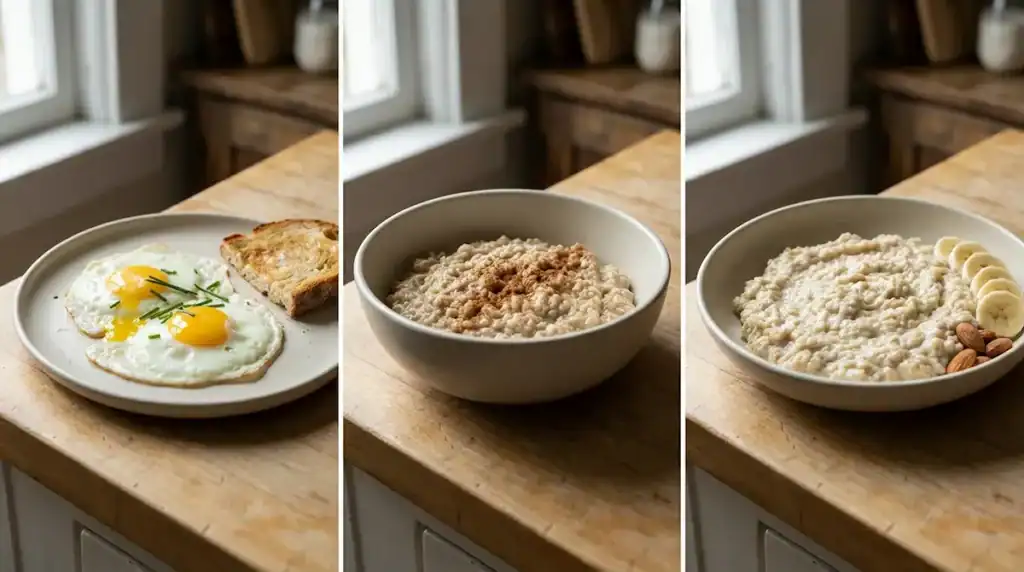
This question divides the internet. Let’s end the debate.
The Macronutrient Comparison
Eggs: Higher protein (12g in 2 eggs vs 5g in ½ cup oats). Virtually zero carbs. Zero fiber. About 140 calories.
Oatmeal: Higher fiber (4g). More carbs (27g). Minimal fat. About 150 calories for ½ cup dry.
Nearly identical calorie count. Completely different metabolic effects.
The satiety factor varies by person. Eggs keep some people full for 5-6 hours. Others feel hungry again quickly without carbs. Oatmeal’s fiber and volume satisfy certain eaters perfectly. Others crash within an hour.
Your biology decides the winner…
Which Is Better for YOUR Archetype
Crash-Prone/Insulin-Sensitive: Eggs win decisively.
No blood sugar impact. Stable energy. No mid-morning crash. Protein blunts hunger better than carbs for most people dealing with insulin resistance.
Volume Eaters: Oatmeal wins.
More physical volume per calorie. A ½ cup of dry oats cooked with a 4:1 liquid ratio becomes a massive bowl. Two eggs? You’re done in four bites. Volume eaters need the bulk.
Keto/Low-Carb: Eggs, no contest. Zero carbs beats 27g every time.
Cholesterol Concerns: Oatmeal may have the edge.
Beta-glucan fiber binds cholesterol in your digestive tract. Eggs provide dietary cholesterol (though dietary cholesterol doesn’t raise blood cholesterol for most people like we once thought).
The Best Answer: BOTH
Stop choosing. The optimal strategy combines them.
The winning combination? Oatmeal + egg whites.
Cook ⅓ cup liquid egg whites directly into your oatmeal. Stir while cooking. They disappear completely—fluffy texture, zero egg taste, 9g extra protein.
Why this works:
Fiber + protein = maximum satiety. The oatmeal provides volume and slow-releasing carbs. The egg whites provide the protein your body needs to feel truly satisfied.
One without the other leaves gaps.
One of my clients told me: “Oatmeal with egg whites is the only thing that keeps me full until lunch.”
That’s the Protein Anchor strategy in action.
You get the fiber and cholesterol benefits of oatmeal. You get protein from eggs and satiety. You avoid both foods’ weaknesses.
You don’t have to choose between the two again. You can combine their strengths into one meal that actually keeps you full.
That’s what top-performing users already figured out. The debate isn’t oatmeal OR eggs. It’s oatmeal AND eggs.
The Bloating Problem: Why Oatmeal Makes You Feel “6 Months Pregnant”
You eat a healthy bowl of oatmeal…
Two hours later, you look down, and your stomach has expanded like you’re hiding a basketball under your shirt.
Why Oatmeal Causes Bloating (For Some People)
High fiber ferments in your gut.
Fiber is good for you—but only if your gut bacteria can handle it. When gut bacteria break down the fiber in oatmeal, they produce gas. Lots of it. That gas has nowhere to go except to distend your abdomen.
These gases include hydrogen, methane, and carbon dioxide. These gases (gasotransmitters) are actually important signaling molecules for your health. The physical buildup of this gas distends your intestines… causing bloating and pain.
Fiber shock overwhelms your system.
Adding 4g of fiber overnight when you’re used to 10g total daily? Your gut rebels. It’s not equipped to handle the sudden increase. The bacteria can’t keep up. The result? Painful bloating and cramping.
Gluten cross-contamination triggers sensitivity.
Even “gluten-free” oats contain proteins similar enough to gluten to trigger reactions in sensitive people. They can cause inflammation and damage to the gut lining, leading to severe bloating.
Phytic acid irritates the digestive system.
Oats contain phytic acid—an antinutrient that binds to minerals and can cause digestive distress. Modern oatmeal isn’t soaked or fermented like traditional preparations, so this acid remains intact and active.
The Lectin Connection.
Whole grains like oatmeal contain lectins that can damage the gut wall in some people. Lectins are “sticky proteins” that bind to the lining of the digestive tract. This can trigger an immune response and inflammation, resulting in digestive distress and bloating.
Low-Bloat Strategies
Soak overnight before cooking.
This breaks down both starches and phytic acid. Your digestive system does less work. Many have reported that the bloating disappears completely with this one change.
Start ridiculously small.
Begin with 2 tablespoons of dry oats. Not ½ cup. TWO tablespoons. Increase by 1 tablespoon weekly. Give your gut time to adapt. Slow expansion prevents the shock.
Try digestive enzymes.
Some have found relief with digestive enzyme supplements taken before eating oats. These help break down complex starches your body struggles with.
Switch to Bob’s Red Mill gluten-free.
Processed in dedicated facilities. No cross-contamination. For sensitive stomachs, this brand change alone can eliminate bloating.
Test elimination.
One of my online clients over 60 reported: “It stopped when I stopped eating oatmeal every morning.”
It’s worth trying. Remove oats for two weeks. Reintroduce. Notice the difference. Your body will tell you the truth.
If you’ve worked through all of this and you’re still dealing with gas and bloating, the issue might not be fiber itself. It might be leaning on one type of fiber all at once. BioTrust’s Ageless Multi-Fiber combines six slower-fermenting fiber sources instead of one big dose, so it’s designed to be gentler on digestion while still supporting regularity. It can be a useful bridge if oatmeal’s fiber load is more than your gut wants to handle right now.
A 6-fiber daily blend designed for adults 40+ to support regularity, gut health, and a healthier microbiome. Each serving provides 6g of fiber, including clinically studied resistant starch, in a gentle formula made for everyday use.
- 6-Fiber Blend: Combines soluble, insoluble, fermentable fiber & resistant starch for more complete digestive support
- Gut Microbiome Support: Helps feed beneficial gut bacteria and supports healthy microbial balance
- Regularity & Digestive Comfort: Supports healthy stool consistency and everyday digestive regularity
- Clinically Studied Resistant Starch: Provides 3.5g of Solnul® resistant potato starch to support gut barrier & metabolic health
- Gentle Daily Formula: Uses slow-fermenting, well-tolerated fibers designed to minimize gas & bloating

For Menopausal Women Specifically
Here’s what nobody tells you…
Hormonal changes during menopause fundamentally alter digestion. A drop in estrogen levels affects gut motility and enzyme production.
Foods you ate for 30 years without issue suddenly become problematic.
“I just have to really watch my diet so I won’t gain weight… I feel bloated even from a bowl of oatmeal.”
That’s what one of my in-home clients said, describing the reality of menopause.
Smaller portions matter more now. ¼ cup dry oats instead of ½ cup. Your changing digestive system can’t handle the volume it once could.
Pair with digestive-supporting foods. Fresh ginger grated into your oats. Fennel tea alongside breakfast. These traditional remedies support your gut during hormonal transitions.
Your body changed. Your oatmeal strategy needs to change too.
Do Oats Have a Lot of Sugar? (The Carb Truth)
The carb anxiety is real.
“Why do people say oatmeal is healthy when it is all carbs?”
Let’s separate fact from fear…
The Actual Numbers
Plain oats contain 0-1g of sugar per serving.
Zero. The carbs in oatmeal are NOT sugar… they’re complex carbohydrates.
Here’s the breakdown for ½ cup dry oats:
- Total carbs: ~27g (mostly starch + fiber)
- Fiber: 4g
- Sugar: 0-1g
- Net carbs: ~23g
That starch? It’s not candy. It’s a chain of glucose molecules that your body slowly breaks down. Completely different metabolic impact than table sugar or a donut.
The fiber changes everything.
Those 4g of fiber slow digestion. They blunt blood sugar spikes. They feed beneficial gut bacteria. Fiber is a carbohydrate too—but it’s working for you, not against you.
Why Carbs ≠ Bad
Here’s what the research actually shows…
When calories and protein are matched, there’s no difference in fat loss between high-carb and low-carb diets. None. The metabolic ward studies repeatedly proved this.
Complex carbs behave differently from simple sugars.
Oatmeal’s beta-glucan fiber forms a gel in your digestive tract. This slows glucose absorption. Prevents insulin spikes. Keeps you full longer.
A 2023 review in Current Nutrition Reports concluded that oats and their β‑glucan can beneficially modulate appetite‑regulating hormones, with several clinical studies showing improved satiety, reduced appetite, and favorable changes in gut hormones such as GLP‑1 and PYY.4
Compare that to a Snickers bar with 27g of actual sugar. Same carb count. Completely different effect on your body.
The issue isn’t carbs. It’s WHICH carbs and WHAT YOU PAIR THEM WITH.
Oatmeal alone? Some people crash. Oatmeal + protein + fat? Stable energy for hours.
The carb is identical. The metabolic response is night and day.
The Keto Perspective
For strict keto dieters, oatmeal doesn’t fit.
“A standard ½ cup serving already exceeds the daily carb limit for most keto dieters.”
That’s true. Keto typically caps carbs at 20-50g daily. One serving of oats uses your entire budget.
Keto alternatives exist.
“Noatmeal” recipes using hemp hearts, ground flax, and chia seeds create a hot cereal texture with <5g net carbs. Add coconut milk, cinnamon, and a few berries. You get the experience without breaking ketosis.
But here’s the reality check…
For everyone NOT doing keto, oatmeal’s 27g carbs are not your enemy.
If you’re in a caloric deficit, you’ll lose fat by eating oatmeal. The science is clear. Energy balance trumps macronutrient ratios every time.
The carb fear comes from diet culture, not physiology.
You can let go of the anxiety. Eat oatmeal without guilt. Watch the scale drop anyway because you’re consistent with your deficit.
That’s what happens when you understand the truth about carbs.
How to Measure Oatmeal Correctly (Avoid the #1 Mistake)
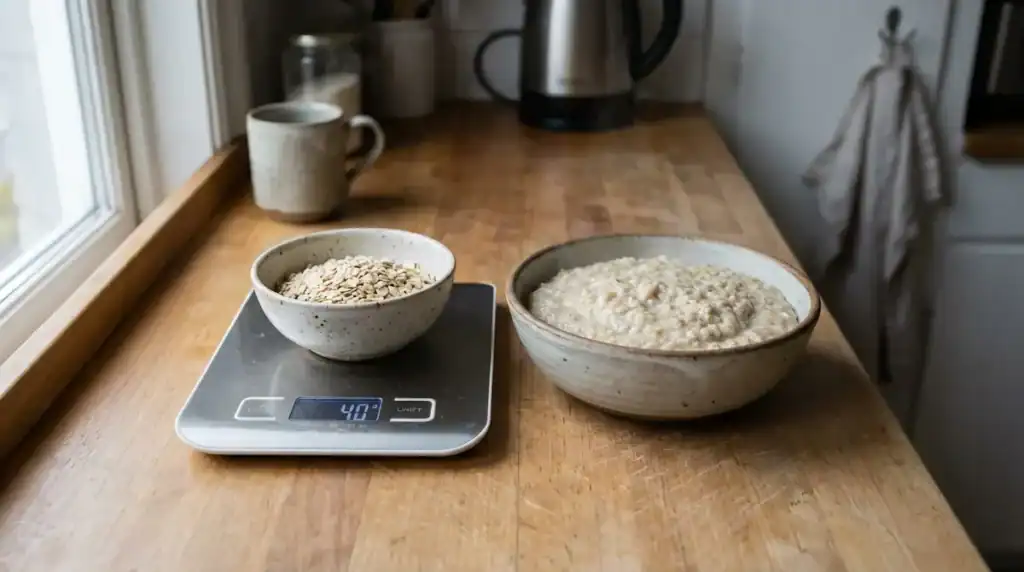
This single mistake sabotages more diets than anything else.
The Measurement Confusion
“Do you measure the oatmeal prior to cooking or after?”
Answer: ALWAYS measure DRY.
Before you add water. Before you cook. Before anything.
Oats absorb liquid. They double in volume when cooked. Sometimes triple with enough water.
Water adds zero calories. But it adds massive volume.
If you measure ½ cup AFTER cooking, you’re eating maybe ¼ cup of actual oats. Your calorie tracking is off by 50%.
One confused person wrote me: “I measured out ¼ cup generic dry oatmeal today…but of course it doubles in size!”
Exactly. That doubling is water. Not food. Not calories.
The nutrition label shows dry weight. When it says “½ cup = 150 calories,” that’s ½ cup DRY, not cooked.
Measure dry. Cook. Eat the massive bowl. Track the small dry amount.
Portion Guidelines for Weight Loss
Standard serving: ½ cup dry oats = ~150 calories
This works for moderate deficits. Provides enough volume and satiety for most people when prepared with the protein anchor and hydration hacking strategies.
For aggressive deficit: ¼ cup dry oats + volume additions
Use the 4:1 liquid ratio. Add grated zucchini. Stir in egg whites. You’ll still get a huge bowl, but you’re starting with fewer base calories.
Here’s the mistake nobody talks about…
A nutrition client of mine came in frustrated. She’d been eating “healthy” oatmeal for breakfast every day for two months. Zero weight loss.
We measured her bowl. 700 calories.
She was eyeballing portions. Adding generous amounts of almond butter, honey, and dried fruit. The bowl looked “normal” to her.
Seven. Hundred. Calories.
And she was hungry again by 10 AM because the massive sugar load from honey and dried fruit crashed her blood sugar.
Use a food scale.
Measuring cups lie. They overflow. You pack them down. Density varies between oat types.
A scale tells the truth. Place your bowl on it. Zero it out. Add dry oats until you hit your target grams.
Most labels show ~40g for a standard serving. That’s your target.
Do this for two weeks minimum. Learn what real portions look like. Your eyes will calibrate. After that, you can eyeball with confidence. But not before.
The difference between thinking you’re eating 150 calories and actually eating 400 calories? That’s why the scale isn’t moving.
You’ll finally understand why you weren’t losing weight despite “doing everything right.” The measurement was wrong the whole time.
FAQs
Is Quaker instant oatmeal good for weight loss?
Quaker instant oatmeal isn’t ideal for weight loss—especially flavored packets loaded with added sugar. Plain instant oats are better, but Quaker Old-Fashioned Oats deliver superior results. They’re less processed, provide 150 calories and 27g carbs per half-cup serving, and won’t spike insulin like instant varieties do.
Why does Dr. Gundry say oatmeal is not good for you?
Dr. Gundry says to avoid oatmeal because of its rapid conversion to sugar, the presence of problematic proteins (lectins and gluten mimics), and widespread contamination with toxic chemicals.
Rolling the oats by steel rollers destroys the grain’s structural integrity. This turns the grain into a “paper-thin membrane” that digestive enzymes break down fast. So he says it’ll spike your blood sugar quickly. He prefers steel-cut oats or alternatives like sorghum, millet, or “Gundry oatmeal” made using hemp hearts, flaxseeds, and millet.
What is the best breakfast to boost your metabolism?
The best breakfast to boost your metabolism combines lean protein with natural starchy carbs. Protein has a 30% thermic effect (your body burns calories digesting it), so pair egg whites or protein powder with old-fashioned oatmeal.
Is oatmeal good for weight loss and diabetes?
Oatmeal’s effect on weight loss and diabetes depends on the type you choose. Steel-cut oats have a low glycemic load (under 20) and help prevent diabetes, but instant varieties contain up to 13g sugar and spike insulin. If reversing diabetes, avoid all oats temporarily to lower insulin levels.
Does the 7-day oatmeal diet work?
The 7-day oatmeal diet doesn’t work for lasting weight loss because it’s unbalanced and lacks protein needed to maintain muscle and metabolism. 95% of people on restrictive diets regain their weight. Instead, pair old-fashioned oatmeal with lean protein like egg whites at every meal for sustainable results.