
Is the afterburn effect after a workout real or a myth? With all the hype on the internet these days, it’s hard to tell whether it’s a legitimate physiological process or just marketing hype.
The afterburn effect promises to boost your metabolism and torch extra calories for hours, maybe even days after you’ve worked out. But does it actually work? And if so, how can you trigger this elevated fat-burning to maximize your workouts?
The last thing you want to do is hurt yourself or waste your time doing an intense workout. And what kind of workouts will trigger the most afterburn so you get the biggest bang for your buck?
Here, I’m unraveling the truth about the afterburn effect backed by scientific studies. You’ll also get five example afterburn effect workouts you can use to elevate your metabolism and get faster results.
Does the Afterburn Effect Really Torch Extra Calories—or Is It Hype?
Quick Answer:
The afterburn effect is scientifically real and not a fitness myth or marketing hype. But the reality of the extra fat burning after your workout has been overexaggerated. You will burn more calories and fat after an afterburn workout… but probably not as much as you think.
Imagine burning calories while relaxing on the couch long after you’ve finished your workout. They call this fitness phenomenon the “afterburn effect,” but it’s scientifically known as Excess Post-Exercise Oxygen Consumption (EPOC).
EPOC has been found in dozens of studies over the past 30 years to increase metabolism and fat burning. After you’ve finished an intense workout, your body must work harder to recover, repair tissue, restore energy, and return to its baseline.
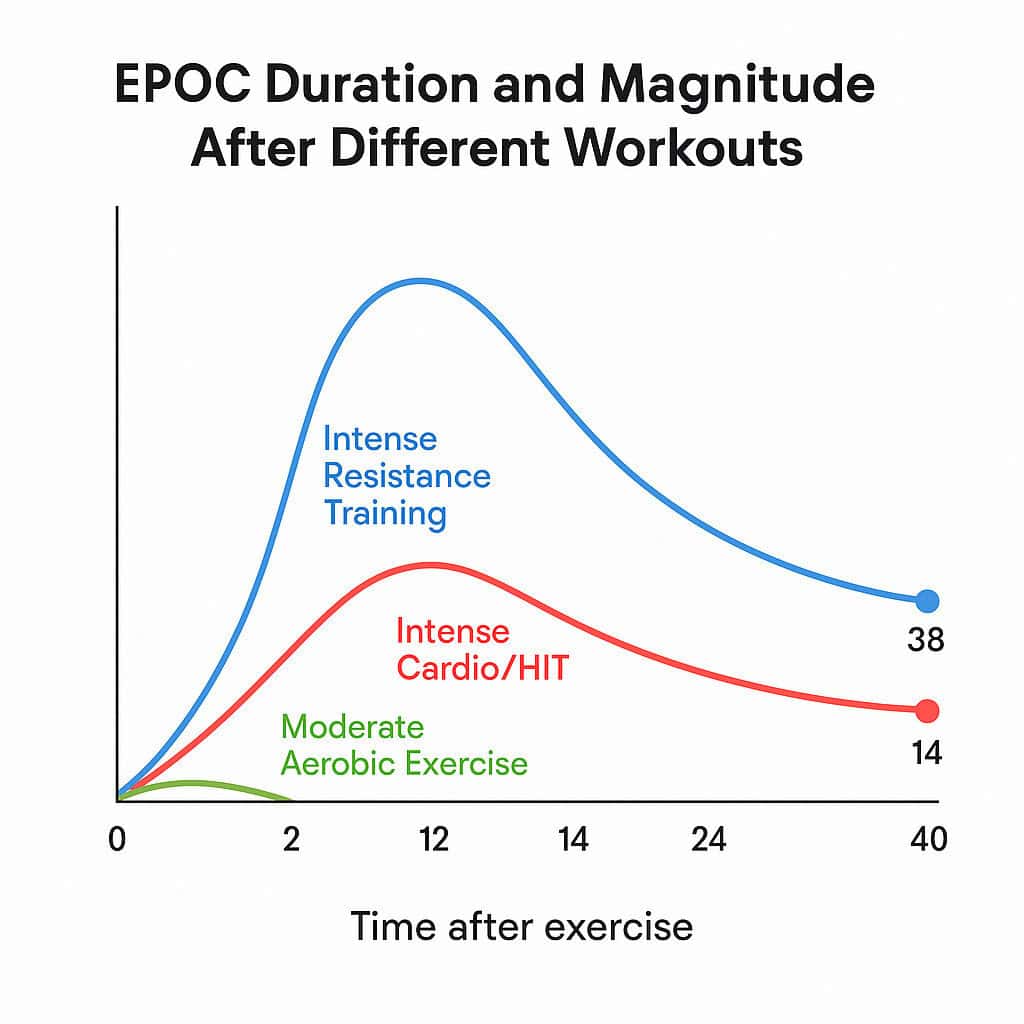
This causes you to burn extra calories for hours, possibly even for 1-2 days, after you’ve finished working out. One study found that EPOC can remain elevated for many hours (possibly up to 38 hours) after a single session of intense resistance or interval training.1
However, even with these increases, EPOC will only account for 6-15% of the total energy cost of the exercise session.2 So if you burn 500 calories in an intense workout, you’ll at most only burn an extra 75 calories in the afterburn. This is about the amount of 10 almonds.
Another study found that high-intensity functional training increased EPOC for 60 minutes post-exercise, resulting in an additional 55 calories burned.3 Researchers found the EPOC is real, but the extra calorie burn is moderate. But they do say that it can add up over time.
The afterburn effect from intense exercise will help burn more calories and fat, but only a modest small amount. But these extra calories burned do add up with time.
So, the afterburn effect isn’t a fitness miracle that will burn off 1,000 extra calories a day. However, it can help tip the scales in your favor over time, especially if you train consistently and maintain a healthy diet.
Plus, there are additional health benefits to afterburn workouts beyond just weight loss. I use high-intensity afterburn workouts 2-3x a week in my own training schedule, not only for the extra calorie burn but for:
- VO2 Max improvements4
- Better heart health5
- Enhanced endurance6
- Strength & muscle gain7
- Improved body composition8
- Functional fitness9
- Improved insulin sensitivity10
- Better cholesterol & triglyceride levels11
- Higher anabolic hormones12
- Lower stress hormones13
- Time efficiency14
- Brain health & mood boost15
How Long the Afterburn Effect Really Lasts
Key Takeaways:
Research shows that the afterburn effect (EPOC) can last from a few hours to possibly 38 hours under ideal conditions, depending on the intensity and type of workout. Most of the calories burned occur within the first few hours, but a longer afterburn effect can still occur and contribute to boosting fat loss over time.
A landmark 2002 study found that EPOC can be elevated significantly for up to 38 hours after a very intense weight training session.16 But most results will be within a few hours post-workout, and the 38-hour afterburn in this study was under ideal conditions.
A later study in 2011 found the EPOC was significantly elevated for 14 hours after 45 minutes of intense cycling exercise, resulting in an extra 190 calories burned.17 This is 37% of the total calories burned from the cycling workout.
The magnitude of the calorie burn tapers off after the first few hours, but maintaining a higher metabolism for that long is important. While it may not burn a ton of calories, it still adds up over time and contributes to your overall fat loss.
Another study found that EPOC can stay significantly above resting levels for several hours after intense workouts. According to their results, EPOC can last for up to 12 hours after 80 minutes of 70% maximal oxygen uptake.18
The key to this 38-hour EPOC higher metabolism was following a tough, intense whole-body resistance training session. Light aerobic workouts, such as jogging and even moderately intense aerobic exercise, will only create a small and short EPOC, if any at all.
Advanced Metabolism Booster & Fat Burner—Age‑Proof Your Weight‑Loss Efforts
- Sinetrol® Polyphenols ignite fat breakdown (lipolysis), boost fat burning (oxidation) & elevate energy expenditure—even at rest
- Up to 7× More Calorie Burn vs. diet alone by supercharging your metabolism all day long
- Chromax® & Berberine Duo curb cravings, slash daily caloric intake by up to 347 calories, and support healthy blood‑sugar balance

How to Trigger the Afterburn Effect
Key Takeaways:
There are 3 main factors in your workouts you’ll need to maximize your post-workout calorie burn with the afterburn effect:
- Duration
- Intensity
- Load
Intensity
Exercise intensity (how hard you push) is the primary driver of the afterburn effect. The higher the intensity of the workout, the greater and longer lasting the afterburn will be.
A study in Medicine & Science in Sports & Exercise found that intensity is way more important than the workout duration for boosting EPOC.19 Higher-intensity exercise sessions caused an “oxygen debt,” resulting in a significantly larger post-exercise calorie burn compared to moderate or low-intensity sessions.
Higher-intensity resistance training and interval work produces much more EPOC than lower-intensity, steady-state cardio.20 Higher-intensity workouts create a greater “metabolic disturbance,” forcing your body to work harder to recover.
Traditional steady-state cardio will only burn calories during the workout session, with a very small afterburn effect. However, with higher intensities, you’ll not only create a greater afterburn effect, but you’ll also burn more calories and fat overall.
Use high-intensity interval training (HIIT), short rest periods, full-body compound movements, and heavy(ish) resistance loads to failure to maximize the intensity.
Load (How Much Weight You Lift)
The amount of weight or resistance you use in the workout (known as the load) is another key factor for maximizing the afterburn effect. Heavier loads increase the metabolic demand on your muscles, forcing your body to work harder both during and after the workout.
High-load resistance training uses weights at or above 75-80% of your one-rep max. This load has consistently been shown to create a larger and longer-lasting afterburn compared to lifting lighter weights for more reps.
A study in the Journal of Sports Sciences found lifting heavier weights led to a greater increase in EPOC than lower-load, higher-rep workouts.21 A study by the American Council of Sports Medicine also found heavy compound lifts boosted EPOC more than lighter isolation exercises.22
A recent 2019 study also confirmed the highest EPOC happens after high-load exercise sessions.23 These high-load sessions had higher EPOC compared to moderate and low-load sessions, even when the total work was matched.
The reason for this is that heavy loads activate more muscle fibers, produce greater metabolic stress, and trigger more micro-damage, which your body must repair afterward.
To maximize the afterburn effect, use weights that feel really challenging. Focus on big, full-body exercises like squats, deadlifts, presses, etc.
The heavier the load then, the more your body has to recover. And the bigger the calorie burn will be after you finish working out.
Volume/Duration
Volume/Duration is how much total work you do. The total amount of work you perform is a major factor in the afterburn effect.
Volume is the total amount of sets x reps x weight. Duration is the total work time. The intensity and load set the stage, but the amount of exercise you do can further increase how many calories are burned in the afterburn.
Longer workouts, combined with high intensity and heavy loads, will lead to a significantly larger afterburn effect than shorter workouts. This is because your body has a higher metabolic “debt” to pay.
One study found that the longer this intense exercise then, the longer-lasting EPOC you’ll have. According to their results, a 50-80 minute workout session produced a significantly larger EPOC than shorter workouts.24
Even with HIIT workouts, you’ll create a bigger afterburn by increasing the number of intervals and total session length.25 When total training volume is higher (more sets and reps, longer workout duration), then the afterburn will stay elevated for longer.26
The intensity, load, and total volume of the workout all influence the afterburn effect. The greater the amount of work you do at high intensity, the bigger and longer the afterburn effect will be.
Yet intensity is king and still matters the most. Volume is most effective when combined with high-intensity training to boost the afterburn effect. Extremely long, low-intensity workouts won’t have the same afterburn effect as shorter, but more intense sessions.
But I don’t recommend forcing yourself to make your workouts longer and longer for more afterburn. There will be diminishing returns after a certain point. Increased volume can lead to fatigue, increased risk of injury, and lower-quality workouts.
Focus on doing quality high-intensity sets and circuits, not marathon workout sessions. Utilize timed circuits, density training (perform more work in less time), and interval blocks to hit the sweet spot without burning out.
Best Afterburn Workouts: Exercises That Keep Burning Calories
Multi-joint, full-body compound exercises will produce the biggest metabolic effect and the most afterburn. These are the exercises that use the most muscle mass, require the most energy, and can be loaded progressively.
Here’s a list of the best afterburn exercises:
- Squats (goblet, front, back, split squat, Bulgarian split squat)
- Deadlifts (conventional, sumo, Romanian, kettlebell, single-leg)
- Push-Ups (standard, T-push-up, incline, decline)
- Lunges (forward, reverse, walking, step-back, lateral)
- Rows (dumbbell, barbell, inverted, TRX/bodyweight)
- Pull-Ups/Chin-Ups (assisted or bodyweight)
- Overhead Press (dumbbell or barbell, standing preferred)
- Swings (kettlebell or dumbbell)
- Carries (farmer’s walk, suitcase carry)
- Dynamic Planks/Core (plank with reach, plank up-downs, mountain climbers)
These afterburn exercises elevate your heart rate and have a higher metabolic demand than isolation exercises (e.g., bicep curls, leg extensions). You can load them progressively as you get stronger, continuing to make them challenging.
The best, most effective training styles to maximize the afterburn effect (EPOC) are:
Metabolic Resistance Training
Metabolic Resistance Training uses circuits of full-body, compound, and multi-joint exercises are performed with minimal rest. High intensity, high work density, moderate-to-heavy loads, and short recovery.
Metabolic Resistance Training workout example:
Do each exercise for 45 seconds, 15 seconds rest between. Complete 3-4 rounds.
- Goblet Squat
- Push-ups
- Rows (dumbbells or bodyweight)
- Reverse lunge
- Plank (regular, dynamic, or with leg lifts)
Rest 1-2 minutes between rounds
High-Intensity Interval Training (HIIT)
HIIT workouts use short bursts of maximal effort (e.g., sprints, bike intervals, sled pushes) alternated with brief recovery periods. An example would be Tabatas (20 seconds all-out, 10 seconds rest, repeat 8 times).
HIIT Workout Example:
- 20 seconds: Squat Jumps
- 10 seconds: Rest
- 20 seconds: Push-ups
- 10 seconds: Rest
Repeat for 8 rounds (4 minutes total)
Density Training
Doing as much work as possible in a set amount of time (e.g., as many rounds as possible in 10-15 minutes). Pair 2-4 compound exercises, set a timer, and rotate through as many rounds as possible with good form.
Density Training Workout example:
Set a timer for 10-15 minutes. Alternate the following:
- Squat (6 reps)
- Row (6 reps)
Do as many rounds as possible (AMRAP), resting only when needed.
Timed Circuits
Perform each exercise for a set time (e.g., 30-60 seconds), rest briefly, and then move to the next exercise (preferably a non-competing movement). Repeat the entire circuit for several rounds. This keeps the intensity high, minimizes downtime, and suits all levels (everyone can do what they can in the time frame).
Timed Circuit Workout example:
Perform each exercise for 30 seconds, then rest for 15 seconds between exercises. Complete all exercises, then rest for 2 minutes. Repeat for 3-5 rounds.
- Kettlebell/Dumbbell Swing
- Push-up (any variation)
- Walking lunge
- Pull-ups or TRX suspension row
- Mountain climbers
Combination/Complexes
String together several exercises (usually using the same fitness equipment, such as a barbell or kettlebell) into a seamless series. No rest, and one move flows to the next.
Complex Workout example:
Deadlift → Bent-over Row → Hang Clean → Front Squat → Push Press
(all done for 6 reps each, then rest)
This skyrockets your heart rate, burns a lot of calories, and is very time-efficient.
Afterburn Effect Downsides, Risks & Side Effects
Increased Fatigue & Recovery Demands
High-intensity, afterburn-style workouts are highly effective, but also very demanding on the body.
It’s not recommended to do afterburn-style intense workouts every day. The metabolic demand and fatigue are very high.
Your body needs time to recover, or else pushing this level of intensity and volume too high can lead to:
- Increased systemic & chronic fatigue
- Risk of overtraining
- Reduced performance
- Plateaus and possible regression if recovery isn’t enough
You’ll likely notice that afterburn workouts, which maximize EPOC, also increase muscle soreness (DOMS) and fatigue. You should allow for sufficient rest (1-3 days) between afterburn workouts, as excessive training can lead to injury or overtraining.27
If you’re fatigued, your form can break down, putting you at a higher risk of injury.
Increased Hunger / Compensatory Eating
Hard workouts can make you super hungry, which can undo all your effort. And you might initially gain some water weight, which can be really discouraging.
After intense workouts, your muscles get tiny tears that need to heal, so your body holds onto extra water with the recovery. This causes temporary water weight that’s totally normal and usually goes away in a few days.
Studies have found that HIIT and intense resistance training can elevate post-exercise metabolism, but some people can experience increased hunger afterward.28 This is because your body wants to “replenish” what you burned.
Higher-intensity workouts burn more calories, and your body can sense the deficit. It ramps up hunger hormones, such as ghrelin, to encourage you to replace those calories.29
Your glycogen (stored carbs in your muscles) levels also deplete after a high-intensity workout. So, your body pushes you to eat more carbs by craving them to refill those stores.
High-intensity exercise can also trigger compensatory eating, where you eat more after working out because you feel you’ve “earned it.” This can accidentally cancel out the calories you burn during exercise.31
These workouts can be stressful on your body, especially if you’re not used to them. This can increase your appetite and compensatory eating as part of the recovery process.
Proper and disciplined nutrition, along with adequate sleep, are essential for supporting recovery. Use my protein calculator to determine how much protein you should be consuming daily to support recovery.
Finally, a Protein Powder Designed for those over 45... Only 150 calories, 4g net carbs, hormone & antibiotic-free. Supports lean muscle, weight loss & promotes healthy aging.
- 24g of clean protein for muscle health
- Fast digesting Whey for muscle support & slow digesting Casein for appetite control
- Four-Protein Time-Released Blend to keep you full and support weight management
- Natural ProHydrolase® enzymes to boost absorption
Diminishing Returns
There’s a law of diminishing returns with afterburn style training. More volume or frequency doesn’t always mean better results.
Studies have found that after a certain point, extra volume or longer workouts will only give you small gains in the afterburn. Doubling the exercise duration does not double the EPOC.30
If you start to feel tired, weak, or unmotivated all the time, then you’re probably doing too much. The key is intensity and not endless volume.
Constant fatigue, burnout, or stalled progress can be signs that your training frequency or volume is outpacing your body’s ability to recover… especially with high-intensity workouts.
It’s not about suffering but progressing. You can work out hard, but it’s better to work out smart.
Need for Smart Workout Programming
Strategically planning your afterburn workouts to alternate hard exercise sessions with easier rest days is crucial to sticking with it in the long term.
I only recommend and personally do 2-3 afterburn workouts per week. It’s good to have 1-3 days of rest between high-intensity workouts.
This is especially true for those new to this style of training. High-intensity afterburn workouts may not be the best option for beginners, individuals with joint issues, or those with cardiovascular or metabolic risk factors (without prior medical clearance).
Your heart rate should return to normal relatively soon (1-3 hours post-workout) after the afterburn workout ends, which is a sign of continued calorie burning and elevated metabolism. However, the afterburn isn’t just about heart rate, but also the cellular, hormonal, and metabolic changes occurring inside your body.
Wearable devices like fitness trackers and smartwatches) can accurately measure the afterburn calories burned after intense exercise and the related body responses.
Studies have shown that the higher the EPOC, the greater the physiological stress… meaning your body needs more time and resources to recover.31 Less fit and overweight individuals can have a higher EPOC because these workouts can be more stressful for them.
But well-trained athletes can perform a higher absolute workload and intensity since they can push harder, still creating a large EPOC. The more muscle mass one has then the higher EPOC they can create since more muscle needs to recover.
Is Afterburn Training Right for You?
If you want fast, efficient fat loss, improved conditioning, and a stronger, leaner body, then Afterburn training is the best investment for your workout time.
You don’t need to spend hours in the gym. You don’t need complicated routines or fancy equipment. You just need to be willing to work out hard with intensity, focus on big full-body movements, and challenge yourself.
Afterburn training isn’t for everyone and shouldn’t be done every day. It’s demanding on your body. You’ll need to put in the effort, discipline, and respect the recovery process.
However, if you’re tired of doing endless cardio and want real, fast results, then afterburn-style workouts are backed by science and proven in the real world.
Yet the afterburn effect isn’t a magic bullet. The extra calorie burn after these intense workouts is real but modest. You won’t burn thousands of extra calories from one workout.
But over many workouts, this extra calorie burn does add up and compound when you multiply it by dozens of workouts… and you’ll also maintain muscle.
It’s not enough to out-eat a bad diet with the afterburn alone… but it does give you an edge when fat loss matters. That’s how you win.
The breakthrough program designed to help you drop 10-30 pounds of excess stubborn fat, bloated water weight & "toxic waste" in a few short weeks.
- Drop 2 Jean Sizes in Less Than 2 Weeks
- Foolproof System to Get Rid of Thigh Fat, Hip Dips & Flabby Arms
- Flatten Your Belly and Lose Your Loves Handles Fast