
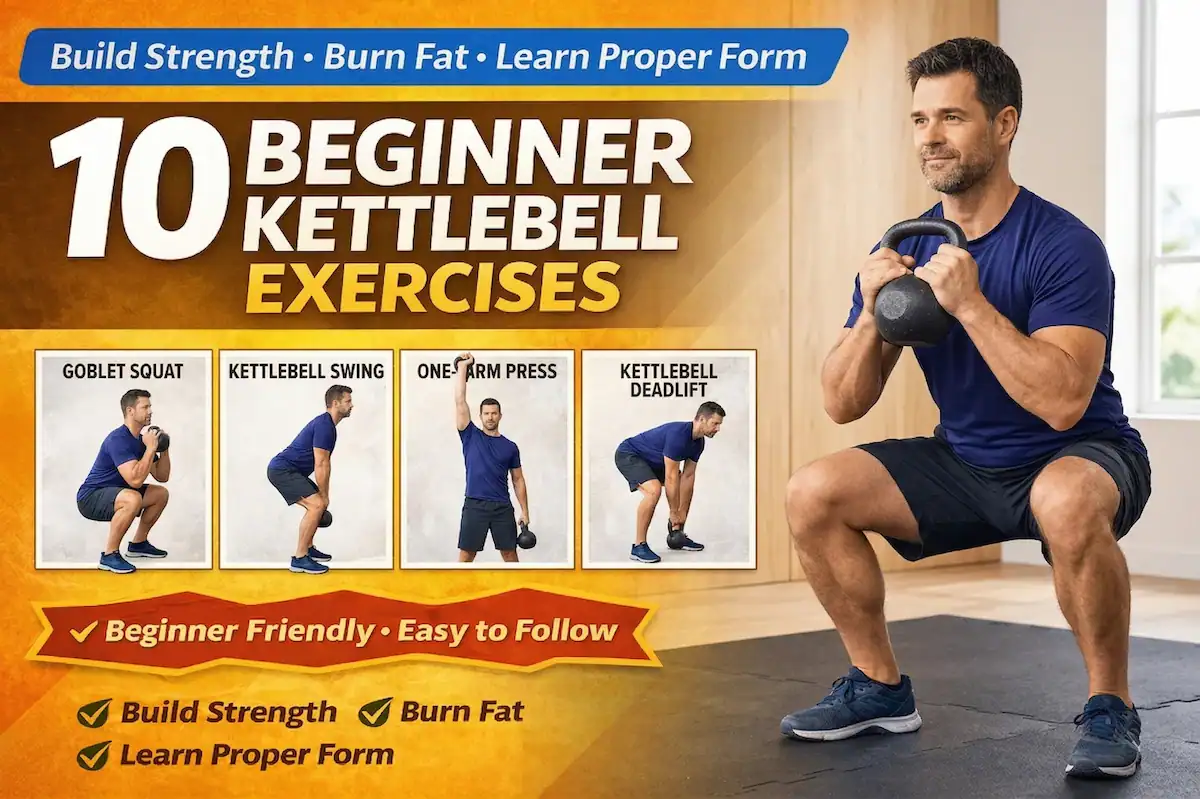

So you have a kettlebell sitting in your living room corner. You picked it up because you heard it could burn fat, build strength, and save you from going to the gym again.
But every time you look at it… You have no idea where to start. Sound familiar?

I see this all the time with new clients. They’re motivated and have the equipment, but they’ve been handed a dozen conflicting routines from YouTube, Reddit, and that one guy at work who “used to lift.” They end up doing random swings, sprain their backs, and wonder if kettlebells are even worth it.
Kettlebells are among the most effective tools for fat loss and full-body strength at home. But only if you start with the right exercises and build a solid foundation.
Get it wrong and you risk injury, frustration, and no results. Get it right, and a single kettlebell becomes the only equipment you need.
Now that you know why kettlebells work, I’ll show you the 10 best beginner exercises. I’ll explain what each one is, why it helps, and how to do it safely so you can start seeing results right away.
The 10 Best Kettlebell Exercises for Beginners
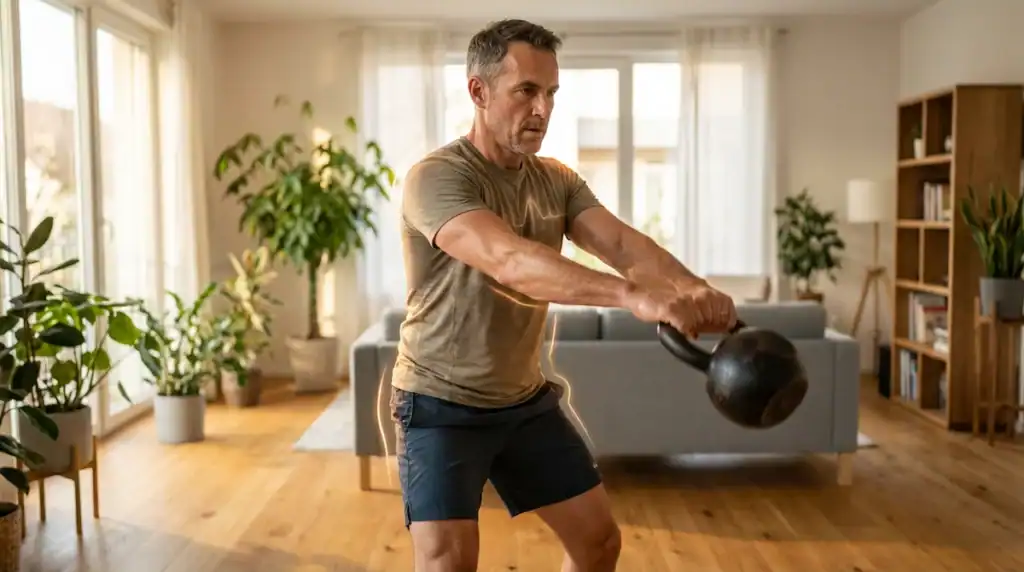
Let’s be honest, kettlebells can look intimidating. I mean they literally look like cannonballs with handles. You might have seen people swinging them easily in videos. It’s normal to worry about picking one up the wrong way and hurting your back before you start.
If that sounds familiar, then you’re in the right place.
Kettlebells aren’t just a strength tool or just a cardio tool. They’re both at the same time. It’s the only piece of fitness equipment you’ll really need to get fit and strong working out at home.
A 2024 randomized controlled trial in BMC Sports Science, Medicine and Rehabilitation found that 12 weeks of kettlebell training in obese young men significantly reduced body fat and improved VO2max, with several fitness gains comparable to bodyweight training.1
One 20-minute kettlebell session can build real muscle, spike your heart rate, and burn serious calories. And all without a single treadmill or weight machine in sight.
A 2010 study found that 12 minutes of kettlebell swings pushed participants to 86.8% of max heart rate and 65.3% of VO2max, while a 2024 randomized trial found kettlebell training improved body composition and strength-related fitness measures.2,3
That’s why so many busy people are ditching the gym and getting better results at home with just one kettlebell.
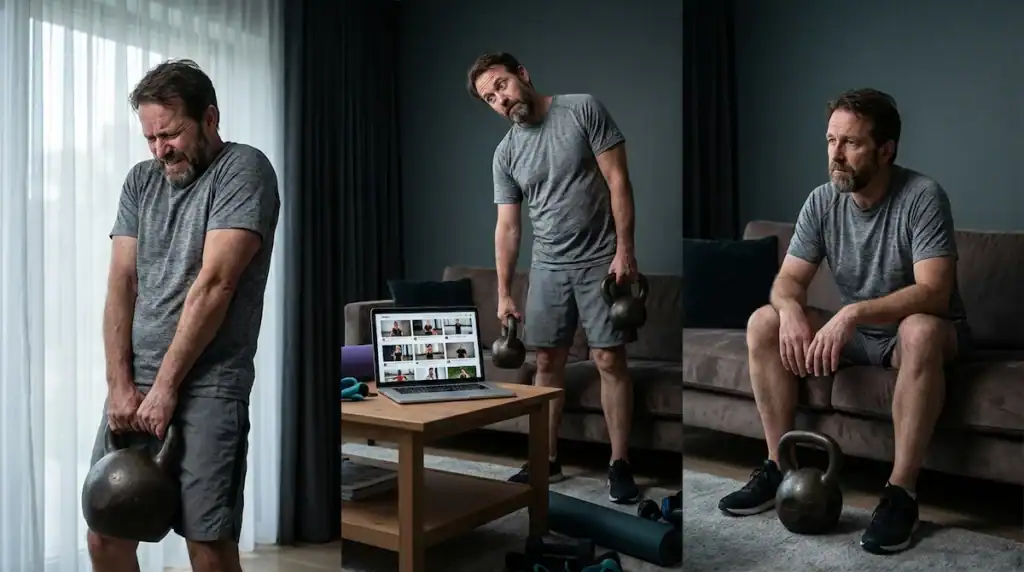
Most beginners make mistakes by choosing a weight that’s too heavy, following a random YouTube routine and getting a sore back, or overthinking things so much that they never start.
Here are the best kettlebell exercises for beginners. They’re safe to learn, effective right away, and enjoyable.
Kettlebell Goblet Squat
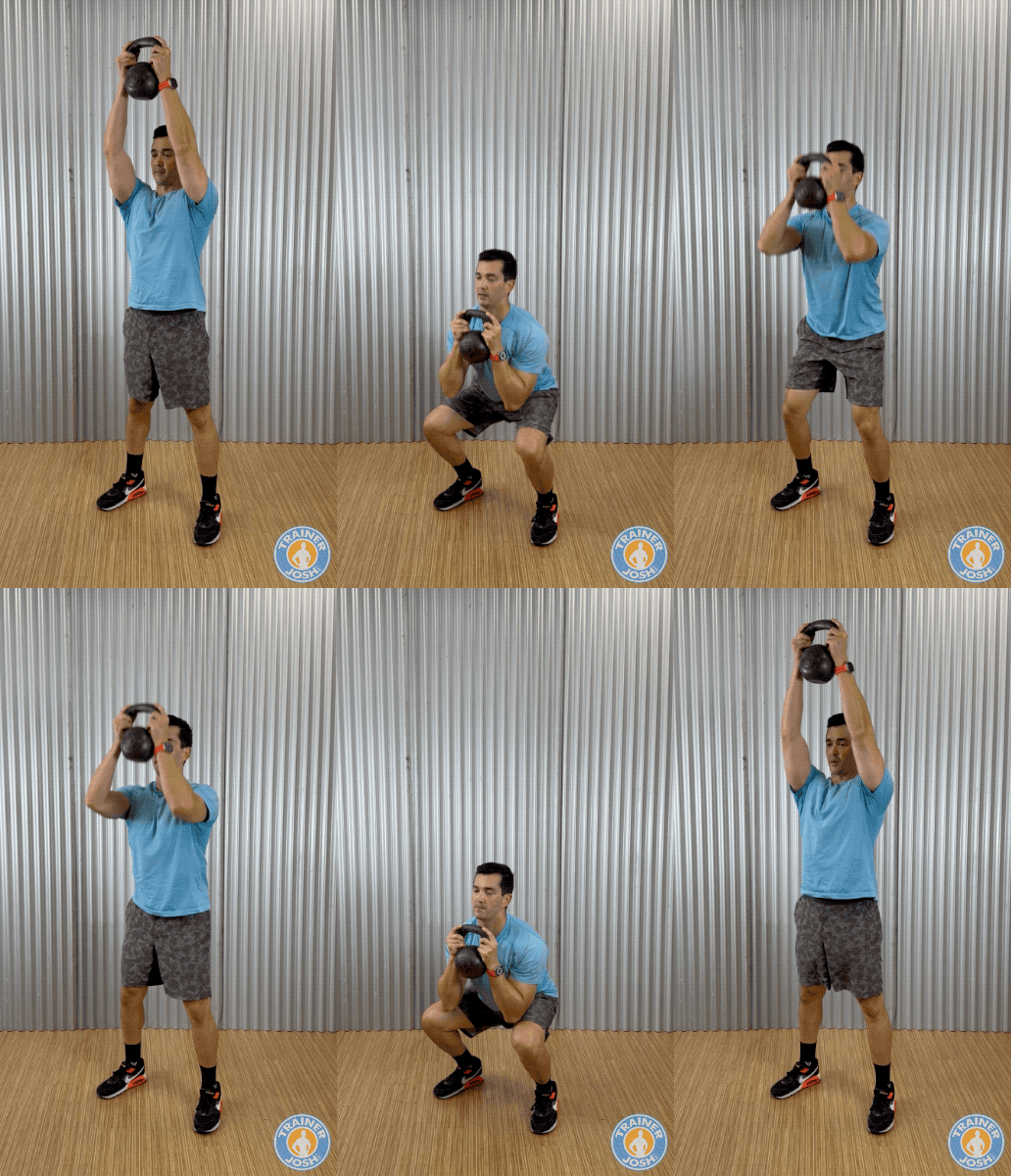
The goblet squat teaches you to squat correctly before bad habits have a chance to form.
Holding the kettlebell at chest height acts as a counterbalance, pulling you forward slightly and forcing your torso to stay upright, your back flat, and your hips to drop straight down. Most beginners collapse forward in a squat. This position makes it physically impossible.
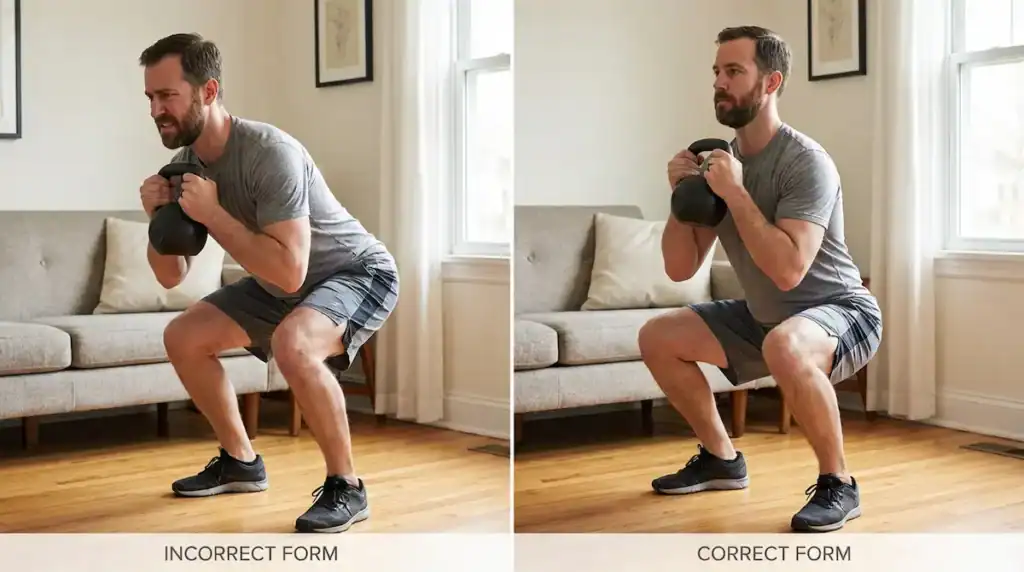
The anterior load (weight in front of your body) forces your rectus abdominis and obliques to fire hard just to keep you vertical. You’re building core strength without a single crunch.
A front-loaded squat variation like the goblet squat increases trunk-stabilization demands, and research on squat variations shows that squatting can produce meaningful rectus abdominis and oblique activation. This front-loaded variation generally requiring greater anterior core involvement to keep the torso upright.3
It also opens up ankle, hip, and knee mobility simultaneously, making it one of the most efficient warm-up and strength exercises a beginner can do.
How to Perform the Goblet Squat:
- Stand with feet hip-width apart and toes slightly turned out. Hold the kettlebell close to your chest by grasping the horns (sides of the handle) or cupping the bottom of the bell.
- Keep your chest up and pull yourself down into the squat by sitting your hips back and down.
- Lower until your hip crease drops below your knees. Your elbows should track just inside your knees, wedging against your inner thighs.
- Pause at the bottom. Use your elbows to gently push your knees outward to open your hips.
- Drive your heels into the floor and stand back up. Finish tall by locking your knees and squeezing your glutes, hamstrings, and abs at the top.
Pro Trainer Tips
- Breathing and Bracing: Inhale deeply on the way down to pressurize and protect your spine. Exhale on the way up.
- Spread the Earth: Imagine trying to tear the floor apart with your feet to maintain knee alignment.
- Hinging Differences: Unlike the swing, the goblet squat requires your hips to go down, not back.
Common Mistakes to Avoid
- Valgus Collapse: Never let your knees cave inward. Press them outward so they track over your toes.
- Rounding the Lower Back: Keep a “big chest” and long spine. If your back rounds, stop just above that point.
- Lifting the Heels: Keep feet flat and drive through your heels. Don’t let weight shift to your toes.
Kettlebell Deadlift
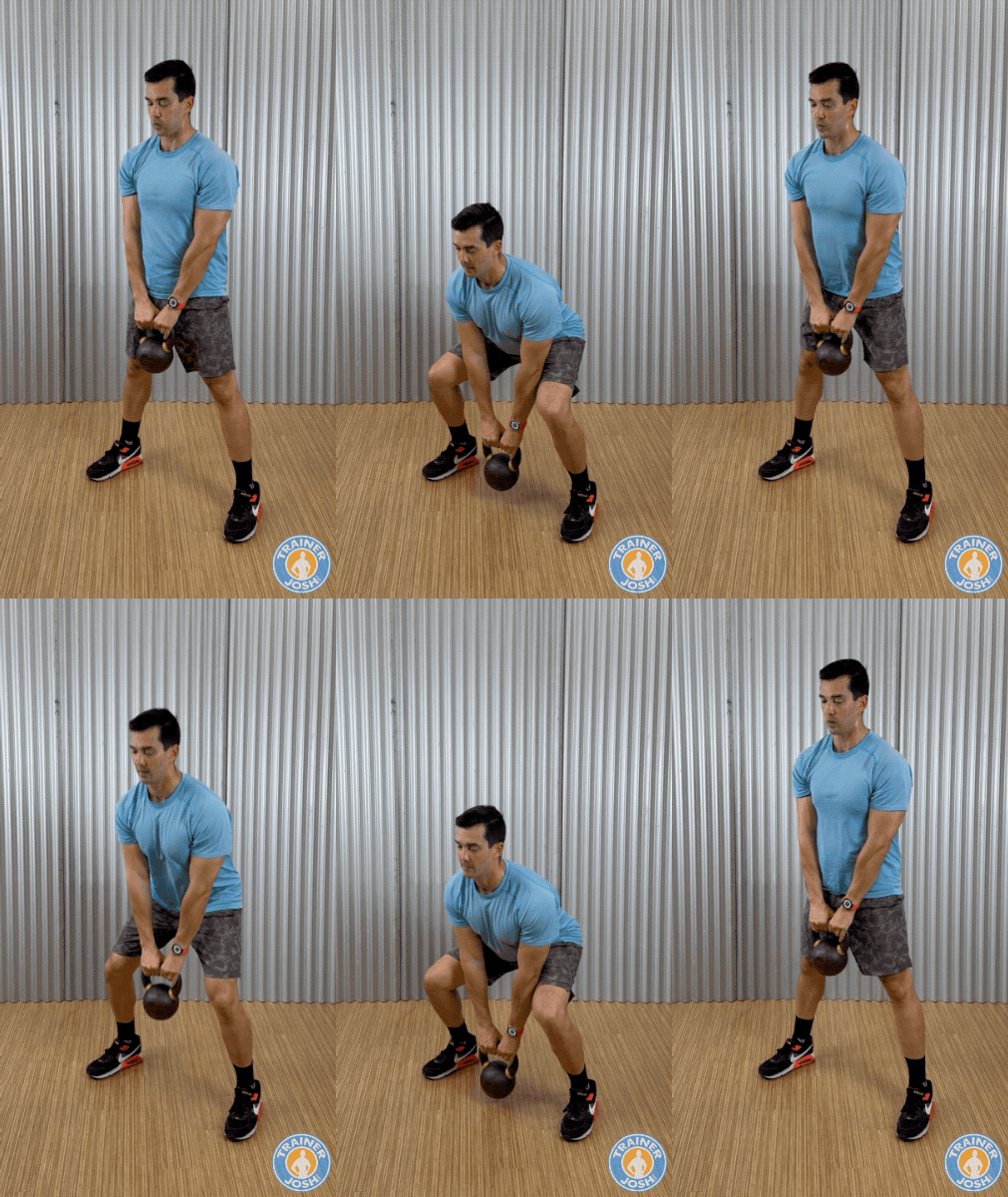
The kettlebell deadlift is universally regarded as the most fundamental strength skill and the essential foundation for all other kettlebell training.4
You’ll learn the proper mechanics of the hip hinge with this exercise. Then you can safely pick up a heavy weight from the ground without damaging your lower back.
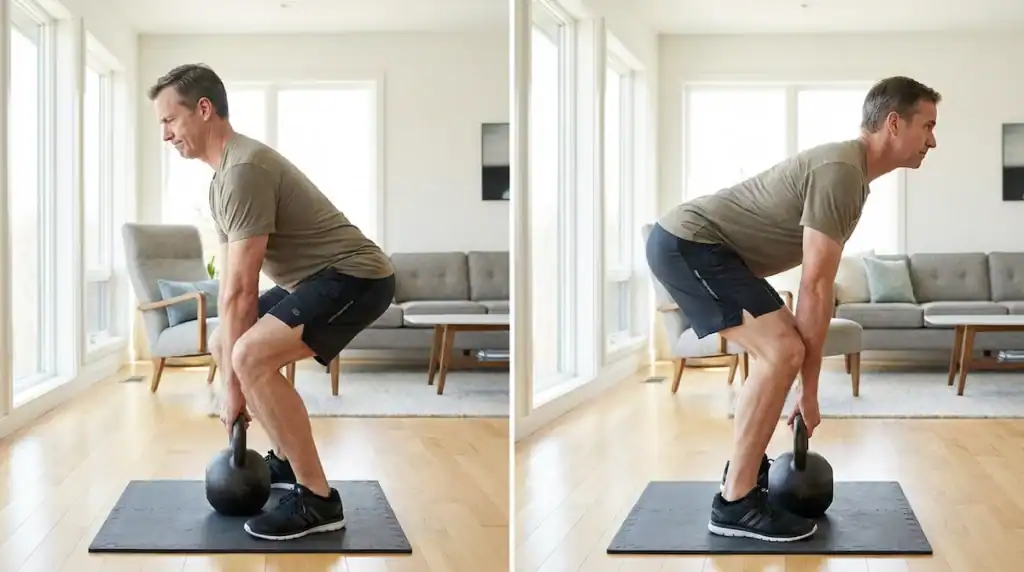
It heavily targets the posterior chain, primarily the glutes, hamstrings, and lower back, along with the quadriceps, calves, and abdominals. Mastering the deadlift secures the vital movement patterns required for advanced ballistic lifts like the swing, clean, and snatch.
How to Perform the Kettlebell Deadlift:
- Stand with feet shoulder-distance apart, toes pointing slightly outward, straddling the kettlebell with the handle between your heels.
- Push your butt backward and slightly bend your knees to lower your torso. Keep your chest open, shoulders pulled back, and look at the horizon.
- Grab the handle with both hands using a loose hook grip. Inhale deeply, engage your lats, and brace your abdominals as if anticipating a punch.
- Drive your heels into the floor and stand up by fully extending your hips and knees. Exhale forcefully as you stand. Finish squeezing your glutes and pulling up your kneecaps.
- Inhale, hinge at the hips, and safely park the kettlebell between your feet with your back completely flat.
Pro Trainer Tips
- Hinge vs. Squat: Your hips should travel backward, not straight down.
- Lat Engagement: Imagine holding a tennis ball between your bicep and ribcage and squeezing it throughout the lift.
- Time Under Tension: Count to five during the ascent and descent to maximize core stability.
Common Mistakes to Avoid
- Looking Down: Keep your neck straight and eyes focused straight ahead.
- Lifting with the Arms: Arms remain straight like passive ropes throughout. Don’t bend elbows or shrug.
- Leaning Backward at Top: Your body should form a straight vertical line at the top. Never hyperextend your lower spine.
Kettlebell Swing
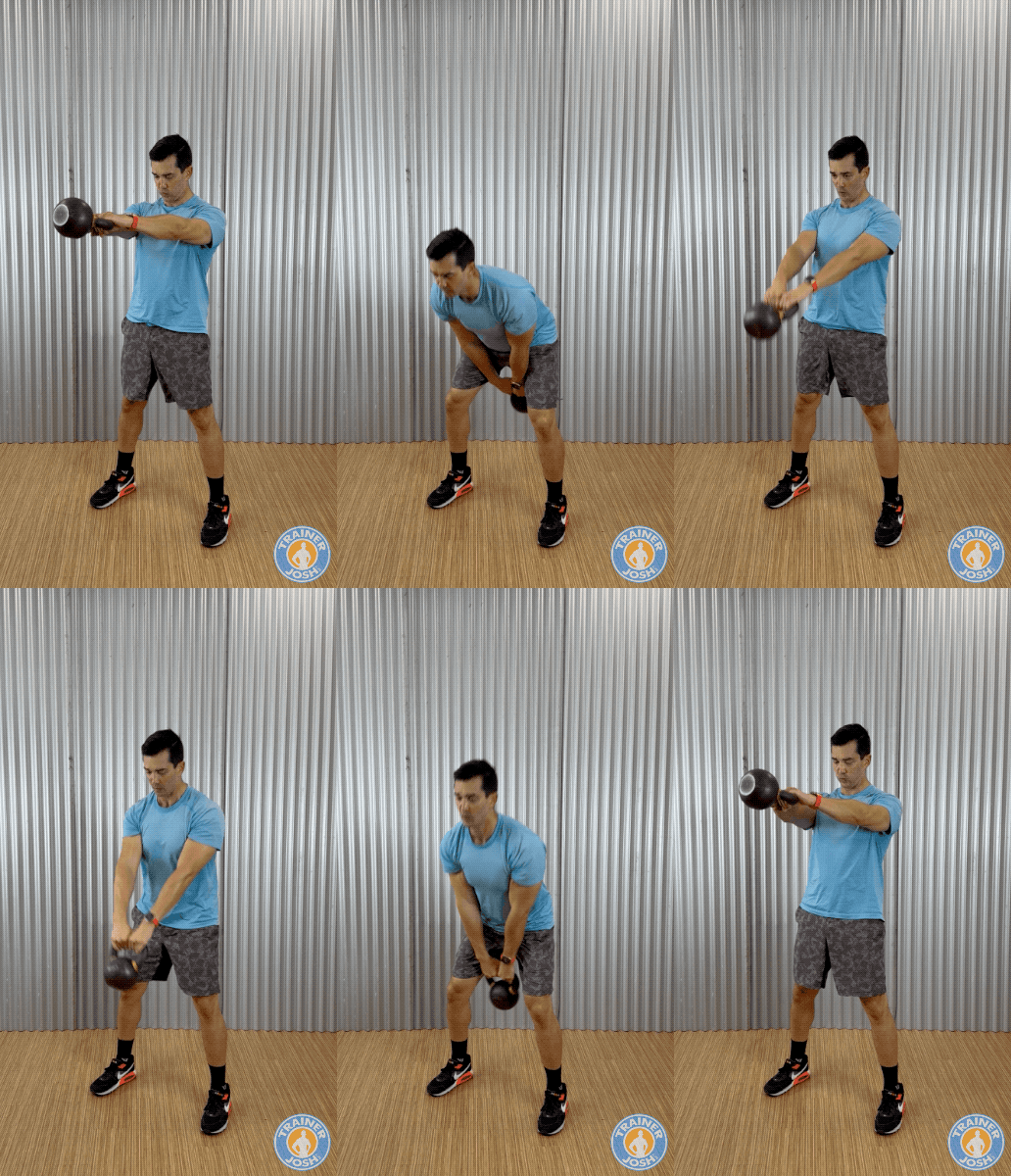
The kettlebell swing is universally regarded as the absolute foundation of all kettlebell training and a highly efficient fat-burning athlete-builder. It smoothly combines intense cardiovascular conditioning, explosive power, and maximum strength development into a single, low-impact exercise.
The swing intensely targets your entire posterior chain, specifically the glutes, hamstrings, and lower back, while simultaneously engaging your abs, quadriceps, and upper body to stabilize the weight.
How to Perform the Kettlebell Swing
- Stand with your feet slightly wider than shoulder-width apart, the kettlebell resting about 12 inches in front of you. Hinge at the waist with a flat back to grab the handle.
- Inhale sharply, engage your lats, and forcefully hike the kettlebell backward between your legs like a football center. Keep the handle above your knees; forearms connect with inner thighs.
- Drive your feet into the floor and explosively snap your hips forward to stand straight. Squeeze your glutes, lock your knees, and brace your abs. The power from your hips launches the kettlebell to your chest or eye level.
- Let gravity pull the kettlebell back down. Wait until it’s close to your hips and your upper arms touch your ribcage before hinging back. Keep arms straight and relaxed.
- Let the kettlebell swing forward slightly on the final rep, then guide it safely to the ground in front of you with a flat-backed hip hinge.
Pro Trainer Tips
- Breathing: Inhale through your nose on the downswing; exhale forcefully through your mouth on the explosive upswing.
- Play Chicken with the Bell: Stay completely upright on the downswing and don’t send your hips back until the very last second.
- The Float: If you snap your hips explosively enough, the kettlebell should feel momentarily weightless at the apex. Your arms are just passive ropes.
Common Mistakes to Avoid
- Squatting Instead of Hinging: Hips travel backward toward the wall behind you, not down.
- Lifting with the Arms: Sore shoulders or traps mean you’re using your arms. The bell rises solely from hip momentum.
- Hinging Too Early: Wait until your forearms are about to hit your stomach before bending forward on the downswing.
Kettlebell Row
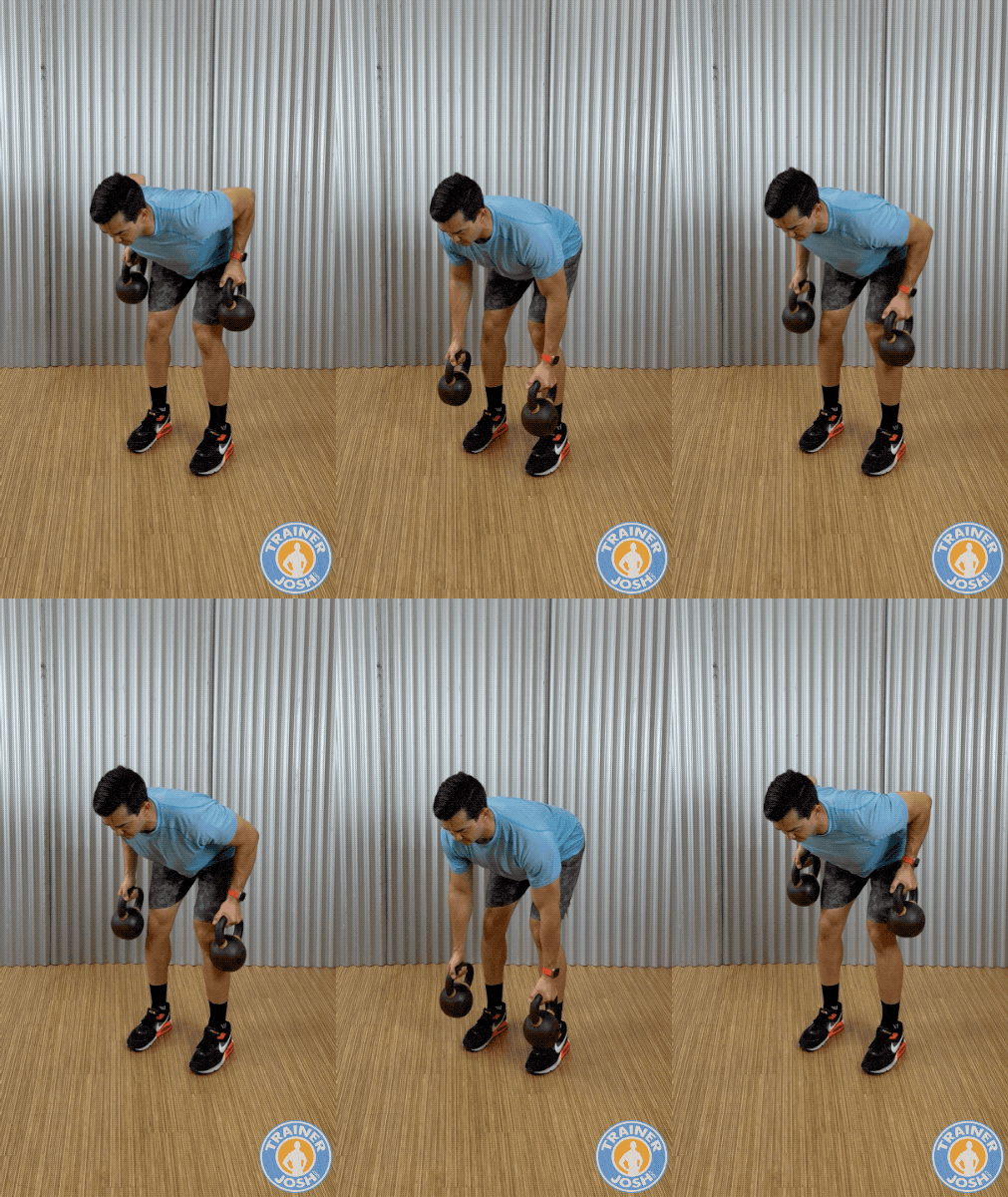
The kettlebell row primarily targets the latissimus dorsi, upper back, middle trapezius, and rhomboids. If you only have one kettlebell then you can do them single handed or can do them double handed if you have two of equal weight.
Unlike standard dumbbell rows, kettlebell rows demand total-body control.5 This heavily taxes your core and obliques as you work to prevent your torso from rotating during the pull.
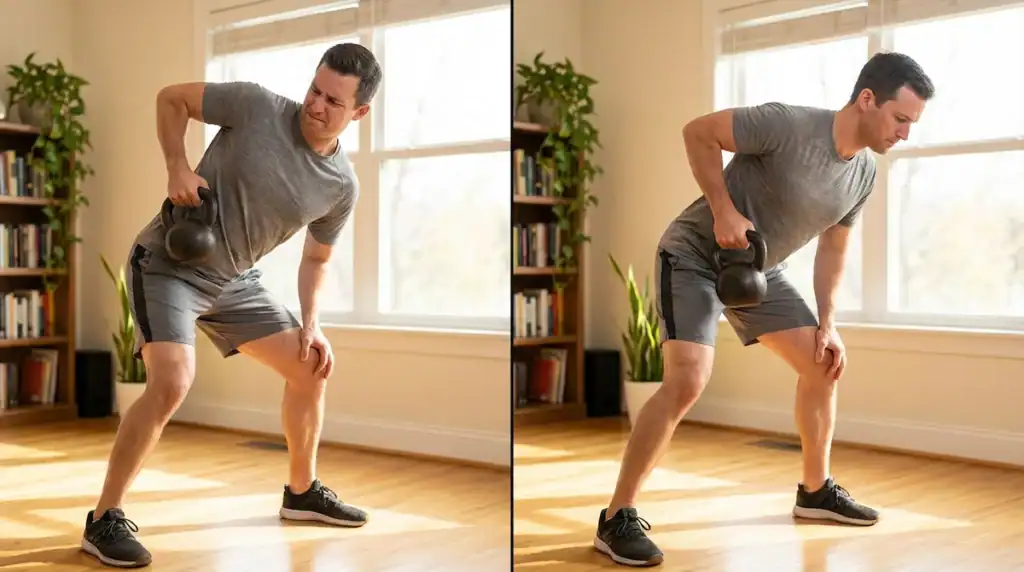
How to Perform the Kettlebell Row
- Hold a kettlebell in one hand in a staggered lunge stance. Push your hips back into a full hip hinge until your torso is nearly parallel to the floor. Rest your free hand on your thigh for support.
- Keep your back flat, core braced, and neck neutral. Pack your working shoulder into its socket.
- Pull the kettlebell to your waist level, elbow tight to your ribs. Lead with your elbow and squeeze your shoulder blade back.
- Slowly lower the kettlebell back to the start, straightening your arm fully without resting the bell on the ground.
Pro Trainer Tips
- Breathing Match: Exhale on the pull; inhale as you lower the weight.
- The Grip: Use a neutral grip so your thumb faces forward.
- Hinging Cue: Reach your hips backward to bend over and keep your torso locked so it doesn’t bob for momentum.
Common Mistakes to Avoid
- Twisting and Rotating: Shoulders and hips must stay square to the floor at all times.
- Pulling with the Arms: Power comes from retracting your shoulder blade, not curling with your bicep.
- Straightening the Legs: Your lower body must remain completely static throughout the rep.
Kettlebell Clean
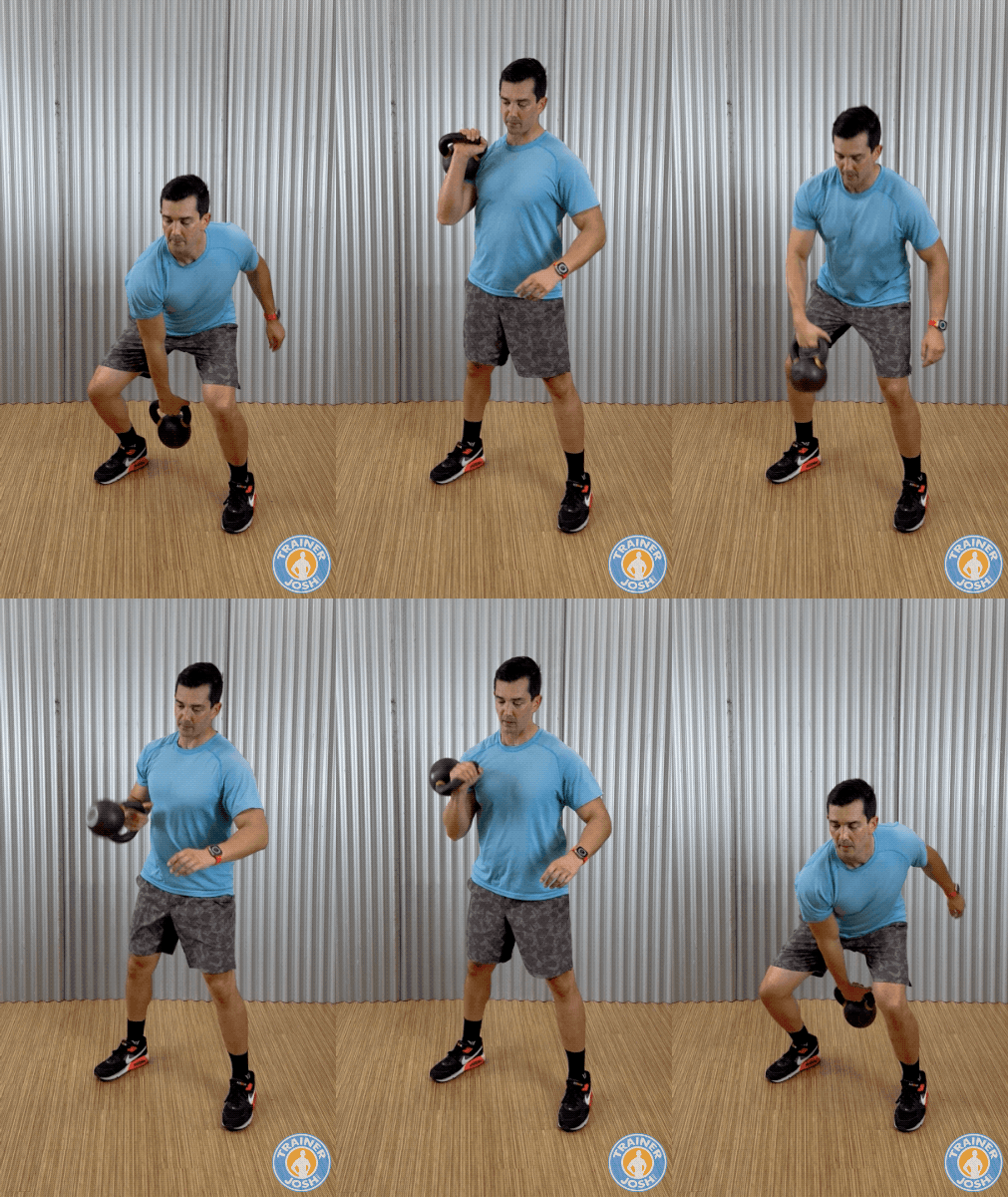
The kettlebell clean engages both the upper and lower body to build explosive power, conditioning, and athletic coordination. It introduces the vital skill of force redirection, controlling the bell’s outward momentum and guiding it smoothly into the rack position at your chest.
A 2012 randomized trial found that 6 weeks of kettlebell training increased maximal strength by 9.8% and explosive strength by 19.8% (vertical jump height), while other research shows it enhances aerobic power.6
How to Perform the Kettlebell Clean
- Stand hip-to-shoulder-width apart, kettlebell in one hand. Push hips back into a hinge, chest up, working arm hanging straight down.
- Swing the weight back between your legs with your forearm, making contact with your inner thigh.
- The Hip Snap: Drive heels into the floor, squeeze glutes, and snap hips forward. Let hip momentum drive the bell upward, elbow tucked tight to your ribcage.
- As the bell rises above your waist, pull your elbow to your ribs and spear your hand through the handle. Let the bell roll around your forearm to chest level. Take a slight knee dip to absorb the impact.
- Let the bell drop freely from your chest between your knees with a loose arm. Hinge at the hips to absorb the weight through your hamstrings and glutes.
Pro Trainer Tips
- Tame the Arc: As the bell passes your waist on the way up, imagine throwing an uppercut. Get your hand around the bell before it swings out.
- Wiggle Your Toes: During setup, ensure you can wiggle your toes to confirm that weight is being distributed to your heels.
- Brace on Impact: Tense your glutes and brace your abs right as the kettlebell impacts your forearm to absorb shock safely.
Common Mistakes to Avoid
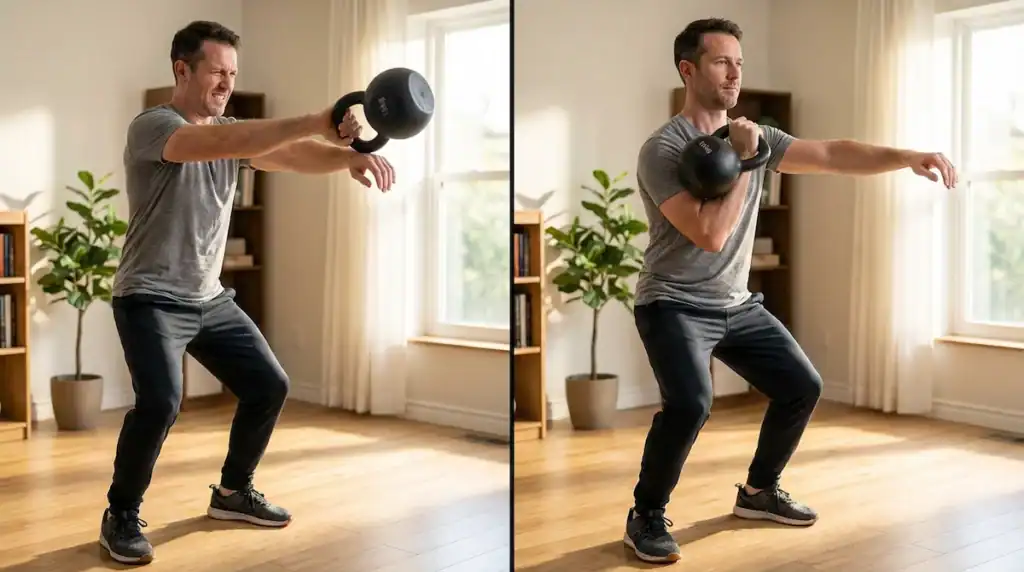
- Curling the Weight: Don’t use your biceps. If your arm is doing the lifting, your hips aren’t doing their job.
- Banging the Forearm: A wide arc causes the bell to flip and smack your forearm. Slide your hand through the handle so it rolls gently.
- Hyperextending the Wrist: Knuckles, wrist, and forearm must form a straight, rigid line at all times.
Kettlebell Figure-8 Pass
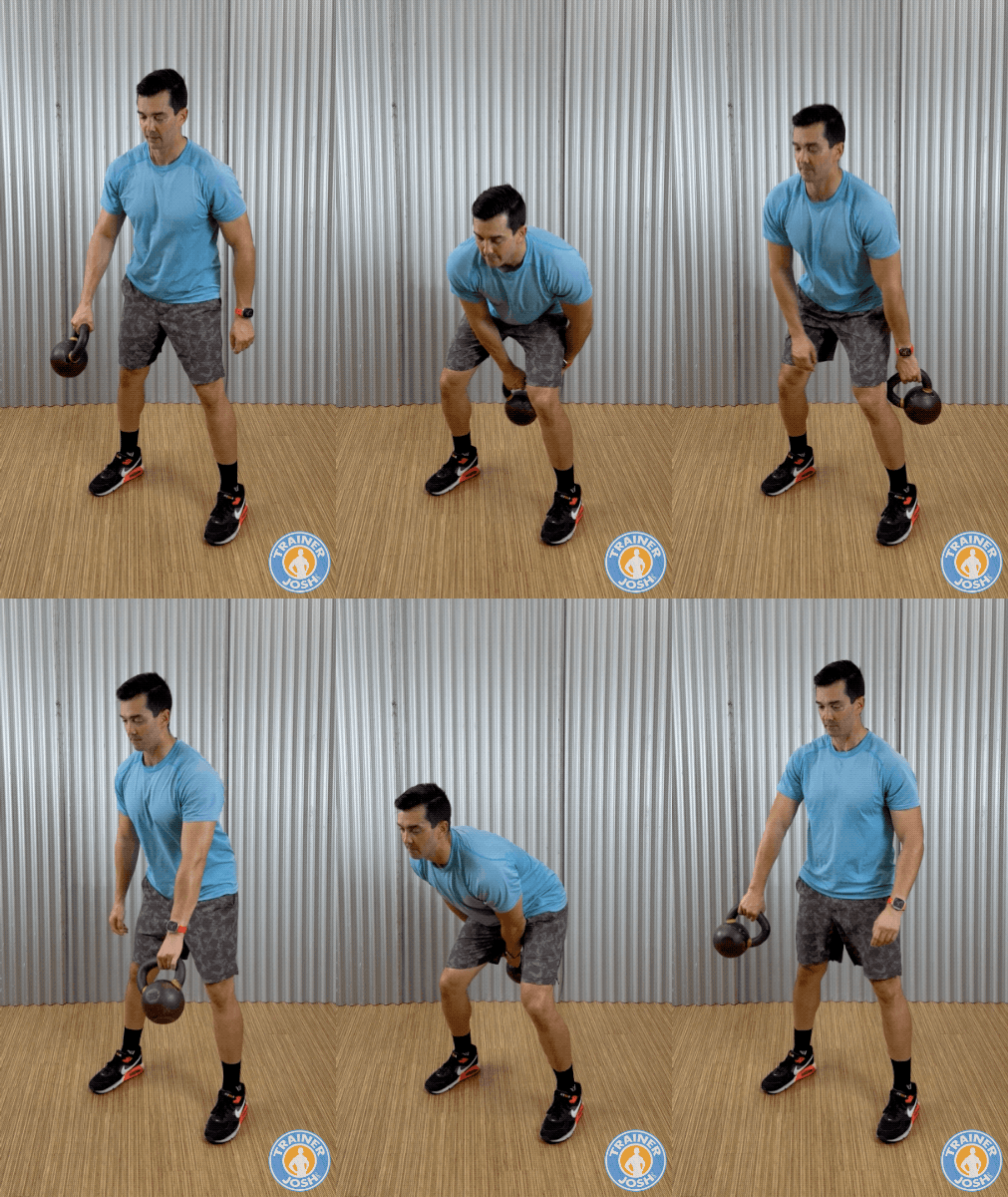
The Figure-8 Pass is a dynamic, functional movement that works as both a warm-up and a surprisingly intense conditioning exercise for your legs, core, and back.
The exercise forces you to maintain a lowered half-squat position while shifting weight from side to side. This intensely targeting your thighs and trunk while developing agility, hand-eye coordination, and spatial recognition.
How to Perform the Kettlebell Figure-8 Pass
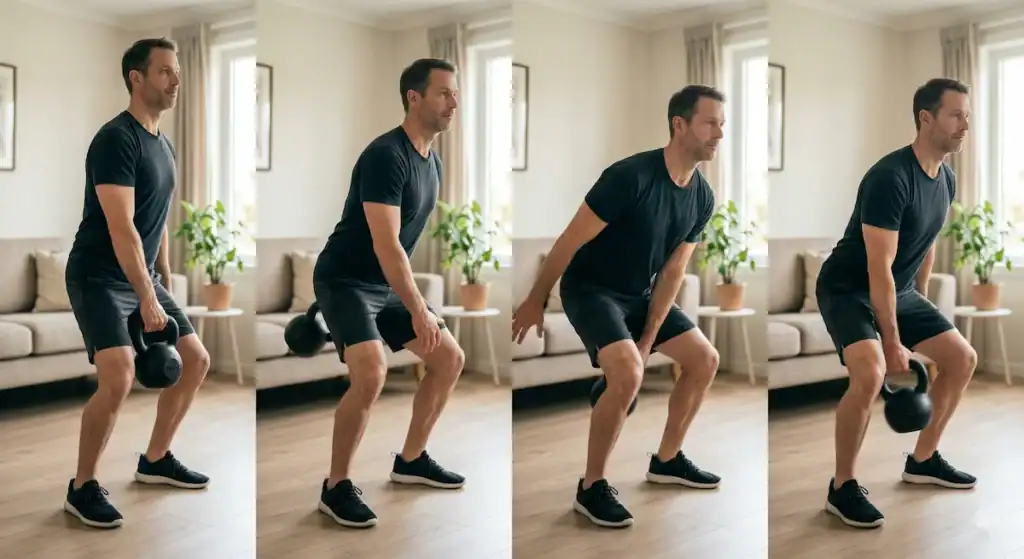
- Stand with feet slightly wider than shoulder-width apart. Push hips back and sink into a half-squat, grabbing the kettlebell with one hand.
- Keep chest up, back flat. Swing the kettlebell back between your knees and shift your hips toward your right side to create space behind your knee.
- Reach your right hand behind your right knee to meet the bell. Pass it from front to back hand, thumbs meeting during the transfer.
- Bring the kettlebell around the outside of your right leg and back to the front.
- Pass the bell back between your legs, shift your hips left, and receive with your left hand behind your left knee. Keep the figure-8 pattern, reversing direction halfway through each set.
Pro Trainer Tips
- Breathing: Exhale sharply every time you switch hands. This naturally forces an inhale at the other transition points.
- Sway the Hips: Don’t stay rigid. Sway your hips side to side with the bell to create a wider gap for it to pass through.
- The Grip: Hold in the corner of the handle (not the center) to leave room for your other hand during transfer.
Common Mistakes to Avoid
- Colliding with Your Knee: Stance too narrow or hips not shifting. Widen your stance, and always pass behind the knee.
- Rounding the Back: Fatigue causes a shoulder slump. If your lower back starts to round, stop the set immediately.
- Going Too Heavy: This drill requires precise timing. Start light until muscle memory is established.
Kettlebell Reverse Lunge
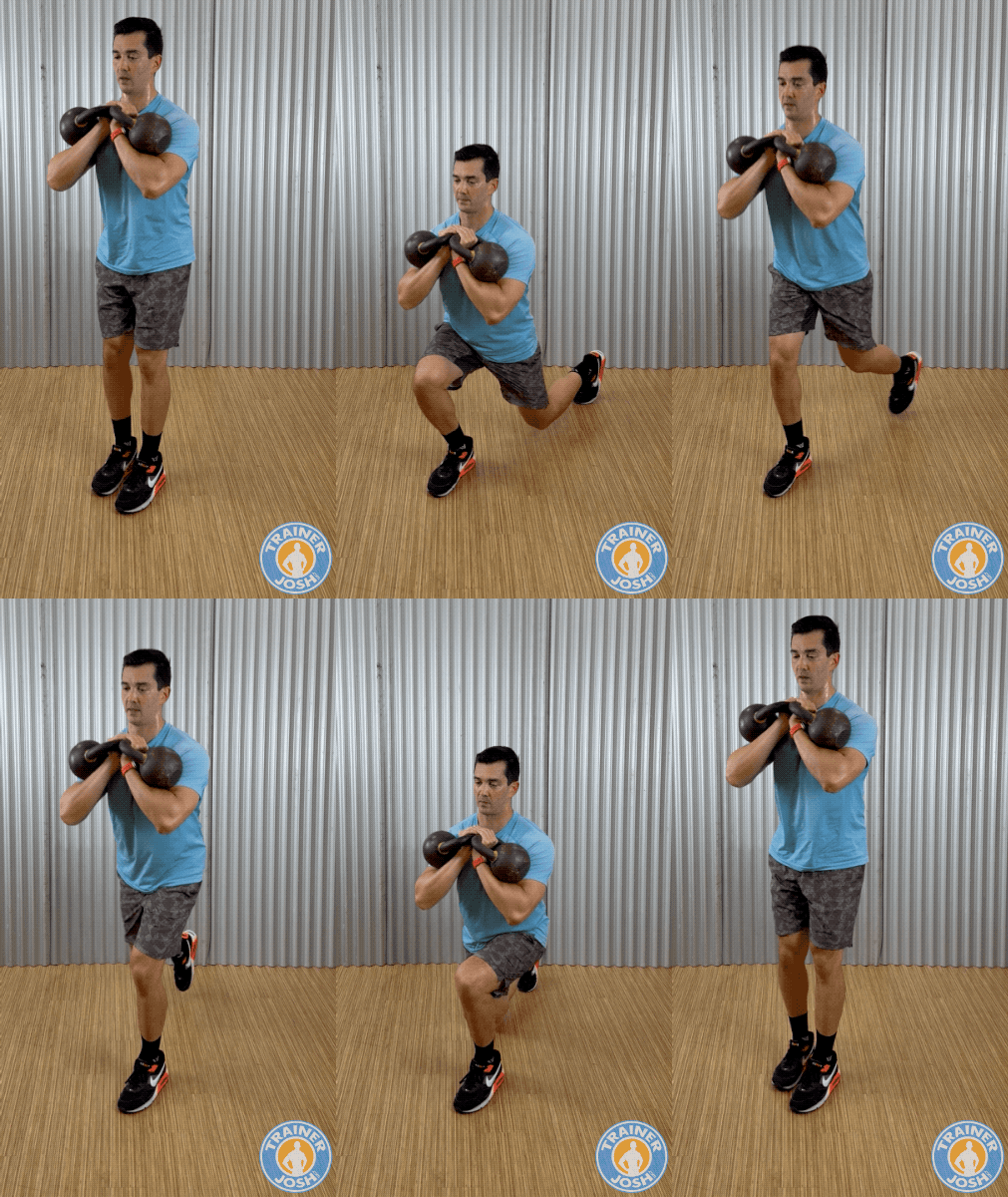
The kettlebell reverse lunge is a highly functional lower-body builder that intensely targets your quadriceps, hamstrings, glutes, calves, and core.
Stepping backward instead of forward makes it more joint-friendly, reducing stress on the knees. The kettlebell’s offset weight forces your deep abdominal stabilizers to constantly engage to maintain an upright torso.
A 2021 study by Rodríguez-Fernández et al. in Physical Therapy in Sport found forward lunges produced greater patellofemoral joint force and loading rate than backward lunges.7
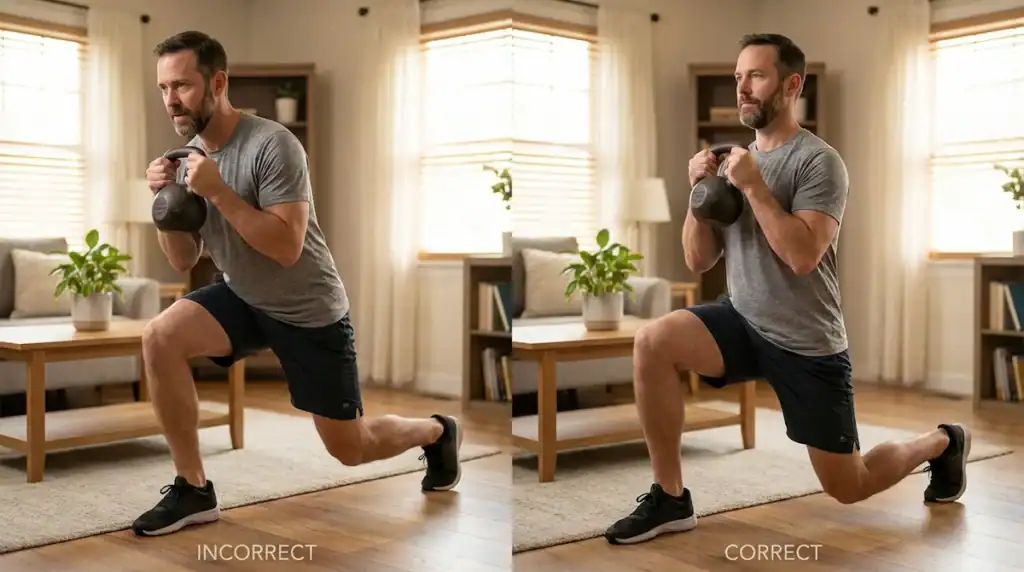
How to Perform the Kettlebell Reverse Lunge
- Stand tall, feet hip-width apart. Hold the kettlebell in goblet style, racked at your shoulders, or hanging at your sides. Brace your abdominals.
- Eyes focused on the horizon, take a large, controlled step backward with one foot. Plant the ball of your back foot firmly.
- Bend your back knee first and lower straight down until your back knee hovers just above the ground and your front thigh is parallel to the floor.
- Pause at the bottom. Both knees should form 90-degree angles. Front knee tracks directly over your ankle.
- Exhale and drive through the heel of your front foot. Push back up to the starting position, bringing your feet together.
Pro Trainer Tips
- Bend the Back Knee First: This keeps your torso upright and ensures correct angles throughout.
- Drive Through the Heel: Maximize glute and hamstring activation by pushing the floor away with your front heel on the way up.
- Stance Adjustments: A wider stance improves balance; a narrower stance forces your core to work harder.
Common Mistakes to Avoid
- Front Knee Past Toes: Never let your front knee travel beyond your toes. This creates a dangerous shearing force on the patellar tendons.
- Looking Down: Staring at the floor causes a forward lean and loss of balance. Keep posture tall and head up.
- Lifting the Front Heel: Front foot stays flat. Weight on your toes disconnects your posterior chain and stresses your knees.
Kettlebell 1-Arm Overhead Press
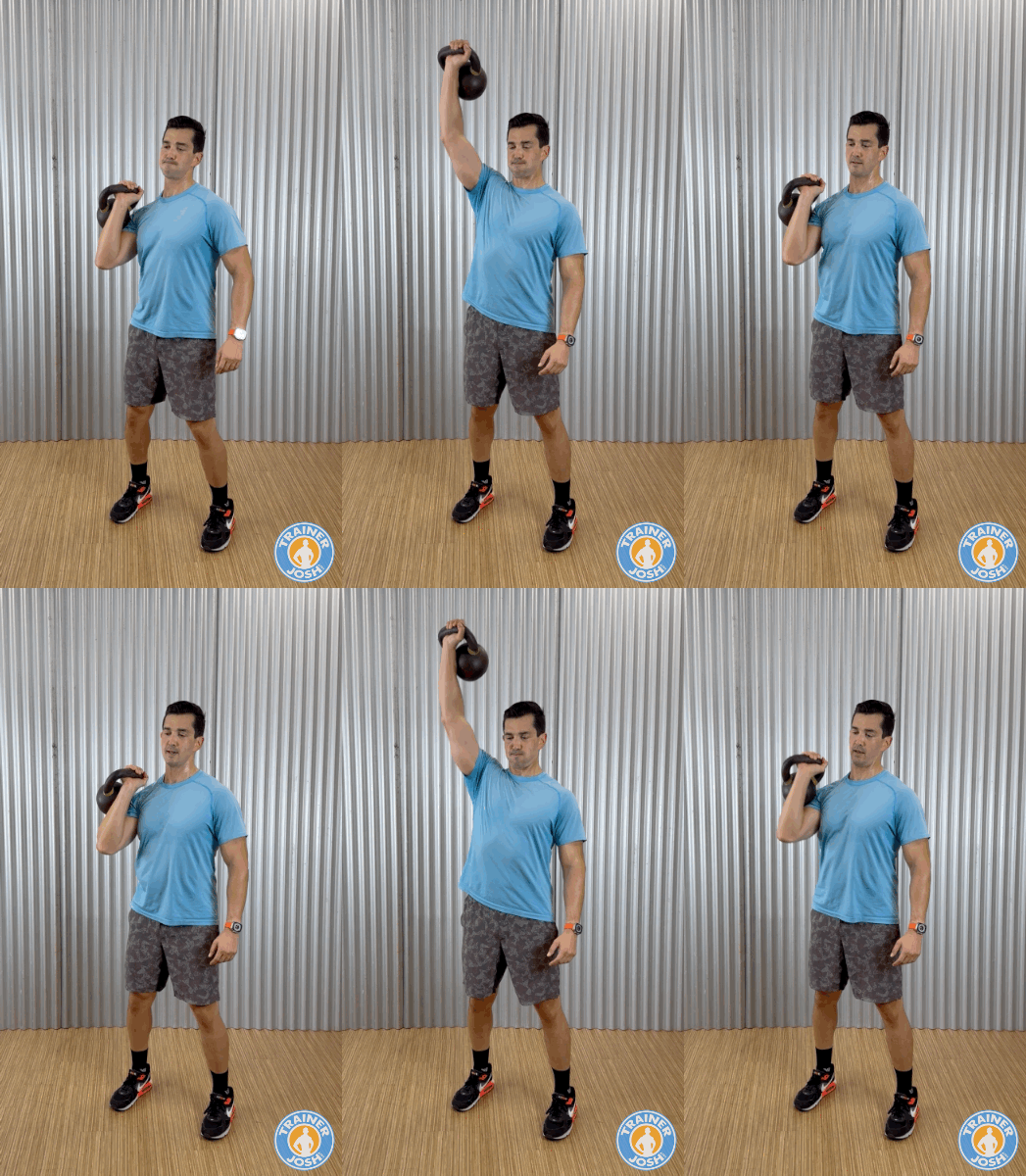
The one-arm kettlebell overhead press builds immense full-body strength, shoulder mobility, and core stability.
The displaced center of gravity forces more stabilizing muscles to engage than a dumbbell press. This strengthens your shoulder girdle and upper back while heavily taxing your core to prevent torso rotation.
A 2022 study by Wilk et al. in Applied Sciences found that one-arm kettlebell overhead presses at 70% 1RM produced higher activation in five out of six assessed shoulder and back muscles compared to dumbbell presses.8
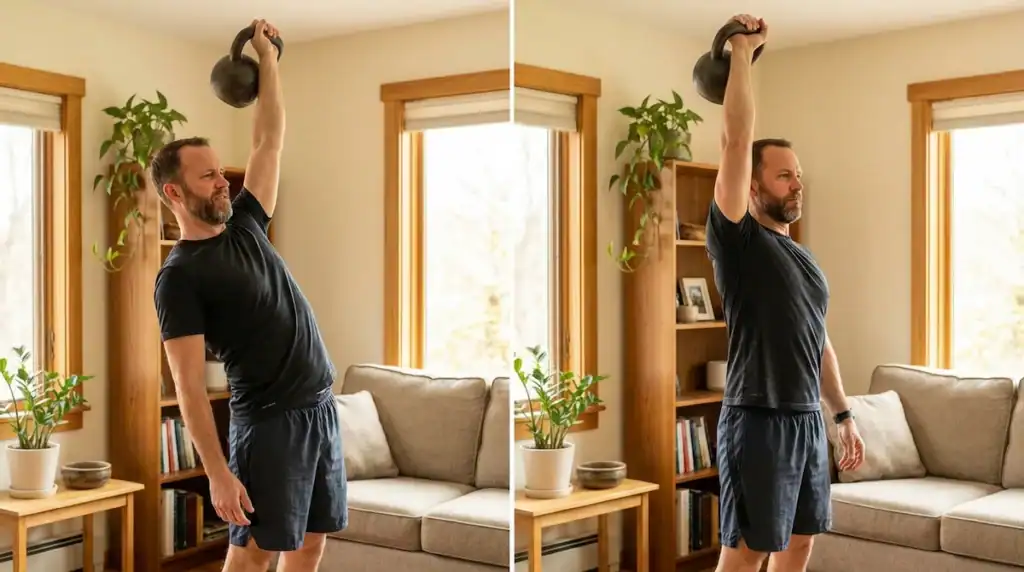
A highly effective press relies on irradiation so generating tension from the ground up through your legs, glutes, and abdominals.
How to Perform the 1-Arm Overhead Press
- Clean the kettlebell to your chest, then rack it. Wrist perfectly straight, hand relaxed, elbow tucked tight to ribcage.
- Before pressing, generate full-body tension. Squeeze glutes, tighten quads, pull up your kneecaps. Brace your abdominals.
- Take a breath and press the kettlebell overhead. Keep your shoulder held down into its socket. Imagine pushing your body away from the kettlebell rather than pushing the weight up.
- Press until your arm is completely straight and elbow fully locked. Bicep should be next to your ear, thumb pointing directly backward. Pause.
- Don’t let the weight free-fall. Inhale and actively pull the kettlebell back down using your lat muscles, as if performing a one-arm chin-up.
Pro Trainer Tips
- Maintain a Vertical Forearm: Visualize pushing your elbow outward, as if doing a lateral raise, to keep your forearm perfectly vertical.
- The Pre-Stretch: Just before pressing, push your elbow down as low as it will go and pull it slightly inward toward your belly button. This pre-stretches the deltoids for more pressing power.
- Breathing: Breathe behind the shield. Hold your brace while pressing; exhale forcefully as you lock out.
Common Mistakes to Avoid
- Leaning Backward: Never lean back to force the weight up. If you can’t press in a straight line, the weight is too heavy.
- Shrugging the Shoulder: Don’t let your shoulder elevate toward your ear. This risks shoulder impingement.
- Limp Wrist: Never let the bell bend your wrist backward. Keep the handle at the base of your palm.
Kettlebell Half Turkish Get-Up
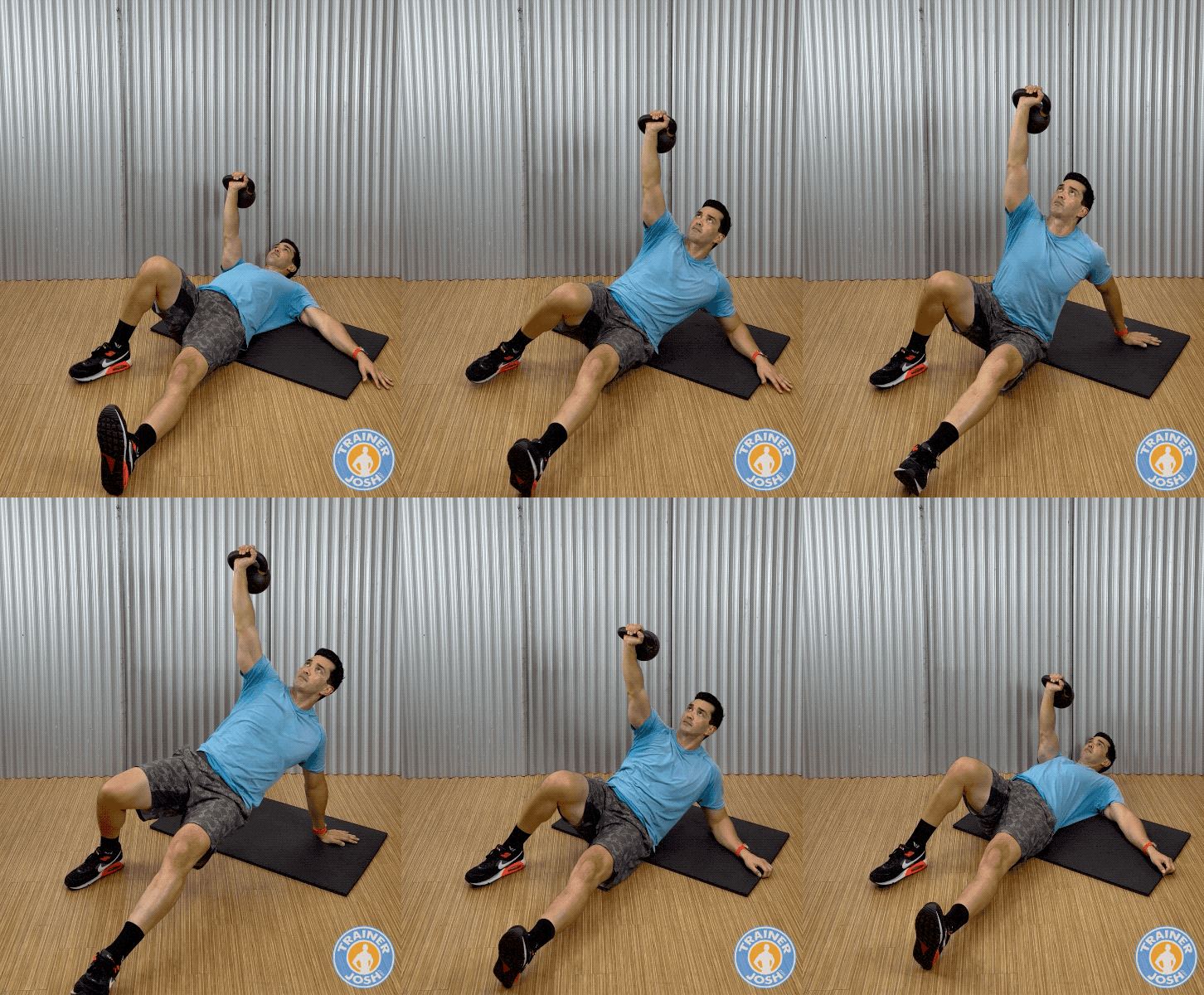
The Half Turkish Get-Up builds exceptional core stability, total-body coordination, and spatial awareness. Breaking down the first phases of the full Turkish Get-Up isolates and develops mobile and stabilizing strength in the shoulder girdle.
Mastering the slow, precise mechanics of the Half Get-Up is highly regarded for bulletproofing the upper body and rehabilitating injured shoulders.
A 2014 study by Chulvi-Medrano et al. in International Journal of Athletic Therapy & Training highlights that the half Turkish get-up builds exceptional core stability and total-body coordination by requiring resistance to spinal rotation, flexion/extension, and side-bending while stabilizing the kettlebell overhead.9
How to Perform the Half Turkish Get-Up
- Lie flat on your back and press the kettlebell overhead with your right hand. Bend your right knee, plant your right foot flat. Extend your left arm and left leg out at a 45-degree angle.
- Eyes focused on the kettlebell, right arm straight and vertical. Push off your planted right foot and roll onto your left hip, propping yourself up onto your left elbow.
- Press your left hand into the floor to straighten your left arm. Keep your chest proud and shoulders down away from your ears.
- Drive through your right heel and left hand. Squeeze your glutes and push your hips as high as possible to form a bridge.
- Slowly reverse the sequence: lower your hips, tuck your left elbow back to the ground, then roll your back flat to the starting position.
Pro Trainer Tips
- Pack the Shoulder: Keep your working shoulder sucked deep into its socket. Visualize energy from your locked elbow pressing hard into the joint.
- Roll, Don’t Crunch: The initial movement to your elbow is an active roll powered by driving your foot into the floor, not a forward sit-up.
- Breathe Behind the Shield: Keep your abdominal wall braced throughout. Take shallow, controlled breaths without losing core tension.
Common Mistakes to Avoid
- Taking Your Eyes Off the Bell: Stare at the kettlebell for the entire movement. Looking away disrupts alignment and risks a dropped bell.
- Bending the Elbow: Never let the elbow of the pushing arm bend. An unlocked elbow compromises shoulder packing.
- Falling on the Descent: Don’t hit the ground hard or let your body fall. Actively push yourself away from the kettlebell to control the descent.
Kettlebell Halo
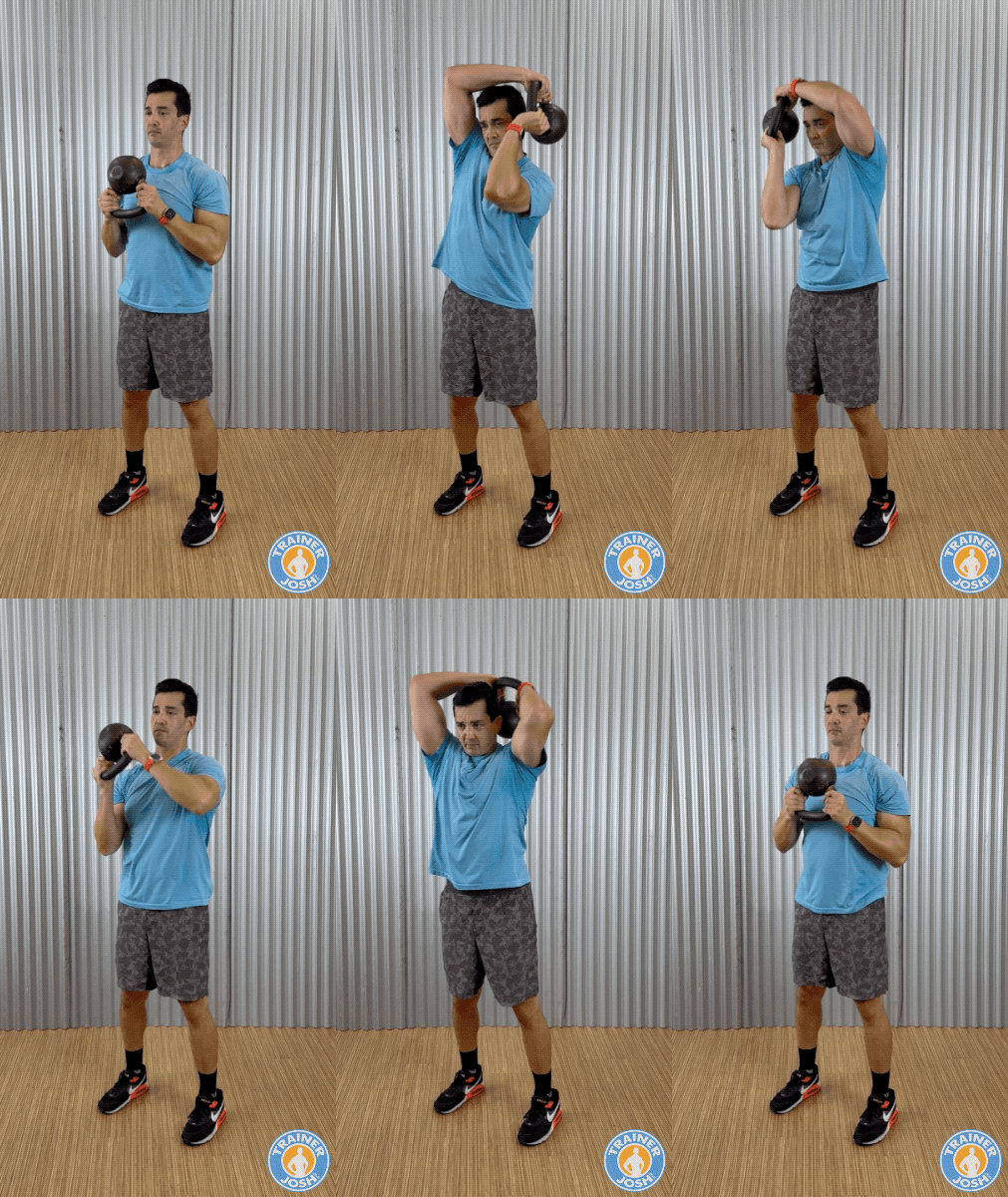
The Kettlebell Halo is a phenomenal mobility and strengthening drill that primarily targets the shoulders, upper back, cervical spine, and upper abdominals.
It rapidly loosens tight shoulders and improves overall shoulder joint flexibility. Because the movement requires you to stabilize a shifting weight circling your head, it acts as a dynamic standing plank, forcing your deep core muscles to engage continuously to prevent bending or twisting.
How to Perform the Kettlebell Halo
- Stand tall, feet shoulder-width apart, knees locked. Grasp a light kettlebell upside down by the horns and hold it in front of your chest or chin.
- Squeeze your glutes, brace your abdominals, and pull your shoulders down away from your ears.
- Slowly circle the kettlebell to one side. As the bell reaches the side of your head, the bottom should point behind you.
- Continue tracing the circle behind your head. At the back, the bottom of the bell faces down, and your forearms should barely clear the top of your head.
- Bring the kettlebell around to the other side and back to the start. Switch directions to work both sides evenly.
Pro Trainer Tips
- Keep it Tight: The path of the kettlebell should mimic a true halo around your forehead. Keep it as close to your head as possible without hitting yourself.
- Articulate the Elbows: Keep your grip secure, but keep your elbows relaxed so they can bend freely to guide the bell smoothly.
- Breathing: Unlike ballistic lifts, breathe normally and steadily throughout. Not a forced breathing match required.
Common Mistakes to Avoid
- Weaving the Head: Your head, neck, and torso must stay perfectly still. The kettlebell rotates around you, not the other way around.
- Looking Down: Dropping your chin breaks your posture. Pick a spot on the wall in front of you and keep your gaze on it.
Why Kettlebells Are So Effective for Beginners
Key Takeaways:
- Kettlebell training burns up to 20.2 calories per minute by simultaneously taxing both aerobic and anaerobic energy systems.
- Kettlebells require your core to work constantly because of their asymmetrical weight. This strengthens muscles that regular exercise often misses.
- Your muscles respond to tension, not equipment. Kettlebells produce that tension across full, three-dimensional movement patterns.
You have 30 minutes, one tool, and want to lose fat and build strength. Kettlebells are perfect for that.
Most fitness tools force a choice: cardio or strength. Kettlebells do both. A single swing works your glutes, hamstrings, quads, back, core, and grip at once… while spiking your heart rate into aerobic zones.
An ACE-sponsored 2010 study found that a 20-minute kettlebell snatch workout burned 272 calories total, or 13.6 calories per minute aerobically. Plus an estimated 6.6 calories per minute from anaerobic expenditure. All for a combined burn of 20.2 calories per minute, which is about the same as running a 6-minute mile pace.10
The real secret is the kettlebell’s off-center weight. This isn’t just cardio with weights. It’s something different.
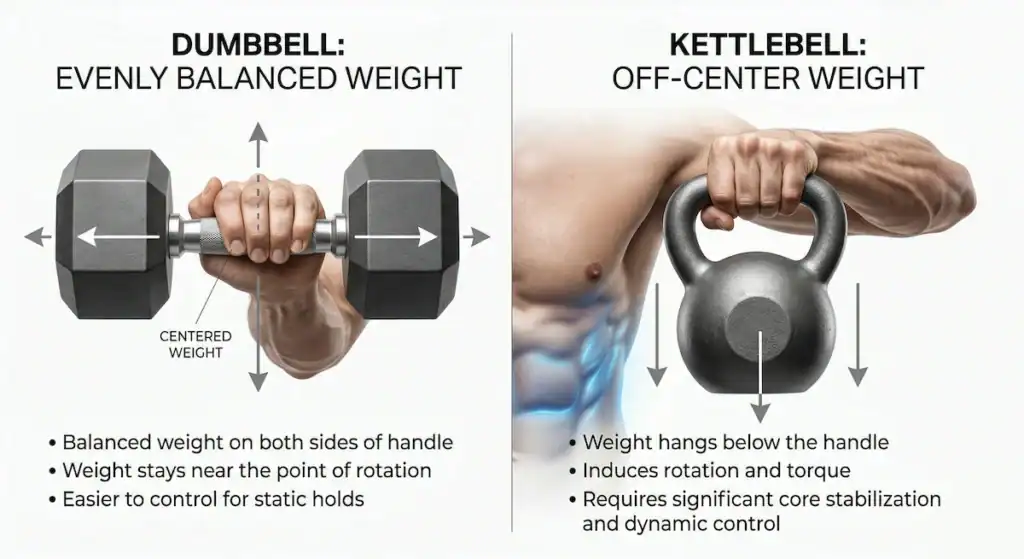
Unlike a dumbbell, with its weight balanced in your palm, a kettlebell’s load hangs below the handle. Your joints, stabilizers, and nervous system constantly adjust for that imbalance. Your core from chest to knees keeps engaged throughout, recruiting deep spinal and intrinsic abdominal muscles that crunches miss.
Your muscles don’t know what object you’re holding. They only register tension. What kettlebells do differently is force that tension through a larger, three-dimensional range of motion. This creates a higher metabolic and neuromuscular demand than most traditional tools can match with a single movement.
That’s why kettlebells feel challenging quickly, even with lighter weights.
A 2016 study by Rodríguez et al. in Journal of Human Kinetics showed that one-armed kettlebell swings activate core muscles like rectus abdominis, obliques, and erector spinae significantly more asymmetrically than two-armed swings, due to the offset load requiring constant core bracing.11
One mistake I see al lthe time (especially with people over 40) is losing muscle while trying to burn fat. And that’s the fastest way to slow your metabolism and make fat loss harder. This is something I recommend to help support lean muscle as you train…
Reverse Age-Related Muscle Loss with Ageless Muscle. Look & Feel As Fit & Strong In Your 40s, 50s, 60s & Beyond
- Reverses Age-Related Muscle Loss: Clinically studied myHMB promotes muscle protein synthesis and inhibits breakdown
- Skyrockets Strength & Size: Premium, micronized creatine fuels greater muscle power and performance
- Boosts Endurance & Recovery: Betaine supports cellular hydration for lasting stamina and faster post‑workout recovery
The Bottom Line:
If you want to build strength, improve your cardio, and work your core all in one session with just one piece of equipment then kettlebells are the most efficient choice.
What Weight Kettlebell Should Beginners Start With?
Key Takeaways:
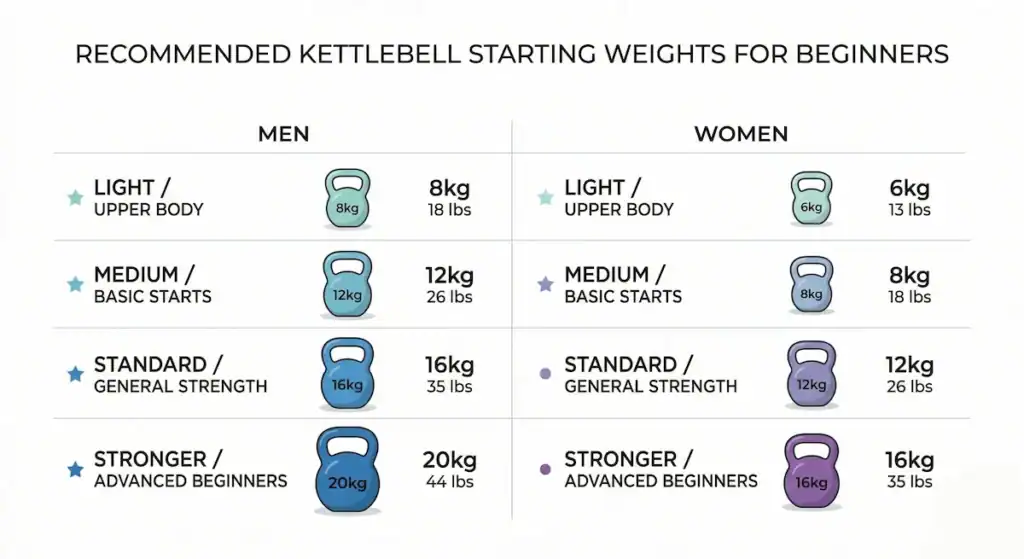
- Men should start at 12-16kg (26.5–35.3 lb), women at 8-12kg (17.6–26.5 lb), depending on fitness level.
- An 8kg (17.6 lb) kettlebell may be too light for swings. This leads women to lift with their arms rather than their hips.
- Test your weight by pressing it overhead and holding for 10 seconds. If it feels unstable, use a lighter one.
Most people pick a kettlebell that feels ‘challenging enough.’ This often leads to poor form, no progress, and a sore back. The right starting weight depends on your gender, fitness level, and the specific movement you’re doing.
For men:
A 16kg (35 lb) kettlebell is the most widely recommended starting point for an average guy. Untrained, older, or lighter men (under 160 lbs) should start at 12kg (26 lb). If you can bench press over 200 lbs, a 20-24kg (44.1–52.9 lb) bell is a reasonable entry point.
For women:
An 8 kg (18 lb) kettlebell is the standard starting weight for most controlled, grinding movements like the Turkish get-up. A strong or athletic woman can jump straight to 12 kg (26 lb).
A 10kg (22 lb) kettlebell is a good starting weight for beginners. For women, it sits in the sweet spot between 8kg and 12kg. For men, it’s lighter than the typical recommendation.
8kg may be too light for a beginner doing swings. If it is, your arms tend to do the work instead of your hips. For women, use a kettlebell weighing at least 20 lb (9kg) for two-handed swings to ensure proper mechanics.
A quick field test: press the bell overhead with one arm and lock your elbow. If you can’t hold it stable for 10 seconds, go lighter.
The main point: Choose a weight that challenges your movement, not just your muscles. The right kettlebell will make your whole body work together.
Beginner Kettlebell At-Home Workout Routine
Here’s an example kettlebell workout routine I would do with one of my beginner clients.
How the A1 / A2 workout format works:
- Same letter = paired exercises:
A1 and A2 are done together as a superset (or mini-circuit). - How to perform it:
Do A1 → rest → A2 → rest → repeat until all sets for “A” are done. - Then move on:
After finishing all A sets, move to B1, B2 and repeat the same pattern. - Why it works:
Exercises are paired so different muscle groups take turns working. One recovers while the other works, letting you train efficiently, use heavier weights, and finish faster.
To maximize your results after every workout then be sure you’re getting the recovery that your body needs to build muscle and burn fat. This is the low-carb protein I recommend to clients:
Finally, a Protein Powder Designed for those over 45... Only 150 calories, 4g net carbs, hormone & antibiotic-free. Supports lean muscle, weight loss & promotes healthy aging.
- 24g of clean protein for muscle health
- Fast digesting Whey for muscle support & slow digesting Casein for appetite control
- Four-Protein Time-Released Blend to keep you full and support weight management
- Natural ProHydrolase® enzymes to boost absorption

Weekly Beginner Training Schedule
If you’re a beginner starting a kettlebell workout routine, you need to manage your training frequency and prioritize recovery. It’s just as important as the workouts themselves.
Here’s how I would structure your weekly schedule…
How Many Days a Week to Train?
- Beginner Baseline: When you’re just starting out, it’s highly recommended to train 2-3 non-consecutive days per week.
- The Standard Schedule: a very common and effective beginner schedule is to train on Mondays, Wednesdays, and Fridays.
- Progression: as you become more familiar with the movements and your conditioning improves, then you can increase your frequency to 3-4 days a week. You can even train up to 5 days a week eventually as long as you’re not sore from previous workouts and have proper nutrition and rest. Just keep in mind though there is an inverse relationship between frequency and intensity so if you train more often then your workouts should be less intense or shorter in duration.
- Duration: regular workouts do not need to be grueling marathons. A highly effective session will only take 20-30 minutes of total time, which includes periods of rest.
The Importance of Rest Days & Recovery:
- Alternate Your Days: you should always allow for at least one day of rest between your kettlebell training sessions.
- Where Results Actually Happen: you have to know that the training is a stimulation but recovery is the adaptation. Your body needs these down days to repair and restore itself. This is when the actual physiological changes that build muscle and improve your fitness occur.
- Muscle Recovery Time: as a general rule, you should give your body 24-72 hours to recover before repeating heavy strength and power training for the same muscle groups.
What to Do On Your Rest Days:
- Leave the Bells Alone: even if you feel enthusiastic, you should resist the urge to lift kettlebells on your off days.
- Do Active Recovery: rest days do not mean you have to sit on the couch all day. You’re encouraged to stay active through cardiovascular cross training. Activities like walking, running, riding a bike, hiking or swimming are excellent ways to keep your heart rate up and promote blood flow without overtaxing your muscles.
- Listen to Your Body: do not let a written schedule override your body’s signals. If you’re experiencing significant soreness, fatigue or feel like your technique is falling apart during a workout then don’t be afraid to take an extra day off. Getting plenty of sleep and adequate nutrition between workouts is mandatory so you can bounce back and perform your best.
Common Kettlebell Mistakes Beginners Make That Send Them to the Chiropractor
Key Takeaways:
- Remember: Swings are powered by hip movement. If your traps feel sore afterwards, you used your arms instead of your glutes.
- Hinging too early on the downswing loads the spine instead of the hamstrings.
- A tight grip causes hand and forearm pain. Hold the handle just firmly enough to control the bell.
Most beginners don’t get injured from lifting too much weight. They get hurt by small mistakes they didn’t realize they were making. I see the same ones constantly, especially from people returning from a kettlebell hiatus with a nagging lower back.
One client of mine came back after a two-week break with a sore lower back and a bruised pride. He’d been doing everything right in our sessions, but training alone, he reverted to squatting the swing instead of hinging. This is what I told him…
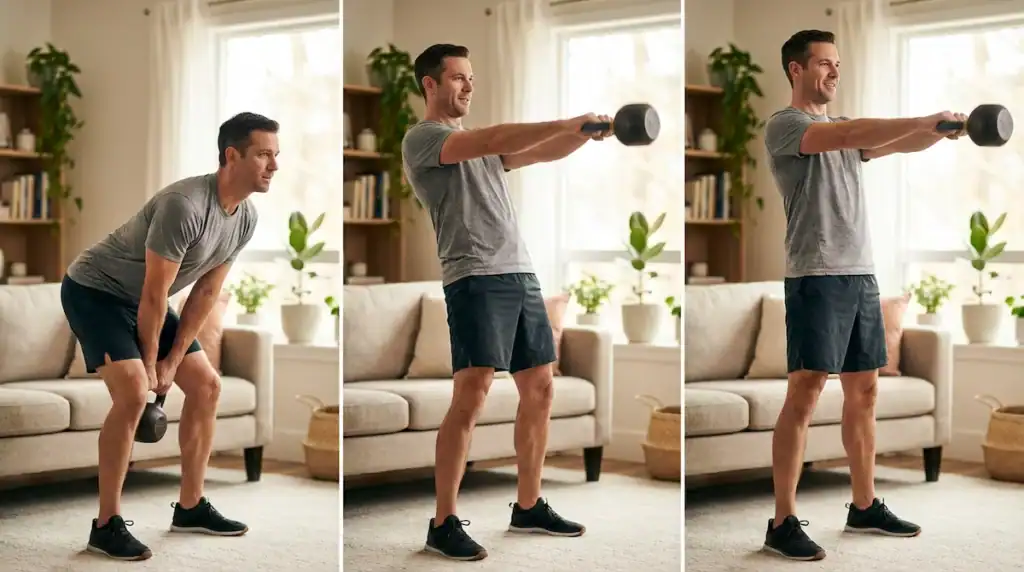
The swing is a hip hinge, not a squat.
Your hips push back, your shins stay mostly vertical, and the power comes from snapping your glutes forward. If your traps or shoulders are sore after swings, you’re lifting with your arms. The bell should feel like it’s being launched by your hips, not pulled up by your upper body.
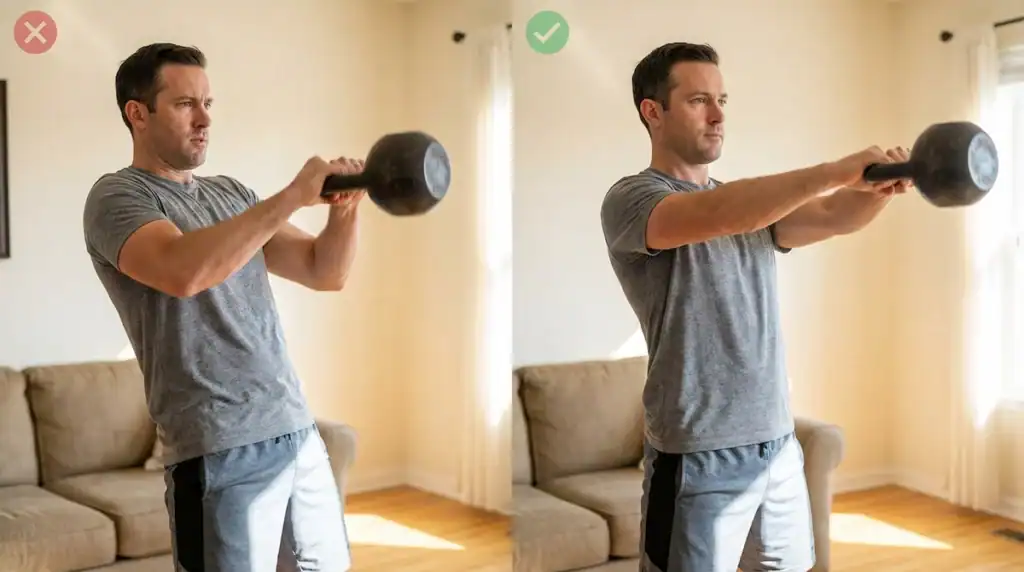
On the downswing, wait.
Most people hinge too early, folding at the hips as soon as the bell drops. Wait until the bell nears your hips before sending them back. Hinging early loads your spine, not your hamstrings.
Your shoes are working against you.
Running shoes with thick soles cushion impact, but they aren’t great for creating a stable base. Try training barefoot or in flat-soled shoes.
One client of mine wore thick-soled shoes and couldn’t feel the ground. After switching to bare feet, her squat depth and balance improved in two sets. This simple change can make a big difference right away.
Grip the handle loosely enough to let it rotate.
Crush-gripping stalls the bell’s natural movement, crashes it into your wrist, and shreds your calluses. A relaxed grip keeps the bell moving fluidly and protects your forearms during cleans and snatches.
The set isn’t over when the last rep is done.
Setting the bell down with a rounded back, or slumping forward with hands on your knees after a hard set, leaves your lower back in a vulnerable, unsupported position.
The main takeaway: Work on your hip hinge form before adding more weight or reps. Your back will feel better within the first week.
Can Kettlebells Actually Burn Belly Fat? Here’s What the Numbers Say
Kettlebells work for fat loss, not because of marketing, but because of how they force your body to produce energy.
Burning calories is only part of the story…
High-repetition ballistic movements, such as swings and snatches, flood your muscles with lactic acid. That lactic acid buildup signals your body to produce more human growth hormone, which directly triggers the release of fatty acids from fat cells to be used as fuel.
On top of that, the metabolic demand raises your EPOC (excess post-exercise oxygen consumption), keeping your metabolism elevated and burning fat for 24 to 48 hours after the session ends. This is known as the Afterburn Effect.
Cardio alone won’t burn stubborn belly fat.
Strength training is the missing piece. Muscle tissue burns up to five times more calories at rest than fat tissue. Building lean muscle with kettlebells doesn’t just burn fat during training; it raises your baseline calorie burn around the clock.
The offset weight also forces your deep core stabilizers, specifically the transversus abdominis and oblique abdominals, to engage continuously. That’s why people consistently report losing inches off their waist just from adding swings to their routine.
I had a client, Mike, 39, office job, about 20 pounds of belly fat he’d been carrying for years. He came to me doing random swings he’d found on YouTube, eating whatever he wanted, and wondering why nothing was changing.
We cleaned up his nutrition and locked in a consistent swing practice three days a week. Six weeks later, his clothes were fitting differently before the scale had even moved. The kettlebell did its job. The diet revealed it
The Bottom Line:
Kettlebells are an effective tool for fat loss, but you need to combine them with a calorie-controlled diet. Otherwise, you might build muscle that stays hidden under the fat.
What Kettlebell Results Actually Look Like (And When to Expect Them)
Kettlebells don’t build a bodybuilder’s physique. They build something most people actually want: lean, dense, functional muscle with real athletic symmetry.
For men, expect broader shoulders, a defined V-shaped back, wiry arms, and a flat midsection without excessive bulk. For women, the changes show up as a firmer, lifted posterior, leaner thighs, a tighter waistline, and a noticeable reduction in cellulite.
You’ll see results sooner than you think…
Within your first 4 sessions (1 to 2 weeks), your body starts shifting from fat-storing to fat-burning mode. Visible changes in the mirror can appear in as little as 20 to 30 minutes with consistent sessions.
By weeks 3 to 6, users consistently report a drop in resting heart rate, losing inches from the waist, and experiencing up to a 50% increase in muscle density and hardness.
At 12 weeks, your aerobic endurance, strength, and physical silhouette all show measurable transformation. That’s also when confidence in movement mechanics solidifies.
Long-term results can be dramatic. One documented case: a woman lost 120 pounds and went from a size 24 to a size 6 by consistently performing kettlebell swings alongside a healthy diet.
Your core wakes up from the first rep. Your posture improves as deep spinal stabilizers strengthen. Your cardiovascular system acclimates within the first session.
You don’t have to wait until week 12 to see results. They start as soon as you begin.
The Bottom Line:
Kettlebells can give you results faster than most other tools, but only if you train regularly and watch your diet.
Kettlebells Over 40 or 50: Why Age Might Actually Make This the Perfect Tool for You
Key Takeaways:
- Kettlebell training increases core strength by 70% in older adults, directly reducing lower back pain.
- Begin at 12kg for men / 8kg for women over 50; practice movements with no weight until mechanics feel controlled.
- Always warm up with halos, prying goblet squats, and hip bridges to prepare joints and activate the posterior chain.
Kettlebells aren’t just safe for older beginners. For many over 40 or 50, they’re the most effective training tool available.
An ACE study found that kettlebell training increased core strength by 70 percent in older adults, thereby directly reducing lower back pain. The offset weight also improves balance organically with every session, which matters more than most people realize.
Falls are the leading cause of injury-related death in adults over 65, and better balance is one of the most protective adaptations you can build.
One of my clients, a 52-year-old with a desk job and a bad hip, came to me convinced kettlebells weren’t for him. “I’m not in good enough shape to start something like this,” he said. We began with bodyweight movement patterns and an 8kg bell, moving slowly through every rep. Eight weeks later, he was deadlifting 20kg with no hip pain and standing noticeably taller. The mobility warmup alone changed his posture.
Weight-bearing kettlebell movements also improve bone density, reverse age-related muscle atrophy, and help control blood pressure. Instructors regularly teach students well into their 70s.
Begin with a lighter weight than you think you need.
Older or deconditioned men should begin at 12kg (26 lb). Women over 50 at 8kg (18 lb). If the mechanics still feel uncertain, practice the movements with no weight at all (using a shoe or a can of soup) until body awareness and control are solid enough to add load safely.
Slow the tempo down deliberately.
Moving slowlyMoving slowly through each rep isn’t a sign of weakness; it’s how you build the neuromuscular patterning that protects your joints and connective tissue during heavier training. Rushing progressions are the primary cause of injury in this age group.
The mobility warmup.
Years of sitting shorten hip flexors and switch off glutes. Before every session, run through halos (shoulders and upper back), prying goblet squats (hips and legs), and hip bridges (glutes and posterior chain) to lubricate your joints with synovial fluid and reduce injury risk.
Note: If you’re over 55 or have a history of heart problems, high blood pressure, or joint injuries, get medical clearance from your physician before starting.
The Bottom Line:
Kettlebells are even more useful as you get older. Start with a light weight, move slowly, and warm up every time.
Kettlebells vs Dumbbells: The Real Difference Nobody Talks About
Both kettlebells and dumbbells build strength, but they make your body work in different ways.
A dumbbell’s weight sits balanced and centered in your palm. A kettlebell’s center of mass hangs below the handle. That single design difference changes everything about how your muscles, joints, and core respond to the movement.
Range of motion is the first place you’ll feel it.
The hanging weight of a kettlebell loads muscles deeper and stretches them further through each rep. Dumbbell exercises are often described as “highly abbreviated” because the symmetrical weight limits how far you can comfortably move.
The kettlebell also keeps your wrist and forearm in a neutral, relaxed position during overhead work. Dumbbells require a bent, cramped wrist that fatigues your grip and strains your forearm prematurely.
Core engagement is the second difference.
A dumbbell’s perfectly centered weight doesn’t demand continuous full-body stabilization. A kettlebell’s offset load forces everything from your chest to your knees to engage constantly just to maintain your center of gravity.
Kettlebells are much more versatile than dumbbells.
Anything you can do with a dumbbell, you can do with a kettlebell. But the reverse is not true.
Ballistic movements like swings, cleans, and snatches combine strength and cardiovascular training simultaneously. You cannot perform those safely or effectively with a dumbbell.
Dumbbells are the better choice if your goal is strict muscle isolation or basic strength movements with a shorter learning curve. If you want strength, mobility, and cardio trained simultaneously with one tool, then kettlebells are the clear winner.
Disadvantages of Kettlebells (Honest Cons)
Kettlebells are great, but they’re not perfect. Being honest about their downsides helps beginners avoid frustration.
The learning curve is real. Swings, cleans, and snatches require coordination, body awareness, and focused practice before they feel natural. If you want to start training immediately with minimal mistakes, dumbbells offer a shorter learning curve.
Wrist bruising is also normal at the beginning. Until you master the clean technique, the bell will bang your forearm. That’s not a sign you’re doing it wrong forever. It just means you’re still learning the path.
Weight jumps are larger than most people expect. Kettlebells typically increase in 4kg (9 lb) increments rather than 1 to 5 lb steps. Progressing between sizes means building your rep capacity before the next bell is appropriate.
Kettlebells won’t maximize strict muscle isolation or absolute maximum strength. For bodybuilding-style isolation work or heavy powerlifting, dumbbells and barbells are better-suited tools.
Kettlebell swings provide the cardiovascular and physical response of sprinting or plyometrics, without the joint impact. Your knees, ankles, and hips stay healthy while your heart rate reaches the same zones.
The handle design keeps your wrist neutral during overhead pressing, which gives your arms far greater endurance than the cramped wrist position a dumbbell forces. The posterior chain development from swings (specifically glutes, hamstrings, and lower back) is difficult to replicate with any other single movement.
The efficiency gap is real. No single tool is comparable for delivering sprint-level cardiovascular output, posterior chain development, and overhead pressing endurance in the same session window.
Beginner Kettlebell Workout Plan (4 Weeks)
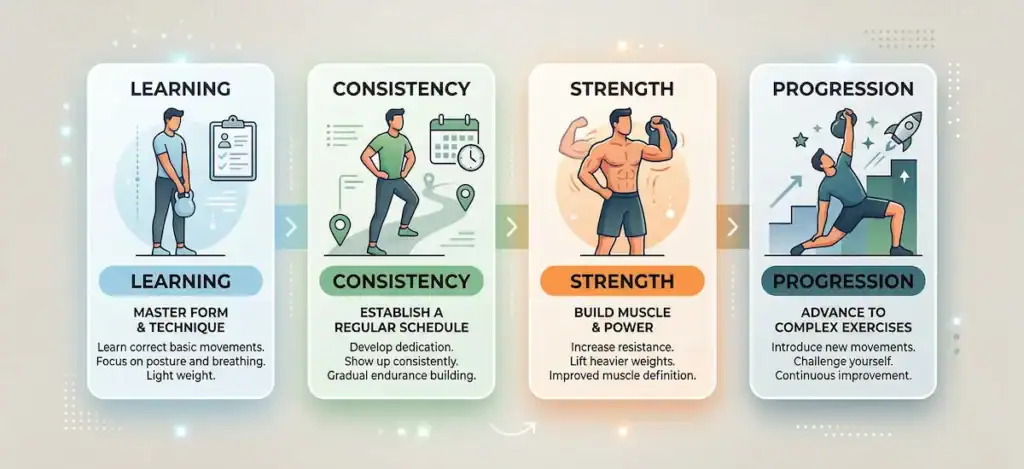
Here are two different 4-week beginner plans: a progressive routine that introduces new movements each week, or a consistent circuit to master the staple exercises.
Option 1: The Progressive 4-Week Foundation Plan
This plan introduces the basic elements of kettlebell training week by week to slowly build your foundation.
How to do it:
- Schedule: 3 nonconsecutive days per week.
- Sets and Reps: Perform each exercise for 3 to 5 repetitions. Rest as needed between exercises, completing the list 3 to 5 times per session.
- Progression: Gradually add repetitions, weight, or both. Always make perfect technique your top priority.
The Weekly Workouts:
- Week 1 (Building the Foundation): Deadlift, Squat-Pull, Two-Hand Swing, Bent-Over Row, and Two-Hand Press.
- Week 2 (Introduction to Power Movements): One-Hand Swing, Single Snatch, Double Clean, and Single Press.
- Week 3 (Heavy Hitters / Ballistics): Single Clean, Double Snatch, Sidewinder, Side Shuffle, and Double Press.
- Week 4 (Developing Coordination and Rhythm): Double Swing, Alternating Clean, Double Row, and One-Stays-Up Press.
Option 2: The 4-Week Circuit Test Drive Plan
This program focuses on mastering staple moves by repeating the same full-body circuit for a full month to lock down your form.
How to do it:
- Schedule: 3 days a week for 4 weeks. Take at least 48 hours to recover between sessions.
- Execution: Complete circuit-style: perform 1 set of each exercise, then move immediately to the next, keeping rest between exercises to a maximum of 30 seconds. Repeat the circuit two more times.
The Circuit:
- 1A. Standing Twist (warmup): 1 set, 30 seconds, no rest.
- 1B. Around-the-Body Pass (warmup): 1 set, 30 seconds, no rest.
- 1C. Halo (warmup): 1 set, 30 seconds, no rest.
- 1D. Single-Arm Swing (warmup): 2 sets, 10 reps per arm, 30 seconds rest.
- 2. Front Squat (racked): 3 sets of 10 reps, under 75 seconds rest.
- 3. Romanian Deadlift: 3 sets of 10 reps, under 75 seconds rest.
- 4. Wide-Stance Goblet Squat: 3 sets of 10 reps, under 75 seconds rest.
- 5A. Straight-Leg Deadlift: 4 sets of 12 reps, no rest.
- 5B. Single-Leg Romanian Deadlift: 3 sets of 8 reps per side, 30 seconds rest.
General Rules for Beginners
- Practice, don’t just work out: Approach sessions as a physical practice. Take your time grooving the technique rather than pushing to 100 percent exhaustion.
- Stick to the basics: Stick to foundational moves for at least three months before advancing to heavy or complex drills.
- Demand quality over quantity: Aim for moderate intensity, leaving gas in the tank. If form breaks down mid-set, stop, rest, and resume with a lighter weight.
Beginner Kettlebell Tips
- Ditch the running shoes. Train barefoot or in flat, thin-soled shoes like Converse Chuck Taylors or wrestling shoes. Padded soles compromise your balance and absorb the ground force you need to drive the bell.
- Never fight a falling kettlebell. If a lift goes wrong, don’t try to save the rep. Guide the bell to the ground and step back. Quick feet are happy feet.
- Give priority to quality over quantity. Treat your sessions as a practice. If the form starts to break down, stop the set immediately. Never sacrifice technique to hit a rep count.
- Give 100 percent of your focus. Don’t watch TV, text, or hold a conversation while lifting. Losing focus is a primary way injuries happen with dynamic weight.
- Fuel up beforehand. Kettlebell training demands massive full-body energy. Eat a light meal with carbohydrates and protein 30 to 90 minutes before your session. A client of mine was barely making it through 15 minutes before completely gassing out. Turned out he was training fasted every morning. One small pre-workout snack fixed it entirely.
- Don’t crush grip the handle. Squeezing too tightly exhausts your forearms, tears your hands, and prevents the handle from rotating fluidly during cleans. Hook the handle loosely with your fingers.
- Maintain your hands. Calluses are a natural part of training, but thick ones will rip off. Use a coarse nail file or pumice stone to smooth them flat every few days after you shower.
- Clear your space. Train on a flat, dry, non-slippery surface with at least a 6-foot by 6-foot clear zone. No pets, children, or objects in your swinging radius.
- Drive with your hips, not your arms. For ballistic movements like the swing, power comes entirely from your hips and glutes. Your arms are passive ropes. Sore arms after swinging mean you’re doing it wrong.
The Simplest Way to Start Training with Kettlebells
Do not overcomplicate your routine. Focus entirely on mastering just one or two foundational movements. You can achieve world-class conditioning without needing a broad range of exercises.
1. The Simple & Sinister Approach (Swings + Get-Ups)
A routine built solely around kettlebell swings and Turkish get-ups makes the most powerful introduction to kettlebell training. The swing conditions your back, legs, heart, and lungs. The slow, methodical get-up builds flexible and resilient shoulders.
The Routine:
5 sets of 10 one-arm swings per arm, followed by 5 sets of 1 get-up per arm.
2. The Swing-Only Approach
If you want the simplest possible starting point, base your entire initial phase on the Two-Hand Swing.
The swing has the greatest fat-burning potential of any kettlebell movement and acts as the foundation for everything else. Mastering it alone builds strength, endurance, and flexibility simultaneously.
3. The Clean & Press Approach
Focus entirely on the Clean and Press using very low repetitions, 1 to 3 reps per set, to safely build brute strength without exhausting yourself. This is considered one of the best comprehensive exercises for all-around strength and development.
General Rules for a Simple Start
- Stick to the basics for at least three months. Don’t rush into complex or heavy drills. Practice the most basic exercises until your technique is flawless.
- Start light. Use a light kettlebell to build core strength and body awareness before progressing to heavier weights.
- Keep your volume low. Perform just 1 to 3 sets of 3 to 5 repetitions for a handful of exercises, training about three days a week.
FAQ
What will 100 kettlebell swings a day do?
100 kettlebell swings a day burn fat, build a stronger posterior chain, and boost cardiovascular endurance, all in under 10 minutes. Tim Ferriss added 100-plus pounds to his deadlift by doing 150 to 300 weekly swings. Beginners should start with 50 reps and gradually build up.
How many kettlebell swings should I do daily?
100 kettlebell swings a day is the ideal minimum effective dose for most people, delivering fat loss, cardio, and strength in under 10 minutes. Beginners should start with 50 reps and build up. Advanced trainees can push to 300 daily swings for a serious 30-day challenge.
What burns 500 calories in 30 minutes?
A high-intensity kettlebell circuit can burn up to 500 calories in 30 minutes. The “Burn 500” workout combines three kettlebell flows, linking swings, squat thrusters, high pulls, and Turkish get-ups into one non-stop session. This ballistic training style burns more calories than most traditional gym workouts.
What are the 3 best kettlebell exercises?
The 3 best kettlebell exercises are the swing, the Turkish get-up, and the goblet squat. Together, these movements build full-body strength, mobility, and cardio in under 30 minutes. Master these first 3. They cover every major movement pattern your body needs to stay strong and injury-free.
What are the 5 best kettlebell exercises?
The 5 best kettlebell exercises are the swing, Turkish get-up, goblet squat, clean, and snatch. These 5 movements build explosive power, full-body strength, and cardiovascular endurance. Master them in order.
The swing and get-up alone outperform 99% of traditional strength programs. The snatch is a lot more difficult to master and a beginner will probably need progressions to work their way up.
